Thursday, February 3, 2022

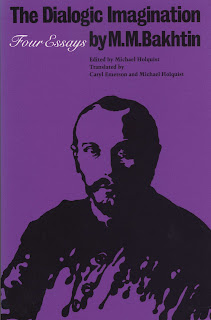
The Dialogic Imagination, Introduction

M. M. Bakhtin (1981) The Dialogic Imagination: Four Essays. Edited by Michael Holquist; Translated by Caryl Emerson and Michael Holquist. University of Texas Press, Austin.


Summary of Introduction (by Emerson and Holquist, presumably)

In this introduction, Emerson and Holquist, or one or the other of the two (it is not indicated; the term “I” is used, so perhaps it is Holquist, the editor) summarize Bakhtin’s life and work and introduce a few key concepts. One key argument is that Bakhtin’s thinking is characterized by a “Manichaean” opposition between centrifugal and centripetal forces in language. I’m not sure if “Manichaean” is quite the right word, because Bakhtin’s thinking on these two forces is ambivalent. In contrast to, for example, Norbert Wiener (for whom “entropy” is equivalent to evil), Bakhtin clearly favors the centrifugal; but he is also a bit like Deleuze and Guattari (whose striated and smooth spaces are clearly related concepts), when they admit that “a smooth space will not always save us” – for Bakhtin, some amount of centripetal or unifying force is important as well (as in his comments on “style” in the Dostoevksy book). Thus it seems that what Bakhtin is looking for is a kind of balancing, though favoring the centrifugal.

In relation to this, Holquist (or Emerson and Holquist) makes an interesting yet cryptic observation that Bakhtin does not reduce this dichotomy to a “binary opposition” such as those employed in structural linguistics. “That opposition leads from human speech to computer language; it conduces, in other words, to machines” (xviii). Here thinkers like Wiener, arguably also someone like Chalmers, is clearly implicated (though it is interesting to think how Haraway, for example, would respond). Nevertheless, to the extent that such a reductive, binarist/digital “conducement” to machines and computer language is something to be resisted, Bakhtin’s nuanced thinking could be useful; however, this observation is made only in passing and is not fleshed out.

Heteroglossia, in this account, becomes the interaction of the two opposed forces: the writer or speaker as unifying force drawing on (or in) the centrifugal, proliferating and novel speech of others, in a way that does not reduce them or their creative power.

The authors summarize Bakhtin’s vision of language as communication evocatively:

“Bakhtin’s basic scenario for modeling variety is two actual people talking to each other in a specific dialogue at a particular time and in a particular place. But these persons would not confront each other as sovereign egos capable of sending messages to each other through the kind of uncluttered space envisioned by the artists who illustrate most receiver-sender models of communication. Rather, each of the two persons would be a consciousness at a specific point in their history of defining itself through the choice it has made—out of all the possible existing languages available to it at that moment –of a discourse to transcribe its intention in this specific exchange.” (xx)

First of all, this recalls Felski’s complaint about the language of discourse “creating” subjects, etc.; and quite reasonably, since Emerson and Holquist are exactly the kind of 80s theorists she is talking about. Nevertheless this is a good example of why such language is not “unfortunate” but rather quite productive and important. Wiener also comes to mind because he specifically recognized the noise in such exchanges, and thus was more subtle than the straw man model of the naive “artists” evoked above. Yet, Wiener also assumes the two conversants as independent, previously existing, “sovereign” (in a literal sense because any entity is like a kingdom holding itself together against the forces of chaos) subject. The image of the situated, self-constructing subject not only improves on Wiener’s model but also allows for a more complex understanding of the uses of “noise” as these subjects are shown to be shielding themselves from, but also drawing on, such noise (“interference” in the text) in the next paragraph.

The authors, incidentally, make the assumption that Voloshinov is Bakhtin, so the above interpretation seems to bear the imprint of Voloshinov (his idea that there is no interiority beyond language, and that the utterance in the situated moment is the most important aspect of language).

It is clear that, for Bakhtin, these centrifugal (or entropic) forces are productive, rather than merely destructive, as Weiner would have it. And perhaps their world views are opposite: it is the eternally productive centrifugal which must be reined in by the centripetal (but not too much, because it must be allowed to remain itself) in order for order to be created (not just maintained). The authors end with a discussion of why Bakhtin feels the novel is so revolutionary and distinctive compared to other genres: it joyfully admits and makes use of its own limitations (and is always playing with and expanding on these). Such joyful inadequacy of the modern novel stands in contrast to Felski’s complaint that modern literature, through just such games, trains readers to be suspicious. If so, this is the fun suspicion of a game (something I do not recall her discussing so far). Presumably Felski will invoke a call for (non-suspicious) joyful reading in her conclusion, but here is a sign that it has been available in modernity all along.


Wednesday, February 2, 2022

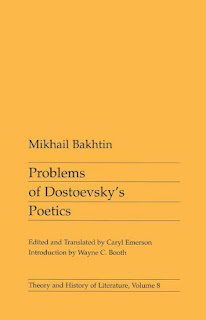
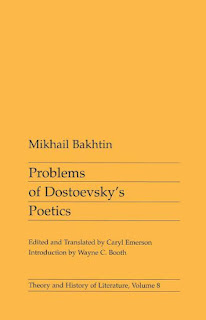
Problems of Dostoevsky's Poetics, Conclusion


Summary of Conclusion

Bakhtin summarizes his point that Dostoevsky is brilliant and the polyphonic novel provides important insights. It is an example of the artistic consciousness catching up to the scientific consciousness of complexity a la Einstein, etc.

In this book we have sought to reveal the uniqueness of Dostoevsky as an artist, an artist who brought with him new forms of artistic visualization and was therefore able to open up and glimpse new sides of the human being and his life. Our attention has been concentrated on that new artistic position which permitted him to broaden the horizon of artistic visualization, which permitted him to look at the human being from a different artistic angle of vision. (270)

 Polyphonic thinking could expand beyond the novel:

This mode of thinking makes available those sides of a human being, and above all the thinking human consciousness and the dialogic sphere of its existence, which are not subject to artistic assimilation from monologic positions

 The polyphonic novel will not replace the monologic one, but it will provide greater insight and an ability to live in the more complex world we find ourselves in. There is an argument similar to that made by Norbert Weiner (who I am also reading), that Twentieth Century scientific understandings of complexity have made it clearer that we don’t need to cling to solid and monologic categories and modes of thinking; with polyphony, the artistic consciousness is catching up to the scientific:

The scientific consciousness of contemporary man has learned to orient itself among the complex circumstances of "the probability of the universe"; it is not confused by any "indefinite quantities" but knows how to calculate them and take them into account. This scientific consciousness has long since grown accustomed to the Einsteinian world with its multiplicity of systems of measurement, etc.

… We must renounce our monologic habits so that we might come to feel at home in the new artistic sphere which Dostoevsky discovered, so that we might orient ourselves in that incomparably more complex artistic model of the world which he created. (272)


Tuesday, February 1, 2022

Problems of Dostoevsky's Poetics, Chapter 5, Parts 2-4


Summary of Chapter 5, parts 2-4

Compared to the extremely dense first part, the next three parts of the chapter are much fluffier and are mostly composed of specific examples from Dostoevsky's books.


Part 2: The Hero's Monologic Discourse and Narrational Discourse in Dostoevsky's Short Novels

This part of the chapter is mostly examples from the shorter novels of phenomena Bakhtin had already laid out. Prominent are The Double and Notes from Underground. B talks about the "word with a sideward glance" at another discourse or perspective; three voices (apparently the original voice, the imagined second voice, and a third that unites them), "loopholes" etc.


Part 3: The Hero's Discourse and Narrative Discourse in Dostoevsky

Bakhtin explores the internal dialogue and regular dialogue of heroes in Dostoevsky, particularly Raskolnikov, for whom other characters are “ideological positions,” that he reacts to and is in dialogue with, and places in dialogic juxtaposition with each other. Heroes reveal themselves or learn to situate themselves in a field of inter-orientations. "Penetrated word" (“a word capable of actively and confidently interfering in the interior dialogue of the other person, helping that person to find his own voice” (242)) and "penetrated discourse" (“a firmly monologic, undivided discourse, a word without a sideward glance, without a loophole, without internal polemic” which is nevertheless “only possible in actual dialogue with another person” (249)) are defined, though they seem to be opposites; the former is discussed but not the latter much. He ends with a reference to unfinalizabilty and the  fact that the narrator's voice does not dominate. 

He states that in Dostoevsky's novels, almost no evolution of thought happens; characters never change their perspective; when something happens, they knew it was going to happen, and are not changed by it. [Why would Bakhtin consider this good? Because surely everything Dostoevsky does is the most awesome thing possible... I guess the point is that such change in the character would be an internal situating; what Bakhtin wants is social situating, the interplay of ideas in a social setting, not just the internal development of an individual.]


Part 4: Dialogue in Dostoevsky

Bakhtin summarizes he importance of dialogue in Dostoevsky's works. Particularly emphasized is that external dialogue is always related to internal dialogue; sometimes speakers in external dialogue are responding to (wittingly or not?) another speaker's statement in an internal dialogue. It is also emphasized that the dialogue is not plot-dependent: though it still follows and relates to the plot, it has an openness or "unfinalizability.” He also talks about how words and themes "pass through" many different voices (the image reminds me of a motif in music, picked up and transformed through different instruments, etc.) – fitting for Bakhtin’s ideal of “polyphony” in the novel. (An example that comes to mind is the phrase “the lesser evil” in the Witcher story of that name).

A character's self-consciousness in Dostoevsky is thoroughly dialogized: in its every aspect it is turned outward, intensely addressing itself, another, a third person. Outside this living addressivity toward itself and toward the other it does not exist, even for itself. In this sense it could be said that the person in Dostoevsky is the subject of an address. (251)

[This marks an interesting potential link with interpellation; Dostoevsky's subjects are highly conscious of, knowingly dependent on, their interpellation? Some echo of Volosinov’s insistence that there is no interiority beyond or before language seems to link here as well.]


Monday, January 31, 2022

Problems of Dostoevsky's Poetics, Chapter 5, Part 1


Summary of Chapter 5: Discourse in Dostoevsky, part 1: Types of Prose Discourse. Discourse in Dostoevsky


This part of a four-part chapter is simply massive in terms of its theoretical content. Most importantly, Bakhtin lays out a three-part outline of different kinds of discourse (with multiple subtypes within the three). This is discussed throughout before being summarized in outline form on page 199 (it would have been easier to follow if the outline had appeared first). The three kinds are:

1) “Direct unmediated discourse directed exclusively toward its referential object”

2) “Objectified discourse (discourse of a represented person)”

3) “Discourse with an orientation toward someone else's discourse (double-voiced discourse)”

The third has three subcategories, and the list appears to be a more elaborated version of the 5-part list from “Discourse in the Novel.”

As he goes through this outline, numerous key concepts are elucidated. One is metalinguistics, Bakhtin’s project for a linguistics that goes beyond the textual limits of his day, to understand “discourse as concrete lived reality” (181). He talks about things like the speech characterizations of characters, to what extent these characters become more distinguished in speech, etc. from the voice of the author, which means they are more objectified (elsewhere he has called this “stylized,” though perhaps that means objectified with the voice of some particular group in society). (On second thought these might just be differing translations of the same word in Russian).

He brings up criticisms that have made of Dostoevsky, that his characters speak the same way he does (there is less “speech characterization); Bakhtin’s response is that this makes Dostoevsky less objectifying, and thus more dialogical, than other authors. This "speech characterization" I have seen, for instance, used to caricature passengers in (certain) taxi memoirs, and it distances and objectifies the voice and character of the passenger from that of the driver/narrator (though this is sometimes perhaps not itself so an intent at monologicality or orchestration, but rather shows a lack of ability or competence of the driver/author to represent or speak for (re-voice) the passenger). Also this seems a good place for a nod to Jack Vance, whose characters who all speak in the same stilted, witty manner as the author.

Dialogic relationships are the subject matter of metalinguistics; as Bakhtin is pointing out, these can also be found within texts, not just outside of texts. He gives examples of various "judgments," (statements), and how they can be or not be in dialogical relationships; this is a key point where his relationship to Volosinov and to Foucault can be elucidated. There seem to be at least four aspects of these dialogical relationships: they must be 1) discursive [they are not relationships per se, but relationships in discourse); 2) embodied (they are not just potential linguistic or articulatory positions, but they have to actually be taken and voiced; 3) they require a logical connection to a referential object; and 4) as utterance in discourse they need to receive an author [or subject position they are voiced by or attributed to]; this could be a real author (as in a speaker or writer of the utterance), or one to whom they are being attributed (such as a character in a story or in double-voiced speech) . [Presumably two judgments being expressed by the same character could be dialogic if the character is shifting positions in an internal debate. Anyway this whole approach seems contrary to Foucault's in the Archaeology of Knowledge.]

An example of a judgment: "Life is good." "Life is good." This is the same judgment repeated twice: the two are separate "verbal embodiments" [utterances] of the same judgment, and can also be placed into dialogic relation (e.g. as two characters agreeing].

The issue of the objectification of another's speech comes up, and this is explored through the different forms this takes in the different discourse types. He also discusses all these types as historical phenomena, making remarks about "epochs" (Classicism, Romanticism) in which different discursive possibilities were available to authors. Bakhtin's point is that the modernist idea of “access to one's own personal ‘ultimate’ word” (202) is a historical condition – in some epochs there is permitted "the ultimate semantic authority of the creator to be expressed without mediation in direct, unrefracted, unconditional authorial discourse" which presumably means modernism (Whitman comes to mind in this regard, as a representative of prose invading poetry). In other epochs, dominated by stylization, the author must speak through the words of others (he calls this “refraction”). However, the fact that Bakhtin's words above sound pertinent today – despite our prose and freedom from stylistic conformity, two aspects that Bakhtin sees as crucial for the modern authorial subject – indicates that for other reasons the independence of the author has become questioned, or culturally fraught as a concept; thus refraction seems more fitting than Bakhtin apparently felt it was (cf. all the communication done through “sharing” and “liking” today). Which leads to a second question: I think Bakhtin is setting up the concept of independent authorial discourse as a historical phenomenon here; this same authorial discourse is what he is in fact critical of, and wants to fight or undermine with polyphony. Yet if this sense of authorial independence has been weakened, is this a result of the polyphony Bakhtin celebrated? Or by something else, meaning the power of the author is less serious of a problem than he presumed?

Without naming them as such, he also discusses the concepts of citationality and orchestration.


Sunday, January 30, 2022

Problems of Dostoevsky's Poetics, Chapter 4


Summary of Chapter 4: Characteristics of Genre and Plot Composition in Dostoevsky's Works


This lengthy chapter could possibly have been several chapters, as it travels from one subject to another. Several genres of the seriocomic are covered, in long lists of “aspects” which often seem they could have been combined into shorter lists. In the first part, Bakhtin discusses how Dostoevsky’s novels are similar and different from other novel forms of the day, including social and biographical novels, but also adventure and “boulevard” novels.

After this he starts talking about carnivalization, and goes back to the Menippean/seriocomic tradition of antiquity, in genres like Socratic dialogues, diatribes, etc. These are examples of ancient carnivalized literature and their influence on later ages is traced. He delineates the aspects of the seriocomic: 1) it is set in present as opposed to ancient or legendary time; 2) it relies on experience (the world around you) rather than legend/myth; 3) it is multi-styled and hetero-voiced.

He treats Socratic dialogue as a sub-genre of the above, with the following aspects:

1. an assumption of the dialogic nature of truth, which is something to be sought out through dialogue (an interesting connection to Detienne's thesis of the changing nature of truth at that time); an opposition to monologism

2. syncrisis (juxtaposition of views) and anacrisis (provocation, e.g. through plot or situation)

3 heroes as ideologists (meaning that the characters engage in explication of ideas)

4. (along with the above) idea is combined with a person, as the image of an idea.


The characteristics of Menippean satire, another seb-genre of the seriocomic:

1. more comic than Socratic dialogues, but this can take form of "reduced laughter"

2. fantastic plot/setting, which allows invention

3. the plot plays a role [as anacrisis?]

4. combination of the fantastic with "slum naturalism"

5. universal, ultimate questions

6. "three planed construction" of movement between earth, heaven, and hell, creating many "dialogues on the threshold"

7. "experimental fantasticality"

8. "moral-psychological experimentation"

9. "scandal scenes" and inappropriate behavior

10. contrasts, combinations, reversals, etc.

11. social utopias in dreams and journeys

12. "inserted genres" [probably akin to the relevance of reported speech in Volosinov]

13. multi-styled, multi-toned

14. concern with current and topical issues


Bakhtin distinguishes between the "objective memory" of genres as opposed to the "subjective memory" of individuals; this allows a tracing of the origins of the novel in carnivalization, whether or not the authors writing them are aware of these influences. However, these earlier genres do not fully develop polyphony: Dostoevsky's big improvement over these ancient sources will be his full use of polyphony, which they lack.

Bakhtin then talks about carnival and carnivalization, very similar to his Rabelais book which he was apparently revising for publication at the time he was rewriting this book. Carnivalistic senses: (numbering not quite clear):

1. upside down/reversal

2. eccentricity

3. "mesalliances" (indiscrete or inappropriate mixing of opposites/contrasts, like laughing corpses)

4. profanation

Perhaps the most important thing about carnival is its revolutionary potential:

Carnival is the place for working out, in a concretely sensuous, half-real and half-play-acted form, a new mode of interrelationship between individuals, counterposed to the all-powerful socio-hierarchical relationships of noncarnival life. (123)

Bakhtin next talks about the carnivalistic act of crowning/decrowning; the ambivalence of this is key. Ritual laughter is always aimed at that which is higher. The most important site of carnival is the public square; this appears in reduced or bourgeois forms as parlors, etc. He talks about the debasement of the sense of carnival in later ages, and its bourgeoisification (not in those precise words) or domestication as it becomes part of the novel etc.; then he goes back to Socratic dialogues and then again to Menippea. Finally he turns to a series of texts by Dostoevsky to discuss how they are menippean.

One important point Bakhtin makes is regarding catharsis: he supports a concept of this distinct from Aristotle's based on tragedy, what could be called an [ambivalent] catharsis, linked to ambivalent laughter; catharsis that implies that nothing is conclusive. [Arguably Bakhtin insists this is "catharsis" only because he believes in the "unity" of the work; it is catharsis by definition, and so Brechtian anti-catharsis could conceivably be called Bakhtinian catharsis.] He also includes notes on Dostoevsky as a responder to capitalist modernity, as his style of writing is designed for this and influenced by this context. Bakhtin ends the chapter with the observation that Dostoevsky is most important for bringing the polyphony, building something more out of the menippean tradition.


Saturday, January 29, 2022

Problems of Dostoevsky's Poetics, Chapter 3


Summary of Chapter 3: The Idea in Dostoevsky

This chapter concerns Dostoevsky's use of "ideas" in his novels, and how this differs from their treatment in monologic novels. Dostoevsky was interested in being an "artist of the idea" and always has some idea which is the central motivation for each novel; however, he does not impose this monologically on his novel, but instead sets it in conversation with other ideas, other voices; it is only in this way that an idea can become "full" or "fully realized" or something like that. Dostoevsky's heroes are also "ideologues" who engage in commentary and explication of ideas through their engagement with the world and other characters/voices. There is a link between this engagement and the "confessional discourse" and self-consciousness of the characters: this provides a link between dialogicity as articulation, and as subjectification. 

In the "monologic world" of a monologic text, thoughts can only be affirmed or denied. The dialogic approach does neither of these, but instead has a third way. Bakhtin traces the history of modern monologism with the growth of rationalism [and thus of the abstract subject]. A monologic author expresses directly their own view, but represents others (or perhaps does not even fully represent them; anyway “representation,” meaning a fixed image, is monologic not dialogic, and subordinates the ideas and voices of the others to the control of the author). In the dialogic novel, in contrast, there is an unfinalizability of characters, and a plurality of independent "voice-ideas" which the hero or the author is able to hear and interact with.

Another key concept is the "form-shaping ideology" or "form-shaping worldview" which governs how ideas and interactions work and are depicted in his novels. "Dostoevsky's form-shaping ideology lacks those two basic elements upon which any ideology is built: the separate thought, and a unified world of objects giving rise to a system of thoughts"(93). [So it both is, and isn’t, an “ideology?”] This is a fairly direct contrast to the way statements and discourses work in (for example) Foucault's Archaeology of Knowledge, and in Deleuze's book about it. Bakhtin instead focuses on the "position of a personality," which could presumably be equated with subject position. [Perhaps it could be argued that this is more like the more bottom-up approach which Foucault subsequently took up after the archaeology of knowledge]. Actually it seems like Bakhtin is saying that Dostoevsky focuses on the "integral points of view" of integral personalities, rather than on statements/utterances (like both Foucault and Volosinov), so Bakhtin's point here might not be as radical as he thinks it is. 

Dostoevsky (or his heroes) "thinks in voices," and moves in a "labyrinth of voices." Bakhtin attacks aphorisms because they separate the word out from its actual context, treating it as self-complete, something that nothing is, according to Bakhtin (cf. Debord’s similar critique of quotations). Instead of a monologic "I" judging the world, there is the interrelationship of "cognizant and judging 'Is' to one another" (100).


Friday, January 28, 2022

Problems of Dostoevsky's Poetics, Chapter 2


Summary of Chapter 2: The Hero, and the Position of the Author with Regard to the Hero, in Dostoevsky's Art

In this chapter Bakhtin lays out his theory of the polyphonic novel with regard to the relationship between the author and the hero. Essentially, they each have their own voice, and neither is superior; whereas in the monologic novel the author has a "surplus" of knowledge available, over and above all the characters, in the polyphonic novel the author has no surplus. [But I wonder what happens when the author/narrator is one of the characters? Despite the first-person Notes from Underground, Bakhtin dismisses first-person narration as a trick that does not really compromise the power of the author.] Dostoevsky depicts, not the reified image of a character (which would be monologic), but the self-consciousness of the character. (Although "chunks" of monologic style persist within the dialogic novel, this does not prevent the latter aspect from forming the most important part of it).

Characters also give voice to "double-voiced" speech (often imagining the words of others about themselves, and responding) in "microdialogues". This involves them enunciating potential statements that others could make, mostly about themselves – in other words, engaging in articulation, largely in relation to the process of interpellation. "Truth" also is shown to be relative to the speaker's subject position: the same statement voiced by a person within their own self-consciousness becomes a lie from the outside as a reification [this and related parts are strongly reminiscent of Volosinov]. The concepts of unfinaliizability (a character who is unfinishable, existing as more than the author or narrator can contain or represent), and dialogicity (statements existing in relation to other statements), are explored.