Sunday, February 6, 2022

The Paris of the Second Empire in Baudelaire, Part 1


Walter Benjamin, "The Paris of the Second Empire in Baudelaire," in The Writer of Modern Life: Essays on Charles Baudelaire. Cambridge, MA: Harvard University Press, 2006. Edited by Michael W. Jennings; Translated by Howard Eiland, Edmund Jephcott, Rodney Livingston, and Harry Zohn.


Summary of Part 1: The Bohème

This section focuses on the complicated class status of Baudelaire as a bohemian, and how this results in a complex and somewhat ambiguous consciousness. Benjamin emphasizes, from Marx, the figure of the "professional conspirator" as a member of the bohemians, and this person's ambivalent role in relation to more authentic revolutionaries from the working class. Various pre-Marxist trends in insurrections and conspiracies are explained away, including Blanqui. The direction this is presumably going in is a recognition of Baudelaire's particular view of the city and the economy, etc. (his "cognitive mapping" in Jameson's terms), and its failings and limitations; however, his particular and unique insight will be emphasized later. Baudelaire uses ambivalent and unsettling imagery, such as the invocation of Satanism, and the image of the proletarians as children of Cain. In the background of this discussion of Baudelaire and some of his contemporaries, lies the changing price and fate of the newspaper, as these grow in popularity after a decline in prices, which is itself brought about through advertising and serial novels, etc. in the fuilleton – which in turn affects everyday life through the spread of ideas, art, etc. This shapes the status of Baudelaire and others like him as sellers of themselves, or of their own thought, in the market that has been created here [and presumably this would make him capable of understanding how fine art was being transformed in similar ways, at the same time?]


Saturday, February 5, 2022

The Writer of Modern Life, Introduction


Benjamin, Walter. The Writer of Modern Life: Essays on Charles Baudelaire. Cambridge, MA: Harvard University Press, 2006. Edited by Michael W. Jennings; Translated by Howard Eiland, Edmund Jephcott, Rodney Livingston, and Harry Zohn.


[I was looking to reread Benjamin's works on Baudelaire and the 19th century in a collection; however, the previous notes I took were on a collection called Baudelaire: A Lyric Poet in the Era of High Capitalism which I seem to no longer have for some reason (it must also have been a pdf, perhaps I just had parts and not the whole). I also have notes on some essay versions published in the Arcades project. Anyway not finding the original, and having already pieced through the Arcades essays not long ago, I figured I would read this version because it has complete versions of some essays: I will draw on my previous notes in reading it.]


Summary of Introduction by Michael W. Jennings


Jennings's introduction goes over the selection of texts and introduces Benjamin's key concepts with short discussions. First off is the dialectical image, a form of theory by montage; I'm still having trouble understanding just what the dialectical image is and how it is supposed to work, what makes it "dialectical." It seems that the dialectics is in some tension between how the image has a meaning in the present, and what its past meaning was; beyond this there seems to be, or to be the potential for, a deeper undermining of any sense or pretension of a fixed meaning (or of an appeal to the authority of fixed meaning). This, perhaps, is part of the value of studying history: it can be used to unsettle or unfinalize [to borrow a term from Bakhtin] the present; but only if the historical itself is also approached in a non-finalizing manner. 

Next key concept is phantasmagoria, akin to Debord's spectacle; Jennings traces this to Marx [and thus to Stirner]. This is also inspired by Lukacs's concept of a "second nature" (as is the spectacle, most likely). One of the importances of, and criticisms of, physiologies and panoramas is how they were complicit with this phantasmagoria. Another key concept is the theory of shock, or rather of the receptability of the poet (like Baudelaire) to receive such shocks from modern life. The ideal modern poet or "hero" as Benjamin apparently uses the term, is thus not a separate unmoved observer but one who is wounded or marked, scarred by the world and expresses this. Anyway as "modern hero" Baudelaire is the replacement for the flaneur, and also to the flaneur's successor the detective, who carries on the objectifying, phantasmagorical fixing-in-place of the urban and of meaning. Baudelaire's work in contrast has a revolutionary potential, and this is tied to his use of allegory, although once again I am still unclear of how Benjamin's concept of this works. The concept seems close to the earlier one of the dialectical image that destabilizes knowledge and, more deeply, the possibility of knowledge. Long experience (Erfahrung) and isolated experience (Erlebnis) are discussed; contra other sources I have read (Brand, I think), Jennings draws out Benjamin's ambivalent positions on both. In any event these are then tied back to the concept of shock (and of spleen and ideal in Baudelaire): somehow allegory often serves to parry the shock of experience in isolated experience. The modern hero, however, does not parry these shocks, but gives expression to them. The concept of the ideal in Baudelaire is also raised; this is held in an ambivalent tension with the spleen, thus giving Baudelaire perhaps some of that in-and-out character of the [rhythmanalyst]. Mechanization is also discussed, and Benjamin's ambivalent position explored.

The discussion ends on the revolutionary potential in Baudelaire, and the ability of his poetry to counter or overturn "auratic" art, which supports the bourgeoisie, tying again to the phantasmagoria/spectacle. Benjamin's work itself fights the phantasmagoric account of history, by tying the past to the present in that unsettling manner.


Friday, February 4, 2022

Discourse in the Novel, Part 1


Mikhail Bakhtin (1981), "Discourse in the Novel," in The Dialogic Imagination: Four Essays. Edited by Michael Holquist; Translated by Caryl Emerson and Michael Holquist. University of Texas Press, Austin.


Summary of Part 1: Modern Stylistics & The Novel

Bakhtin starts off this essay by criticizing the tendency to choose either the form (as with the Formalist school) or the content (as with “ideological” approaches) of “verbal art” to study. “Form and content in discourse are one,” (259) he announces, a sentiment which aligns with Deleuze and Guattari’s crusade against hylomorphism. Instead of separating discourse into the false or misleading opposition of form vs. content, it needs to be understood in its social context. He attacks approaches which use the hylomorphic distinction to focus on the discourse as either only the product of some unitary language (a power imposed from above, overly homogenizing), or of the individual voice of the author (overly individualizing, in contrast). He defines the novel as “artistic prose” discourse.

He lists five types of “compositional-stylistic unities” which take place or are used in the novel: 1) direct authorial narration; 2) stylization of everyday discourse, as in skaz; 3) stylization of semiliterary forms (such as letters, a diary, etc.); “various forms of literary but extra-artistic authorial speech”; and 5) the individualized speech of characters. These are all subordinated to the higher stylistic unity of the work as a whole. [This list seems to have been later revised into the one on page 199 of the Dostoevsky book].

He defines the novel a second time, as “a diversity of social speech types... and a diversity of individual voices, artistically organized” (262). This leads into a discussion of heteroglossia on page 263. He propounds his theory of national languages possessing “internal stratification” into a wide number of group voices and “social dialects,” jargons, age groups, and so on. The novel draws on this diversity of voices and languages which it “orchestrates” using the different compositional unities (of the above list), which are on the one hand vehicles for heteroglossia to enter into the text, and a means of orchestrating it.

He returns to his discussion of traditional stylistics and how it is unable to understand this symphonic, orchestrating aspect of the novel. He also has choice words for the langue/parole distinction (264) as “presupposed unities” which are the product of theoretical academic perspectives, not actual discourse. Similarly, the distinction between “poetics” and “rhetoric” is used by scholars of the latter (and by Formalists) to argue that the novel should be understood as rhetoric and not as poetics (i.e., as convincing or as sending a message, rather than as having some other poetic or artistic unity; an outdated distinction which I frankly cannot see the logic of, anyway).

He outlines his overall theory of language as the struggle between centripetal (unifying) and centrifugal (heteroglossic) forces. National languages are an example of unifying forces, as are monologic genres such as epic poetry. The novel, on the other hand, draws on and relies on heteroglossia and in fact has used this as part of its development out of folk genres to oppose or parody the monologic discourse of poetry, etc., which had been involved in the formation of nations and states. In between these two is the concrete utterance which takes part in both, “a point where centrifugal as well as centripetal forces are brought to bear (272). This leads to the possibility of the analysis of any utterance as “a contradiction-ridden, tension-filled unity of two embattled tendencies in the life of language.”

This immediately brings to mind the critique of critique (aka “postcritique”), by Sedgwick and Felski, in which precisely this tendency to see “contradiction” and “tension” in all discourse comes under fire. It is clear from context that Bakhtin does not see this at all the way they describe it. For Bakhtin this is simply how language works. Felski is perhaps assimilating it to the agency/structure opposition from the 90s (I don’t think she has said this specifically, however); but for Bakhtin an individual speaker can have both centripetal or centrifugal intentions (and effects), and likely both at once [thus this is a theory of articulation, because the moment/act of utterance is about establishing connection or dialogue with other utterances]. And these tensions/contradictions are themselves productive of the character of language (and its possibility as an open but regular medium) so seeking them out for analysis is not necessarily an act of “suspicion.” Meanwhile Sedgwick’s “strong theory,” and “weak theory,” in for example her discussion of The Novel and the Police, could be seen as respectively monologic and heteroglossic language [perhaps ironic because that book appears to have a thesis directly contrary to Bakhtin’s: that the novel is disciplinary and not liberating (though seeing that as merely an opposition is a bit of vulgar Foucauldianism, to coin a phrase)]. And of course in relation to Wiener who I am also reading, the dismal opposition between order and entropy becomes a much richer and more complicated and nuanced relation between centripetal and centrifugal forces (I made a previous comment to this effect in the notes to Bakhtin’s Dostoevsky book).


Thursday, February 3, 2022

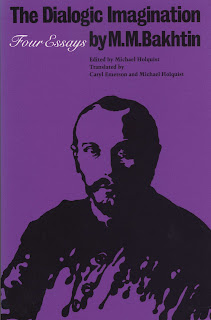
The Dialogic Imagination, Introduction

M. M. Bakhtin (1981) The Dialogic Imagination: Four Essays. Edited by Michael Holquist; Translated by Caryl Emerson and Michael Holquist. University of Texas Press, Austin.


Summary of Introduction (by Emerson and Holquist, presumably)

In this introduction, Emerson and Holquist, or one or the other of the two (it is not indicated; the term “I” is used, so perhaps it is Holquist, the editor) summarize Bakhtin’s life and work and introduce a few key concepts. One key argument is that Bakhtin’s thinking is characterized by a “Manichaean” opposition between centrifugal and centripetal forces in language. I’m not sure if “Manichaean” is quite the right word, because Bakhtin’s thinking on these two forces is ambivalent. In contrast to, for example, Norbert Wiener (for whom “entropy” is equivalent to evil), Bakhtin clearly favors the centrifugal; but he is also a bit like Deleuze and Guattari (whose striated and smooth spaces are clearly related concepts), when they admit that “a smooth space will not always save us” – for Bakhtin, some amount of centripetal or unifying force is important as well (as in his comments on “style” in the Dostoevksy book). Thus it seems that what Bakhtin is looking for is a kind of balancing, though favoring the centrifugal.

In relation to this, Holquist (or Emerson and Holquist) makes an interesting yet cryptic observation that Bakhtin does not reduce this dichotomy to a “binary opposition” such as those employed in structural linguistics. “That opposition leads from human speech to computer language; it conduces, in other words, to machines” (xviii). Here thinkers like Wiener, arguably also someone like Chalmers, is clearly implicated (though it is interesting to think how Haraway, for example, would respond). Nevertheless, to the extent that such a reductive, binarist/digital “conducement” to machines and computer language is something to be resisted, Bakhtin’s nuanced thinking could be useful; however, this observation is made only in passing and is not fleshed out.

Heteroglossia, in this account, becomes the interaction of the two opposed forces: the writer or speaker as unifying force drawing on (or in) the centrifugal, proliferating and novel speech of others, in a way that does not reduce them or their creative power.

The authors summarize Bakhtin’s vision of language as communication evocatively:

“Bakhtin’s basic scenario for modeling variety is two actual people talking to each other in a specific dialogue at a particular time and in a particular place. But these persons would not confront each other as sovereign egos capable of sending messages to each other through the kind of uncluttered space envisioned by the artists who illustrate most receiver-sender models of communication. Rather, each of the two persons would be a consciousness at a specific point in their history of defining itself through the choice it has made—out of all the possible existing languages available to it at that moment –of a discourse to transcribe its intention in this specific exchange.” (xx)

First of all, this recalls Felski’s complaint about the language of discourse “creating” subjects, etc.; and quite reasonably, since Emerson and Holquist are exactly the kind of 80s theorists she is talking about. Nevertheless this is a good example of why such language is not “unfortunate” but rather quite productive and important. Wiener also comes to mind because he specifically recognized the noise in such exchanges, and thus was more subtle than the straw man model of the naive “artists” evoked above. Yet, Wiener also assumes the two conversants as independent, previously existing, “sovereign” (in a literal sense because any entity is like a kingdom holding itself together against the forces of chaos) subject. The image of the situated, self-constructing subject not only improves on Wiener’s model but also allows for a more complex understanding of the uses of “noise” as these subjects are shown to be shielding themselves from, but also drawing on, such noise (“interference” in the text) in the next paragraph.

The authors, incidentally, make the assumption that Voloshinov is Bakhtin, so the above interpretation seems to bear the imprint of Voloshinov (his idea that there is no interiority beyond language, and that the utterance in the situated moment is the most important aspect of language).

It is clear that, for Bakhtin, these centrifugal (or entropic) forces are productive, rather than merely destructive, as Weiner would have it. And perhaps their world views are opposite: it is the eternally productive centrifugal which must be reined in by the centripetal (but not too much, because it must be allowed to remain itself) in order for order to be created (not just maintained). The authors end with a discussion of why Bakhtin feels the novel is so revolutionary and distinctive compared to other genres: it joyfully admits and makes use of its own limitations (and is always playing with and expanding on these). Such joyful inadequacy of the modern novel stands in contrast to Felski’s complaint that modern literature, through just such games, trains readers to be suspicious. If so, this is the fun suspicion of a game (something I do not recall her discussing so far). Presumably Felski will invoke a call for (non-suspicious) joyful reading in her conclusion, but here is a sign that it has been available in modernity all along.


Wednesday, February 2, 2022

Problems of Dostoevsky's Poetics, Conclusion


Summary of Conclusion

Bakhtin summarizes his point that Dostoevsky is brilliant and the polyphonic novel provides important insights. It is an example of the artistic consciousness catching up to the scientific consciousness of complexity a la Einstein, etc.

In this book we have sought to reveal the uniqueness of Dostoevsky as an artist, an artist who brought with him new forms of artistic visualization and was therefore able to open up and glimpse new sides of the human being and his life. Our attention has been concentrated on that new artistic position which permitted him to broaden the horizon of artistic visualization, which permitted him to look at the human being from a different artistic angle of vision. (270)

 Polyphonic thinking could expand beyond the novel:

This mode of thinking makes available those sides of a human being, and above all the thinking human consciousness and the dialogic sphere of its existence, which are not subject to artistic assimilation from monologic positions

 The polyphonic novel will not replace the monologic one, but it will provide greater insight and an ability to live in the more complex world we find ourselves in. There is an argument similar to that made by Norbert Weiner (who I am also reading), that Twentieth Century scientific understandings of complexity have made it clearer that we don’t need to cling to solid and monologic categories and modes of thinking; with polyphony, the artistic consciousness is catching up to the scientific:

The scientific consciousness of contemporary man has learned to orient itself among the complex circumstances of "the probability of the universe"; it is not confused by any "indefinite quantities" but knows how to calculate them and take them into account. This scientific consciousness has long since grown accustomed to the Einsteinian world with its multiplicity of systems of measurement, etc.

… We must renounce our monologic habits so that we might come to feel at home in the new artistic sphere which Dostoevsky discovered, so that we might orient ourselves in that incomparably more complex artistic model of the world which he created. (272)


Tuesday, February 1, 2022

Problems of Dostoevsky's Poetics, Chapter 5, Parts 2-4


Summary of Chapter 5, parts 2-4

Compared to the extremely dense first part, the next three parts of the chapter are much fluffier and are mostly composed of specific examples from Dostoevsky's books.


Part 2: The Hero's Monologic Discourse and Narrational Discourse in Dostoevsky's Short Novels

This part of the chapter is mostly examples from the shorter novels of phenomena Bakhtin had already laid out. Prominent are The Double and Notes from Underground. B talks about the "word with a sideward glance" at another discourse or perspective; three voices (apparently the original voice, the imagined second voice, and a third that unites them), "loopholes" etc.


Part 3: The Hero's Discourse and Narrative Discourse in Dostoevsky

Bakhtin explores the internal dialogue and regular dialogue of heroes in Dostoevsky, particularly Raskolnikov, for whom other characters are “ideological positions,” that he reacts to and is in dialogue with, and places in dialogic juxtaposition with each other. Heroes reveal themselves or learn to situate themselves in a field of inter-orientations. "Penetrated word" (“a word capable of actively and confidently interfering in the interior dialogue of the other person, helping that person to find his own voice” (242)) and "penetrated discourse" (“a firmly monologic, undivided discourse, a word without a sideward glance, without a loophole, without internal polemic” which is nevertheless “only possible in actual dialogue with another person” (249)) are defined, though they seem to be opposites; the former is discussed but not the latter much. He ends with a reference to unfinalizabilty and the  fact that the narrator's voice does not dominate. 

He states that in Dostoevsky's novels, almost no evolution of thought happens; characters never change their perspective; when something happens, they knew it was going to happen, and are not changed by it. [Why would Bakhtin consider this good? Because surely everything Dostoevsky does is the most awesome thing possible... I guess the point is that such change in the character would be an internal situating; what Bakhtin wants is social situating, the interplay of ideas in a social setting, not just the internal development of an individual.]


Part 4: Dialogue in Dostoevsky

Bakhtin summarizes he importance of dialogue in Dostoevsky's works. Particularly emphasized is that external dialogue is always related to internal dialogue; sometimes speakers in external dialogue are responding to (wittingly or not?) another speaker's statement in an internal dialogue. It is also emphasized that the dialogue is not plot-dependent: though it still follows and relates to the plot, it has an openness or "unfinalizability.” He also talks about how words and themes "pass through" many different voices (the image reminds me of a motif in music, picked up and transformed through different instruments, etc.) – fitting for Bakhtin’s ideal of “polyphony” in the novel. (An example that comes to mind is the phrase “the lesser evil” in the Witcher story of that name).

A character's self-consciousness in Dostoevsky is thoroughly dialogized: in its every aspect it is turned outward, intensely addressing itself, another, a third person. Outside this living addressivity toward itself and toward the other it does not exist, even for itself. In this sense it could be said that the person in Dostoevsky is the subject of an address. (251)

[This marks an interesting potential link with interpellation; Dostoevsky's subjects are highly conscious of, knowingly dependent on, their interpellation? Some echo of Volosinov’s insistence that there is no interiority beyond or before language seems to link here as well.]


Monday, January 31, 2022

Problems of Dostoevsky's Poetics, Chapter 5, Part 1


Summary of Chapter 5: Discourse in Dostoevsky, part 1: Types of Prose Discourse. Discourse in Dostoevsky


This part of a four-part chapter is simply massive in terms of its theoretical content. Most importantly, Bakhtin lays out a three-part outline of different kinds of discourse (with multiple subtypes within the three). This is discussed throughout before being summarized in outline form on page 199 (it would have been easier to follow if the outline had appeared first). The three kinds are:

1) “Direct unmediated discourse directed exclusively toward its referential object”

2) “Objectified discourse (discourse of a represented person)”

3) “Discourse with an orientation toward someone else's discourse (double-voiced discourse)”

The third has three subcategories, and the list appears to be a more elaborated version of the 5-part list from “Discourse in the Novel.”

As he goes through this outline, numerous key concepts are elucidated. One is metalinguistics, Bakhtin’s project for a linguistics that goes beyond the textual limits of his day, to understand “discourse as concrete lived reality” (181). He talks about things like the speech characterizations of characters, to what extent these characters become more distinguished in speech, etc. from the voice of the author, which means they are more objectified (elsewhere he has called this “stylized,” though perhaps that means objectified with the voice of some particular group in society). (On second thought these might just be differing translations of the same word in Russian).

He brings up criticisms that have made of Dostoevsky, that his characters speak the same way he does (there is less “speech characterization); Bakhtin’s response is that this makes Dostoevsky less objectifying, and thus more dialogical, than other authors. This "speech characterization" I have seen, for instance, used to caricature passengers in (certain) taxi memoirs, and it distances and objectifies the voice and character of the passenger from that of the driver/narrator (though this is sometimes perhaps not itself so an intent at monologicality or orchestration, but rather shows a lack of ability or competence of the driver/author to represent or speak for (re-voice) the passenger). Also this seems a good place for a nod to Jack Vance, whose characters who all speak in the same stilted, witty manner as the author.

Dialogic relationships are the subject matter of metalinguistics; as Bakhtin is pointing out, these can also be found within texts, not just outside of texts. He gives examples of various "judgments," (statements), and how they can be or not be in dialogical relationships; this is a key point where his relationship to Volosinov and to Foucault can be elucidated. There seem to be at least four aspects of these dialogical relationships: they must be 1) discursive [they are not relationships per se, but relationships in discourse); 2) embodied (they are not just potential linguistic or articulatory positions, but they have to actually be taken and voiced; 3) they require a logical connection to a referential object; and 4) as utterance in discourse they need to receive an author [or subject position they are voiced by or attributed to]; this could be a real author (as in a speaker or writer of the utterance), or one to whom they are being attributed (such as a character in a story or in double-voiced speech) . [Presumably two judgments being expressed by the same character could be dialogic if the character is shifting positions in an internal debate. Anyway this whole approach seems contrary to Foucault's in the Archaeology of Knowledge.]

An example of a judgment: "Life is good." "Life is good." This is the same judgment repeated twice: the two are separate "verbal embodiments" [utterances] of the same judgment, and can also be placed into dialogic relation (e.g. as two characters agreeing].

The issue of the objectification of another's speech comes up, and this is explored through the different forms this takes in the different discourse types. He also discusses all these types as historical phenomena, making remarks about "epochs" (Classicism, Romanticism) in which different discursive possibilities were available to authors. Bakhtin's point is that the modernist idea of “access to one's own personal ‘ultimate’ word” (202) is a historical condition – in some epochs there is permitted "the ultimate semantic authority of the creator to be expressed without mediation in direct, unrefracted, unconditional authorial discourse" which presumably means modernism (Whitman comes to mind in this regard, as a representative of prose invading poetry). In other epochs, dominated by stylization, the author must speak through the words of others (he calls this “refraction”). However, the fact that Bakhtin's words above sound pertinent today – despite our prose and freedom from stylistic conformity, two aspects that Bakhtin sees as crucial for the modern authorial subject – indicates that for other reasons the independence of the author has become questioned, or culturally fraught as a concept; thus refraction seems more fitting than Bakhtin apparently felt it was (cf. all the communication done through “sharing” and “liking” today). Which leads to a second question: I think Bakhtin is setting up the concept of independent authorial discourse as a historical phenomenon here; this same authorial discourse is what he is in fact critical of, and wants to fight or undermine with polyphony. Yet if this sense of authorial independence has been weakened, is this a result of the polyphony Bakhtin celebrated? Or by something else, meaning the power of the author is less serious of a problem than he presumed?

Without naming them as such, he also discusses the concepts of citationality and orchestration.