Wednesday, March 2, 2022

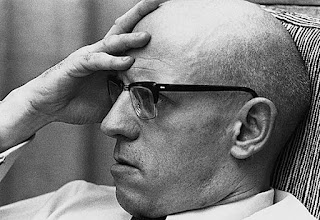
Foucault's "What is Critique?"


Foucault, Michel. “What Is Critique?” In What Is Enlightenment? Eighteenth-Century Questions and Twentieth-Century Answers, edited by James Schmidt, 23–61. Berkeley, CA: University of California Press, 1997.


Summary:

Foucault begins the talk in his usual indirect manner:

For the issue about which I would like to speak today, I have no title. (24)

Right after which he says that the question he wants to discuss is "what is critique?” but it seems this title "would have been indecent" so he is resisting it (actually it turns out to be “What is Enlightenment” that would have been indecent). He gives a first description of critique, as something that is "on the outer limits of," close to, and up against philosophy and even "in lieu of all possible philosophy.” He establishes two boundaries: "the high Kantian enterprise and the little polemical professional activities that are called critique." This is what the two have in common:

it seems to me that there has been in the modern Western world (dating, more or less, empirically from the 15th to the 16th centuries) a certain way of thinking, speaking and acting, a certain relationship to what exists, to what one knows, to what one does, a relationship to society, to culture and also a relationship to others that we could call, let's say, the critical attitude.

[And this set of relations to self, others, and world is what makes critique an act or practice of articulation, and a technology of the self.] Critique is a practice of [deterritorialization], yet it remains subordinate to a different move, that of "constituting" stuff:

After all, critique only exists in relation to something other than itself: it is an instrument, a means for a future or a truth that it will not know nor happen to be, it oversees a domain it would want to police and is unable to regulate. All this means that it is a function which is subordinated in relation to what philosophy, science, politics, ethics, law, literature, etc., positively constitute.

He contrasts the pleasure of critique with its utility, and then says it is supported by a "general imperative" which ties it to virtue. Foucault elaborates his historical framing of critique as "one possible route" to discuss this history: presaging aspects of his later History of Sexuality series, he finds critique growing out of the Christian pastoral, which focused on this idea of allowing yourself to be governed, of submission to the church, authority, God, etc., for the purpose of being directed towards your salvation. This subjectifying relationship of obedience has a "triple relationship to the truth:"

1 "truth understood as dogma"

2. "a special and individualizing knowledge of individuals"

3. "this direction is deployed like a reflective technique comprising general rules, particular knowledge, precepts, methods of examination, confessions, interviews, etc.” (26)

 [In other words 1) an unquestionable and set Truth that can be known; 2) a secondary, perhaps variable truth about individuals (presumably, their extent of obedience  and their fitting into the system; where they stood, how "good" they were (and presumably they or their shepherds also "know" this or seek to); and finally 3) a collection of techniques for improving oneself in this system)].

This led to the explosion of the question from the 15th century on, how to govern? Which question "cannot apparently be dissociated from the question "how not to be governed?"" (28). This itself does not necessarily mean not being governed at all, but rather:

how not to be governed like that, by that, in the name of those principles, with such and such an objective in mind and by means of such procedures, not like that, not for that, not by them. (28)

This is the critical attitude; this challenge, distrust, etc. seeking to limit, transform or displace government is both a response to, and a [product] of, the project of the arts of governing. He thus offers a first definition of critique: “the art of not being governed quite so much.” (29) [Here in the "not so much" is the phenomenon once again of critique or suspicion, etc. taken up to a point but not farther, a point that is itself up for debate or argumentation, and is ultimately pragmatic]. This "vague or fluid" definition allows him to elucidate three historical "anchoring points" for the critical attitude:

1. Ecclesiastical resistance; the Protestant Reformation, with a return to scriptures and textual critique. The idea of who can speak or know the truth, through the application of reason, spreads to the laity, who have the same authority as the church hierarchy of reading and interpreting the scriptures; this spreads as far as the ability to question the scriptures themselves, and their truth or authority.

2. The concept of natural law and rights are put forward as brakes on, and limits to, the ability of the powerful to govern, placing limits on existing law, which is now revealed to be [arbitrary] and historical in nature; a setting up of some concept of law which is distinct from that of authority, and problematizing existing laws in relation.

3. Finally, a confrontation with authority: nothing that an authority tells you is true is to be accepted simply for this fact, but only “if one considers valid the reasons for doing so.” Certainty, the ability to trust or believe, is here distinguished from authority.

[So essentially 1) a right to reason, spread to everyone; 2) a concept of reason or truth or “law,” separated from authority and might; and 3) a separation of “certainty” or the [compellingness] of truth and logic, from authority.] The triad of religion, law, and knowledge is derived from Kant in “Was Ist Aufklärung” where these are ways that subjects are kept in a minority condition.

[I have at hand James Miller’s summary of this article in his biography of Foucault; he finds it “remarkable” and “idiosyncratic” that Foucault derives the critical tradition from “the heretical practices of dissenting religious sects” rather than from German theorists (Miller, 302). To the contrary, I find it reminiscent of Bookchin’s description of the Enlightenment as a bottom-up affair, originating with widespread disaffection among the peasantry, and moving into the academy. Numerous parallels with Bookchin and other anarchist thinkers make this text a key one for the interpretation of Foucault as an anarchist or fellow traveller. Arguably Foucault’s openness to seeing other, non-philosophical, etc. movements and sources as revolutionary – including religious ones – was behind his controversial endorsement of the Iranian Revolution in the year following this lecture.]

The "core of critique" is a “bundle of relationships” set up between power, truth, and the subject. A relationship is set up between governmentalization and critique:

And if govemmentalization is indeed this movement through which individuals are subjugated in the reality of a social practice through mechanisms of power that adhere to a truth, well, then! I will say that critique is the movement by which the subject gives himself the right to question truth on its effects of power and question power on its discourses of truth. Well, then!: critique will be the art of voluntary insubordination, that of reflected intractability. Critique would essentially insure the desubjugation of the subject in the context of what we could call, in a word, the politics of truth. (32)

[But does the subject really "give themself" the "right" to question? Or is there some imperative, or even interpellation in the Enlightenment subject involved? Is not the imperative for critique, or the critical attitude, tied to the Blackmail of the Enlightenment, the call for continuous improvement and reform? It seems that critique, or the “critical attitude” is demanded of the Enlightenment subject, as part of the way the subject and truth are related, one should not be capable of taking truths on faith, or rather, it is the believer on the basis of faith who must defend their choice to do so, in the context of the Enlightenment.]

Reason and Critique, for Kant, require courage, but are also about knowing one’s own limits, and possibly even about knowing when to stop questioning: Kant asks:

do you know up to what point you can know? Reason as much as you want, but do you really know up to what point you can reason without it becoming dangerous? (34)

Foucault explains: "...once one has gotten an adequate idea of one's own knowledge and its limits, ... the principle of autonomy can be discovered." We then no longer obey because we are told to, but because we choose to: “the obey will be founded on autonomy itself.” But in turn, this rationalization of the relation of authority results, in turn, in such reason becoming the basis for authority: critique as a practice of autonomy is [recuperated]. Foucault details the emergence of the suspicion that "reason itself is responsible for excesses of power" (38), particularly in Germany.

He seems to suggest that the lack of a real [Protestant] Reformation in France, as opposed to Germany, as well as the close ties of the Revolution to the valuation of reason (and the Enlightenment), made France, or the French Left anyway, less open to the critique of reason, which was thus left to the French Right to voice. In Germany, in contrast, it was the Left which voiced this suspicion. This means the concept of critique or the link between "ratio and power" is not inevitable, but has to be established, [articulated], and this happened differently and earlier in Germany as opposed to in France. It is the growth of phenomenology, and the importation of the Frankfurt school, that lead to this critique in France, and the connections between reason and power start to be investigated and questioned. The 20th Century experiences of Fascism and Stalinism, and more generally of the overall rise of scientific authority and state power, also drive the growth of this questioning of reason’s role in upholding domination, and the question, “What is Aufklärung?” returns.

Foucault asserts that his goal in discussing this is not "to be critical or polemical", but rather "to point out differences and somehow see up to what point we can multiply them, disseminate them, and distinguish them in terms of each other, displacing, if you will, the forms of analyses of this Aufklärung problem, which is perhaps, after all, the problem of modern philosophy."  (44) He notes that he is trodding the boundaries between philosophy and history. He says you have to

fabricate history, as if through fiction, in terms of how it would be traversed by the ques­tion of the relationships between structures of rationality which articulate true discourse and the mechanisms of subjugation which are linked to it... (45)

 A long, dense, two-page paragraph begins with a subject asking, "What, therefore, am I?" (46): [so the critical subject is moved, from its questioning of power and reason, etc., to question itself as well, to interrogate what it is. This would be like Gramsci's call for an "inventory of traces"]. However, Foucault's “historical-philosophical” method will move away from this:

 The first characteristic of this historical-philosophical practice, if you will, is to desubjectify the philosophical question by way of historical contents, to liberate historical contents by examining the effects of power whose truth affects them and from which they supposedly derive.

[This sounds like his archaeological approach; actually I might be misreading a tension between the question "what therefore am I" and the "historical-philosophical practice" which "desubjectifies"; maybe this is just the way to go through answering or asking the question. By “liberate historical contents,” I think he means he is taking apart the elements (earlier he had described a power-truth-subject triad as the “core of critique”), taking them apart to disable their assumed relationships; this is the first characteristic of the historical-philosophical practice.

The 2nd characteristic is temporal specificity: 

In addition, this historical-philosophical practice is clearly found in the privileged relationship to a certain period which can be determined empirically. (46)

This is the Enlightenment period. There is a bit of a "Kafka and his Precursors" discussion of how we can see Aufklärung in the ancient Greeks, etc., because we are looking for it, rather than because it was already there somehow. The question itself is not necessarily stuck in particular historical periods; however there is the pragmatic issue of

under what conditions, at the cost of which modifications or generalizations we can apply this question of the Aufklärung to any moment in history, that is, the question of the relationships between power, truth and the subject. (47)

Foucault describes his motivation [and arguably, his practice of critique] in an “opening up” motto for his critique of critique/Aufklärung:

I was saying before that I wanted in any case to very vaguely trace possible tracks other than those which seemed to have been up till now most willingly cleared. This in no way accuses the latter of leading nowhere or of not providing any valid results. (48)

Foucault crucially argues that Kant introduced a separation between Aufklärung and critique, by means of which Kant achieves critical distance and is able to critique the Enlightenment (and the role of power in relation to knowledge and the subject). Foucault lists the steps of Kant's "procedure of analysis":

1) "starting with the historical destiny of knowledge at the time of the constitution of modern science";

2) looking for the "indefinite effects of power" in this "destiny," which will be linked to "objectivism, positivism, technicism," etc.;

3) "connecting this knowledge with the conditions of the constitution and legitimacy of all possible knowledge," and

4) "seeing how the exit from legitimacy (illusion, error, forgetting, recovery, etc.) occured in history."

This "procedure of analysis is "deeply mobilized by the gap between critique and Aufklárung engineered by Kant" (48-9). [i.e. it is not so much that critique and Enlightenment are distinct, but that there is a gap opened between them, so there can be a critique of the enlightenment, even as the enlightenment demands critique. Is Felski doing a similar move -- establishing a gap between “critique” and “post-critique?”]

I believe that from this point on, we see a procedure of analysis which is basically the one most often followed, an analytical procedure which could be called an investigation into the legitimacy of historical modes of knowing (connaitre). (49)

 So this is the sort of truth-preserving critique of reason created by Kant, and maintained up through today by Habermas, etc., which asks:

 what false idea has knowledge gotten of itself and what excessive use has it exposed itself to, to what domination is it therefore linked? (49)

 Foucault will of course do something different: he is interested, not in the "problem of knowledge" (and how to free it from the distortions of power) but of power itself. He outlines a set of three “levels” or dimensions of analysis (archaeology, genealogy, strategy) that will allow him to investigate what he calls “événementialisation,” here translated as “eventualization,” though more commonly as “eventalization” (because the latter better preserves the weirdness of the French neologism, instead of flattening into a regular English word which does not have the same meaning as Foucault is intending). Eventalization essentially means how “ensembles” (from such cultural formations as sexuality, to medical discourses and institutions like the prison, asylum, etc.) come about, as events basically, without thinking of them as manifestations of something eternal or inevitable.

The first level, archaeology, seeks links between power and knowledge, without making judgments as to legitimization or truth/falsity (like the Kantian approach would). With this less judgmental approach, “connections between mechanisms of coercion and contents of knowledge can be identified” (49-50).

What we are trying to find out is what are the links, what are the connections that can be identified between mechanisms of coercion and elements of knowledge, what is the interplay of relay and support developed between them, such that a given element of knowledge takes on the effects of power in a given system where it is allocated to a true, probable, uncertain or false element, such that a procedure of coercion acquires the very form and justifications of a rational, calculated, technically efficient element, etc. 

He describes the link between power/knowledge, also distinguishing “savoir” from “connaissance” in passing:

Hence, the use of the word knowledge (Savoir) that refers to all procedures and all effects of knowledge (connaissance) which are acceptable at a given point in time and in a specific domain; and secondly, the term power (pouvoir) which merely covers a whole series of particular mechanisms, definable and defined, which seem likely to induce behaviors or discourses.

 Power/Knowledge aren't fundamental realities, but are instead points chosen for the their analytical pertinence:

We see right away that these two terms only have a methodological function. It is not a matter of identifying general principles of reality through them, but of somehow pinpointing the analytical front, the type of element that must be pertinent for the analysis. It is furthermore a matter of preventing the perspective of legitimation from coming into play as it does when the terms knowledge (connaissance) or domination are used. (51)

Furthermore these should always be specified as to content, rather than speaking generally of "Power" or of "Knowledge" as if these were essences: they are an "analytical grid":

such and such an element of knowledge, such and such a mechanism of power. No one should ever think that there exists one knowledge or one power, or worse, knowledge or power which would operate in and of themselves. Knowledge and power are only an analytical grid. (52)

He provides an excellent and clear summation of the concept of power/knowledge, in the context of pointing out how they are not composed of distinct elements "external" to one another:

for nothing can exist as an element of knowledge if, on one hand, it is does not conform to a set of rules and constraints characteristic, for example, of a given type of scientific discourse in a given period, and if, on the other hand, it does not possess the effects of coercion or simply the incentives peculiar to what is scientifically validated or simply rational or simply generally accepted, etc. Conversely, nothing can function as a mechanism of power if it is not deployed according to procedures, instruments, means, and objectives which can be validated in more or less coherent systems of knowledge.

 Thus an "ensemble" such as the healthcare, or medical, or scientific system at a particular point in history, is supported by a "knowledge-power nexus" which the Foucauldian scholar studies (as opposed to evaluating its legitimacy, or seeing it as a manifestation of some natural or eternal truth). The point is rather to understand how these "positivities" became "acceptable.”  The fact that something now seems obvious in retrospect has to be gotten beyond, because it did not at the time seem obvious, and it is that lack of necessity or inevitability that has to be restored in the analysis. Two correlative operations to be performed: 1) "bring out the conditions of acceptability of a system" and 2) "follow the breaking points which indicate its emergence." (54) He refers to this level of power/knowledge excavation as "archaeological."

The identification of the acceptability of a system cannot be dissociated from identifying what made it difficult to accept: its arbitrary nature in terms of knowledge, its violence in terms of power, in short, its energy. (54)

Ensembles are not analyzed as instances of universals or "individualizations of a species" but as "pure singularities:" the singularity of madness [in its time as a construct of modern medicine], of sexuality, etc. (55). The approach "has to keep itself within the field of immanence of pure singularities.” 

Then what? Rupture, discontinuity, singularity, pure description, still tableau, no explanation, dead-end, you know all that. 

His "analysis of positivities" "does not partake" in three "so-called explicative procedures to which are attributed causal value according to three conditions" (55-6) (these are: final authority; unitary origin; and unavoidability/necessity: three causal frameworks which Foucault seeks to avoid by focusing on positivities/eventalisation). Instead he will see "singularities" [singular historical formations, such as sexuality, psychoanalysis, etc,]  as the effects of [power/knowledge] networks. There will be many kinds of relations and connections, and forms of necessity among these "heterogeneous processes" (57). The singularity itself is seen as singular [historically unique], rather than being reduced to some single cause (that would account for any number of such singularities, thus reducing them to the no longer singular).

 The second level of analysis is genealogy: a way of seeking to understand the "conditions for the appearance of a singularity born out of multiple determining elements" without appealing to a "principle of closure" (57). There is no closure for two reasons:

1) we are not looking outside of the network of relationships for a final cause in the nature of things, but in the network of power/knowledge relationships; we don't find causality in "the nature of things" but in the uncertain logic of interactions, decisions, actions, etc.; the contingent.

2)  with the second reason he jumps to the level of strategies: the analysis of the mobile, fragile, and complexly changing relationships and networks. There is a “perpetual slippage” between competing [articulations] and changing meanings, formations, etc. which could be called strategies (58).

 To rephrase this triad simplistically, archaeology opens up understanding of past moments independently, in a manner that does not subordinate them to the present or any other overarching unity; genealogy understands the process of change without imposing an origin or telos; and strategy seems to focus on the agonistic context of meaning etc. in the present. He insists that archaeology, strategy, and genealogy are simultaneous dimensions of analysis, not successive levels or steps. He discusses how power is to be seen "in relation to a field of interactions" and as possibly reversible: it is not merely a top-down phenomenon but a bottom-up one as well. In this much more complex view (than Kant’s etc.) there is an “indivisibility of knowledge and power in the context of interactions and multiple strategies;” so any power formation or form of domination becomes only a temporary, fragile “event;” there is no longer a question of legitimation, right vs. wrong forms of domination, but simply of power relations. [And here is where the importance of ritual comes in, as a necessary form of renewal, maintenance, and re-articulation]. [Contrary to a common misunderstanding, relations of domination and legitimation remain important within this Foucauldian world-view; they are simply understood as part of the field of power-relations, instead of being held apart as principles upon which to found a critique].

In what way can the effects of coercion characteristic of these positivities not be dissipated by a return to the legitimate destination of knowledge and by a reflection on the transcendental or semi-transcendental that fixes knowledge, but how can they instead be reversed or released from within a concrete strategic field, this concrete strategic field that induced them, starting with this decision not to be governed? (60)

[He's talking about how this will not to be governed has historically been recuperated by the return to authority, or greater authority, part of the movement of subjectification (induced, recuperated). In my earlier notes (from who knows when) I called this “very Master and Servant.” Is there not a further parallel with ressentiment? Isn't it funny though that he evokes a language of liberation here?]

Summarizing, he describes the history of Kantian, etc. critique as "this swinging movement, this slippage, this way of deporting the question of the Aufklärung into critique" (61), but Foucault wants to go the other way, back towards Aufklärung; or rather, he wants to close the gap between “critique” and “Aufklärung” [here standing in for the entire apparatus of modernity, reason, etc.] and understand them as one.

And if it is necessary to ask the question about knowledge in its relationship to domination, it would be, first and foremost, from a certain decision-making will not to be governed, the decision-making will, both an individual and collective attitude which meant, as Kant said, to get out of one's minority. (61)

[So the goal is still the same as Kant had indicated, but it will be without this gap between critique and Enlightenment/reason/apparatus (or between reason as pure practice of critique, and reason as complicated mangle).] In a concluding statement, the host Gouhier rightly chides Foucault for the pretense that he is "not a philosopher" and "barely a critic," lines which Foucault of course delivers in a way that is far more intolerable than if he had merely been bragging about what a great philosopher and critic he was.

The questions from the audience are not contained in this translation; fortunately Miller discusses some of them in the summary referenced above. Miller’s summary of the lecture is actually quite limited, focusing primarily on the definition of critique as the will not to be governed; he does not discuss the subjects of power/knowledge and eventalization at all, and seems in fact disinterested in these concepts, perhaps because they are difficult to subsume into the fascination with death, under which he attempts to subordinate all of Foucault’s thinking. Anyway: one questioner asks whether this whole agonistic field of power and knowledge could not in fact be called “the will to power;” Foucault concurs. Another questioner asks for an interrogation of the “will not to be governed,” to which Foucault responds with a discussion of the “practice of revolt” throughout history (Miller, 305). Here he again reiterates the need to look beyond philosophy for a broader spectrum of practices, and finds a commonality in the movements of the Protestant Reformation and 20th Century Marxism, as forms of struggle against domination, and creators of hope, for a future and better world.

What Foucault has not really discussed here, though some aspects of his talk hint at it, is the extent to which critique, as an ethical imperative after all, is in fact mandated of the Enlightenment subject, in order to be considered enlightened, “awake,” etc. The figure of the uncritical ideological dupe is in this context an Other against which you are interpellated: you accuse others of being such dupes, while you yourself want to avoid being one, or being seen as one. [This is linked to the whole fear of automata]. And Kant’s form of critique, making use of the gap between the reason of the particularly awake and insightful individual, and the compromised reason of the society which that individual critiques, is the exemplary model of such a recuperated will-not-to-be-governed, which in fact functions as a drive or engine propelling governmentality forward into new and more complex, more subtle and effective forms. Foucault is attempting to hold on to the compelling hope that this will-not-to-be-governed helps create, while resisting, or at least attempting to resist, the ultimate recuperation and restoration of the “blackmail of the enlightenment.”

Foucault’s attempt to get beyond Kantian critique means taking critique a step further (by questioning and going beyond the principle of legitimation); and his second questioner asks him to go a step further than that (by questioning this will-not-to-be-governed). Foucault clearly acknowledges the desire but seems unable to formulate exactly how to do so. But again, Foucault’s agenda is not an endless corrosive critique, but critique-up-to-a-certain-point, in the service of constitution: as he has stated, the field of power/knowledge relations is not some fundamental reality, but a pragmatically chosen level of analysis, useful because it throws open a way to understand history, power relations, etc. as agonistic, open-ended, and ultimately creative and even revolutionary in potential.

Tuesday, March 1, 2022

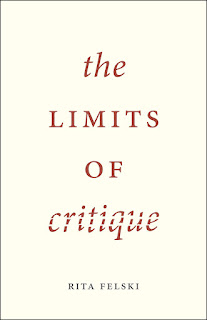
Limits of Critique, Chapter 3


Summary of Chapter 3: An Inspector Calls


In this chapter Felski explores the connections between the practice of critique in literary studies, and the detective novel. Both have certain continuities, such as the presumption of some crime or mystery to be solved, and a particularly insightful character who solves this crime or mystery. She does not focus, again, on the sociological context (which would have been more interesting imho) in part because she wants to highlight the rhetorical aspects of this connection. For instance, she points out that literary studies, like novels, have plots or “plotting” and that suspicious readings are one of these typical, and culturally recognizable and invocable, plots: one of the central stories or familiar narratives by which authors and readers are prepared to organize the books they encounter, and understand their relation to the world. One of her key charges is that suspicious readings, like detective novels, blend interpretation with moral judgment, and thus take a normative, judgmental position on the “crimes” they are solving or revealing.

She points out that both detective novels and literary critiques have a double plot: one involving a criminal and a crime, the other involving a detective who solves the crime. In the detective novel the criminal is revealed to be a particular person, the crime is individualized; in critique, on the other hand, the culprit is “a text, genre, or linguistic structure” rather than a particular writer; however, Felski argues that these “nonhuman forces” are “personified” because they are imputed “intentions, needs, or desires” (94). It is not clear to me why imputing causality or even agency to a “nonhuman force” should be the same as “personification;” Felski insists on this because the next step is the assignment of guilt to the personified force. Both this move of personification, and the linked one of moralizing judgment, may well have plenty of exemplars (she cites several), yet it seems more than a bit forced to insist that these are qualities of every kind of critical reading. Then again, she is taking a somewhat polemical approach: she is using categorical language here, but later on will qualify this and bring more nuance into her account.

This is also the first of several points in the chapter where I wondered when she will call herself out for the obvious ironies of her position: she is herself investigating the crime of suspicious reading, identifying a non-human “critique” as guilty party, and assignment the blame of the crime of moralizing judgment. Assuredly, she must be fully aware of this irony, and also that readers will be aware. In fact, not until late in this chapter does she give any recognition of this, acknowledging her own attempt at “a nimble two-step without tripping over my own feet, both agreeing and disagreeing with my fellow critics of suspicious reading” (113). My only thought is that she is refraining, intentionally – perhaps, in order to distance her own authorial position from that of some of the critics she is critiquing – specifically, the postmodern, Foucauldian ones she will get to later in the chapter – who would take the position of delighting in such irony. Felski perhaps wants to avoid this, by now, somewhat cliché stance, and could also be intentionally not making the jujitsu power move, of calling oneself out in order to forestall the reader’s ability to do so. There has been no clear indication of this, but could one of the aspects of a postcritical critic, as we are told we will find in the final chapter, be this sort of non-parrying exposure, intentionally leaving insights and authority to the reader instead of claiming or attempting to corral as much as possible for the author?

Some aspects of the practice of critique she is critiquing:

The critic thus assembles a line of argument that correlates textual clues to larger social conditions that the work is anxious to paper over. (96).

(Felski incidentally is innocent of this by default, because her approach is rhetorical rather than sociological). Despite their claims that they are uncovering what is hidden, Felski insists that “the critic does not uncover guilt so much as generate it out of the axioms of her own interpretative practice.” Again, this is a surprisingly simplistic insistence on the reality vs. irreality of that which is “uncovered” vs. “generated” by critique, and also notably an insistence that these must be exclusive of one another.

She turns to the topic of “metasuspicion,” aka post-structural critiques of suspicious reading. Here, “suspicion is not eliminated or eradicated but ratcheted up a few more notches and applied with fresh zeal to a fresh target” (105), even “scrutinizing its own motives in a self-reflexive loop of spiralling distrust” (106). This is the practice she calls the “critique of critique” and which she herself intends to avoid:

The more vigorously critique is interrogated, after all, the more we seem to reinforce the very style of thinking we are trying to avoid. (107)

It seems a bit ironic, given that she lists “Foucauldian critics” among her main targets here, that her criticism at this point to be is essentially that of the “blackmail of the enlightenment.” She also, at least at this point, is not addressing the disabling aspects of such critique – neither, on the one hand, the strategically political disabling of dominant narratives that Foucault discussed as one of his motives; nor, on the other hand, the power move such critiques can make to choke off or render less practicable some particular practice of critique (e.g., the Freudian methods she mentions these critics as targetting).

Having set up this encounter with “Foucauldian critics” and the critique of critique, which she promises will come in the next chapter, she then shifts tone and starts discussing the positive, attractive and pleasurable aspects, even the enchantment, of the “art of critique.” [This bears a superficial resemblance to D&G’s practice, in A Thousand Plateaus, of setting up dichotomies in the first half of a chapter, then dissolving these dichotomies later, in an attempt to get past the concept of dichotomy; however, Felski’s acknowledgments of nuance are temporary, and Bakhtin might say, orchestrating; they are a momentary diversion from her polemical stance, which returns at the end.] Critique can provide a “jolt in perspective” (109) and can take the form of “addictive play” (110); she even notes the positive impacts that critical readings can have (115). Here is where she acknowledges her “nimble two step” of trying to both agree and disagree with the critics of critique, as she states that “critique is not a capital crime” (it is not in itself bad) but “only a misdemeanor” (in other words, it is still to be avoided). She reiterates her charges that suspicious readings involve personification and moral judgment; more tellingly, imho, she charges it with having become predictable (114) and even banal (115-6): “it no longer tells us what we do not know; it singularly fails to surprise” (116). This observation immediately strikes me as dependent on the sociological and political context of critique (which she has excluded from consideration; it also seems to distinguish her ultimately playful and opening-up (though along the way moralizing) critique of critique, from Latour’s more closing-off critique; perhaps because the stakes and context of discourse (who argues or takes what positions against whom, and to what ends) are very different in their respective fields.


Monday, February 28, 2022

Limits of Critique, Chapter 2


Summary of Chapter 2: Digging Down and Standing Back


In this chapter, Felski takes on the role of spatial metaphors in the practice and discourse of critique. she talks about the power of “metaphor clusters” and the advantages and disadvantages of using particular metaphors: “analogies can smooth or derail the path of thought” (53) [how do you “derail a path”?] She uses the metaphor of “fresh” vs. “stale” to describe the effect of promising new metaphors as opposed to established, constraining ones. “Figures of speech can become stubbornly entrenched and hard to budge, taking on a life of their own, dictating what and how we see.” [aka, wheels in the head]. She talks about how metaphors “choreograph” a text, influencing how a reader approaches and understands it. Her main intent in this chapter is to take on the two prominent metaphorical descriptions of critique, featured in the title. The first, “digging down” metaphor of uncovering is associated with Freudian and Marxist traditions; the second, “standing back” metaphor with post-structuralism and a recently influential issue of Representations.

A key text for the “digging down” metaphor is Jameson’s The Political Unconscious, which combined both Freudian and Marxist influences and popularized the “digging down” metaphor, along with Althusser’s concept of “symptomatic reading.” The presumption of such an approach is that the “manifest meaning” of a text is superficial or misleading, because there is a deeper, “latent” meaning, which reveals the true purpose or message of the text. For Freudians this is a “repressed” meaning. More broadly, “digging is an ethical and political imperative” on the part of the critic (58). She traces some of the history of this metaphor, from the influence of archaeological discoveries (such as Troy) on Freud’s use of the digging and discovering metaphor; to the emergence of a more sophisticated psychoanalytical approach, informed by semiotics, in the 1970s (Lacan, etc., are not named).

In exploring the productivity of this approach, she notes that when “gaps and fissures” in a text are discovered, this allows for an ambiguous reading, rather than mere hypercriticality and “suspicion” (63). “Admiration and love,” can coexist with, or form an essential motivation for, critique, and texts can be “rescued” from the “shame of the sheerly ideological” by noting how they struggle with or challenge ideology rather than merely replicating it. She notes Jameson’s “stout defense” of the “positive hermeneutic” aspect of Marxist critique (64): that this is not merely, or even primarily, about tearing down, and that leftist critique in fact has utopian elements and inspirations. She then somewhat weakly criticizes Jameson’s point, by calling such utopianism an “endemic suspicion of the present,” in which “all hopes are pinned on a world beyond this world.” She backs this up with a note citing Latour’s “compositionist manifesto.” Similarly, she notes the nuance of George Steiner’s “fourfold structure of interpretation,” only to conclude that “this double-sidedness disappears, however, once dialogue gives way to a diagnosis of symptoms.” That is, the specific form or practice of “symptomatic reading,” (a subcategory of this broader metaphor which she has traced over a century) is taken as more significant than all the ambiguity and complexity that advocates of “digging” critique speak about. It’s like she has to recognize that they talk about and praise ambiguity, but then take it away from them, because it will be part of “post-critique,” and thus be denied as an inherent or essential aspect of “critique.”

Part of her criticism could be understood as a call for a “flat ontology” or a “flat reading” (though she uses neither of these terms, nor the “flat” metaphor, which is part of the “surface” metaphor she will be critiquing next). In such a reading, “ideology” or the “political unconscious” are [spooks,] and don’t really exist out in some imagined underworld or overarching space; instead they are “housed in the scribbled notes, computer files, and footnotes of the critic’s own workspace” (66). This is a riff on Latour’s criticism of Levi-Strauss’s “unconscious structures of primitive myths,” (202n23), as existing not in Africa or Brazil but in the filing cards in Levi-Strauss’s office, or more specifically, in the assemblage of human and non-human actants that has composed or created or established them, or whatever word Latour wants to use [though isn’t it fair to ask, does not “Levi-Strauss’s office,” itself, exist in Latour’s files and folders, etc.?]. Felski follows this with one of the first of three or four short paragraphs (scattered through the chapter) in which she outlines her own vision of how texts should be read. She cites Ricoeur re: a “surplus of meaning,” which any text overflows with, and which is more than any one reader or critic could capture or interpret. “There is no need to resort to repression, in other words, to account for contradiction, nuance, or implicit meaning” (66). [here we are at the boundary between the opening and closing sides of post-critique: does the above “no need” imply that the search for “repression” should cease? Or that it should simply not be mandatory or dominant, and that it can co-exist with other approaches and styles? After all, sometimes, repression happens, however that term is to be understood].

It seems her argument is really with “symptomatic reading,” and its need to posit symptoms which are themselves the result of a repression of the latent meaning, in the service of some kind of ideological unity or orthodoxy. Althusser and Jameson seem fitting targets of such a critique. However, it is less clear that this criticism accurately fits all of the variety of approaches which use the “digging” metaphor, and she seems to be taking this as a kind of ideal form which the rest must be seen as somehow trending to – perhaps “unwittingly?” She ends the section on digging with a reference to criticisms that arose from within, and a move toward a more nuanced and open form of reading by Macherey and others. She notes the rehabilitation of Freud as the “French Freud,” who was not simply a believer in the scientific veracity of his own theories, but one who was always testing the limits of the knowable: Freud was thus rehabilitated “by applying essentially the same techniques that had been used to ‘save’ canonical works of art” (68). She notes: “it was assimilated, in other words, into an influential style of thinking, that views irresolution, contradiction, and doubleness as the quintessential intellectual virtues” (69). This invocation of a late-20th century academic form of metis leads to the emergence of the next, competing critical metaphor of surfaces and “standing back.”

However, the second “metaphor cluster” she has identified ends being a bit more mixed: “surface,” “standing back” at a distance, and so on. Instead of keeping the “standing back” emphasis from the chapter title, she names this section, “Against Nature,” emphasizing a different key aspect of this form of critique, which is denaturalization [although this whole concept of “second nature” seems also key to many of the Marxist critics who fit better with the first trend]. Typical of her argument here are statements like: “The right to rail against social injustice, reinterpret images, or take issue with badly made arguments is not in dispute, but it is less evident that such rebuttals need to be framed as excoriations of nature” (71). Not to jump ahead too far, there is just so much conflation going on in that sentence: for instance, the implications that to criticize naturalization per se means also to insist that “such rebuttals need” to take that specific form; and also that accounts of “second nature” and “denaturalization” are “excoriations of nature.” WTF?

She traces this “excoriation of nature” through various precursors, such as the 19th century dandies of the aestheticism movement, a la Baudelaire, etc. In a reaction against the idealization of nature in Romanticism, the aestheticists celebrated artificiality and feared or derided “nature” as the “realm of the automatic and unthinking.” Another trend is that of Russian Formalism and their practice of ostranenie, or “strangemaking.” (Phenomenology’s suspicion of the “natural attitude” is added as another precursor a few pages on (73)). “Denaturalize” and “defamiliarize” become synonyms (72). The point of defamiliarization/denaturalization is to reveal that what we consider to be “natural” is in fact a product of culture. “Modern ‘culture,’ in a paradoxical reversal of the usual distinction, thus enforces the metaphorical sway of ‘nature,’ as second nature.” The “paradoxical reversal” she seems to be referencing here, is the fact that “nature” is culturally (ahem) a much stronger and more privileged term than “culture;” this form of criticism reverses that to undermine the power of exactly this privileging of “nature” and of naturalizing categories, etc. It is interesting that (and all the moreso given her frequent references to Latour) she does not mention the cultural (ahem) and institutional dominance of the “hard sciences” and of biological and “natural” explanations in the US, which is in fact the source of the “cultural and social explanations are belittling” theme she has copied over from Latour (and seeks to deploy uncritically, if it is fair to use that word). She has of course signalled in the previous chapters that she will argue against the claim of critique to be oppositional; she may of course be correct about this within specific discourses but on the broader field, it certainly remains a counterhegemonic discourse – and it seems a bit naive or willful to ignore this fact, quite evident to, for instance, an instructor of introductory anthropology and sociology courses. She will, later in the chapter, claim that “critique” is elitist and academic, and cultivates an alienating language and stance which distance it from the everyday language of everyday people; be that as it may, this very insistence on “critique” as a dominant discourse, seems clearly confined by a perspective limited to the ivory tower, and only certain parts of it, at that. And certainly not the best funded or influential parts!

She lists three kinds or aspects of “nature” which come under the glare of critique: human nature, inner nature, second nature. She repeats this theme often throughout the rest of the chapter, and the question arises as to whether she really wants to rehabilitate the concept of “nature” (untouched or excused from these criticisms), and to what end? One guess is that this is a form of post-humanist argument, that our way of talking and being suspicious of “nature” limits our connections and “alignments” or whatever with non-humans and the natural world more generally. However, this has not been specifically stated here. Another question that arises here is what role such rearticulations of words and concepts like “critique” and “nature” as here proposed, play in a potential contemporary rearticulation of the position of academics, the university, and so on in these early decades of the 21st century. Felski (paralleling and echoing the more pointed account in Bookchin, as I was reading recently) outlines the growth of “critique” as an academic practice, corresponding to the era of the acceptance of (tame variants of) Marxism into the academy from the 60s through the 80s. Bookchin’s reading seems to see these radical intellectuals/academics (he was himself one after all) as part of a class fraction (or what have you) involved in a link or alliance with the working class (and later on, with progressive movements challenging racial, gender, and heteronormative hierarchies). The academic practices of “critique” and “denaturalization” Felski is critiquing emerged in this era, and thus served the interests of this class or group, (or class fraction, I don’t really know the Marxist terminology). [Felski herself does not mention any kind of class or group analysis of this sort, though she does make a passing reference to “elective affinity;” perhaps she is saving this topic for chapter 4, on politics]. In any event, some have argued that we are currently in the midst of a new rearticulation to fit new changing circumstances: old words and concepts are being updated to meet the new needs of the time. This is the critique outlined, for instance, by Michel Bauwens of the “woke ideology” (or the coherent and interesting parts of that critique, anyway). A word like “critique” from this view, is done away with to make way for new terminology: a fresh start and a shorter citation pattern (we all just talk about “matters of concern” now, and cite Latour instead of Foucault or Butler, or Gramsci). But a new rehabilitation of “nature” seems to put a lot more at stake. Later in this chapter Felski recounts, critically, the attempts by Butler and others to stave off naturalizing categories and the collapse of their form of critique into “orthodoxy;” she again will dismiss this as “not necessary.” But the other (suspicious, yes) side of the question is what is gained by academics (or a group or faction thereof) becoming newly re-enabled to talk about “nature” and the “nature” of things? In the context, of course, of a university and culture that have privileged nature and naturalizing categories all along, all the moreso as the university becomes increasingly streamlined into a productive, corporate-aligned business model.

She turns next to the topic of antinaturalism as style and tone, starting off with a surprisingly inaccurate reading of Foucault’s style as “famously impassive,” “purged of obvious signs of affect and attachment,” “cool rather than hot” (74). Though it is fair that Foucault is “scrupulously nonjudgmental,” this is all part of his ironic detachment, which is, far from lacking in affect, above all playful and often maddeningly so. In a footnote she slightly qualifies this with a recognition that there is “another side” to Foucault, but overall it is surprising that a writer like Felski, so attuned to nuance and style, would short-change one of the foremost proponents and practitioners of the gay science.

She turns then to Roland Barthes, and describes the great influence of his Mythologies: followed with his own dissatisfaction at how orthodox and common the method he used had become by the 1970s; his response was to “move away from critique” (75; in Felski’s words), to experiment with more diverse and playful styles of reading and writing. (It is of course Felski’s circumscribed usage of “critique” that limits the word to Barthes’ earlier, but not his later, texts, nor indeed to his own critique of his earlier style).

She notes that this “ironic consciousness” was often linked to political and radical activism, and that an “elective affinity” was forged between “French theory” and “a vanguard of queer theorists, feminists, and postcolonial scholars (76). This group is/was particularly critical of naturalizing language and the use of it by social movements: they used the ironic detachment and corrosive unending critique of the “stand back” variety to evade cooptation. This led them to question or oppose the use of any received, naturalizing, or essentialist language, like “identity,” appeals to the biological reality of “woman,” etc. (and is not Felski herself carrying this forward a step by critiquing the received value of “critique?”) Felski quotes Lee Edelman: “critical negativity, lacking a self-identity, can never become an orthodoxy.” This idea of critique, or a radical practice of critique, as immune to cooptation, and specially so, is one of the key arguments Felski is determined to refute. Here, she takes Edelman’s claim to task from “the perspective of actor-network theory,” by pointing out that “critical negativity” in fact has numerous “identities:” “as a material and physical object, a contribution to a tenure file, a reckoning with one’s scholarly rivals, a means of working through a midlife crisis,” and so on. Other than the fact that “identity” seems to be being used in different sense by Edelman and Felski, this appeal to context (always situate?) is of course reasonable but seems to too-confidently insist that a corrosive critique, or an attempt at hewing to anti-naturalizing or anti-essentializing discourse, can have no effect whatsoever and is nothing but a pipe dream. The ultimate question is about the power and possibilities of articulation which such concepts and uses of language have – and situating/contextualizing them does problematize them further but not in a way that actually discredits such language, but rather, that renders it really more important to be understood fully, imho. (And it seems likely that Felski will return to this as her point: she is not anti-critique, but postcritique, after the manner of the “postmodern” or the “post-structural”; however, her polemical language and rhetorical stance (of disabling by explaining) makes her come across as a bit blunter, and indeed I suspect she is moving (“unwittingly” or not) between both positions).

She continues her discussion of postcolonial readings informed by the “stand back” tradition; the idea that texts and their authors “unwittingly” reproduce colonial ideology “is key” (77). “The set of socially constructed phenomena becomes an ever-expanding field that subsumes every conceivable object and practice.” This latter is a silly-sounding statement – the very premise of cultural anthropology and several related disciplines is that “socially constructed phenomena” are what we have to work with, and it is better to realize and study that, than otherwise – by this light, the perception that socially constructed phenomena is “an ever-expanding field” is reminiscent of the conservative who complains that gay and transgender people have suddenly been brought into existence by political activists. There is, of course, a sense in which, per the usage of ANT, this is true; and in fact the point Felski is making is, ironically, that the concept of “socially constructed phenomena” is itself a socially constructed phenomenon, a product of a specific, situated, assemblage of humans and non-humans, etc. But we get again here to the problem of just where Levi-Strauss’s office is (see above); and there is an extent to which both Latour and Felski, having marshalled the endlessness of critique to embark upon a critique of critique, want to suddenly cut off this endless process at a convenient or useful point – which is, itself, quite reasonable as a pragmatic and productive move, but which imho is less felicitous when it appears to be made into a basis for a moralizing argument against other ways of talking about the social and so on, and of using critique.

Here, she again refers to the argument that to explain something as socially or culturally constructed is to “reduce it to dust” (paraphrased from her words, which derive from Latour’s). She cites Latour’s discussion from Reassembling the Social where he is moving away from the terminology of “social construction” because other sociologists misunderstand it – specifically, he and the other ANT thinkers having shown that science is socially constructed, other sociologists congratulate them for showing science to be all “hogwash” or words to that effect. (Scientists, in turn, are also indignant over this idea). Latour and his friends are initially (and correctly) surprised that other sociologists misunderstand the concept and accord so little status to products of social construction, even though these are the things they themselves study. The problem with this passage is it is wholly a straw man argument – no one is named or quoted to this effect – very typical of Latour (though not of Felski, who gives direct quotes from real people and texts when she wants to give examples of discourse). And then these people who clearly misunderstand sociology and the concept of social construction, are taken as exemplars of sociology and social construction, and the reason these concepts have to be moved beyond. This slippery slope argument used by Latour is then adopted by Felski but used as a tool – by explaining the rhetorical and socially situated character of critique as a practice and as a set of metaphors, she seems to believe she is degrading it – but that does not follow, at all, because of course everything is socially constructed.

She turns then to Butler as an exemplar of “fin-de-siècle critical theory” (78), trying to avoid essentializing language and the trap of identity. I think in reality the more important metaphor or sense of critique here, which Felski has not identified as such, so far as I can tell, is not its “superficialness” as opposed to depth (that was a convenient organizing opposition of her own, but it does not live up to the needs of the chapter overall), but its endlessness and corrosiveness or mobility, its resistance to fixed endings and conclusions. And yet how Felski responds to Butler is also to emphasize the undendingness of discourse: she points out that when people accept or claim identities (which Butler is resisting) they are practicing what I would call (after Spivak) “strategic essentialism;” not as final or enduring states but as temporary ones: “they speak, they hesitate, and they speak again” (79). Such essentializing can be used to police and control, but it is not always used for this purpose or this effect. “It is not that questions of power are irrelevant to such speech acts but that the writer must clarify their relevance by attending to specific cases.” [Always contextualize?] None of these very apt observations seem to be much of a criticism of Butler’s point about language, however. It seems that in Felski’s situated view, aspects like citationality and the entailments of articulation are simply being ignored. Of course, for instance, a strategic essentialism that makes an appeal to a concept of enduring identity, reproduces that concept and keeps it alive and relevant. Merely to point out that discourse is situated and agonistic, etc. does not obviate that point about overall and long-term effects. It is all about articulation, and Latour and Felski, in debating the uses of language and concepts, are playing the same game. She does cite Toril Moi making an observation Volosinov would approve of: “It is impossible to theorize power in language in advance of any utterance.... You need to understand who says what to whom, for what purpose, under what circumstances.” Yet again, Volosinov’s target was actual functionalists and structuralists, it is hard to see how such a criticism applied to Butler cannot but depend on a reductive understanding of what they are saying and doing.

Nearing the end of this section, she makes the claim that the style of antinaturalism creates “a forbiddingly high wall between ordinary language and the language of critique” (80). A fair point but one fitting more for the academy in general than any particular school within it – one could argue that much of what ANT does is construct new terminology to replace the old, thus creating new in-groups who know the right language to use (e.g., “matters of concern,” “attachments,” and so on). She reiterates her critique of the critique of naturalism and the “taken for granted:”

It is one thing to point out that certain ideas are bad and also taken for granted. It is another to conclude that they are bad because they are taken for granted—in other words, that anything taken for granted is an agent of domination.

Two thoughts here: 1) part of the most successful aspect of her critique of critique so far, is precisely how she has pointed out that certain aspects of it (such as its special radical or moral character) are in fact taken for granted, and that this is bad! And even allows for domination to creep in! 2) again, what she is specifically targetting in this paragraph is the idea of nature, and it seems a rearticulation is being called for – and what rearticulation of “nature” and of “the natural” is being made possible, and for whom, and for what interests could an “elective affinity” be found, in the present and near future?

She ends with the observation that all forms of thinking and language rely on unanalyzed “black boxes” and here we see perhaps, a more important critique – a reference to the limits of critique promised by the book’s title. “In short, critique overestimates [aka, “takes for granted?”] the transcendent force of its own self-consciousness and the extent to which it can liberate itself from convention” (81). [Mind you, what was identified a few pages ago as “fin-de-siècle critical theory” is now equated with all of “critique.”] She equates this with “the old dream of philosophical transcendence, the view from nowhere,” – what she earlier referred to as the “suspended animation” of the philosopher (76) – and this is a ridiculous thing to say, given the political attachments of many of the people she is criticizing, and the arguably disabling attack she herself is making on their attempts at avoiding essentialism, etc. – and to what end? Is she not the one who will be left in “suspended animation” via her critique of all the attachments and black box assumptions of critique as a radical practice?

In the concluding section, she summarizes, “we have considered two variants of critique, hermeneutics versus genealogy, depth versus surface, the pursuit of truth versus the interrogation of nature.” Once again, slippages abound – two common sets of metaphors used to describe critique have somehow become two “variants of critique,” not to mention the fact that she has in fact identified quite a range of metaphors, which don’t seem to neatly fall into the two categories that she keeps insisting on. And of course, it is weird to call arguments against naturalization “the interrogation of nature,” for so many reasons, but most simply, because its advocates don’t believe that what they are interrogating is in fact “nature.” She discusses Foucault’s theory of power and how it differs from Marxian and Freudian depth-seeking, and cites Dreyfuss and Rabinow on the claim that Foucault’s work escapes the charge of being a “hermeneutics of suspicion” (82). She goes back to her move, in the previous chapter of (quite reasonably, imho) expanding on the use of the word “hermeneutics” to include what Foucault is also doing, as “second-order hermeneutics” (83). (And thus the opposition between “digging down” and “standing back” “variants” of critique, has now become an opposition or rather historical and methodological relation, between “strong” (aka first-order) and second-order hermeneutics). Here I should expect some recognition of the similarity in moves: Foucault criticized “hermeneutics” and tried to create new methods (e.g., “genealogy”) that move beyond it; isn’t this what Felski is also doing with “critique?” And in both cases it is a fair question to what extent the words they have chosen to describe what they are critiquing are accurate or even reasonable fits. She ends with a call for a text to be seen as a “phenomenon to be engaged” and “a potential source of knowledge rather than just an object of knowledge;” and for reading as “a cocreation between actors that leaves neither party unchanged” (84). To me, this comes across as a reasonable, though not particularly shocking or surprising call – for what we could call a third-order hermeneutics?


Thursday, February 24, 2022

Limits of Critique, Chapter 1


Summary of Chapter 1: The Stakes of Suspicion


Felski introduces her critique of critique and the idea of critique as “mood.” One of the repeating questions which I come back to in reading this is, to what extent is “critique” the best word for what she is criticizing? There are certainly strengths and weaknesses: one of the strengths is what could be called the “blackmail of critique,” in which critique is presented as the only oppositional view and everything else is just unthinking and uncritical; while at the same time, critique (or at any rate suspicion) is widespread institutionally in the service of order (as police, detectives, etc.). The immediately obvious benefits of her argument are those in which she situates “critique” as an institutionalized practice, an imagined community, an overarching modernist narrative, and so on.

She emphasizes the connection of critique with de- prefixes rather than re- prefixes: “demystify, destabilize, denaturalize” rather than “recontextualize, reconfigure, or recharge” (17). My response here is, besides noting the de/re link to D&G, that isn’t this just to repeat the claim that critique must be part of a praxis to be useful? Here, as in Latour, the assumption that critique is first and foremost an academic practice becomes limiting.

One accusation of the use of critique that she returns to is the point that “accounting for the social causes of something serves as a means of downgrading it” (23). This is true rhetorically – and above all culturally – but only under certain conditions of articulation (my notes here refer to the ritual/ritual split, and to the effects of the Aristotelian cause/category trick (which she refers to (without using that name), and the Latourian question of delegation in an assemblage (which she does not refer to). This idea that explanation or contextualization is dismissive needs to be resisted, not accepted as somehow inevitable or acceptable. She demonstrates the peril of this almost immediately with a imho poorly thought out point of terminology, that “critique does not produce persons but must seduce persons” as part of a paragraph criticizing the “unfortunate locutions” of social constructionism. Intentionally or not, in doing so she has aligned herself with a realist view of the subject, and thus falling directly into the [culturally far more dominant] natural vs. social opposition in which “nature” is the preferred term, and “social” is seen as ephemeral or secondary (this is why social explanations render things unimportant while natural ones solidify their importance).

And in relation to this ephemerality of the social as against naturalized categories (she promises a critique of “denaturalization” later), she consistently makes spook-like references to critique as “spirit” etc.: e.g., “Suspicious interpretation, we could say, ‘takes on a life of its own’...” (23), or as “spirit of disenchantment” (32).

Again, she discusses (more convincingly) the aspects of critique as mood and as ethos (in the rhetorical sense: convincing by character). She talks about critique as [disciplinary] “self-problematization” and the allure of theory in the 80s and 90s. Part of this was about learning a mood and demeanor, part was the creation of a community, attachments etc. None of this, however, is particularly damning, unless “critique” is defined very narrowly as a mood or approach which could never admit or accept this side of itself. She in fact notes the positives of this, but then proceeds as if situating or contextualizing the practice did indeed degrade it – this may be the most significant problem with her approach.

One interesting issue is that she (and others) adopt the term “hermeneutics of suspicion” from Ricoeur for their critique of critique, but Ricoeur meant this much more positively. There is thus a discussion on what Ricoeur meant by it and the positive sides of critique which he saw (which include problematizing the self, the “complacency of consciousness” (31)). Opposed to this is a “hermeneutics of restoration” which looks to a text for inspiration or wonder, joy., i.e., “uncritically.” Felski says the difference between these two is the difference “between unveiling and unmasking” – a distinction which I completely cannot follow. These are both forms of decipherment/uncovering (aletheia) but she does not expand further to show how they are different, or for that matter, which is which.

Interestingly, she embarks on a lengthy – and to my mind, quite reasonable – defense of “hermeneutics” (and more broadly, “interpretation”) as a term against the slanders of Foucauldians, Derrideans, and everyone who has pigeonholed the word into the revelatory insights of a priestly caste (my terms there). “If we conceive of interpretation as a retrieval of non-obvious or counterintuitive meaning” then it is obviously much more widespread and important and thus not to be dismissed (33). This immediately begs the question as to why “critique” is to be slandered in exactly the way she complains that “hermeneutics” has been. A lot of the implicit force of her argument – the mood perhaps I should say – has to do with implied but to me murky differences between “critique” vs. “interpretation,” “explanation” vs. “understanding,” and so on. Anyway she spells out that practices of critique are kinds of interpretation and so should not be so hostile to hermeneutics, but then states that in her conclusion she will draw on hermeneutics as an alternative to critique. My feeling is that instead of using any of these words in these vague ways, qualified terms should be introduced: e.g., “suchandsuchy critique,” or “so-and-so interpretation.” Of course she will not because 1) she has already criticized the “critique of critique” whereby a certain practice of critique is identified as “bad critique”, thus salvaging the category of critique itself (as in Debord’s “spectacular critique”); and 2) simply, she has chosen to take on the concept or at least the word critique wholesale, either for the glamour of slaying so powerful a dragon, or, more empathetically, for the value of achieving independence from such a wheel-in-the-head. She ends her “rebranding” of hermeneutics with a reference to Ricoeur insisting that hermeneutics is about “exposing ourselves to a text as well as imposing ourselves on a text;” this is immediately reminiscent of Benjamin’s modern hero (as opposed to the flaneur or panoramicist), and of course to the practice of critique as understood at SUVA.

She then spends several pages on the concept of “suspicion,” explaining in particular how and why she uses this term instead of Sedgwick’s more judgmental “paranoia,” or the more favorable “skepticism.” IMHO there are interesting points made regarding suspicion as mood, but much of what this term allows is an over-generalization of the criticism of critique, to any “suspicious” practice. Her primary text on this is a mid-20th century psychologist Shand, who comes across as a classist twit (and his problematic over-spread, and reification, of “suspicion” she adopts as her own).

Part of her critique is a temporal one, regarding expanding suspicion in modernism and post-modernism, in which context academic critique is simply no longer as special or different as it imagines itself to be. She details four “strands” of the “prehistory of suspicion” that continue to have effects today (she appears to be obliquely referencing, but not using, the Foucauldian concept of “genealogy): 1. philosophical suspicion; 2. literary suspicion; 3. vernacular suspicion; and 4. professional suspicion.

The philosophical is of course the obvious one and that which Ricoeur had been referring to, and in fact overemphasizing. Literary suspicion is about the practice of writing and reading modernist texts, having to do with the suspicious practice, and reaction to, modernity, a “suspicious sensibility” (43).

“Vernacular” suspicion is what I would have called “political” and it is interesting how the word choice degrades it a bit, as if “well let us pause to recognize what goes on outside the ivory tower.” Her treatment of this is far better than Latour’s, though still unsatisfying. She points out the “weapons of the weak” and suspicion as a practice by the oppressed, exploited, etc.; and that sometimes this emerges into what we could call a critique (citing Laclau and Mouffe: “a state of subordination is transformed into a state of antagonism” (44)). This extra-academic practice of critique is used by academics as a support for their special claims of their own practice of critique as an inherently oppositional force. Felski counters that “vernacular suspicion is promiscuous rather than partisan” (45), echoing Latour’s invocation of conspiracy theories. And indeed this is an important point to take note of in this “post-truth” moment. She later asserts (citing Christian Thorne): “forms of skepticism or antifoundationalism have no inherent or necessary political effects” (51) – a significant response to Stirner, yet one still wonders just what meaning “political effects” has in this context: that is, how it is articulated/reterritorialized. She promises to return to this in chapter 4: my questions here would have to do with the politics of articulation, of which the “political effects” she cites (rightist “skeptics” for example as opposed to progressive causes, etc.) are a secondary articulation (into our existing political system). (Leaving aside the question of whether people who believe in conspiracy theories are being “skeptical” or “credulous”).

Finally, professional suspicion, she points out, is separated by class from the former, undermining its ability to lay claim to vernacular suspicion as a founding and righteous predecessor or inspiration. (Though she notes the idea of academics etc. as “knowledge workers” in a “New Class”, I would raise the issue of intellectuals as lumpen, and also question to what degree so-called “knowledge work” can be usefully and non-problematically separated out from other forms of “work”). She makes an important point, that professional suspicion is not just academic but suffused throughout the subjects who operate the state, most classically the detective, but also police, bureaucrats, experts and professionals more generally; I would add scientists (she does not). “Suspicion” in this sense becomes again part of modernity more generally, and in the service of power rather than opposed to it. On the other hand, this has been a sleight of hand – replacing “critique” with “suspicion” as if they are the same – and the figure of the detective who is professionally suspicious, but who through some experience develops a critique (and thus ends up betraying his bosses, etc.) immediately arises. I would hope that she would engage with Foucault’s notion of critique as ethic, because here the subjectifying call to be critical could be tied into the reproduction of power systems in an ambiguous way. In contrast, her insistence on submerging critique into the broader category of “suspicion” is more rhetorical and does not seem to produce much beyond a Latourian-style closing off of critique as terminology. She takes aim at “Foucauldian critics” who themselves have tried to puncture the “disinterested,” “objective” stance which professional suspicion takes the form of – while practicing it themselves! This is not as much of a withering critique as she seems to imagine it to be, because she has once again assumed that if “the ideal of objectivity … is traced back to modern regimes of power” it is “thus implicitly or explicitly discredited” (48). This is a pretty bad reduction of the ambiguous Foucauldian stance of the productivity of power – and given that Foucault is, to me, the primary source on what “critique” could or should be (she has yet to refer to his essay of that name), an insight into what potential insights could be missing overall from Felski’s book. We shall see; in regard to her point about the affective style of these Foucauldians (Rose, Joyce come to mind): to the extent that this is a valid criticism, should the answer be that they just need to re-read the Gay Science?

Felski ends with a restatement of her critique of critique (50) and a revealing statement:

A suspicious sensibility, it turns out, assumes various guises and crops up in many different milieus. It is cultivated by prosecutors and professionals as well as anarchists and avant-gardists; it thrives among cops as well as robbers, climate change skeptics as well as queer theorists. In short, suspicion is thoroughly enmeshed in the world rather than opposed to the world, and offers no special guarantee of intellectual insight, political virtue, or ideological purity. (51)

Let’s take these three sentences in turn. First sentence: the “suspicious sensibility” takes the form of a spook, which is truly acting when subjects imagine themselves to be; furthermore, it possesses the shapeshifting cleverness and mobility of metis. The paradox of whether such metis/polytropism opposes the State (a la Scott) or acts in its service (per various readings of the “polytropic” in colonialism) is immediately raised. Second sentence: lacking a proper name for this form, I called it a “crowded field” in my notes on the text. Basically it fills the function of any list of numerous disparate social actors (e.g., in taxi driver memoirs, summaries of their diverse passengers). Something panoramic is going on here though I have yet to explore it further. In the immediate context, however, she is making an important insight but does not seem to be drawing out of it what I would have (though this could happen later). I would suggest this shows how important and timely such suspicion is, and that suspicion (and its subcategory, or ambiguously related practice anyway, critique) take place within a crowded field in this “post-truth” moment. The complexity and contestedness of the current world hardly seems like a compelling denunciation of the need for critique as a “suspicious” re-articulation. Of “suspicion” perhaps; but this concept is the weakest and most amorphous in the book so far. Anyway the third sentence: I mean obviously this is absolutely correct, but again it is addressed to an amorphous “suspicion” rather than a more specific practice of “critique.” Perhaps the Gay Science or the Pyrrhonists should be referred to for a more joyous and varying affective experience of critique; Felski has simply defined the word into one affective corner and based her argument on this limitation (along with the subsequent hat-trick of shifting her criticism to “suspicion”). Anyway her next two chapters will explore the “style and sensibility of critique” in more depth.


Wednesday, February 23, 2022

Limits of Critique, Introduction


Rita Felski, (2015) The Limits of Critique. University of Chicago Press, Chicago.


Summary of Introduction


Felski announces that she will be taking on critique as both mood (rhetorically speaking, and perhaps also as a stance of the author) and method, and reiterates Ricoeur's term, the "hermeneutics of suspicion,” from which so much of the present critique of critique (or “postcritique” as Felski would prefer) is framed. She identifies four key elements of critique:

1) a "spirit of skeptical questioning or outright condemnation";

2. an "emphasis on its precarious position vis-à-vis overbearing and oppressive social forces;”

3) "the claim to be engaged in some kind of radical intellectual and/or political work" and

4) "the assumption that whatever is not critical must therefore be uncritical" (4). She will presumably be tackling each of these in turn throughout the book.

At several points she makes statements which place her project on the side of what I call "opening up" critiques of critique, that is, the emphasis is not on disabling critique as a term or a practice, but on opening up space for other approaches in an academic context in which "critique" has become dominant and even mandatory. [Note: by resisting "critique" as a dominant force, she is employing element 3 of "critique," above, even while resisting tactic 4 (she allows that non-post-critical critiques can be [critical].)]

 She jousts with invisible and unnamed interlocutors who sometimes take the form of straw men (e.g. on page 9). She launches into a criticism of what she identifies as the "critique of critique:" namely, the critique of critique as normally done, that is is not sufficiently critical (9). She points out that this can involve a certain posturing ("To be sure, critique has its problems, but only because it has strayed from its true path as I define it" (8)). [Debord's denouncements of "spectacular critique" come to mind]. And she points out that this “critique of critique” means that critique is the cure for critique, which leads to an endlessness of critique – which I hope she will later discuss in terms of Foucault's concept of the "Blackmail of the Enlightenment," and yet also of his sense of critique as an ethical imperative. She ends with a mention of "receptivity" as a position that is distinct from the shielded and wary practice of critique: this struck me as strange, because I had been thinking specifically of openness and receptivity as inherent aspects of critique (based on the practice at SUVA: to practice critique you need to be open to, receptive of the work of art while also keeping some distance (much like Lefebvre's in-out stance); and to be receptive to critique, you have to be open to criticism, while also keeping yourself separate enough from your artwork so as to not feel hurt, etc.]

In general this book looks quite exciting and promises to greatly expand my understanding of the nuance and breadth of "post-critique." Nevertheless I am also more and more convinced that this really could be called a "critique of critique." Felski (and others) are clearly delimiting "critique" into a particularly narrow category (just like Latour did) and then insisting that what is outside of that (namely, what they are doing) is not "critique." They thus are performing the very same definition-based move that they are criticizing. [And Foucault’s comments on how Kant opened up a “gap” between “critique” and Aufklärung seem immediately relevant]. This is all, also, situated within disciplines like literary criticism, which Felski identifies as overly saturated with critique. Much like with Latour, there is a presumption that "critique" is solely the practice of academics, and just how or why such a concept or term could be important outside of academia remains unaddressed and perhaps not even considered (but she promises to address the politics of critique in chapter four).

In passing, I noted a number of uses of enchanted language involving "spirit," or "demon," used negatively as something that possesses "critics." A promising aspect is the discussion of "mood" or rhetoric, and alternative hermeneutics beyond "suspicion."


Tuesday, February 22, 2022

Cunning Intelligence, Chapters 3 through 6


Summary of Chapters 3 through 6

Chapter 3: The Combats of Zeus

Despite the name this chapter is really about the Theogony and the successive reigns of Ouranos, Kronos, and Zeus. The Prometheus story is discussed but not in anything like the depth I would have been interested in; hopefully both Prometheus and Pandora will return. The main point Detienne and Vernant make is to disagree with the tradition of pseudo-Apollonius who posed the U-K-Z cycle as three successive rulers. Instead, they argue, Gaia and Ouranos are primordial powers; Kronos uses metis to rebel violently against the overly passionate and stifling nature of Ouranos, and thus establishes the first kingships (by severing or smashing the originary nature of the universe, he created a split in the “texture of the world,” and thus the need for order, or an ordering force, is created: sovereignty comes into existence along with its opposite, evil). Sovereignty itself is a trick (dolos) conceived by Gaia and implemented by Kronos. However Kronos brings on the vengeance of the Erinyes, and Zeus comes to deliver justice and to bring a new order founded on more moderate and just metis. So there is a kind of dialectic going on.


Chapter 4: The Union with Metis and the Sovereignty of the Sky

The key point of this chapter is to explain the myth of Metis being eaten by Zeus as the foundation of Zeus's unending sovereignty, which differs from that of Kronos who was able to be overthrown. Zeus cannot (he does not even sleep), and even the trickery by Prometheus he actually sees through and tricks in turn. Metis and Themis (Justice) are contrasted as different kinds of oracles of the future: Metis sees what could happen and offers advice to mortals to help them shape the future; Themis, as destiny, sees a certain future and pronounces sentences of life, death etc. This is interesting in relationship to Boethius's attempt to reconcile God's perfect knowledge of the future (a la Themis) with human free will (a la Metis). By swallowing Metis and then marrying Themis, Zeus has consolidated power and inaugurated a new cosmic order to replace that of the Titans. Some further interesting elements are references to pharmakon and to Typhon and Anatolian dragon-slaying myths, relevant to Siegfried.

 Zeus tricked Metis, according to one version, by the old trick of getting her to change into a fly; they explore the examples of numerous parallel stories in which shapeshifters are tricked. And so the trickster becomes the tricked:

 What had been confused and enigmatic becomes, to the advantage of the one who dominates it, clear and unequivocal. (112)

It is the victory of knowing order over the polysemous and polytropic.


Chapter 5: The Orphic Metis and the Cuttle-fish of Thetis

This chapter traces the images of Metis in the Orphic theogonies, i.e. the Orphic religion  [which developed out of Dionysianism and thus was not quite orthodox re: ancient Greek religion; indeed it has more similarities with Isis/Osiris and with Christianity. Nevertheless the Orphic theogonies both borrow from and alter the story from Hesiod.] In any event the Orphic theogonies, and also some other sources such as a poem by Alcman and the “rhapsodic” theogonies, are surveyed to explore the theme of Metis and her attributes, even as the theogonies and their stories change, and as Metis is replaced or displaced by other goddesses or gods with different names but similar characteristics. On a side note, it becomes very interesting that there are so many different versions of the Greek gods’ origins, during both the Classical era (as shown in the tellings by various poets, playwrights, and philosophers), and later on.


Chapter 6: The Eye of Bronze

This short chapter starts off a section called, “The Divine Forms of Knowledge: Athena, Hephaestus.” Basically the character of Athena is discussed and her close relationship to her mother, Metis. The story of Murmix who steals the plough from Athena and is changed into an ant, is used to demonstrate that Athena possesses sollertia, manual skill and practical intelligence [the Latin term for metis, the story being from Servius]. They argue against the thesis that Athena was originally an earth goddess tied to agriculture, by showing that the agriculture/plough myth is really about technology and skill, not agriculture; after all Athena is the daughter of Zeus and metis, she is sometimes called Metis herself. Athena has renounced her femininity to maximize her warriorness. She is discussed in relation to the Dumezilian concept of a "warrior function." They discuss the power of Athena's shield, the Aegis, more powerful than Zeus's thunderbolt, and made either by Hephaestus or Metis, according to different myths. The Gorgon head paralyzes the enemy. 

 This mesmerizing power of the Gorgon which is deployed by the aegis is, in Homer's epic, also acknowledged to exist in the eyes of the frenzied warrior who is possessed by Lússa, Madness, or in the terrible glare projected by  a shield of bronze. (182)