Part II: The Flaneur
The discussion of the flaneur begins with the subject of panoramic literature: "These works consist of individual sketches which, as it were, reproduce the dynamic foreground of those panoramas with their anecdotal form and the sweeping background of the panoramas with their store of information" (67). "They were the salon attire of a literature which was basically designed to be sold on the street." He discusses physiologies, the sort of who-are-the-people-in-your-neighborhood literature of the time. There is an interesting contrast to Benjamin with Bakhtin, who would perhaps have emphasized the folk origins of these, and seen them as parodic or oppositional to more elite forms. Benjamin, in contrast, sees them as a sort of colonizing of urban space by a bourgeois anti-urban consciousness: "It was a petty-bourgeois genre from the ground up." He cites Monnier as an exemplar: this is a guy who was middle class and wrote satires of the middle class. Where Bakhtin would no doubt see (and value) the satire, what does Benjamin see?
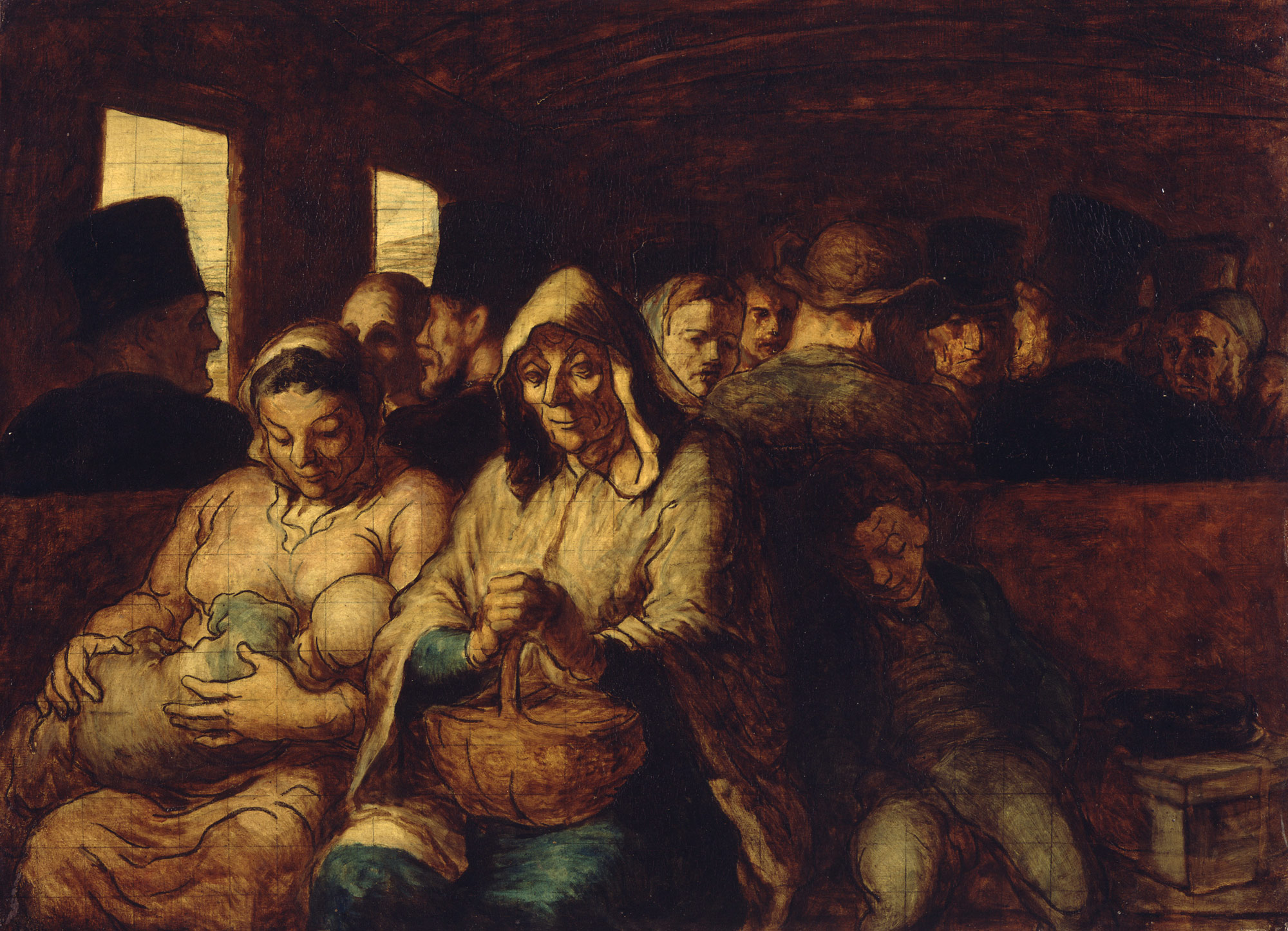
According to Benjamin, (and his source, Edward Fuchs), "Innocuousness was of the essence" for physiologies, because they were a response to the September Laws, which tightened censorship and drove true parodists out of business. "These laws summarily forced out of politics an array of capable artists with a background in satire." Daumier is specifically referenced in this regard for having moved away from pointed political parody into the safer physiological realm of “scenes from everyday life” (238n96). The images of everyday people in the panoramic literature is simplistic and “socially dubious,” designed to put the bourgeoisie mind at rest.
The built environment is crucial to the existence of the flaneurs. They are pre-Haussmann, so the arcades were necessary as a place they could do their strolling and observing. [This is complicated by Brand's demonstration that there were earlier forms of flaneuristic literature, though his are set in London.] The flaneur is the chronicler of the arcade, and the arcade gives him relief from the boredom of the "sated reactionary regime" of the Second Empire. The arcades are between a street and an interior, and the flaneur thus makes the street his home [in a sense which is the opposite of that of the "homeless" – the street is domesticated and made safe for the middle or upper middle class consumer]. However, the flaneur is contrasted to the "bourgeois" because the latter prefers an oil painting in his living room, while the flaneur prefers "a shiny enameled shop sign."
That life in all its variety and inexhaustible wealth of permutations can thrive only among the gray cobblestones and against the gray background of despotism was the political secret of the literature to which the physiologies belonged. (69)
[This “variety and inexhaustible wealth of permutations” is another reason why Bakhtin would have seen this as parodic or carnivalesque, or potentially so; perhaps the flaneur's confident authority monologizes the text; but for Bakhtin there would still be that push-pull of heteroglossia vs. orchestration; and the social context that inspired or demanded the reaction of the writer, not just the writer as some independent expression of the bourgeois [though as noted in the introduction, Benjamin is also open to the importance of urban influence in scarring or affecting the writer]. I am reminded of Brand’s confession at the end of his book that, despite all his criticism of flaneuristic literature, he still loves it and wishes there had been more (in the US); it feels likely this is also true for Benjamin.
He quotes Simmel on the visuality of the big city; also on the new transportation systems which were putting people together without talking to each other [an novel discomfort depicted by Daumier; Schivelbusch will explore this further.] Benjamin uses "orchestration" in a meaning parallel to Bakhtin's, to describe how Bulwer-Lytton pulls together his description of diverse urban characters with the literary device, that “everyone has a secret.”
The physiologies were just the thing to brush such disquieting notions aside as insignificant. (69)
["Such disquieting notions" above refers to the theme of Bulwer-Lytton's book, which the footnote (by the editors) describes as "moralizing"; but what could be more bourgeois than such "moralizing" tales by Bulwer-Lytton, of all people? It seems simplistic to see the physiologies as shielding the bourgeoisie from [heteroglossic] complexities that they at other times marshal and "orchestrate" into morality tales (and won't these also be the theme of the detective novel which follows after the flaneur? Benjamin’s answer to this will be that the truly flaneuristic literature, which peaked in the early 1840s, would die out and be replaced by the more dark and fascinated detective novel.
The "phantasmagoria" of the flaneuristic novel does not work well, it is fragile. This leads to the development of more scientific, or at least scientistic (though involving some actual empiricism) discourses, such as phrenology and police identification methods [and the early urban sociologists such as Mayhew]. Benjamin does not state this, but it seems that this shifts the authority from the unique socially-situated insight of the individual flaneur, to a method; and wouldn’t Sherlock Holmes be a boundary figure, whose grasp of the method is magnified by his unique individual brilliance and insight? Anyway, we are heading to a literature like Poe’s “Man of the Crowd” in which the observer makes immediately astute observations just from a glance [though Brand, and apparently Benjamin, seem to absolve Poe of this charge because that story is ... parodic!]. This literature, according to Benjamin,
"... assured people that everyone could--unencumbered by any factual knowledge--make out the profession, character, background, and lifestyle of passers-by."
[This has interesting echoes today with the AI face-reading/emotional state reading tech promoted by the military. Instead of being concerned about where people fit in to the social order, it is about their interior state and future actions; [a jump from procession to routing]. Benjamin would see this as a continuation of the attempt to “capture (dingfest machen) a man in his speech and actions” (79).
This all makes the city seem safer and not as dangerous (contrasted with quotes from Baudelaire equating the city to a dangerous jungle). Increased knowledge is needed to deal with the city: but people are proclaiming their interests moreso than their character. Thus the "knowledge" or insight of the flaneur is really the projection or performance of people advertising their interests/products on the marketplace that the city has become. Benjamin raises this to assert that Baudelaire is different than the flaneurs he celebrates, because he believes in original sin, and so gives no credence to this marketplace "idol" of the flaneur. "His belief in original sin made him immune to belief in a knowledge of human nature." As the “soothing little remedies” of the physiologists become implausible and outdated, the new literature which replaces them becomes more about the masses than about types, about the "function" of the city [as a depersonalizing and anonymizing setting. An interesting shift from character to setting parallels the later shift, according to Deleuze, from discipline to control...
Benjamin describes the shift from flaneur to detective; Baudelaire was also incapable of writing detective novels (this is a good thing from Benjamin’s perspective). Poe’s stories “Marie Roget” and “The Man of the Crowd” are discussed; others by ETA Hoffman and Stefan George, and particularly the writings of Hugo on the crowd are contrasted with Baudelaire. In parallel with this literature is the growing police sciences (anthropometry, etc.) and control over the city, for instance though the numbering of houses. This is resisted in working class districts where people refer to homes by their names instead of their numbers, [which is possible because those neighborhoods are still communities with traditions such as named houses. This change also reflects the state becoming less and less in touch with such communities, governing more abstractly and bureaucratically rather than through patronage relationships.]
He links this growth in attempted urban control to the introduction of gas lighting; and its changing meaning over time (first thought of as garish, later romanticized after electric lighting, which in turn was seen as garish). The flaneurian practice of walking turtles in arcades is contrasted with Taylorism which soon "carried the day" (though this seems like a bit of an abrupt jump, from the 1840s flaneurs to the early 20th Century). He finds significance in Poe's man of the crowd going into a bazaar: this prefigures the end of the flaneur, as a consumer in a department store.
The flaneur is himself a commodity, enjoying the narcotic of the crowd: the commodity is the speaker (argues Benjamin) when Baudelaire claims that the poet can "enter another person whenever he wishes" (86). There is a recurring theme of narcotics and intoxication; commodities are being intoxicated by the surging of the crowd – or there is some kind of give and take, a reciprocal intoxication or flow of affect and "phantasmagoria.” Just like the human artist, writer, flaneur, etc. has become a commodity (and thus takes on some characteristics of a produced material object), so the object is intoxicated as well. A reference to "holy prostitution" seems linked to the openness of the Baudelarian poet to the city around him, and likewise of the commodity to the consumer, and vice versa]
A lengthy quote from Engels illustrates his negative vision of urban crowds in London: he remarks on the "brutal indifference", the "unfeeling isolation" in which everyone in the urban crowd is wrapped up in their own private interests and pass each other unseeingly. The flaneur also experiences this disconnected particle-crowd, but enjoys the experience because of his illusory mastery through shallow caricatures (aka physiology). According to Benjamin, Baudelaire's "pleasure" from being in crowds is an identification with commodities, and thus part of a [false consciousness] that goes away if one gains class consciousness as a proletarian: with commodities.
Unlike such “proletarianized” consciousnesses, Baudelaire is part of the "petty bourgeoisie" who, at that time, are not yet forced by history to have this awareness of how their mode of existence is imposed on them by the mode of production; later, after they have declined further, they will. At this time they are allowed to find or expect enjoyment but not power (89). They are "passing time;” this involves empathy with commodities, even damaged and decaying ones (perhaps especially).
Baudelaire was "intoxicated" with the city and "let the spectacle of the crowd act on him"; he thus saw both the good and the bad (aka spleen and ideal). This is contrasted with negative images such as Shelley’s "Hell is a city much like London.” Benjamin strangely expresses this more positive or ambiguous view, not only as the product of intoxication, but as a “veil”:
For the flaneur, there is a veil over this picture. This veil is formed by the masses; it billows. "in the twisting folds of the old metropolises." Because of it, horrors have an enchanting effect upon him. Only when this veil tears and reveals to the flaneur "one of the populous squares . which are empty during street fighting" does he, too, get an undistorted view of the big city. (80)
[In other words, the "masses" are a fascinating veil over the city; when there are no people and the bare built environment is revealed, there is an "undistorted view.” This sounds like a strange and unusual use of the contrast between the peopled and the unpeopled images of the city (more commonly, in writers like Lofland, or Raban, the unpeopled representation of a city expresses anti-urban sentiment and an erasing of the feared crowd; the common car commercials in which an expensive car zooms around in an eerily emptied urban space come to mind as examples). However, Benjamin’s way of putting this might have something specifically to do with the consciousness of the flaneur, as a commodified person who identifies/empathizes with the commodity, and takes enjoyment from the phantasmagoria/spectacle, and so basically sees (and enjoys) himself-as-commodity in other people. A working class person with a "proletarian" consciousness would no doubt see the masses, and the empty city, differently. I bet Benjamin might also say this has something to do with the Romantic/Victorian fascination with ruins as well, as revealing a "truth" about cities.]
A street, a conflagration, or a traffic accident assembles people who are not defined along class lines. They present themselves as concrete gatherings, but socially they remain abstract--namely, in their private concerns. (80)
[Again the crowd is seen as an assemblage of people who remain separated from each other. According to Benjamin, it is "monstrous" that these private persons are assembled by the "accident" of their private interests as consumers. [Presumably they should instead have some non-private, non-consumerist shared interest]. Totalitarian states seize on this and "rationalize the accident of the market economy which brings them together" to pose this crowd as a "race" united by fate (93). Benjamin talks about the link Hugo made between the crowd and the spirit world; in Benjamin’s words, "For the crowd is the spirit world's mode of existence." [This is reminiscent of Brand's discussion of Whitman talking to the ghosts of the future].
Hugo saw the masses as an audience (of readers or of voters (because he was also a politician); he was no flaneur (95). Benjamin ends this section by comparing and contrasting Baudelaire and Hugo:
[Baudelaire] like Hugo, failed to see through the social semblance (Schein) which is precipitated in the crowd. He therefore placed it in opposition to a model which was as uncritical as Hugo's conception of the crowd. This model was the hero. While Victor Hugo was celebrating the crowd as the hero of a modern epic, Baudelaire was seeking a refuge for the hero among the masses of the big city. Hugo placed himself in the crowd as a citoyen; Baudelaire divorced himself from the crowd as a hero. (96)
[The Baudelarian hero (who came across as a modern alternative to, and improvement on, the flaneur, in the introduction) here becomes more problematic: as someone opposed to or defined against the crowd?]