Showing posts with label Paris. Show all posts

Tuesday, January 23, 2024

Profane Illumination, Chapter 4


Summary of Chapter 4: The Ghosts of Paris

In this long chapter, Cohen works to distance Breton’s writing in Nadja from several other representational modes. First off is the monumental history critiqued by Nietzsche:

Breton's Nadja offers no such monumental vision of Parisian histor­ical grandeur. Rather than encompassing the city in a panoramic glance, Breton wanders in among its streets, catching enigmatic glimpses of scenes from daily life or dwelling on places singularly tangential to the great structures of collective memory. (79)

She takes as an example the Vendôme column; when Breton visits this location in Nadja, he is immediately reminded of how it had been torn down during the Paris Commune. In terms of monumental history, the restoration of the column means that the revolutionary moment has been erased and the column now appears as “one more image of the bourgeois state’s eternal reign” (79). For this reason, the non-monumental historiographic project “cannot rely on realist methods of representation” (80) (since these would show the literal, physical presence of the column, and not be able to show its former non-presence). [Though it seems to me this is not wholly true. Breton mentions the former overthrow of the column by Courbet and the communards; the memory of this event is still part of the column, so even as it stands it also lies in ruin, inevitably, to any observer who knows the history. THOUGH C is arguing not about the column as an object having various “real” or “unreal” qualities, etc., but about ways of seeing the column; realism privileges the visual, and it is thus according to realism that the column has only the present, visual meaning, not the past, haunting meaning.] [It’s a bit ironic for Courbet to be used in an argument against realism.]

“In Nadja Breton explores the pos­sibility of writing surrealist historiography by applying a Freudian paradigm of memory to collective events.” [She is making the move I inferred above, though does the connection to Freudianism lessen the ambiguity and productive ambivalence? of the column being both standing and fallen.] She quotes Benjamin’s description, from his Surrealism essay in Reflections, of Breton’s method in Nadja (though he says it is more of a “trick” than a “method” of substituting “a political for a historical view of the past” [by “historical view” is presumably meant something along the lines of monumental history.]

Cohen then explores Parisian panoramic literature of the 1920s, and of some earlier decades, to reconstruct the discourse and [structure of feeling] of the era in which Breton was writing, in order to get a better sense of how a reader of his time would have recognized the various “ghosts” haunting the Paris through which Nadja and Andre travel. She started off doing an exhaustive survey of panoramic literature on Paris from the 20s, but realized this was not necessary as it was all very redundant:

Repeatedly, the same historical associations were identified with Breton's charged Parisian sites, confirming the hypothesis that there did indeed exist a contemporary res­ervoir of Parisian phantoms that Breton could invoke.

The uncanny effects of Parisian places, Breton suggests, derive from ef­faced historical memories that continue to cluster around the place of their occurrence in invisible but perceptible form. (83)

Comparing Breton’s text with that of the panoramic literature on the various sites he mentions, C finds that Breton consistently pursues the connections between Parisian bohemia and the history of insurrection at any particular locations; this is “a crucial component to Nadja's attack on orthodox Marxist notions of praxis” (94). Nadja is continuously associated with the side of the revolution that lost out, from the royalists to the Girondins (and Lepeletier, more of a radical, but an early martyr). Acc C, Breton is outlining an opposition to violent revolution, through contrasts or whatever with all these ghosts of failed past revolutions. Reference is made to the Sacco-Vanzetti riots on 1927, which were also failures, because the French Communist party hoped they would spark a more general revolutionary movement.

For in these experiences Breton finds confirmation for a haunting notion of subjectivity which calls into question the possibility of establishing an enlightened and conscious subject outside of ideology in several ways. Posing the problem of whether there exists a self-present subject at all, Breton also suggests the conscious subject as the locus where the reigning ideology reproduces itself. Ghosts endowed with powers of resistance only surge up in moments when the subject's conscious experience is disrupted by forces coming from a mysterious unconscious realm. In addition, the collective uncanny suggests that history is composed of temporal strata layered as in the situations of individual psychic repression at issue in psycho­analysis. (106)

In contrast to mainstream Marxism, Breton focuses on Bohemians and lumpen as the revolutionary class; “ragpicker as revolutionary” (106ff). Cohen recounts Breton’s annoyance at the shiny happy people on the sidewalk shaking hands, etc. which I had found so amusing; C, in contrast, appears to read this as Breton’s distrust of the working class as having revolutionary potential.

Rather, against the Marxist interest in mobilizing the proletariat, Breton stresses the need for individual, tactical disruptions of reigning social orders in what he calls “unchaining.” In doing so Breton disqualifies the class from which orthodox Marxism expects revolution, for he suggests as precondition to praxis the subject’s being freed from the material conditions of industrial production. Socially transformative activity becomes instead the province of subjects who no longer define themselves according to their work: (107)

The key concept Cohen pulls out of Breton’s book is désenchaînement, “perpetual unchaining.” The need for this is his response to Nadja’s insistence that the working class are “good people;” he takes this to mean martyrs for the cause (for work, for the nation in wars, for the CP in revolutionary struggles). It involves an openness to “the marvelous,” “an interest that surrealism itself took over from the Gothic tradition” (107).

Chaîne also means assembly line:

Enchainement is a word resonating not only on the material level but also on the conceptual level, as the enchainement of ideas; the disruption of dominant conceptual structures is an oft-stated goal of surrealist revolution. (108)

If Breton appropriates the Marxist liberatory language of “unchaining,” then, it is to displace Marxism's vision of the working class rising up and casting off its chains.

The inclusion of various lumpen/bohemian characters in the novel is contrasted with Marx’s distrust of this class.

But precisely its marginal relation to capitalist processes of production endears bohemia to Breton. In its Lumpen constitution and practices, bohemia embodies the unchaining of social hierarchies that surrealism seeks. (109)

She discusses Breton’s [détournement] of the word “perverse” into something positive (from Latin pervertere, to overturn, C notes]. This “more closely approaches his flea-market vision of social change than does the word revolution” (110). Breton is also interested in bohemia’s links to the libidinal unchaining of the erotic, which is also traditionally distrusted by mainstream marxism:

In Breton's subsequent theoretical writings he will try to reconcile Marxism with his interest in unchaining libidinal forces, speculating that the seemingly differentiated fields of libidinal and economic production may in fact turn out to be one. (110n58)

C turns to criticisms that mainstream surrealism accorded women a secondary status, stating that there are two ways to put surrealism’s treatment of women in perspective; first, by looking back, Cohen notes that the subordination of women in surrealism, even as they were made into “emblems of its power” goes back to the Jacobin revolutionary tradition (110-1). Second, looking forward, she finds that surrealism had some positive influence on feminist theory, through the concept of “subversion.” C provides some interesting comments on the status of “subversion” for “politicized postmodernism” at the time of her writing in the early 1990s:

After over a decade, subversion is losing its prestige; touting it as a political practice all too often seems like prescribing snakeoil for gaping social wounds. The pressing critical questions, we have started to feel, are elsewhere (nothing is so profoundly anti-erotic as the recently out­moded, Benjamin remarks), for example in exploring the complex relation of the aesthetic to other forms of social production rather than in denying its specificity or simplistically exalting its effect. I suspect moreover that the death-knell of subversion has, at least for the moment, been sounded with the fracturing of the Reagan-Bush right. Alleviating in some measure the academic left’s sense of social and political marginalization, this fracturing removes a key factor in the appeal of subversion to the politically engaged wing of American critical postmodernism throughout the 1980s. (111)

In a discussion of de Certeau’s influences, the distinction between Bataille and Breton is neatly summarized:

But in the case of tactics de Certeau’s view more resembles Bretonian unchaining than the equivalent therapeutic unleashing of the forces of the unconscious onto existing social order prescribed by Bataille. (111)

Bataille celebrates absolute negation and general collapse through expenditure; Breton and de Certeau are more interested in “small-scale moments of intervention” (e.g., de Certeau’s interest in “tactics”). The trouvaille, or lucky find, is dear to both surrealism and de Certeau. She also finds a link to D&G:

I think, for example, of Deleuze and Guattari’s “molecular multiplicities of desiring-production,” which owe much to Nadja’s haunting subjectivity; the trajectory here runs from unchaining to deterritorialization. (112)

Though she notes that “High surrealism is cer­tainly a conspicuous absence in Anti-Oedipus” which prominently cites the Beats and the renegade surrealists of Bataille’s faction.

She raises the issue of aestheticization, or the rendering of workers, bohemians, etc. into aesthetic tools via representation, in a way degrading them and stealing their agency: Breton is opposing aestheticization by traditional Marxism, but he himself risks doing it himself, and navigating this takes up most of the rest of Cohen’s discussion.

Discussing the degraded life of the urban proletariat, Breton points out that to make the worker into an agent of social change is to aestheticize the social realities of the worker’s life. One can certainly argue, however, that Breton’s interest in bohemian practices lends glamour to the dirty business of sifting through society’s trash. … It could equally be objected that Breton glamorizes prostitution and madness. (113)

However, according to C, Breton does not in fact aestheticize these positions because “Breton simultaneously narrates his encounters with Nadja in a fashion undoing the bohemian suggestions for revolutionary practice that he proposes” (114).

[Fanny Beznos, a character from the book who plays a key in this part of Cohen’s discussion, and who Breton recounts seeing at a flea market selling books, later died in Auschwitz].

Cohen’s summary of the plot; Nadja is a stock character from 19th century social novels, the newcomer woman to the city who falls into prostitution:

In this desperate state, she meets a bored, young, married aesthete. Fascinated by her fragile mental health, the aesthete seduces her, driving her to madness; repelled by the sordid details of her life, he eventually abandons her. Later learning that, utterly destitute and alone, she has been institutionalized, he does nothing to help her but only abstractly bemoans her fate. (114)

This somewhat callous ending has disappointed many critics and indeed, readers in general (Breton comes across as so bourgeois in the end); Cohen, however, sees it as part of what makes Breton’s novel actually revolutionary; he is contrasted in particular to the writers of social novels, such as Eugene Sue, and Zola, and she describes how each would have written the story differently, to elicit particular feelings, so as to prompt readers to support social reforms. Breton denies us these nice cathartic feelings, and further complicates his books relation to the social novel by also bringing in elements of the post-Romantic prose poem a la Nerval or Rimbaud, precursors to surrealism.

In valorizing the prostitute, for example, Baudelaire’s prose poem redeems as aesthetically fertile her availability to chance and to the unknown as well as her refusal to engage in the forms of behavior which bourgeois morality defines as work.

Unlike Sue or Zola, Breton’s account of Nadja does not place the reality of prostitution, insanity, etc., under the obligation of communicating “a certain ideological necessity” linked to bourgeois moralizing, like that which Marx criticized in Sue (116). Instead of “replacing the social Nadja with the aestheticized Nadja” Breton problematizes all this with his constant questioning as to “who is the real Nadja?” This also does not romanticize bohemian unchaining, because it can lead to madness, etc. Instead, Breton’s setting up the possibility of unchaining, then showing also its pitfalls, creates for the reader an aporia or aporias, (in the Derridean sense of the word):

Breton’s generic disruption does not offer transcendence or liberation but rather throws the reader into impasse, aporia, and specifically the aporia of oppressive material conditions which destroy the efforts at ideological unchaining necessary to change them.

Nadja’s fate raises the possibility that surrealist désenchaînement may not only fail to undermine the superior force of the ruling order; it may exist only as an effect of the order it thinks to challenge. (117)

[The above implication that romantic désenchaînement might be part of the [spectacle] is not pursued any further in this chapter].

She notes criticisms that B’s attitude toward the insane prisoners of the asylum is patronizing and condescending, tinged with bourgeois moralism.

Many readers have expressed disappointment that Breton does not present his and Nadja’s adventures as heady and intoxicating transcendence. Condemning Breton for his final betrayal of Nadja, they link it to his betrayal of the marvelous series of steps the text sets out to take. It seems to me, however, that such betrayal does not mark the failure of the text’s disruptive power but instead its accomplishment. The disruptive force of the betrayal can indeed best be gauged by readers’ persistently negative reactions to it, which bear witness to their own unexamined needs for texts presenting optimistic schemas of social change. (118)

Interestingly, Cohen’s defense of Breton here could be said to be similar to his approach in the book: she defends him but also allows cracks and doubts in the edifice, so that Breton can be seen as both brilliant revolutionary and failed, un-self-critical bourgeois consumer of the spectacle, at the same time.


Tuesday, December 12, 2023

Profane Illumination, Chapter 3


Summary of Chapter 3: “Qui suis-je?” Nadja’s Haunting Subject

In this chapter, Cohen traces Andre Breton’s relation to Freudianism through his novel Nadja. Breton saw connections between Freudianism and Marxism:

he pursues not only how the Marxist and Freudian forces of deter­mination in the last instance are susceptible to apprehension by each other’s methodologies but also the possibility that they communicate closely (thus the notion of communicating vessels) and may in fact ultimately be indistinguishable. (60)

She traces in particular the concept of the “haunting” self in Nadja.

Breton posits this identity as a sequence of temporally differentiated moments. The I becomes a series of ghosts of its contiguous experience rather than a centered self. (64)

Breton references Rousseau, and C contrasts his writing with Rousseau’s project of portraying himself “as the portrait of an already formed, extratextual subject” in his confessions:

Breton's subjectivity is not any­where fully present but rather must be constructed through narrative; his textual act of representation resembles the process of self-construc­tion characteristic of the Freudian talking cure. (66)

Like an analysand’s discourse, Breton’s narration acquires significance not from the accuracy of any event represented but rather “dans son ensemble,” from the relation among the memories narrated, as the narration be­comes itself the event that generates meaning....

Breton’s text lacks a metalanguage that will comment with authority on the events he recounts. Asserting that his self is constituted by a series of haunting I’s, he refuses to grant to any one I a privileged status as the real Breton.

Breton suggests the subject as the ghost of some sort of unconscious realm, simultaneously implying that this unconscious is individual and that it is related to objective factors. Breton emphasizes the objective character of this realm increasingly as his reflections on its content proceed.

By “objective character,” she means the I as an object:

Alienating the I as the objective myself and then dissociating this objectified self from himself, turning it to “he who from farthest away comes to meet me,” Breton raises the uncer­tainty of his being able to reconstitute such alien material as a unified self at all. With the introduction of an objective dimension into the sub­ject, the possibility exists that the boundary between subject and object will crumble in the direction of contingency rather than recuperation, and this problem echoes in the final question, “Is it myself [moi­-meme]?” (67)

She discusses Sartre’s attack on Surrealist views of the subject, for instance his criticism of automatic writing (which Breton championed) as a sort of eating away at, or erosion of, the subject:

Au­tomatic writing is above all else the destruction of subjectivity. When we attempt it, spasmodic clots rip through us, their origin unknown to us; we are not conscious of them until they have taken their place in the world of objects and we have to look on them with the eyes of a stranger. (Sartre, quoted on p. 68)

Sartre is thus alarmed at the alterity or uncanniness of the self to its self, which the surrealists celebrate. It is interesting to consider why this alarms Sartre (speaking here for the viewpoint of existentialism, and to a degree for traditional Marxism) so much, given that in the traditional Hegelian dialectic, the individual consciousness must in fact go through this phase of becoming an object to itself, in order to become a full “self-consciousness.” The issue, I think, is that the dissolution of subject into object celebrated by the Surrealists such as Breton goes too far, and is not recuperable into the unified and rational self which traditional Marxism desires. Whereas in Marx the worker, for example, sees themself through their product, their own agency mixed with the world, in the case of automatic writing, it is the opposite, some other force intrudes and supplants or replaces our own agency, so our own creations are mysterious and alien to us. [On “action without agency,” see below.]

Sartre reacts with venom to the surrealist representation of the sub­ject because such a subject is ill-suited to carry out the praxis an existen­tialist protocol of engagement demands. (68)

Cohen makes much of Breton’s juxtaposition of a photo of himself with the subtitle referring to his envy for “any man who has the time to prepare something like a book”:

While in a standard documentary photo Breton’s portrait would illustrate the sentence to which it is juxtaposed, Breton constructs this sentence in such a way that he problematizes establishing a one-to-one correspondence between photograph and the textual passage whose ex­traliterary existence it documents. There are, after all, two parts of the sentence to which the photograph could refer. The subject of the photo­graph could be identical with the subject of the sentence, “I.” It could also, however, refer to the object of the sentence from which Breton’s subject here differentiates himself, “every man who has the time to prepare something like a book.” (69)

The photo of himself appears in a sense to refer to some other guy who can more confidently write and finish a book. B had presaged this with an earlier reference to a character from

a film I saw in the neighborhood, in which a Chinese who had found some way to multiply himself invaded New York [actually San Francisco] by means of several million self-reproductions. He entered President Wilson’s office followed by himself, and by himself, and by himself, and by himself; the President removed his pince-nez. (Breton 1960, 34-7)

Breton states that this film “has affected me far more than any other.” Howard translates the French title L'Étreinte de la Pieuvre as The Grip of the Octopus, but the original English title is in fact The Trail of the Octopus (though how often does an octopus leave a trail?). The self-duplication cited by Breton is achieved through a cinematic trick, which Cohen explores through a quote from Barthes on photography, but is interestingly far from the only example of self-duplication in that rambling, semi-coherent, massively trashy and entertaining silent film serial (the plot makes as much sense as automatic writing). First off, the number of villains (various stock ethnic stereotypes, for the most part) in the film start to multiply, ally, bicker, and fight amongst themselves; there is a Monsieur X (evil French guy) who obscures his face with a mask, but soon there are at least three characters wearing the same mask, posing as Monsieur X. Towards the end Wang Foo (the evil Chinese guy, who can multiply himself) rips the mask off the true Monsieur X, only to find he is one of his own (Wang Foo’s) copies!

The full potential of this serial’s accidental surrealism has yet to be taken up by scholars, though some exceptions are Mayer 2017 and Ungureanu 2020. Apropos of Breton’s agenda in Nadja, Mayer uses The Trail of the Octopus to demonstrate that “the detective serial maps a world of action without agency,” observing that “nobody is in control any longer, the police, the detective, the villains and the victims each pursuing their own, often discordant, agendas.” The movie also happens to feature disembodied eyes, such as appear several times in the images accompanying Nadja, and Monsieur X’s mask is similar to that which appears in one of “Nadja’s” (Leona Delacourt’s) artworks.

To return to Cohen’s argument:

This mention of how cinematic reduplication captures a differentiated subject points to a more general similarity between Breton’s ghostly definition of subjective manifesta­tion and what numerous theoreticians of photography have charac­terized as the ghostly nature of the photographic sign. (70)

She gives a quote from Barthes, which she suggests is influenced by a close reading of Nadja:

In the realm of the imaginary, the Photograph . . . represents this very subtle moment where, to tell the truth, I am neither a subject nor object, but rather a subject who feels itself become object: I then live a micro-experience of death (of parenthesis): I become truly a ghost. (71)

Rosalind Krauss had discussed surrealism and photography as index; Cohen notes this but decides to use the related but more Freudian term, trace.

We might term the ghostly mode of presence that Breton’s haunting subject shares with the photographic image trace-like, borrowing from Nadja’s own description of how she will haunt Breton.

Nadja in fact describes herself as a “trace,” in one of her cryptic statements to Breton. C links this to uses of the term “trace” in Freud:

For Freud the term designates a sign that represents the subjective activ­ity that produced it in distorted rather than mimetic fashion. (72)

[We can see how “distorted rather than mimetic” will link back to the previous chapter’s discussion of Benjamin and superstructure.] For Freud, the trace in the dream is altered through displacements to avoid censorship by the conscious ego or whatever.

Extending the term from dream to waking experience, Breton uses trace to designate the indexical fashion in which the ghostly subject haunts the tracks of his own experience.

The subject of Nadja is “the obscure realm of which the subject is a ghostly manifestation.” C notes Freud’s theory of the uncanny, according to which this is all the return of the repressed.

She comes now to a very interesting quote in which Breton distinguishes his own method in the novel from that of psychoanalysis. In Cohen’s version:

I would like finally . . . if I say, for example, that in Paris the statue of Etienne Dolet, place Maubert, has always simultaneously attracted me and caused me unbearable discomfort, that it will not immediately be deduced that I am merely ready for psychoanalysis, a method I respect and which I consider to aim for nothing less than the expulsion of man from himself, and from which I expect other exploits than those of a bailiff. (Breton, quoted in Cohen, p. 73)

Her reading here actually caught me by surprise, as being the opposite of what I had thought on reading the novel; I had interpreted Breton as criticizing psychoanalysis by saying that it “expels a man from himself,” but according to Cohen, he is in fact saying that it should do this but does not, instead locking him in like a bailiff. The issue here is that Cohen has departed from Howard’s translation, something she usually indicates but here does not. Here is Howard’s translation of this passage:

… it will not immediately be supposed that I am merely ready for psychoanalysis, a method I respect and whose present aims I consider nothing less than the expulsion of man from himself, and of which I expect other exploits than those of a bouncer. (Breton, 1960, 24)

The actual word in French is huisser, which can have either meaning, but from the French original we can see that Cohen’s interpretation is correct:

… on n'en déduisît pas immédiatement que je suis, en tout et pour tout, justiciable de la psychanalyse, méthode que j'estime et dont je pense qu'elle ne vise à rien moins qu'à expulser l'homme de lui-même, et dont j'attends d'autres exploits que des exploits d'huissier. (Breton, 1998, 24)

A pun is being made on the word “exploit;” “exploit d’huisser” means a kind of writ which is served by a bailiff or process server. So the “bailiff”/psychoanalyst is neither confining nor expelling the subject, but serving them a writ to appear in court, which could be understood as another metaphor like Althusser’s “interpellation.” [After all, psychoanalysts are priests, as D&G would say.] A vignette of Breton and Freud’s mutually dissatisfactory encounters at the beginning of the chapter had illustrated Breton’s impatience at Freud’s deeply bourgeois agenda; in contrast

Instead of using psychoanalysis in the service of the ruling bourgeois order, Breton is interested in pressing it into the service of revolution, although the distance between his conception of this notion and the event as under­stood by orthodox Marxism remains to be defined. (73)

[Breton has reasonably good leftist cred, but this did make me laugh, remembering a passage in which the narrator/Breton, who repeatedly insists in the novel that he is “not a public person” and wants to disappear, etc., looks at the people of Paris around him, shaking hands and talking on the morning sidewalk, and observes morosely, “No, it was not yet these who would be ready to create the Revolution.” (Breton 1960, 64). Alas! If only it was circa 1991 and I was young, black-clad, and smoking arirangs because they’re too cool for anyone, I could see myself shouldering through a crowd, muttering, “Allons, ce n’étaient pas encore ceux-là qu’on trouverait prêts à faire la Révolution...”]

The novel Nadja is full of contradictions, as numerous scholars have noted and made hay of. To begin with, it is named after the female lead character, but the male narrator begins it by asking, “Who am I?” and this is indeed the primary theme of the book. Breton announces at the beginning his inspiration by Huysmans’ plotless stories, and the novel shares certain features with automatic writing. Much of it revolves around serendipity and coincidence, and the characters wander the streets of Paris in a way that at once evokes the dérives of the Situationalists several decades later, and yet is distinct in that while the Situationalists felt they were exposing and challenging the workings of capitalism and the Spectacle, for their Surrealist forebears it appears to be more about exposing the truly haunting and ephemeral character of the self, or the unconcious. In the light of (for instance) D&G’s discussion of interpellation, Breton’s exploration of the ephemerality of the self, refusing to return it to a unity, and his exposure of its changing nature in relation to Nadja [who serves as his “point of subjectification” in D&G’s terms], seems less like a challenge to subjectification than a cogent understanding, and illustration, of how it works.

I’ll throw in my favorite quote from the book for no special reason; a great summation of life and love in the [second world]:

How does it happen that thrown together, once and for all, so far from the earth, in those brief intervals which our marvelous stupor grants us, we have been able to exchange a few incredibly concordant views above the smoking debris of old ideas and sempiternal life? (Breton 1960, 111)


Breton, Andre (1960) Nadja. Translated by Richard Howard. Grove Press, New York.

Breton, Andre (1998) Nadja. Editions Gallimard, Paris.

Mayer, Ruth (2017) “In the Nick of Time? Detective Film Serials, Temporality, and Contingency Management, 1919-1926" The Velvet Light Trap 79:21-35.

Ungureanu, Delia, (2020) “What Dreams May Come: Marguerite Yourcenar, Van Gogh, Akira Kurosawa.” Renyxa 10:227-44.


Saturday, September 16, 2023

Profane Illumination, Chapter 1


Margaret Cohen, (1993) Profane illumination: Walter Benjamin and the Paris of surrealist revolution. University of California Press, Berkeley.

Summary of Chapter 1: Gothic Marxism

Cohen introduces the concept of Gothic Marxism, by which she refers to “a Marxist genealogy fascinated with the irrational aspects of social pro­cesses, a genealogy that both investigates how the irrational pervades existing society and dreams of using it to effect social change” (1-2). Her two primary interlocutors for the study will be Walter Benjamin and Andre Breton, both of whom struggled with the economic determinism of the “vulgar Marxism” of their day; Breton developed a “modern materialism” which, Cohen argues, influenced Benjamin in his great unfinished Arcades Project, and in his work of bringing Freud into a Marxist vision.

Cohen appears fond of long numbered lists, for instance she summarizes Breton’s influence on Benjamin thus:

We will see Benjamin particularly provoked by (1) the modern materialist appeal to the fissured subject of psychoanalysis to modify the conscious and rational subject dear to practical Marxism; (2) its application of psychoanalytic notions of history to collective history in order to displace a linear or mechani­cally causal vision of historical process and to break down the base­ superstructure distinction with appeal to libidinal forces permeating both; (3) its use of psychoanalytic formulations of determination and representation to complicate a reflective model for the relation between superstructure and base; (4) its psychoanalytically informed interest in the everyday, which it uses to revise orthodox Marxist notions of the stuff of history as well as to open possible reservoirs for recuperative experience in damaged life; and (5) its application of psychoanalytic notions of therapy to an Enlightenment view of critique, notably as this application pertains to the dialectical image (p. 6).

She notes past scholarship on the connections between Benjamin’s Arcades Project and surrealism; this has normally been interpreted as Benjamin importing surrealist influence into Marxist analysis:

In the standard Marxist readings of this relation, informed by the Marxism either of the Frankfurt School or of Brecht, Benjamin's use of psychoanalytic language, notably dream language, has been considered the place where he substitutes the smoke and mir­rors of writerly technique for critical analysis. (8)

Breton, in turn, has been dismissed by mainstream Marxists as "lacking in seriousness.” C situates this in relation to the contest between “high surrealism” (Breton) and “renegade surrealists” (Bataille), with the latter being the ones favored by later theorists. She discusses the relation with, and the debt owed to, the surrealists such as Breton, by the later “theoretical avant-garde” of Lacan, et al., who dismissed Breton and the high surrealists. A lot of the rejection by the subsequent generation can be seen as a reaction to the dominance of surrealism for a time: “With the aging of the generation tyrannized by high surrealism, official recognition of the movement is returning” (12n33).  

She situates her project as a form of what Benjamin called “rescuing critique,” that is, a critique that rescues elements of the past through an understanding of their resonance with the presence, but which, by remaining “critique,” does not devolve into nostalgia. She gives another list of the rescued material with which a Gothic Marxism will be interested:

The most suggestive material rescued here includes: (1) the valorization of the realm of a culture’s ghosts and phantasms as a significant and rich field of social production rather than a mirage to be dispelled; (2) the valorization of a culture’s detritus and trivia as well as its strange and marginal practices; (3) a notion of critique moving beyond logical argument and the binary opposition to a phantasmagorical staging more closely resembling psychoanalytic therapy, privileging nonrational forms of “working through” and regulated by overdetermination rather than dialectics; (4) a dehierarchization of the epistemological privilege accorded the visual in the direction of that integration of the senses dreamed of by Marx in The 1844 Manuscripts: “. . . the complete emancipation of all human senses and qualities . . . The senses have therefore become directly in their practice theo­reticians” ; accompanying this dehierarchization, a practice of criticism cutting across traditionally separated media and genres as well as critical attention to how and why these separations came to be; and (5) a concomitant valorization of the sensuousness of the visual: the realm of visual experience is opened to other possibilities than the accomplishment and/or figuration of rational demonstration. (11-12)

To summarize the above:

1) a culture’s “ghosts and phantasms” are not just a mirage, but a “field of social production;”

2) ditto for a culture’s “detritus and trivia,” likewise not to be consigned to the dustbin;

3) moving beyond critique as a form of argument and opposition to something more like                            psychoanalytical therapy [this feels very 90s];

4) replacing the privilege of the visual with an integration of all the senses; and

5) at the same time, valorizing the “sensuousness of the visual” as more than just a stand-in for “rational     demonstration.”

She notes that she will be linking up to the Gothic Marxism of later French avant-garde thinkers, including Deleuze and Guattari, Michel de Certeau, and particularly Louis Althusser, and concludes with a note on Benjamin’s concept of “fascination” (15), which seems related to the Aristotelian concept of wonder; she quotes Ackbar Abbas, stating that Benjamin “sees in fascination not a will-less affect, not the response of last resort, but a willingness to be drawn to phenomena that attract our attention yet do not submit entirely to our understanding.” This sounds very much like the sensibility of the "modern hero" in Benjamin's Baudelaire book.


Sunday, March 13, 2022

The Paris of the Second Empire in Baudelaire, Part 3


Summary of Part III: Modernity


In this section, there is a strong feeling of Benjamin’s mode of composition of the essay from his clippings gathered in the Arcades Project. You can see him gathering his clippings and quotations into groups, first under the higher headings (Bohemian, Flaneur, Modernity), then here, under "Modernity," into further subheadings (writing as work/fencing, the ragpicker, the apache, antiquity as modernity, etc.) which he strings along in turn. Since he rarely gives an overall summary of how these are related to each other, the reader is left to infer this for themself.

The first point has to do with Baudelaire’s writing and representation of the city as a kind of dangerous, even perilous labor. Baudelaire saw writing poetry as work, and Benjamin compares it to the labor of Guys in painting (as described by Baudelaire in the Painter of Modern Life). Though Baudelaire wrote favorably of the flaneur, he himself was not one. The [modern hero or representer of the city] is distinguished from several types of "observer:" first the flaneur, also the "amateur detective" and the badaud, or rubbernecker (98-9); observation is a "priggish habit," per Chesterton. In contrast, Baudelaire and Dickens are absent-minded dreamers who wander the city: "Dickens did not stamp these places on his mind; he stamped his mind on these places."" (99, quoted from GK Chesterton)

Benjamin uses the language of "shocks" and "parries," and fencing,  though not referencing urban environment but events of Baudelaire's life, and his writing in response:

The shocks that his worries caused him and the myriad ideas with which he parried them were reproduced by Baudelaire the poet in the feints of his prosody. Recognizing the labor that he devoted to his poems under the image of fencing means learning to comprehend them as a continual series of tiny improvisations. (99)

 For Baudelaire the street became a place of refuge from creditors, this he made a "virtue of necessity":

But in flanerie, there was from the outset an awareness of the fragility of this existence. It makes a virtue out of necessity, and in this it displays the structure which is in every way characteristic of Baudelaire's conception of the hero. (100)

Baudelaire was "overtaxed," and lacked control over his own means of production, or an apartment, good clothes, etc. Through an emphasis on Baudelaire’s hard work and penury, Benjamin establishes links between Baudelaire as poet and the lumpen, "dangerous classes" etc. – though he will later pull Baudelaire back from this linkage, in a sort of dialectical move. In any event Baudelaire portrayed proletarians in their everyday lives as being as brave as gladiators.

Benjamin discusses the idea of suicide as a noble gesture, practiced by the proletariat as a form of resistance to the brutality of modernity; according to Benjamin, this is different than how suicide was seen in ancient times, in which the suicides were somehow noble or exceptions of some kind. Suicide is a distinctly modern thing; [though this complicates the opposition Benjamin has already made between Baudelaire and Balzac etc. as [realist-era] moderns in an opposition against the preceding "romantics," of whom who could be more a clear example than Goethe's Young Werther?]

Benjamin gives a nuanced discussion of how somber blacks and greys came to dominate men’s clothing during the 19th Century. This is on the one hand part of the beautiful aspects of the specifically modern which Baudelaire wants the painter of modern life to illustrate: yet there is also a mocking aspect to his description of a nation of everyone dressed as undertakers, as if “We are all attendants at some kind of funeral” (106). Benjamin describes the later critique of men's fashion by Friedrich Theodor Vischer and its similarity to Baudelaire’s in emphasizing the ridiculousness of modern somber fashion as also at the same time somehow democratic, or at least moreso than the earlier eras when the wealthy emphasized their difference through the richness of their clothing [procession to circulation here]. [Nevertheless there is a contradiction here which Benjamin does not seem to fully emphasize, not to mention that while he situates the origin in the contest between democratic and monarchist regimes in 19th century France, there is an earlier history coming from the Protestant Reformation. I am thinking of Rembrandt's group portraits of Dutch bourgeois men, all nearly identical in their somber democratic Protestant black, which they nevertheless distinguish by the finery of their textiles, showing that they are in fact wealthy and not commoners. Or in the 19th and 20th Century American cities, in which most men dressed practically identically in suit, tie, and hat, but the wealthy are wearing tailored suits from prestigious makers, and the poor are wearing mass-produced suits off the rack. Or in 21st Century Silicon Valley, etc. culture, which adopts the democratic hoodie and jeans, but then these are super-expensive designer hoodies and jeans, and so on.]

Benjamin turns to how Baudelaire and writers like him celebrated the “apache” (an urban ne'er-do-well)  or the chiffonier or ragpicker as hero; [the key question is, how is this personage presented differently as "hero," than in the panoramic/flaneuristic literature? The difference appears to be that there is a parallel between the ragpicker and the poet who is describing them, in terms of their activity: Baudelaire sees himself in the ragpicker, or vice versa? There is apparently at least a respect for these urban characters as “heroes,” as opposed to the flaneuristic representation of them as images for bourgeois consumption, but frankly Benjamin may assert this but does not go far to demonstrate it.]

The poet and the ragpicker are linked in an “extended metaphor.” Even their gait or way of movement through the city is equated:

This is the gait of the poet who roams the city in search of rhyme-booty; it is also the gait of the ragpicker, who is obliged to come to a halt every few moments to gather up the refuse he encounters. (108-9)

According to the translators, Benjamin here borrows a term from Brecht, "Gestus," to describe this gait or characteristic [in the original German, but translated out as “gait?” It is unclear]. (252n221).

Baudelaire felt some need for modernity to become antiquity, meaning apparently to achieve greatness in art etc., sufficient to be admired by later epochs. This is linked to his valuation of modern life as subject matter for art, and the idea that antiquity should “serve as a model only where construction is concerned; the substance and the inspiration of a work are the concern of modernity." (110) In the Guys essay, Baudelaire defines modernity as "the transitory, fleeting beauty of our present life." [Benjamin’s interest in drawing out and emphasizing Baudelaire’s juxtaposition and mixing of modernity and antiquity is perhaps an example of his practice of the dialectical image, a way of destabilizing the categories of modern and ancient, more particularly the modern?]

Baudelaire's theory of beauty, from the Painter of Modern life, regards the interaction of two elements: one is "constant, immutable," and the other is "relative, limited," derived from the current milieu (i.e., the modern) (110, quoted from Baud). Benjamin adds, hysterically: "One cannot say that this is a profound analysis" (111). Benjamin criticizes Baudelaire's theory of art as not living up to his own work, and being inadequate for the time: the poem "Le Cygne" is presented as an example, with the city as brittle and changing, with the famous line about the city changing faster than a mortal's heart. Benjamin quotes Peguy about Hugo, to show what Baudelaire wanted: Hugo could see in the beggar on the street, the ancient beggar; in the modern fireplace the ancient hearth, etc.

Benjamin discusses the Victorian fascination with visions of Paris, London, etc. as future ruins, and also the city as doomed [Baudrillard's much later concept of “exposure” a la the WTC fits here] and as involving some impeding urge to suicide, which is the "passion moderne" (114). Maxime Du Camp has a vision of Paris as future ruins, and is moved to write a description of the city as the ancient authors had failed to write of their now ruined cities, in the past. Benjamin links this to the concurrent destruction and rebuilding of Paris by Haussmann. [Thus it is the changing nature of the modern city which compels the writers to try and capture it for the future; there is a need for a sense of fragility and vanishing, in order for this momentary capture to be understood as desirable or necessary/urgent]. This is in fact what Benjamin means by an "image":

"Les poetes sont plus inspires par les images que par la presence meme des objets;" said Joubert. The same is true of artists. When one knows that something will soon be removed from one's gaze, that thing becomes an image. Presumably this is what happened to the streets of Paris at that time. (115)

However, Baudelaire himself is not impressed with the future ruins image so much but the idea of [a living?] antiquity springing directly out of modernity, and thus he prefers the detailed engravings of Charles Meryon that gave a sense both of detailed lifelikeness of the modern, and the timelessness of antiquity. Benjamin makes a reference to "allegory" as the form or means of "interpenetration of antiquity and modernity": 

For in Meryon, too, there is an interpenetration of classical antiquity and modernity, and in him, too, the form of this superimposition – allegory – appears unmistakably. (116)

Modernity's constant renewal and consuming of itself means that the modernity of Baudelaire's time is indeed already antique:

To be sure, Paris is still standing and the great tendencies of social development are still the same. But the more constant they have remained, the more everything that stood under the sign of the "truly new" has been rendered obsolete by the experience of them. Modernity has changed most of all, and the antiquity it was supposed to contain really presents a picture of the obsolete. (118-9)

The next pile of clippings Benjamin assembles are on the subject of lesbians as modern heroes (119). He links this to Saint-Simonianism which celebrated the image of the androgyne or hermaphrodite, and discusses Claire Démar's early Saint-Simonian feminism, and her plan to abolish motherhood through a [Spartan] style system (119-20). Benjamin situates this historically, talking about the "masculinization" of the "feminine habitus" through factory work, and in "higher forms of production." Baudelaire had a fascination with this, his stance was ultimately contradictory, as revealed through his poems. Benjamin quotes Lemaitre on Baudelaire’s contradictory attitude toward women and to modernity; yet, according to Benjamin, this contradiction was what Baudelaire was aiming for:

To present this attitude as a great achievement of the will accorded with Baudelaire's spirit. But the other side of the coin is a lack of conviction, insight, and steadiness. In all his endeavors, Baudelaire was subject to abrupt, shock-like changes; his vision of another way of living life to extremes was thus all the more alluring.

[The overall fascination Benjamin has with Baudelaire and his time seems to be with its incompleteness or unachieved possibility. Baudelaire achieves partial insights but then draws back from them or rejects them. This was prefaced earlier in the essay in the context of Baudelaire’s class position and his linkage with the bourgeois “professional conspirators,” who, not truly linked with or representing the truly revolutionary class, were doomed to fail. This link will return at the end of this section when Baudelaire is compared again to Blanqui, whom Benjamin treats as the exemplar of this conspiratorial type, both admirable and pathetic at once.]

The subject of poetic rhythm comes up in a discussion of Baudelaire’s poem, “L'Invitation au voyage:”

This famous stanza has a rocking rhythm; its movement seizes the ships which lie moored in the canals. To be rocked between extremes: this is the privilege of ships, and this is what Baudelaire longed for. (124) 

[In this reference to rhythm Benjamin contradicts Bakhtin's claim, according to which rhythm is a form of stylization which removes the poem from reality, and monologizes it under the voice of the poet. Here, in contrast, rhythm is affective, an impress of the actual view or experience of the rocking boat, into the poem, and into the experience of the reader or listener [i.e., something analogue is carried through]. This in turn perhaps demonstrates Baudelaire's susceptability, his openness to shocks, etc., and even a place for the non-human in the “polyphonic” and “heteroglossic.”]

The image of the boats is significant to Benjamin’s argument, because they embody a contradiction, in that that they are tied up, yet beckoning to sail away; this is like the modern hero:

The hero is as strong, as ingenious, as harmonious, and as well-built as those boats. But the high seas beckon to him in vain, for his life is under the sway of an ill star. Modernity turns out to be his doom. There are no provisions for him in it; it has no use for his type. It moors him fast in the secure harbor forever and abandons him to everlasting idleness. Here, in his last incarnation, the hero appears as a dandy.

[With this description of the hero as dandy, we are of course reminded that we are in the Second Empire, in which there is considered no hope, no room for innovation or advancement, etc. [one of the “No Future” generations, at least in Benjamin’s telling]. This somewhat constrains the overall applicability of the "modern hero" as described here, to other stages or periods of the modern, does it not?]

Benjamin describes the modern hero with a quote from Baudelaire: "a Hercules with no labors to accomplish" (124). Benjamin links dandyism to bourgeois merchants, who desire to avoid or not show the shocks of trade, and changing fortunes [it is a pretense or artifice that covers one up]; Baudelaire himself was not a successful dandy because he was too strange, when it requires a balancing act. [The discussion here of the dandy is very short, and little of the complex class issues are gone into]. The point seems rather to raise and then dismiss the equivalence of the writer-as-modern-hero with the dandy (whom Baudelaire had described as the last of the heroes) because the "modern hero" is in fact not a "hero":

Because he did not have any convictions, he assumed, ever new forms himself. Flaneur, apache, dandy, and ragpicker were so many roles to him. For the modern hero is no hero; he is a portrayer of heroes.  (125)

So now we see the list of (proletarian and bourgeois) heroes, oppositional to modernity (apache, ragpicker, flaneur and dandy) are pulled back away from the modern hero, who either fails to become one or never could have been one of them. The “extended metaphor” ends here.

Turning to the subject of poetic language, Benjamin asserts that Baudelaire, like some other writers in his time, fought against the "segregation" of words into those worthy of lyric or tragic poetry ("elevated speech") and those words which were not, being too urban, modern, intimate, or crude. Baudelaire also pursues this line in his use of words and images for allegories and metaphors, which is part of what makes his writing surprising and effective. Benjamin ends this section by comparing the effect of Baudelaire’s writing to a protest march by Blanqui and his forces in 1870 during the funeral procession of Victor Noir (about a year and a half before the Commune): "Baudelaire's poetry has preserved in words the strength that made such a thing possible." (129)

With this comparison of these two figures that Benjamin had begun the essay by contrasting, the image of the modern hero becomes that of someone produced by, trapped in, and fighting against their own time:

But the differences between [Baudelaire and Blanqui] are superficial compared to their profound similarities: their obstinacy and their impatience, the power of their indignation and their hatred, as well as the impotence which was their common lot. (129)

[It seems there may also be something in this regarding Baudelaire and Blanqui being limited to their own class perspective and position, despite their empathy for the proletariat.]


Monday, July 18, 2016

Daumier's Hack Drivers

"Cabriolet, sir, sir?" "I can barely afford to walk!" (Le Charivari, 1839)

A good portion of the current cultural image of the cabdriver developed in the Nineteenth Century. Hack and cab drivers were commonly featured in the physiologies – illustrated lists of common urban personalities or character types, a sort of “Who Are The People In Your Neighborhood?” meant to reassure readers that the quickly changing city was still legible.

Honoré Daumier (1808-1879) was one of the great lithographers and caricaturists of the time. Daumier had a keen political conscience, and loved to skewer the powerful and wealthy, not hesitating to take on the King himself. At the same time, Daumier did not exempt everyday Parisians from satire; as Baudelaire put it, Daumier “teaches us to laugh at ourselves.”

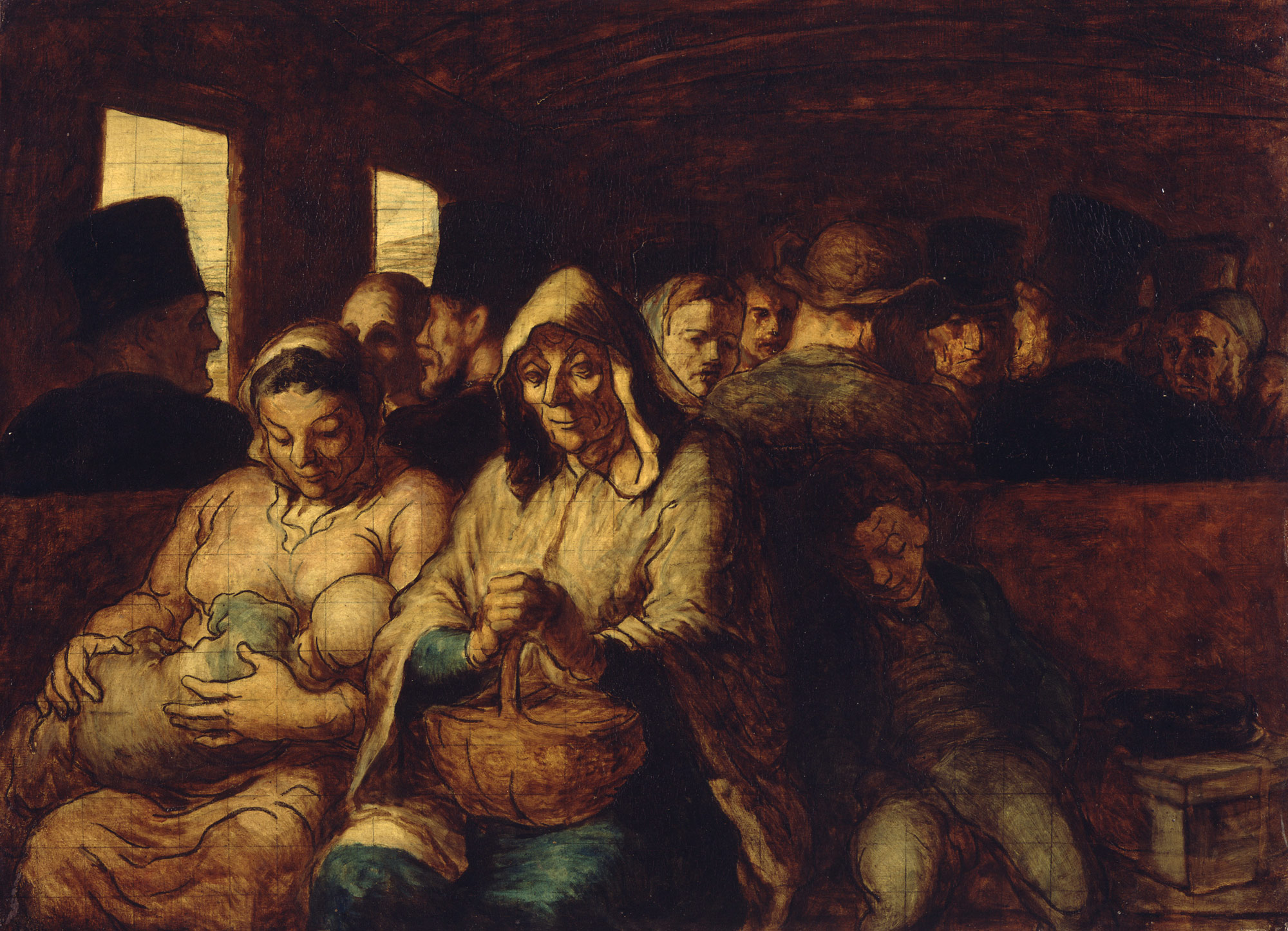
Daumier was very conscious of what today might be called the micropolitics of everyday life. He was also particularly observant of the indignities and hidden injustices of transportation—most famously, in his depictions of third class railway passengers, but also the long-suffering riders of omnibuses and stage coaches, and even those travelling by boat on the Seine. He also repeatedly returned to the subject of Parisian fiacres (hacks) and cabriolets (cabs), and the interactions between their drivers and passengers.

In Daumier’s prints, the hackmen are selfish, wily, and unkempt—precisely as they appeared in the work of his contemporaries. However, as a champion of the poor and oppressed, Daumier was more sympathetic to workers, including hackdrivers, than many of the other physiologues of his time. The bottom line for Daumier, nevertheless, is that no one gets off easy, and most often, both drivers and passengers come across as ridiculous figures.

Driver: Where to, bourgeois? Shall it be by the hour or by the trip?
Passenger: Rue St. Honoré.
Driver: What number?
Passenger: I will show you... Rue St. Honoré.
Driver: What number?
Passenger: I don't know!
Driver: Excuse me then: by the hour!
(1841)
Many of Daumier's cab cartoons focus on a common source of contention between drivers and passengers: the method of fare calculation. Decades before the invention of the taximeter, Parisian cabs charged either a flat rate by the trip, or a variable fare based on time. In the above comic, a savvy driver deals effectively with a drunk, disoriented customer. Seeing that the passenger is uncertain of the correct address, the driver declares it a time-based fare, to ensure that he will be paid for the inevitable time spent searching for the actual destination. Like almost all of Daumier’s hackdrivers, the driver here is holding a whip, wearing an overcoat, and sporting a tall plug hat which has become warped and misshapen through long exposure to the elements.

COACHMAN:  Go on, Gentlemen, argue over my cab as much as you like. But argue by the hour, for I will have my pay! (Le Charivari, 1855)
This driver waits stoically for two disputing passengers to duke it out over his cab, while insisting that he will be paid for the wasted time.

By the Minute: "Driver, you're hardly moving!" "Driver, you're not going anywhere!" (Le Charivari, 1857)
Since the per-hour rate was slightly higher than the per-trip rate, it was often advantageous for drivers to give rides by time rather than by trip—leading in turn to suspicions by passengers that drivers were driving intentionally slowly, in order to “run up the fare.” Daumier illustrates these concerns with these two excruciatingly slow drivers, grinning like Cheshire cats at the complaints of the helpless businessmen trapped in their vehicles.

A fiacre by the hour. (Le Charivari, 1839)
Less conspiratorially, in this illustration the driver has simply fallen asleep through exhaustion, to the consternation of his passenger, who is paying by the hour. The yellow body and black top was typical of Paris cabs in this era.

Daumier would return to the theme of the sleeping fiacre driver in a later cartoon:

"Look here, driver, look here... what are you thinking? I will never arrive at the train on time... I will miss the train!" (The driver continues to voyage through the land of dreams.) (Le Charivari, 1864)

"Driver, stop! I will pay by the hour!"
"By the hour? In the rain? You insult me!"
(Le Charivari, 1864)
Then as now, rain would bring a reversal of power, and cabdrivers, instead of having to search for passengers, took advantage of increased demand to pick and choose the most desirable fares. Here the gentleman hailer offers to pay the driver the higher per-hour rate in order to secure a ride. The driver pretends to be insulted by this pandering—more likely, he hopes to make more money at the per-trip rate than at the per-hour rate, while the rain lasts.

"Driver, driver! You have to stop for me, save my life! bring me quickly, by the trip!" "Come on, Spaniard, you're not being reasonable. You don’t have to fear the rain because you have a coat!" (Le Charivari, 1858)
Then again, these rain-soaked Commedia dell'arte performers dressed as Scaramouche (?) and Pierrot offer to to pay by the trip; but the driver refuses, perhaps because of their destination, or perhaps because he knows actors are likely to be broke, and therefore unlikely to tip well.

"Driver! The hand of our daughter!" (Le Charivari, 1867)
Desperate for a cab, a family offers their daughter's hand in marriage to the driver who will stop for them—to no avail.

"Take you to the Madeleine? Give me a break! I will take you to the Jardin des Plantes, I have a dinner appointment in that direction." (Le Charivari, 1866)
Daumier may be intentionally ambiguous about just who is “abusing the liberty” of whom. The bourgeois couple, who have apparently been pestering the off-duty fiacre driver with requests for a ride? Or the driver, who decides to take them, not to their destination, but to a place more convenient for him?

"The ladies are from the half-world (demi monde), but they don't wear half-skirts (demi-jupes)." (Le Charivari, 1855)
Like expensive clothes, riding in hacks was a status symbol of the rich, but was open to appropriation by upwardly aspiring members of the lower classes. Here, Daumier pokes fun at the pretentions of prostitutes who mimic both the clothes and the riding habits of the nobility.

"Driver, are you hired (loué)?" "No, sir." "Well, love those who advise you, not those who praise (loue) you." (Le Charivari, 1842)

This pedestrian joker’s pun on the French word for "hail" makes the driver grimace. It’s about as funny as asking an English-speaking cabdriver, “Are you free? ... Then how do you make any money?”

The following driver calms an anxious passenger with a mix of soft-spoken friendliness and subtle menace reminiscent of Tom D'Andrea in Dark Passage:

"Calm yourself, bourgeois, and know that I will drive you as gently as if it were your funeral!" (1842)