Showing posts with label advertising. Show all posts

Sunday, February 6, 2022

The Paris of the Second Empire in Baudelaire, Part 1


Walter Benjamin, "The Paris of the Second Empire in Baudelaire," in The Writer of Modern Life: Essays on Charles Baudelaire. Cambridge, MA: Harvard University Press, 2006. Edited by Michael W. Jennings; Translated by Howard Eiland, Edmund Jephcott, Rodney Livingston, and Harry Zohn.


Summary of Part 1: The Bohème

This section focuses on the complicated class status of Baudelaire as a bohemian, and how this results in a complex and somewhat ambiguous consciousness. Benjamin emphasizes, from Marx, the figure of the "professional conspirator" as a member of the bohemians, and this person's ambivalent role in relation to more authentic revolutionaries from the working class. Various pre-Marxist trends in insurrections and conspiracies are explained away, including Blanqui. The direction this is presumably going in is a recognition of Baudelaire's particular view of the city and the economy, etc. (his "cognitive mapping" in Jameson's terms), and its failings and limitations; however, his particular and unique insight will be emphasized later. Baudelaire uses ambivalent and unsettling imagery, such as the invocation of Satanism, and the image of the proletarians as children of Cain. In the background of this discussion of Baudelaire and some of his contemporaries, lies the changing price and fate of the newspaper, as these grow in popularity after a decline in prices, which is itself brought about through advertising and serial novels, etc. in the fuilleton – which in turn affects everyday life through the spread of ideas, art, etc. This shapes the status of Baudelaire and others like him as sellers of themselves, or of their own thought, in the market that has been created here [and presumably this would make him capable of understanding how fine art was being transformed in similar ways, at the same time?]


Saturday, November 28, 2015

November 28, 1910: San Francisco's Taxicab Drivers Go On Strike

Though the large cab companies fought the union, some small companies such as the Blue Moon Taxicab Service supported the cause. Advertisement from the San Francisco Call, December 2, 1910 (California Digital Newspaper Collection)

For most of the Twentieth Century, taxicab drivers in San Francisco were represented by the Chauffeurs' Union, Local 265 of the International Brotherhood of Teamsters, founded in October, 1909.

The Chauffeurs' Union faced many troubles in its first year of existence. There was a turf conflict with the old Hackmen's union, which was faced down with the aid of the Labor Council; there was competition from the "Professional Chauffeurs' Association," a fake "union" invented by garage owners and the auto industry in order to keep drivers from joining the real union. By the end of 1910 local 265 was nevertheless ready to take on the five biggest taxicab companies in the city, starting on November 28, 1910.

Drivers at that time were earning a commission of 20% of the meter, which rarely came to more than $3 (about $70 in today's money) for a 13 hour shift; out of this they had to pay for their own gasoline. The strikers demanded a daily wage of $3.50, free gasoline, and a closed shop.

San Francisco was at that time in the bidding to host the Panama-Pacific International Exposition, and the city fathers didn't want news of labor unrest tarnishing the city's image. So many of the details of the strike come from newspapers in other cities. For example:

Small Strike Bitter Affair

Although Only 100 Men Are Involved In San Francisco Taxicab Strike, a Half Dozen Arrests Have Been Made and Score Shots Fired.

San Francisco, Cal., Nov. 30.--Although not more than 100 men are involved, the strike of the taxicab drivers, which was inaugurated here Monday night, already half a dozen arrests have been made and a score of shots fired. 
President Carl Dreger of the Chauffeurs’ union and five other union men today were admitted to bail, following their arrest for alleged stoning of a nonunion cab. The police are investigating a shooting affray at the same corner early today, in which Richard Kemp, a non-union driver, emptied his revolver into a crowd of union sympathizers who had stoned his cab, breaking his windshield and the glass door of the body. Two women were in the vehicle at the time, it is said. 
The drivers are standing pat on their demand for 20 per cent of the cash fares and free gasoline. Three of the five companies against which the strike was instituted have given in.

Medford Mail Tribune, Wednesday, November 30, 1910

The strike lasted for two weeks and ended with a compromise. Drivers got their free gasoline but remained with 20% of the meter; while some small companies unionized, the two largest companies (Taxicab Company of California, and Pacific Taximeter) kept the open shop.


Saturday, August 8, 2015

The Spread of TNC Horse-Hiring

A TNC horse-hiring advertisement. Source: Craigslist.
For legal purposes, “Transportation Network Companies” (or TNCs) such as Uber and Lyft are defined as services that “facilitate rides between passengers and private drivers using their own personal vehicles.” Increasingly, however, drivers for these and similar “ridesharing” platforms will be driving cars that they have leased or rented.

Last week, Uber announced its Xchange Leasing program, which is designed to expand Uber’s driver pool to include those who do not have—or do not want to ply for hire with—their own vehicles. With this leasing program, and a rental program being piloted in select cities, Uber is taking a step into a growing phenomenon in the “ridesharing” industry. Numerous companies, large and small, are renting or leasing cars to drivers to operate on the Lyft or Uber platform.

This is just another example of the ways in which “ridesharing” services are recreating aspects of the taxicab industry. In this case, what is being recreated is a very old practice—to wit, horse-hiring.


Horse-hiring in a London cabyard. From Vance Thompson, "The London Cabby," 1904. Courtesy of Taxi-Library.

“Horse-hiring,” as the name suggests, goes back to the horse-drawn era. A would-be cabdriver, who lacked their own horse and cab, could rent these—by the shift, day, week, or month—from a hack company or from a neighborhood livery stable. The driver would pay the owner a set fee for the vehicle, and keep the rest of however much money they were able to make during the period of the lease. As a Parisian cabdriver explained it in 1903:
The day begins at six o'clock. 'Tis then I get my first horse and pay my day––eighteen francs, at present; sometimes the rate is higher, sometimes lower; if it rains the patron puts up the price; if there is a fête day he puts it up––for the day of the Grand Prix we paid thirty francs this year.... And we do what we can. Here a bourgeois and there a bourgeois and so the day goes. (from Vance Thompson, “The Paris Cabman,” 1903)

Horse-hiring was eclipsed in the Twentieth Century by the spread of the employee-cabdriver model, in which companies tracked cab income using the newfangled taximeter, and split the earnings with drivers (this is one of the reasons why Uber, which takes 20% to 25% of each fare, is currently faced with class action lawsuits for treating its “independent contractor” drivers as employees).

But horse-hiring never completely went away--though it now involved the rental of cars, not of horses. During the Depression it was often the mode of choice for smaller fleets:
Horsing - horse-hiring - A small fleet owner, with 18 or 20 cabs, hires a driver to take car out, buy his own gas and oil, and pay the company $5.00 a day for the cab. What he makes above this is his own. This practice is called “horsing.” (from Marion Charles Hatch, "Stories, Poems, Jargon of Hack Drivers," 1938).

The short-term commitment made possible through horse-hiring created a flexible, intermediate model between the independent driver, who owned and operated a single cab, and the employee driver who worked for the big fleets. With the collapse of the employee-driver model in the 1970s and 1980s, many large fleets turned to horse-hiring; this led to the independent contractor status shared today by cabdrivers and “ridesharing” drivers alike.

It was only a matter of time before horse-hiring emerged in the newest and fastest-growing branch of the cab industry: ”ridesharing.”

TNC horse-hirers come in all sizes, big and small. Last summer, I watched the spread of TNC horse-hiring advertisements in Craigslist’s Jobs-Transport section. First appearing in San Francisco, these spread rapidly to Los Angeles and other large Western cities such as Phoenix and Dallas. A larger horse-hirer with more funding and media coverage is Breeze, which started in San Francisco and has since spread to five other cities; other large players include HyreCar, a horse-hiring marketplace available nation-wide (though spottily), and Flexdrive, a Cox subsidiary which rents cars to Uber drivers in several Southern cities.

And now Uber itself is getting into the game.

For drivers, the attraction of horse-hiring is clear. As many ridesharing drivers have discovered, driving your own car as a taxi adds up to a lot of wear and tear on your personal vehicle. The more miles you drive, the more your car depreciates in value; an accident could result in painful out-of-pocket expenses, and put you out of work until your car gets repaired. Rideshare drivers in many states are still in legal limbo regarding insurance, unsure of what kind to buy, or how, and often avoiding the issue by hiding the fact from their insurers that they drive for hire.

Horse-hiring does away with all of those problems. Many leases cover maintenance, or even include insurance; when a vehicle gets worn down, or is involved in an accident, the lease driver can just switch it for another. Although renting a car involves a higher up-front cost (these are businesses, after all), that is a cost the driver knows ahead of time, unlike the uncertain costs of maintenance, repairs, and insurance claims which fall in the lap of the owner-driver. Fleet owners enjoy economies of scale over individual car owners; if horse-hiring leases reflect these savings, renting could even be cheaper than owning for TNC drivers.  The “ridesharing” movement has shifted many of the risks of taxi operation onto the drivers; horse-hiring is a way for drivers to shrug off some of those risks.


This San Francisco horse-hirer offers drivers a range of leasing options. Source: Craigslist.

Horse-hiring in the TNC world is still young, and different companies are experimenting with different versions (longer or shorter term rentals? insurance included or not? mileage caps or no mileage caps?). However, it can be expected to grow. This should not be surprising; it is just another way that the development of the “ridesharing” industry is recreating economic structures and relationships which have long existed within the cab industry.


Friday, May 8, 2015

A History of San Francisco's Cab Industry, in Advertisements (Part Two)


Changing perceptions of work, technology, and public space in San Francisco are revealed through historical advertisements for the city's cab industry.

(Read Part One here.)

Pacific Taximeter Cab Company ad, San Francisco Blue Book, 1910 (archive.org).

The taximetered, motorized cabriolet—or, if you’re American and in a hurry, the “taxicab”—was the combination of two inventions. First, the taximeter, which had been invented in the 1890s, but had only gradually been adopted by the world’s cab fleets; and second, the purpose-built motorcab, strong enough for an enclosed rear compartment (or convertible, as in the picture above). Passengers were protected from the elements by a windshield—which also, as it happened, recreated the separation of driver and passengers that had existed in horse-drawn carriages.

(Windshields for the drivers came later).

The first taxicabs to roll onto San Francisco streets in 1909 were operated by the Pacific Taximeter Company, though a slew of competitors followed within the year. Along with driving gloves and tall boots (for muddy streets), the driver in this 1910 ad sports the uniform and chauffeur’s hat which became the new standard “cabby” costume. Only the badge remained from hackdriver days.

1909 was also the year the Chauffeur’s Union (Teamsters Local 265) was founded. Strikes, along with intense competition, unforeseen costs, and insurance payouts, led to the demise of many of the early taxi companies, including Pacific Taximeter, which was absorbed by one of its competitors within a few years.


Kelly's Garage ad, San Francisco News Letter, 1926 (archive.org)

The full-service garage was the automotive descendant of the livery stable: a taxicab company, car rental, parking garage, and repair shop rolled into one. Kelly’s made the transition seamlessly, operating both autos and carriages through the turbulent Teens, and switching to fully automotive by the Twenties. This 1926 ad features a cartoon version of the uniformed chauffeur in full regalia, and manages to cast aspersions on drivers for other, newer cab companies, who, it implies, are more likely to drive recklessly.

Founded in 1878, the business throve until 1936 when the Kelly family sold to the Gray Line. The old stable/garage was converted to offices, and stood until the 1990s when it was torn down to make way for the San Francisco Towers.

Losing its role in everyday street travel, the horse-drawn carriage returned to its origins as a vehicle for pleasure rides and special occasions. The last old-time horse-cab drivers were independents after the tradition of John Glover. They could be found around Golden Gate Park into the late Twenties.

Ad for Luxor Cab, Douglas "20" Police Journal, 1928 (archive.org).

The pattern for most of the Twentieth Century was set by the Twenties, by which time almost all the cab companies of the Teens had vanished, or had been absorbed by the Yellow-Checker conglomerate, which became the dominant company. But Yellow always had competitors. Founded in 1928, Luxor Cab is today the oldest continually operated cab company in the city, and at 87 years, has achieved greater longevity than any of the other cab companies, horse-drawn or motorized, which have ever operated in San Francisco.

DeSoto Sedan Service ad, San Francisco Telephone Directory, 1938 (archive.org).

The Great Depression brought new turmoil into the taxi trade as cabdriving became a back-up job for waves of unemployed workers. Car dealers, having trouble finding buyers, promoted cars as “job-creators”—buy a car and get an instant job, driving that car as your own taxicab! The result was a massive oversupply of cabs on the street, and a race to the bottom as desperate “wildcat” drivers competed for business by slashing prices lower and lower.

The city responded by imposing minimum rates of fare, and prohibiting any new taxicab permits unless "public convenience and necessity” could be shown. This was the birth of the regulatory structure which (through various mutations) continues to this day.

The imposed regulations did not so much squash the cut-rate cabs as squeeze them out sideways into the new category of “sedan service,” which was invented to circumvent taxi regulation by offering flat rates instead of using the taximeter. At "Rates Lower Than Taxis,” the flat-rate sedans multiplied: Olympic Sedan Service, Peacock Sedan Service, Eddie’s Sedan Service... but only DeSoto Sedan Service survived the decade. It was operated by San Francisco’s DeSoto dealership, which, ironically, had a contract to sell purpose-built DeSoto Skyview taxicabs exclusively to Yellow Cab.

Which meant that if you called Yellow, you rode in a DeSoto, but if you called DeSoto, you rode in a Plymouth. Got it? Okay.

By the 1960s, DeSoto had converted its “sedan service” into a regular taxi service, and the company had been sold to a group of drivers, who re-formed it as the DeSoto Cab Cooperative.


Yellow Cab ad, San Francisco Municipal Record, 1964 (archive.org).

An urban icon, the yellow cab owes its origin to Chicago cab magnate John D. Hertz (also of “Hertz Rent-a-Car” fame), whose Yellow Cab Manufacturing Company produced a line of purpose-built taxis in the 1920s. These yellow vehicles were distinct and popular enough that the cab companies around the country which bought them often named themselves after the vehicle; San Francisco got its “Yellow Cab” company in 1922.

In the mid-20s businessman W. Lansing Rothschild consolidated most of the city’s cabs, including Yellows, into the Yellow-Checker company, popularly known as “Yellow Cab.” Yellow Cab went on to dominate the San Francisco cab industry for the next five decades. Yellow controlled all the best cabstands in the city, including the wharf, top hotels, and the airport. Seeking to lure customers, independent drivers painted their own cabs yellow, until the city put a stop to this by requiring the distinct “color schemes” by which San Francisco cab companies are still distinguished.

As Yellow Cab of California, the company expanded its empire into other cities, including Oakland, Los Angeles, and Phoenix. Size proved to be Yellow’s undoing: acquired by the Westgate-California Corporation, Yellow fell prey to the spectacular collapse (due to embezzlement and mismanagement) of that corporation. Yellow went out of business in 1976, putting over a thousand cabdrivers out of work and idling almost half of the city's cabs.

After a year of disorder, medallion-holding drivers formed the Yellow Cab Cooperative, which remains the city’s largest licensed cab company.

City Cab advertisement, The New Deep City Press, 1976 (courtesy of Alan Freberg).

As epicenter of the counter-culture, San Francisco attracted generations of artists, individualists, rebels, and dreamers. More than a few ended up driving cabs. Beat poets of the Fifties, Diggers of the Sixties, and bohemians of every decade found inspiration behind the wheels of San Francisco taxicabs, lured by the independence and freedom—even the danger—of the job, and above all, by the city it allowed them to explore.

Evocative of San Francisco’s tradition of psychedelic poster art, this City Cab ad appeared in a 1976 issue of the New Deep City Press, a magazine of poetry, art, fiction, and political commentary, written and produced primarily by drivers for City Cab. Repeating features included the Maxie the Taxi comic, and a series on how to play craps by cabdriver Jimmy the Glove.

The division between driver and passenger—in the form of the partition between front and back seats, and marked by the driver’s formal uniform—eroded over the course of the century, as what had once been markers of respectability came to be perceived, instead, as uncomfortable tokens of class inequality. The partition became rare in the 50s; by the 60s, drivers were starting to wear everyday streetclothes instead of uniforms or suits. The chauffeur’s cap hung on as a symbol (a cabdriver makes it part of a Sergeant-Pepper-ish look in 1969’s “Yellow Cab Event”), but has rarely been seen since the 80s. Once again, only the badge remained.

The late 1970s saw the breaking of the Chauffeur’s Union, and a loss of status for the occupation, as drivers went from being “employees” (with benefits such as healthcare, pension, and paid vacations) to “independent contractors” (with squat). This went in hand with broader trends in the 70s and 80s: the flight of industrial jobs from the city, and the erosion of union influence.

DeSoto Cab receipt, 1990s.

Changing technology disrupted San Francisco’s cab industry—again and again. Radio dispatch was introduced in the Forties; computerized dispatch in the late Eighties; and over the last decade, improved GPS-based computerized dispatch, and smartphone e-hailing. Each new technology transformed the way cabs and passengers moved through, and interacted with, the city.

By the 1990s, when this DeSoto Cab receipt, complete with Conquistador-as-cabdriver (unshaven, arm slouched on the driver’s window, but still dressed for conquest), advertised “Radio Dispatched 24 Hour Service,” the taxi radio had become a part of the cab’s iconic image. To ride in a cab was to hear the rapid-fire dispatcher (“he sounds like an auctioneer!”); to drive one was to learn to listen, interpret, imagine, and contest the city through the stream of street names, addresses, cab numbers, and random commentary flowing from the radio.

Any kind of technological change involves a trade-off, a shifting around of cost, convenience, knowledge, and relations of dependency. Changes in taxi dispatch—first computerization, then e-hailing—have increasingly restricted the flow of information to drivers, and so decreased the reliance on interpretive and navigational skills developed by drivers through experience.

In early 2015, DeSoto rebranded itself as Flywheel Taxi, taking the name of a prominent e-hailing app. Not unlike the old Telephone Cab and Carriage Company, the name invokes the novelty and appeal of the newest dispatch tech. Yet the rebranding of “DeSoto” to “Flywheel” implies something else as well: a changing image for the San Francisco cabdriver. The legendary explorer, forever searching for the Fountain of Youth, has been replaced with a “flywheel”—literally, a cog in a machine.

"Uber targets Lyft," photo by Steve Rhodes, 2013 (Creative Commons).

The Great Recession brought turmoil into the cab industry as waves of the unemployed and underemployed sought to make ends meet by driving for hire. They were helped along by smartphone e-hailing companies, which, taking a cue from the old “sedan services” of the Thirties, branded themselves as “ridesharing” instead of as “taxicabs” to avoid regulation. Cheap and convenient, paid “ridesharing” car services swiftly became popular—in 2014 there were six such companies operating in San Francisco—and thousands of ridesharing cars roamed the streets, swamping the number of licensed cabs.

Freed from the constraints of the city’s taxi regulations, ridesharing companies recreated the cycles of earlier cab history. Unlimited numbers of vehicles plying for hire led to price wars (at lower than Depression rates); lack of commercial insurance led to legal debates over liability. In an echo of the Thirties, buying a car was promoted as a form of job creation, and one major ridesharing company offered vehicle financing to prospective drivers (though claims of predatory lending ensued). With the development of “horse-hiring” (leasing cars to drivers for a set time and fee)—a practice which, as the name suggests, goes back to livery stable days—little remained to distinguish rideshare drivers from taxi drivers (except, of course, that the latter still wear badges).

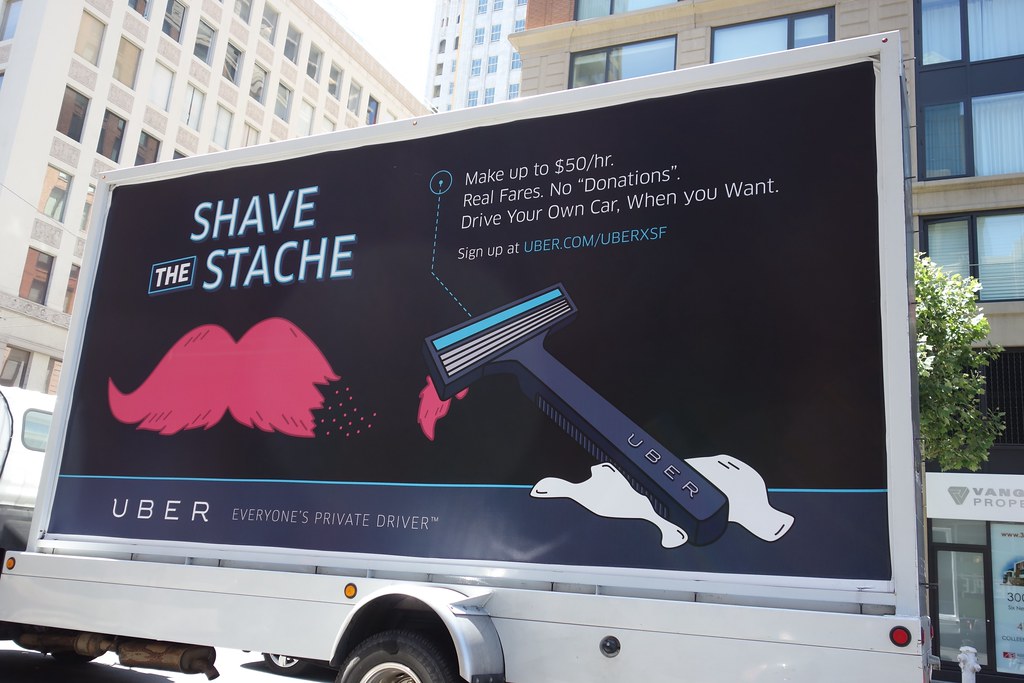
The above 2013 ad illustrates the competitive spirit embodied by Uber (originally UberCab), which quickly became, in effect if not in name, San Francisco’s largest and most politically connected cab company. Like the previous holders of this title (United Carriage and Yellow Cab), Uber has proved both technologically innovative and mercilessly expansionist (though not, perhaps, as classy; is there a tackier way to advertise than by clogging the streets with mobile billboards?)


SFMTA bus ad, 2014. Courtesy of San Francisco Citizen.

Competing trends of regulation and deregulation face off in the 21st Century. For San Francisco’s cab system, this means a contest between the city’s Municipal Transit Authority (MTA), which governs licensed taxicabs, and corporations like Uber, Lyft, and Sidecar (which, though headquartered in San Francisco, are incorporated in Delaware). At stake is not just the movements of cabs, drivers, and passengers, but the data they create as they are increasingly tracked by mobile, interconnected devices. The debate over cab regulation today is just a precursor to future conflicts over who will control the technology and information used to move cities in the coming century.

The public image of drivers for hire is up for grabs. Rideshare services ask riders to think of their drivers, not as “cabdrivers,” but as either “private drivers” or as “friends with cars;” “Hail a Fellow Human, Not a Taxi” read one rideshare-promoting headline, revealing a new (sub-"human") low in the cultural image of the cabdriver. “Do you know what you’re getting into?” responded city regulators, using this 2013 bus ad to cast suspicion back at the less-regulated “rideshare” services.

Caught in the middle are the drivers. Since the 1970s, drivers for traditional cab companies have been treated as independent contractors, with few workplace protections, no benefits, and no job security. The growth of corporate “ridesharing” services like Uber and Lyft represent a further intensification of this trend towards precarious work. Drivers have begun to organize in return: rideshare drivers have held strikes and protests to bring attention to their precarious working conditions; San Francisco’s licensed cabdrivers have formed a local branch of the AFL-CIO-affiliated National Taxi Workers Alliance, in the most significant instance of labor organizing in the San Francisco cab industry since the downfall of the old Chauffeurs’ Union forty years earlier.

What does the future hold? Will there be a resurgence of the regulated taxi model (integrated into an intelligent “transit first” system overseen by the MTA)? Or the further spread of the deregulated “ridesharing” model, controlled by multi-city (or in Uber’s case, transnational) corporations? Or will both be swept aside by the development of driverless cabs, which (depending on which expert you ask), we can expect to see within five years, within twenty years, tomorrow, or never? (Place your bets!)

(For the record, my money is on low-flying drone sedan chairs...)

The trouble with reading history from advertisements is that they tend to paint a rosier, more simplistic picture than what really exists; a deeper understanding has to be filled in from the gaps and silences that haunt the edges of the advertised image. Today we live in a world more saturated with a marketing perspective, and with the distorted view that it feeds us, than ever before. Yet, whatever the future holds, it depends on the choices we make, collectively, today. What sort of city do we want to live in? How do we want workers to be treated? And what relationship do we want to see between technology and its users? Hopefully, a little historical perspective can help us see past the myopia of the present.


(Read Part One here.)


Wednesday, April 22, 2015

A History of San Francisco's Cab Industry, in Advertisements (Part One)

Historical advertisements for San Francisco's cab industry offer glimpses of the changing city.


Advertisement in Daily Alta California, 1855. (California Digital Newspaper Collection)

Gold Rush San Francisco was a city of mad extravagances, fueled by that great disruptor, gold. Miners returning from the diggings with pockets full of gold dust and nuggets descended on the city looking for a good time. For many, this meant picking up some liquor, prostitutes, and hangers-on in the Barbary Coast, then stumbling over to the Plaza (today’s Portsmouth Square) for a hack, which they treated as a mobile party-wagon, riding around the town for hours, or taking excursions to the Mission, Meigg’s Wharf, or the Ocean Beach, stopping for drinks at the numerous watering holes along the way.

The city’s earliest hired carriage drivers rose to the occasion. Traveler J.D. Borthwick reported that “the hackney carriages of San Francisco” in the 1850s “were infinitely superior to those of any other city in the world.” In contrast to their rough surroundings, they were “large handsome carriages, lined with silk, and brightly painted and polished, drawn by pairs of magnificent horses, in harness, which, like the carriages, was loaded with silver.” Cab fares were proportionately high: “One could not cross the street in them under five dollars.”

Most of the hack drivers of the day were independents—owner/operators of a single carriage—like John Glover, who ran the above advertisement in the Daily Alta California for a week in November, 1855. Glover seems to have been in a running competition to have the finest equipage in the city; the Alta reported that this carriage, built in Boston and shipped to California by sea, had cost him $5000, which would have been a preposterous sum in 1855—anywhere but in San Francisco, that is.

As Glover’s ad indicates, he spent much of his time on the Plaza, waiting for business. Just such an elegant carriage can be seen in the Plaza hack stand in an 1860s photograph by Eadweard Muybridge.

Advertisement for Tomkinson's livery stable, c. 1880. Courtesy of the California History Room, California State Library, Sacramento, California.
The livery stable was an essential feature of any city in the horse-drawn era. If you owned your own horse and carriage, this was where you boarded and stored them; if, like most people, you had neither, this was where you rented or hired them when needed. Liveries were also the mainstay of the hack industry. Independents like John Glover stored or rented their hacks and horses at livery stables, and some stables, like Tomkinson’s, kept their own small fleets of hired carriages and drivers.

As the frontier city settled down into the gilded-age metropolis, institutions like Tomkinson’s catered to “the Elite and Wealth of San Francisco.” For this advertisement (with photo taken by the celebrated firm of Isaiah Taber) Tomkinson rolled out a selection of his best carriages onto Minna. The hackdrivers are in standard cabby attire for the day—tall plug hats, long duster coats, and hackman’s badge. Are those younger members of the Tomkinson family looking down from the second story balcony? This photograph offers a rare glimpse into the vanished working-class culture of the old South of Market alleyways—what the San Francisco Call dismissively termed “Minna street society”—and which would later be depicted by Jack London in stories such as “South of the Slot.”


Advertisement for the Telephone Cab and Carriage Company, 1883

Disruptive technology transformed San Francisco’s cab industry – in the 1870s. San Francisco was one of the first cities anywhere to see dispatch-oriented carriage companies, the precursors to the modern full-service cab fleet. Beginning in 1877, cabs of the United Carriage Company could be ordered from company stands—first by home telegraph, and soon after, by telephone. Visitors from Eastern cities wrote admiringly of the convenience: "When shall we have a similar enterprise in New-York?"

The UCC spawned a group of imitators with similar names, such as the Pacific Carriage Company, and the City Cab and Carriage Company. The small, short-lived Telephone Cab and Carriage Company was ingeniously named after the radical new cutting edge tech of the day. Perhaps catering to tourists, newcomers, or anyone who couldn’t quite remember the name of that-big-cab-company-you-call-by-telephone, the intent was not unlike the "AAA Yellow Airport VIP Taxi" companies you might see today.

The TCCC's owner, P.A. Dolan, was an Irish immigrant who showed a preference for hiring brothers and cousins, also named Dolan. The Dolans had an unfortunate tendency to get into shootouts, at least one of which was linked to Dolan's involvement with Democratic Party machine politics of the day; the Mayor had the power to dole out favourable cabstand locations as rewards for political support, and contests between mayoral candidates could take the form of proxy warfare between rival hack teams on the city streets.

For the story of another carriage company from the era, see The Short, Contentious History of the Gurney Cab Company in San Francisco.


Advertisement for the Mobile Carriage Company, San Francisco Call, 1904.
(California Digital Newspaper Collection)

The first automobile dealers in San Francisco had a problem—most people found their product unfamiliar and frightening. To get those vehicles off the lot, and accustom the public to riding in them, the “motor livery” was born. Vehicles were rented out by the trip or by the hour, with a chauffeur whose job was not only to operate the machine, but to fix it when it broke down.

People were both fascinated and terrified by the early automobile. No clip-clop of horse hooves warned pedestrians of their approach as they zipped down city streets at inhuman speeds of twenty, even thirty miles an hour. Passengers, fired up by watching daredevil auto racers out at the Ingleside track (such as cigar-chomping Barney Oldfield), would urge their chauffeurs to speed on the way back into the city, resulting in spectacular and often gory collisions with streetcars, carriages, and hapless pedestrians.

This 1904 Mobile Carriage Company ad shows a chauffeur and passengers in what looks like a Pierce Arrow. These "Brass Era" motorcars were not ready to replace the horse and carriage. Drivers and passengers were thrown together on open, windblown seats, similarly bundled up in goggles, scarves, and gloves. The sedate carriage, with a closed compartment which preserved the social distinction between driver and passenger, remained the more respectable way to get around town.

Though motor liveries may have started out at “rates less than carriages,” they soon became much more expensive. The city responded by fixing the legal rates of hire, and requiring licenses for both vehicles and their drivers.


Advertisement for Kelly's Stables, San Francisco Call, May 15, 1906.
(California Digital Newspaper Collection)

The Great Earthquake and Fire was, among other things, a transportation nightmare. As tens of thousands tried to flee the city, some of the more entrepreneurial hackmen responded with an early instance of “surge pricing,” charging up to $100 per seat for rides from the Palace Hotel to the ferries. Not all of the city’s hackdrivers tried to cash in on the disaster; the photographic record shows hacks (often sans horse) being used to evacuate household belongings from a residential neighborhood; to form an impromptu barrier on Van Ness; and as temporary housing in a Golden Gate Park refugee camp.

The fire took at least 3,000 lives, reduced most of downtown to smoking rubble, and utterly ruined the upcoming social season for the city’s elite. The Call reported that so many of the city’s carriages had burned that attendees of upper-class events, from marriages to social visits, had to make do with “any kind of an old ‘hack’ such as one saw formerly on street corners and around the park entrance.”

Kelly’s stables, one of the old premier livery stables of the city, had the good fortune to be located just outside the fire line. Less than a month after the devastation, as the city began to rebuild, Kelly’s reassured customers that they were still available “at the old stand,” on Pine near Franklin.


Advertisement for United Carriage Company, San Francisco Blue Book, 1907.

The old meets the new in this 1907 United Carriage Company advertisement. According to one story, the UCC had lost all but five carriages in the 1906 fire; by 1907, the grand old carriage company was rebuilding its fleet, with a new headquarters on Eddy, just off the new auto row along Van Ness. The photos demonstrating the UCC’s catalog of carriages were taken at the foot of the Panhandle, a location charged with significance. The 1903 McKinley Monument, seen in the background, would have reminded San Franciscans of happier, pre-quake days; just across the street stood the Coliseum exhibition hall, which in 1907 hosted San Francisco’s first major automobile show (and yes, the DMV now stands on the Coliseum's former site).

Now with “Rubber Tires and Brakes,” the horse-drawn carriage was still evolving, even in its final years as a significant mode of transportation. As the ad reveals, the UCC had already begun a switch to the motorcar, offering the popular Thomas Flyers for hire alongside its carriages.

The bold front did not save the distinguished old hack company. The United Carriage Company went bankrupt, and its entire stock (including 70 carriages, 95 horses, and 2 automobiles) was auctioned off by creditors in 1909. That same year, the first taxicabs hit the streets of San Francisco.


(Read Part Two.)