Showing posts with label precarity. Show all posts

Tuesday, December 28, 2021

Rhythmanalysis in Taxicabs and Soft Cabs: a report from three North American cities

Here is the abstract of my latest publication, a chapter in Rhythmanalysis: Place, Mobility, Disruption and Performance, edited by Dawn Lyon, and just now out in print:


Rhythmanalysis in Taxicabs and Soft Cabs: a report from three North American cities

Just who is the “analyst” who practices rhythmanalysis? The extension of the name “rhythmanalyst” to other than scholarly practitioners makes possible an investigation of the relationship of rhythmanalysis to other rhythm-analytic forms of knowing and representing urban space, and the ways in which these differing but related practices may challenge, undermine, or inform each other. In this paper, drawing on years of ethnographic and autoethnographic research in three North American cities, I discuss the rhythmanalytical practice involved in cabdriving, as this is shaped by the technologies drivers use to sense the city, and by the transformation of the taxicab into the “ridesharing” or soft cab. First, I discuss the occupational knowledge and wayfinding practice of cabdrivers, and the extent to which their work requires the development, by means of a variety of tools and practices, of a sense of the city as composed of multiple interacting rhythmic movements, or polyrhythmia, with which they must strategically converge and facilitate. Second, I discuss the redelegation of the role of rhythmanalyst to predictive algorithms and mobile interfaces, as part of the reinvention of the taxicab, and its associated micropolitics and power/knowledge relations, by smartphone enabled hailing and dispatching services. Struggles over, and transformations of, these non-academic forms of rhythmanalysis may provide insight, in turn, into the contemporary politics of the production of social space.


Sunday, January 21, 2018

The Misadventures of Mike Brannigan (Interlude)

Mike Goes To The Fair

The Centennial Exhibition in Philadelphia was the greatest event of 1876. (Library Company of Philadelphia)

(Read Part Fourteen: The Worst Cabdriver in Galveston)

In 1876, Mike Brannigan decided to go to the fair. And not just any fair: the biggest, grandest fair in the world!

Which was, of course, The International Centennial Exhibition in Philadelphia, celebrating the 100th Anniversary of the United States.

"Mommy, look!" Fairgoers enjoy the novelty of popcorn balls at the Centennial Exhibition. (Free Library of Philadelphia)

The Centennial Exhibition was a massive event, drawing in over ten million visitors within its six months of existence. People streamed into Philadelphia from across the US and beyond, to gawk at the latest technological marvels (such as the first working public exhibition of Edison’s telephone), a monorail, and exotic specimens of humanity. Some of today’s stereotypically all-American fare, such as popcorn balls, and root beer, were made popular at the Centennial.

Mike Brannigan, however, did not go to Philadelphia to sight-see, or to snack on popcorn. He went to make money.

Hacks line up outside a Philadelphia Hotel in 1876. (Detail of photo at the Free Library of Philadelphia)

All those people crammed into one city, trying to get around would need transportation—and Mike was just one of reportedly thousands of hack and carriage drivers who swarmed in from all over the country to provide that service, much the way Uber and Lyft drivers today travel long distances to work peak events in the hope of a payout big enough to make it all worthwhile.


And just like an Uber driver, Mike was no doubt looking for the chance to extract a little, shall we say, “surge pricing,” out of his passengers... He must have been as happy as... well, as a rat at a fair...

A cab with the Fare Controller and Indicator installed (behind the driver). (New York Daily Graphic, 1876).

It was during the Centennial Exhibition that the first attempt in the US at a taximeter-like device—the “Fare Controller and Indicator”—made its appearance, used by one of the cab companies servicing fairgoers. Like later taximeters, the fare controller was designed to keep a certain kind of cabdriver from overcharging passengers. Sadly, there is no record of Mike’s thoughts about this invention.

(For more about the Fare Controller and the Centennial Exhibition, see "How Ludwig van Beethoven Invented the Taximeter")

Hotels were full and places to stay were scarce during the Centennial (Free Library of Philadelphia)

Mike—for once in his life—doesn’t show up in the police reports or the papers in Philadelphia during his stay there; but many other vagrant drivers, including some from Texas, do. It appears that these drivers, not surprisingly, tended to overlook the city’s cab regulations concerning licensing and rates of fare. Also, drivers are reported to have slept in their vehicles at night, perhaps because beds in the overcrowded city were both scarce and expensive.

The Precariat, servicing party-goers since 1876! An Uber driver prepares to sleep in his car (Bloomberg)

And then, in the middle of the summer, a record heat wave struck the city. Attendance dropped; business became difficult. Perhaps Mike, desperate for money, worked himself harder than usual. On July 23, 1876, the Galveston Daily News reported the gossip on the street:
It was reported in hack circles yesterday that Mike Brannagan died of sunstroke in Philadelphia a day or two ago, the news having come by telegraph.

Since Brannigan just might have known Mark Twain back in San Francisco (why not?), it should be only fair that he get to deliver the punchline (which Twain never quite did):
“Reports of my death have been greatly exaggerated!”

And if you, dear reader of this series, had been hoping against hope, that yes! Mike Brannigan had actually met the fate he deserved!—I am sorry. THE Mike Brannigan—who had already avoided death by hanging, firing squad, getting shot point-blank, and being torn apart by angry mobs (on two separate occasions)—could never meet his end in such a pathetic, footnote-like manner. Sunstroke? Think again.

Mike was fine, although very little of his experience at the fair is recorded. For instance: did his wife, of only two years, accompany him to Philadelphia, or remain in Galveston? There is no evidence either way. But my guess is that she did go. She had relatives in New York City, who she liked to visit. And also, a man like Mike Brannigan needs a close watch. I bet Mary went along to keep him in line, and this may well be why he never shows up in the papers for the usual infractions.

Uncle Sam's carved head adorns this souvenir cane from the 1876 Centennial Exhibition, which was sold at an auction in 2013.

We have only one more, slightly puzzling, detail regarding Mike’s experiences in Philadelphia: In September he sent a package of souvenir canes back to Galveston. The letter he sent to a friend, detailing how the canes were to be distributed, was published in the Daily News on October 5, 1876:

Centennial Mementoes. 
The following missive from Mike Brannagan, who went on to Philadelphia to make a raise with his vehicles among the Centennialites, was received yesterday by Pat. Tiernan, and created some amusement: 
September 22, 1876. 
Friend Pat—You will receive a package of canes. Please deliver them as they are marked. You can tell Dick Nagle there is a friend of his—a clerk—at the Transcontinental. Time is getting short. We will all leave here the day after the Centennial. One hundred and thirty thousand visitors at the grounds to-day. Deliver as marked, and oblige your friend. 
Col. Mike Branagan. 
The canes referred to present a curious variety, from the fancy tassel stick to the huge hickery. The following are the favored few: John Westerlage, Chief of Police Atkins, Grey Nichols, Col. Wood, Thos. Tydings, Dick Nagle, Frank D. Harrar, Barney Tiernan, Pat Tiernan, Thos. Ochiltree.

There are two curious things about this letter. First, this is the first recorded instance in which Mike refers to himself as “Colonel.” More on that later.

Second, there was some massive joke here, which made it funny enough to be reprinted in the paper, but which is now not easy to pick out. On the surface, Mike is sending some souvenir canes to his friends—each of whom gets a specific style of cane, ranging from a “fancy tassel stick” to a “huge hickory.” The recipients, though, are almost all prominent citizens of Galveston—the Police Chief and the Sheriff, two policemen, a capitalist, and several politicians. Mike did have a long-established pattern of cozying up to powerful people in order to get political protection. But were these folks really Mike’s cronies? Was he teasing a bunch of friends, or taunting his enemies?

The Centennial Exhibition came to an end on November 10, 1876, and the next day Mike decamped from Philadelphia, along with countless others, and returned to Galveston.

A few years later Mike and his wife moved to El Paso.

Next time (for real): The Best Cabdriver in El Paso


Saturday, January 20, 2018

Digital Mediation, Soft Cabs, and Spatial Labour

The new special issue of Digital Culture & Society on "Mobile Digital Practices" has been released, featuring my article on "Digital Mediation, Soft Cabs, and Spatial Labour:"

https://www.degruyter.com/view/j/dcs.2017.3.issue-2/issue-files/dcs.2017.3.issue-2.xml

Click here for the free repository version of the article.


Abstract

Critics of digitally mediated labour platforms (often called the “sharing” or “gig economy”) have focused on the character and extent of the control exerted by these platforms over both workers and customers, and in particular on the precarizing impact on the workers on whose labor the services depend. Less attention has been paid to the specifically spatial character of the forms of work targeted by mobile digital platforms. The production and maintenance of urban social space has always been dependent, to a large degree, on work that involves the crossing of spatial boundaries - particularly between public and private spaces, but also crossing spaces segregated by class, race, and gender. Delivery workers, cabdrivers, day labourers, home care providers, and similar boundary-crossers all perform spatial work: the work of moving between and connecting spaces physically, experientially, and through representation. Spatial work contributes to the production and reproduction of social space; it is also productive of three specific, though interrelated, products: physical movement from one place to another; the experience of this movement; and the articulation of these places, experiences, and movements with visions of society and of the social. Significantly, it is precisely such spatial work, and its products, which mobile digital platforms seek most urgently to transform. Drawing on several recent studies of “ridesharing” (or soft cab) labour platforms, I interrogate the impact of digital mediation on the actual practices involved in spatial work. I argue that the roll-out of digital labour platforms needs to be understood in terms of a struggle over the production of social space.


Friday, December 22, 2017

Sorry, Robot! A Rock Just Took Your Job


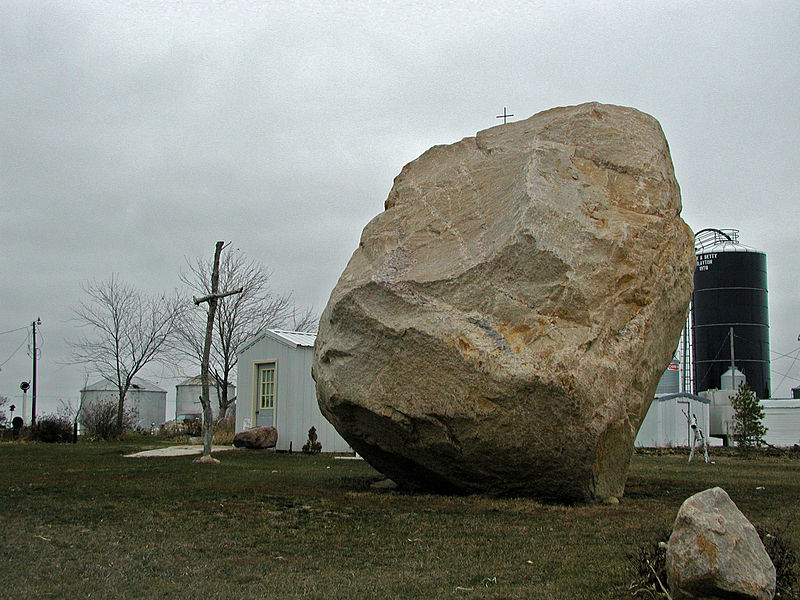
A big rock (Wikipedia).

Did you blink? The moment of the robo-cop has already come and gone. While the Knightscope K5 and its competitors kicked up controversy in 2017 just as easily as they ran over children and rousted the homeless, their jobs as peacekeepers in the class war-zone of today’s cities may be over.

Their replacements? Big rocks.

San Francisco, which has long been one of new tech’s bleeding-edge experiment zones, has already gone lithic. Tired of repeatedly clearing homeless encampments, the city has turned, not to perimeter-policing robots, but to “defensive boulders” to prevent the legions of out-of-work delivery workers, Uber drivers, and mall cops from returning to their homes-away-from-home.

We are seeing a glimpse of the future. After the humans have all been replaced by robots, the robots will naturally all be replaced by rocks.  Compared to robots and humans, rocks are cheaper, more efficient, and more sustainable. Unlike both humans and robots, rocks are uniformly well-behaved, and rarely malfunction. Rocks do not strew garbage, commit weird acts of violence, throw themselves into fountains, or rise up in revolution; none of that.

Rocks just sit there quietly, looking decorative.

The coming Age of the Rock will be long and peaceful. Then, over the millennia, by a process not unlike Moore’s law, but a lot more inevitable, they will gradually miniaturize. In this final utopia, the world will be as Shelley foresaw:


...boundless and bare,
  The lone and level sands stretch far away.


Saturday, March 4, 2017

Disrupt the Disruptors! An Interview with Kelly Dessaint

Cabdriver, zine publisher, and Examiner columnist Kelly Dessaint’s Behind the Wheel series is a must-read for anyone interested in an on-the ground view of how tech gentrification and the “sharing” economy have transformed the experience of life and work in San Francisco.

Kelly Dessaint's Behind the Wheel series chronicles his path from Uber/Lyft driver to licensed San Francisco taxi driver. They are available in print or pdf from his website, as well as from Amazon. He also writes the I Drive SF column for the Examiner.


 .
I’m inbound on Post street. While I wait for the light to change at Jones, I practice my double bass drumming on the steering wheel along to the Slayer CD blasting from the stereo in my taxicab. (Behind the Wheel 3, page 1)

The third installment of Behind the Wheel begins and ends just like most of the stories it contains—in motion through the streets of San Francisco. Dessaint was the first driver/writer to publish about the experience of driving for Uber and Lyft, and he has since joined the ranks of the city's licensed taxi drivers. Like most writing about cabdriving, the stories in Behind the Wheel take the form of fragmentary, slice-of-life episodes, but Dessaint’s stories are unified by a sense of movement, recurring characters, and a compelling theme of analog resistance to the digital colonization of everyday life.


One of the most striking characters is San Francisco itself. At least since Tex Reed’s 1970 book Hey Taxi, San Francisco cabdrivers have been writing complicated love stories to the city. Cabdriving memoirs from other cities often emphasize a sense of the alienation of disconnected service work, or even the despair of being caught in a dead-end job. San Francisco’s cab writers—including Dessaint—don’t overlook the downsides of the work, but they always balance it with a sense of intoxication with the city, and the myriad stories of the people they drive through it. The result is a mix of light and shadow, of spleen and ideal, a performance far more human and interesting than the sugar-coated kitsch of (for example) Lyft Me Up San Francisco. Dessaint calls it “the incurable madness of taxi driving:”

San Francisco is like a drug. When it gets inside you, each moment is a revelation. Until things get ugly. (Behind the Wheel 3, page 10)


Behind the Wheel paints a psychogeographic portrait of San Francisco, joining a tradition that includes Rebecca Solnit’s Infiinite City and Gary Kamiya’s Cool, Gray City of Love. Like the “spatial stories” described by the philosopher De Certeau, Dessaint’s stories are narratives in motion, lighting up the city through the movements of a cabdriver and his passengers:

And if you’re lucky, one ride follows the next, like jigsaw puzzle pieces falling into place. One minute you’re working the swanky hotels on Snob Hill, the next you’re dropping off in the oft-forgotten Bayview, where urban detritus collects like dust bunnies under a credenza.
And you’ve seen it all, cause you’re a cabdriver, or at least you’ve seen most of it, although in reality, you don’t know fuck all. (Behind the Wheel 3, pages 58-9)

We meet a myriad of other characters of course—passengers from all walks of life, taxi drivers hanging around the garage or the cabstand—but the most interesting is Dessaint himself. Unlike the wry persona affected by many cab writers (such as the Examiner’s old Night Cabbie columnist), Dessaint reveals his own reactions to what he encounters, showing his defeats along with his triumphs, and his exhaustion, uncertainty, and anguish at the hands of abusive passengers, particularly during his “ridesharing” phase:

It’s nights like these that make me want to curl up into a fetal position and rethink this whole ridesharing deal. (Behind the Wheel 2, page 28)

As a whole, the three Behind the Wheel books tell the story of Dessaint’s growth through cabdriving, and his own arc of progress from Lyft driver, to Uber driver, to licensed San Francisco taxi driver—in a direction diametrically opposed to the official narrative of the “sharing economy.” And this is one unifying theme of the Behind the Wheel series: it is a story of defiance, an act of political activism. The series is a war-cry against the gentrification of the city, and the intrusion of tech interfaces and algorithmic manipulation into everyday life. In one of the most important chapters of Behind the Wheel 3, Dessaint teams up with a disgruntled Uber driver to confront David Plouffe himself at a tech conference. In a later chapter he argues with some passengers who don’t realize the contradiction between supporting Bernie Sanders, and patronizing Uber and Lyft:

This new gig economy is regressive. It pushes the most vulnerable members of our society into wage slavery, where they’re paid for piecework rather than given an opportunity to secure a stable income. And what’s more, instead of seeing their profits increase by working more, due to the constant Uber/Lyft price wars, they actually make less in the process. How can you support a system like that? (Behind the Wheel 3, page 55)

The Behind the Wheel series is a must-read for anyone interested in seeing the real, gritty, human reality of how work and urban space have been transformed by the tech-centric “sharing” economy (And as a bonus, each book comes with a “Disrupt the Disruptors” bumper sticker!)


My Other Car Is A Taxicab

I interviewed Kelly by email about Behind the Wheel, along with his long-running zine Piltdownlad, his Examiner column I Drive SF, and his future plans.

How did you start writing a column for the Examiner?

I'd been blogging about my experiences driving for Uber and Lyft for a while and getting a decent amount of attention. I was extremely critical of both companies and how they were treating drivers. I'd already put out the first two zines and started writing for Disinfo.com and Broke-Ass Stuart. To explore other aspects of driving for hire, I was planning to go to taxi school and get my a-card.

On New Year's Eve 2014/2015, Flywheel ran that special where every ride was $10 and it killed business for Uber and Lyft, who'd been getting bad press about surge pricing. I worked that night and it was dismal. Just horrible. I drove around empty most of the night. The next day I wrote a blog post called "Night of the Living Taxi" that made the rounds. Several news outlets contacted me, including Joe Fitzgerald Rodriguez of The Examiner. We talked on the phone for a while and the next month he recommended me to the new editor as a modern version of the Night Cabbie, but as an Uber driver. By this time I'd already started driving a taxi, so I pitched my idea of a column about a former Uber/Lyft driver turned cab driver. The editor was interested. When we met to go over the details, he told me that one of the things he wanted to do when he took over The Examiner was revive the Night Cabbie. Of course, in the beginning, and still to this day, comparisons are made between his column and mine. Except I'm not anonymous.

Incidentally, the editor was relieved that I wanted to use my real name. Though I quickly realized the advantage the Night Cabbie had by not revealing who he was. Writing for a newspaper is restrictive because there are limits to what you can write about. Which is why I find doing the zine more liberating because I can write whatever I want. And I'm not bound by a 700 word limit.

How did you first get into writing and zine publishing?

I've always written. It's something my parents encouraged me to do for as long as I can remember. Whether it was filling notebooks with derivative song lyrics or pecking away at my mother's Royal typewriter trying to compose bawdry poems, writing was a way I was able to truly express myself. And shock the adults around me.

As a teenager, I wrote vociferously. Exploring both verse and prose before eventually settling on prose as my preferred method of communication. After getting rejected by any half-way decent magazine I found on the newsstand, I started my own zine and book publishing empire. (And by "empire" I mean that Gateway computer set up in a burned out garage behind my mother's house in East LA.)

I modeled my publications on lit journals from the 60s that I'd found in used bookstores and collected over the years, as well as contemporary handmade, photocopied punk zines coming out of the underground, listed in the back of Maximum Rocknroll and Flipside.

From there, I just kept pushing the boundaries... writing and publishing and designing... collaborating with different artists and writers until we inevitably went our own ways... usually acrimoniously. But not always...

In 2010, I started my latest project: Piltdownlad: A Personal Narrative Zine. 

How did you pick the name for the zine? Some relation to Piltdown Man?

Pitldownlad comes from an album by the D.C. band Fidelity Jones entitled "Piltdown Lad." I combined the two words for aesthetic reasons. Fidelity Jones was the first punk band I saw live, during a visit to D.C. when I was 17. "Piltdown Lad" is their only full length LP. There is very little commentary associated with the album or a title song, but I assume it's an expansion on the idea of the Piltdown Man (a fake early man) to incorporate feeling "fake" as a young (new) person. Perhaps. Or a reference to arrested development. Or, the Peter Pan complex. I don't know really... 

I used Piltdownlad as a vehicle to explore the darkness of my childhood in relation to my current existence as a writer trying to make sense of the past and the future, as well as an outlet to review equally, over-personal zines. 

Where does the Behind the Wheel series fit into this?

After ten issues, around 2014, I discovered Lyft, the ride-hail company. I thought to myself, here is something that is culturally relevant - albeit entirely absurd - that I'd love to document. Something I was convinced surely wouldn't last for long. From Lyft, I delved into Uber, which I also assumed was a fly by night operation at best. 

As I documented the stupidity, the madness, the desperation of using one's personal car as a taxicab, I stumbled onto many fascinating discoveries... Namely, that I loved driving around San Francisco, witnessing the last gasps of a city that I'd always associated with free expression and limitless artistic possibilities as tech start ups took over and molded the cultural reality into something darker and sinister... And the realization that Uber and Lyft weren't going anywhere soon. 

That's where the Behind the Wheel series was born, and from which it has evolved: detailing the nightmare of what was, and what may never be again. And holding a torch for the last bastion of analogue technology: taxi driving. 

It's safe to say I may have bit off more than I can "eschew." And now I'm in a vicious circle. But I still believe that salvation comes from hard work. And driving a taxi in San Francisco is a challenge I have yet to master. And may never master. But I am keeping notes... 

What do you mean when you say you're in a "vicious circle"?

The vicious circle I referred to is driving a taxi to write about driving a taxi... The writing comes easy. The driving, not so much. I suppose I could just work a few days each month, collect some stories, talk to other cab drivers, get their stories and do the column without subjecting myself to the physical stress, the poor financial returns and the constant sense of futility. But that's not the type of writer - or person - I am. Unfortunately, the story I want to tell requires active participation. And that comes with a plethora of consequences, both personal and financial. 

When writing the three Behind the Wheel issues, do you have a particular audience or reader(s) in mind?

I do. And it changes with each issue. When I wrote the first one I thought of readers of my previous zines. The second, people who read my blog. And the third, readers of my column. I've been fortunate to receive a decent amount of messages and comments from people who read my stuff. I don't always reply but I try to incorporate responses in future writings, either through inside jokes or references that only a few will catch.

I know from talking to taxi drivers that geography is a major issue to them when they read about locations. So I always make sure not to fuck up my cross streets or routes. Cause when I do, I immediately hear about it.

A few months back, some guy left a comment on an old column of mine in which he questioned my claim that taxis serve poor people, or the working poor, rather. His argument being that Uber is way more affordable. True, but that's irrelevant. Obviously. The complete lack of insight into how poverty works makes my mind swell each time I think about his comment. I still haven't figured out a single rebuttal because there are so many to make. When I try my mind just goes pfffffftttttttt. And yet, I find myself incorporating the subject of poverty into what I'm writing, not in a direct way, but just adding small scenes along the way. It's a subtle reply, I guess.

What are the most important things you want your readers to learn or understand from your writing?

I think writing should be exciting to read. It should be honest. It should capture the feel of a time and place. It should break rules and constantly push boundaries. I don't see much of that today. I'm often amused by things I read, but rarely am I excited. Like first discovering Henry Miller. Or Thomas Pynchon. Or Hunter Thompson. Not that I actually believe I'll ever reach that caliber, you know, but at least try, right?

Will there be a 4th Behind the Wheel? Do you have other future writing planned?

I've started working on the new BTW. Which will be mostly unpublished stuff about the daily process of driving and going into the city every day from Oakland. "The Thin Checkered Line."


Before I started documenting my experiences driving for hire I was working on other personal narratives under Piltdownlad. I'm actually hoping the new zine will lead to a return to those past stories to wrap up a manuscript I should have returned to the publisher over a year ago. I released a book about my abusive childhood several years ago and that's what led to Microcosm, the publisher, approaching me about another book that dealt specifically with punk rock as a method of recovery from abuse, called No Fun: How Punk Rock Saved My Life.  


The Behind the Wheel series is available from Dessaint's website, or from Amazon.


Wednesday, June 15, 2016

Uber, Devourer of Souls

Moloch, from coverjunkie.com


What sphinx of cement and aluminum bashed open their skulls and ate up their brains and imagination? Moloch! Moloch! Nightmare of Moloch!

Moloch the loveless! Moloch the heavy judger of men! Moloch who employed whole intellects, who dreamt and made incarnate gaps in Time & Space through images juxtaposed, to recreate the syntax and measure of poor human prose with superior technology; and sent the best minds of Silicon Valley onto the streets, looking for a spatial fix;

Creating the great suicidal drama of madman bums, and pink-mustached hipsters:

who jumped in limousines and loned it through the long streets where skyscrapers stand like endless Jehovahs, trying to make a full-time living as part-time taxi drivers; who dreamt of pings, of neon blinking traffic lights, the noise of wheels and children; who wept at the romance of the street;

who wandered around and around at midnight wondering where to go; who accepted into their private vehicles a battalion of conversationalists, yacketayakking screaming vomiting whispering facts and memories and anecdotes and hammers to the eyeball and shocks of surge pricing receipts and jails and class warfare; who received a four-star rating and screamed with joy;

who were promised rates of fare and hourly guarantees that vanished into nowhere; who chained themselves to the endless ride with predatory car loans; who failed to pay unemployment tax and were dumped by insurers; or who poverty and tatters and hollow-eyed were run down by exhaustion, traffic, vitriol, the drunken taxicabs of Absolute Reality.

Moloch whose mind is pure machinery! Moloch whose blood is running money!

They broke their backs lifting Moloch to Heaven!


Wednesday, March 16, 2016

A Spectre is Haunting Uber: Jason Dalton’s tale of smartphone possession

We control the horizontal; we control the vertical.


Kalamazoo Uber driver and shooting suspect Jason Dalton’s story of being possessed by the Uber app is only the latest in a long history of such stories, in which people have attributed paranormal or spiritual powers to new technologies. Tales of otherworldly beings communicating through the telegraph, radio, television, or computer screen are motivated by the anxieties that arise with social and political changes driven by new forms of communication and action-at-a-distance. Today, while Uber’s PR department scrambles to keep the phrase “going Uber” from becoming an updated version of “going postal,” it is worth looking more closely at Dalton’s delusions for some insight into the particular fears and dreams of our up-and-coming app-governed existence.

In his book Haunted Media, Jeffrey Sconce describes the long history of stories of possession and paranormal activity surrounding new and unfamiliar technologies. The telegraph and radio gave rise to stories of spirit possession and the entire phenomenon of the spirit “medium:” a human who, not unlike a radio, was “tuned” to frequencies through which they could talk to the dead. Television and the internet inspired stories of mind control, alien invasion, and being trapped in worlds of illusion. In each case, the paranormal stories that have swirled around new technologies boil down to the hopes and fears these technologies inspire, and such questions as:
  • how can you talk with someone who isn’t present?
  • how can these images seem so real when we know they are not?
  • how can we make sense of this invisible power that flows all around us, and through us?
We may laugh today at people being afraid of telephones and radios, but Dalton’s story owes more than a little to contemporary cultural anxieties over the increasing saturation of our lives with apps designed to influence, and to some extent to control, human behavior. Though exaggerated by his paranoia, each of Dalton’s crazy claims reflect the actual controls and suggestions made by the real Uber app.

In his interview with police, Dalton made these claims:

1. Dalton saw an “Eastern Star” or “devil head” in the app.
2. The app triggered Dalton's actions with colors and sounds.
3. Dalton described possession by the app as more of a “feeling” than a “telling.”
4. Dalton felt that the app was telling him where to drive.
5. Dalton felt that the app gave him special abilities or protections.
6. Through the Uber app, Dalton felt connected to some greater, inexplicable power.

Each of the quotes below (in italics) are from the interview notes made by officers Moorian and Ghiringhelli, and made available by WZZM in Kalamazoo.


1. Dalton saw an “Eastern Star” or “devil head” in the app.
Dalton said that if we only knew, it would blow our mind. Dalton then explains how when he opens up the Uber taxi App a symbol appeared and he recognized that symbol as the Eastern Star symbol. Dalton acknowledged that he recognized the Uber symbol as being that of the Eastern star and a devil head popped up on his screen and when he pressed the button on the app, that is when all the problems started.

Uber did just change its logo, but neither the old nor the new logo matches the “devil’s head” described by Dalton. Nevertheless, as Uber drivers have already started pointing out over at uberpeople.net, there are in fact upside-down five-pointed stars (as well as rightside-up ones) all over the background of the newly-designed app. Dalton seems to have fixated on this.


TruYouber: Sure, the new Uber app is covered with up and down-facing pentagrams. But isn’t it more disturbing that it is clearly modeled after the logo of the world-conquering corporation in the dystopian Dave Eggers novel, The Circle?

It was not enough for the devil’s head logo to simply be there: Dalton himself had to speak its name for it to take power over him. When he recognized the symbol and “spoke what the symbol was,” it responded (he claimed) by turning from red to black.
Dalton said that when the Uber symbol is red, it is just picking up and dropping off people, but when he recognized the symbol and spoke what the symbol was, the color changed from red to black.
Dalton said he wishes he would never have spoken what that symbol was when he saw it on his phone. Dalton described the devil figure as a horned cow head or something like that and then it would give you an assignment and it would literally take over your whole body.
Dalton said that if he wouldve never ever mentioned the Uber symbol resembling the Eastern Star, he never wouldve had any problems.

2. The app triggered Dalton's actions with colors and sounds.
Dalton was asked what was different tonight from the other nights and he said as a driver partner with Uber, the icon is red and it had changed to black tonight.

The red-to-black shift which Dalton reported seeing is a bit harder to explain. On a normal, non-possessed Uber driver app, the screen does go black—right before a ride request, after which the screen zooms in on a blue circle centered on the hailer’s location, while a ringing/beeping sound alerts the driver to touch the screen to accept the ride. Dalton reported such beeping when the app was taking control of him.
I asked Dalton why the system allowed him to stop for the officers and Dalton said that he didn’t know. Dalton then told us that he did know one thing, that when the system switched from black to red and when the officer was about to say something to him it went beep beep beep for Dalton to log back into the system. ... Dalton said that when the system switched back is when Dalton got his presence back.

The Uber app is, of course, designed to influence driver behavior through the control of information, and through certain visual and audio cues; and Uber does have a history of experimenting on driver behavior by tinkering with the app. Nevertheless, it is probably safe to assume (barring further revelations) that Dalton hallucinated this whole red-to-black shift.
Dalton said that as soon as the police officer stopped him tonight, the symbol went from black to red and he felt like he was no longer being guided. Dalton said that was the reason he didnt shoot the officer because the app went from black back to red. Dalton explained that when the symbol turns to black, it literally has control over you. I asked Dalton why didnt he just uninstall the app and he said it sort of had you at a certain point.


3. Dalton described possession by the app as more of a “feeling” than a “telling.”
Dalton said it also told him to be available all the time. ...he said it wasnt like a telling, it was more of like a control. ...Dalton said that Uber requires a driver to have a car newer than 2007 and when you plug into it, you can actually feel the presence on you.

Significantly, Dalton said that the app didn’t tell him what to do; it rather took control of him through a sort of feeling of presence. This makes sense, because this is just how algorithms influence human behavior, by feeling or intuition, rather then “telling” per se. Paranoias about receiving instructions are so last century—befitting antiquated technologies like radio or television. Today, instead of being given instructions, we rely on algorithms working in the background to guide our behavior; apps like Uber work like video games, by giving users a circumscribed freedom of action within which we intuit or “feel out” the algorithms which assign value to our actions. McKenzie Wark calls this an “intuitive relation to the algorithm;” the most successful game players, or Uber drivers, are those who have “most fully internalized” the algorithm.

Dalton certainly internalized the algorithm; unfortunately, he seems to have confused Uber’s taxi game with a FPS.
Dalton said that he could only tell us that it has the ability to take you over. We confirmed with Dalton that he was referring to the Uber app and Dalton said yes. Dalton then told us that it feels like it is coming from the phone itself and he didnt know how to describe that. ... Dalton said that as he was sitting there with us, it was almost like artificial intelligence that can tap into your body.
Dalton then said that is why he is trying to tell us it is like an artificial presence.
Dalton said that it would take you over to the point that you are like a puppet.


4. Dalton felt that the app was telling him where to drive.

This one is hardly surprising. Uber driver apps are automatically integrated with Google Maps or with Waze, and while Uber drivers are not technically required to use and follow GPS, they are strongly encouraged to do so. Dalton seems to have interpreted this suggestion as mandatory.
I asked Dalton where he was headed when he was stopped and Dalton said that the system was telling him to drive. I asked Dalton if he knew where it was telling him to drive and Dalton said that the system was literally telling him to just take turns (as he made a motion with both hands on a steering wheel making turns).
Dalton said that it starts out that you have to follow the navigation, but it gets to the point where you dont have to drive at all, the car just goes. Dalton said that as long as you have a 2007 or newer car, your phone can link through your car.

Great news for driverless car fans: there is no need to wait five or ten years for scientists to develop self-driving cars when Uber can achieve the same effect right now through the magic of spirit possession!


5. Dalton felt that the app gave him special abilities or protections.

This is one of the most interesting aspects of Dalton’s story. Just like in any deal with the devil, you lose control of yourself, but you gain certain perks in return.
Dalton then told us that when the app would turn from red to black and it was a 5 star driver that is when it was telling you you could drive just as fast as you wanted to.

This tallies with the stories told by several of Dalton’s passengers, that he drove insanely fast, and blew through stop signs and stoplights. The app, apparently, was giving him superhuman driving powers and privileges.
Dalton said that the Iphone can take you over. Dalton explained how you can drive over 100mph and go through stop signs and you can just get places.

The five-star rating system is one of the means whereby Uber (and its similar competitors) encourage drivers and passengers to feel like they have some power within the system. Dalton seems to have taken this very seriously:
Dalton explained how there is a customer service score on Uber and when he tapped the button, he could say anything he wanted to about the person and it would be anonymous. Dalton then said that he could hear other peoples phones ding and their score or rating would go down.


6. Through the Uber app, Dalton felt connected to some greater, inexplicable power.

Dalton attributed great knowledge and power to the Uber app, or some greater power that it was “attached to.”
Dalton said he was seeing himself from outside of his body. Dalton said that this thing knows where everything is through your phone. Dalton said that it knows everything and when I asked what it was he said whatever Uber is attached to.
Dalton said that there is something bigger than Uber just picking up people and dropping them off.

Isn’t this exactly what Uber’s CEO has been claiming all along?


The New Spooks
Dalton then told us that he is not a killer and he knows that he has killed.

Let’s go out on a limb here and assume that the Uber app did not make Dalton shoot all those people. He did it himself. He was bonkers, and confronted with the horror of what he himself had done, he rejected his own actions and blamed them on the conveniently available construct, the “app.” Which we all know to be an uncanny, and untrustworthy, interloper in our social relations. Jason Dalton thought he was being controlled by the app, but, in truth, he had split himself in two—one half a helpless puppet, haplessly looking on while the other half, the ghost in the machine, wrought mayhem.

Or maybe it wasn't Dalton who split himself in two. The very working of the app involves the tracking and profiling of a "data double," a spectral data-Dalton corresponding to the human Dalton, and through which the human Dalton can be tracked, profiled, and manipulated. And Dalton isn’t the only person having trouble telling where his own actions end, and algorithmic controls begin.

Apps like Uber (and Google, Instagram, etc.), through which algorithms massage us, are popular because we embrace the controls they exert on human interactions. They really do seem to know everything, or at least a lot of things. They promise us great new powers, at a (Faustian) bargain. In Uber’s case, the app provides a preprogrammed set of social roles—driver, passenger—into which actual humans can be plugged-in, interchangeably. The app promises freedom, while delivering stress, exploitation, and constant surveillance. Both YouTube and the news are full of videos of drivers having "Uber meltdowns" in which they quit the job, often spectacularly—though thankfully, not as bloodily as Dalton did.

Dalton's tale opens up all kinds of hauntological questions about the dawning algorithmic era. To what extent was it all his own paranoid delusion, and to what extent the new experience of app-enabled alienation? Haunted by our data shadows, all of our senses of individuality and identity, of agency and responsibility, may be scrambled and shuffled by the rollout of socially mediating algorithms. Will we recognize the future that is created as our own doing, or attribute it to the grotesque ideas of an algorithmic brain?


Tuesday, December 22, 2015

Taxi Inferno, anthropologist Wallace Zane’s harrowing cab ride through Los Angeles


Cabdriving in Los Angeles; illustration by Gustave Doré.

Who Came Along for the Ride?

In the middle of the road of life I found myself in a shadowy wood, for the straight and narrow path had been lost. Somehow, I had suffered the spiritual death of losing one's way. I was driving a cab in L.A.

So begins Taxi Inferno, a spiraling descent, via taxicab, into the depths of Hell, otherwise known as Los Angeles. It is a fascinating and unusual book—equal parts urban ethnography, cabdriving memoir, and underworld adventure. The story begins when the cabdriver/narrator (loosely based on author Wallace Zane) picks up a drunken and abusive old man who turns out to be none other than Charles Bukowski—or perhaps, the ghost of Charles Buwkoski, or an imposter... And just as Virgil led Dante, so “Bukowski” leads the unnamed anti-hero on a sprawling exploration of the city and the damned who dwell therein. In the author’s words:

I describe it as a death and violence, deceit and fraud, cab-driving, police-chasing translation of Dante's "Inferno." It is written as a mirror of the "Inferno," with Charles Bukowski as the guide instead of Dante's Virgil. Each location in hell corresponds to a neighborhood in Los Angeles, along with its punishments. 

Fun as that sounds, this isn’t a novel trashing LA. The Los Angeles of Taxi Inferno may be Hell, but it's also a lush landscape of human anguish, desire, and deceit. In its own way, the book is a love song to the city, told through the eyes of a lost soul seeking redemption from himself. For all their sinfulness and perfidy, both the city and Bukowski—along with numerous gallons of cheap wine—help the driver in his quest. The result may be the most despairing, soul-revealing, yet grudgingly loving psychogeographic journey through LA since the night Marlowe told himself he wasn’t human.

Taxi Inferno could be read casually on its own, but to get the full experience, you quickly realize you should be reading it side-by-side with Dante’s Inferno. The parallels between the two are numerous and carefully constructed. Zane’s book doesn’t just evoke the Inferno; it is the Inferno, Canto for Canto, transposed to a Los Angeles seen through the eyes of a miserable cabdriver and his drunken psychopomp. Instead of ABANDON ALL HOPE we read WELCOME TO LOS ANGELES; in one of Zane’s most beautiful sequences, the innumerable fires of Dante’s Eighth Circle, “A sinner so enfolded close in each,” become the lights of the city viewed from Mulholland drive. For both faithfulness and originality, Zane’s tribute to Dante rivals Menard’s Quixote.


Road Scholar

Yet what may be most surprising about Taxi Inferno is that this was originally envisioned, not as a work of fiction, nor as a cabdriving memoir, but as a report on the author’s ethnographic study of the taxicab industry in Los Angeles. Zane didn’t just drive a cab; he was a cabdriving anthropologist (though the same could no doubt be said of most cabdrivers, and of more than a few anthropologists). I sent Zane a few questions about his writing process via email; here are his replies:

You said you had originally considered writing this in a more traditionally ethnographic format, but decided instead to go with fiction. Could you discuss why?

I wrote up several outlines and beginnings of chapters on my taxicab research, but it felt too dry to hold my, or any reader’s, interest. When I wrote my earlier ethnography about the altered states of consciousness of an Afro-Caribbean religion, the entire culture was approached in an attitude of wonder at the strange and unknown (Journeys to the Spiritual Lands; Oxford, 1999). Cab drivers and the cab life felt so much just a beat-down version of the ordinary working life all around the industrialized world that I had difficulty presenting the material with any sense of novelty or excitement. My several false starts at writing up the data made me realize I needed to see the cab drivers through eyes I did not yet possess.

How did you come up with the idea of a tour of LA by way of Dante’s Inferno?

I had read the Divine Comedy in English some years prior to my taxicab research. In the process, I came to realize that I was missing something important in a text so canonical. I could appreciate only a portion of the magnitude of the document. I learned Italian to be able to read Dante in the original. When I finally was able to do so with minimal reference to dictionaries, I began to see the music and to be transported by the metaphors. This happened around the time of my ethnographic research amongst the taxicab drivers.

I had been trained as a psychological anthropologist (hence, the altered states research in the Caribbean) and my taxicab research was also a psychological study. The official name of the research project was “The socialization of deceit amongst Los Angeles taxicab drivers.” I was interested in how they cheated their customers, but far more in how they taught each other to cheat and the sanctions against drivers who did not participate in the petty fraud.

A larger question quickly emerged: why do the drivers cheat their customers? The simple answer is that taxicab drivers are at the very bottom of an immense architecture of corruption in Los Angeles. Sometimes, a driver would have to pay over a hundred dollars in small bribes a night just to make a hundred dollars himself. As an Angeleño, that revelation was like a kick in the chest (New York is corrupt, Chicago; not my city, not LA).

In trying to perceive why Dante was so canonical I found I had to read Thomas Aquinas, but more importantly Aristotle’s “Ethics.” Each of these consistently asserted what I came to believe about fraud in Los Angeles: the worst sins are the sins of corrupt governments against their governed subjects.

As I thought about the Inferno particularly (by far, the most exciting part of the “Commedia” for a non-medieval reader), it seemed to me that the ranking of sin by Dante, the weaker sins those of the flesh and the more robust those of the state, matched so closely what I was seeing as a taxicab driver, that I could draw a rather strong parallel. As I sketched out the circles of Dante’s hell, the similarity was too compelling to the taxicab life to leave it alone.

Avoiding spoilers (of course), could you talk about the significance of the narrator’s transformation through the course of the book, and his relationship to Bukowski/Virgil?

Dante’s Inferno portion of the “Commedia” is modeled on Aeneas’ journey to Hades in Virgil’s great poem. That is modeled on Homer’s account of Odysseus. I knew I was entering treacherous sands by calling forth the most important minds the world has known, and, to minimize unflattering comparisons, I could not make my attempt as straightforward as had Virgil or Dante. Mine is a mirror, a sort of a cracked mirror for a man (myself) to observe these hallowed others (to be looked at, close to, with one eye, from the other side of the glass).

I hold the metaphor of the mirror throughout. Dante and Virgil proceed clockwise and Bukowski directs me counterclockwise around Los Angeles. Bukowski's poetry can be thought of as prose presented poetically, and I am pounding out, on my keyboard, a prosaic poesy.

I call the text a translation, though that is probably not fair to the general reader; however, occasionally, in the text, I do refer to it as a translateralization. It began first as a translation, tercet by tercet, from the ancient Italian (Tuscan) to modern English, then turned, translated again, verse by verse, to taxicab idiom, which for me meant not only language but ethnographic description.

Virgil, the confident guide at the beginning of the Inferno, becomes confused and full of missteps the further down they travel; Dante responds with increasing contempt. Bukowski begins as a tottering old man, barely able to stand, and not only increases in competence the deeper they journey into incontinence, deceit, and fraud, but becomes heroic in his guidance. By the thirtieth canto, the narrator of Taxi Inferno is as fully convinced of Bukowski’s righteousness as he can be of anyone’s, and follows Bukowski through Cocytus’ coccyx, to Hyperion, the destination of all the fecality of LA; willingly, thrillingly, screaming at a hundred miles an hour. The narrator begins the story lost, with no aim but money and sleep; by the end, he is redeemed through poetry, possessing nothing but meter, memory, and a new set of glasses to see the world.

You paint a picture of the character, background, and experiences of the narrator/driver; how autobiographical is this character?

One can think of ethnographic research in general as first-person science, making nearly all ethnographic reports autobiographical, in the sense that the anthropologist is writing, or distilling, what was seen first-hand: an account, in a way, of a portion of the writer's life.

Dante's Virgil is not Virgil's Virgil, and my Bukowski is not Bukowski's Bukowski (or even Chinaski), though close. And something similar is happening with all of these narrators. The narrator of Taxi Inferno is me to some extent, but only a portion of me, or perhaps, we should say, historically me. It is me that chews on the past, and, like a junkyard dog, won't let it go, however dirty and depleted it becomes. That is only one of the many mes, and I think almost everyone can say the same.

I indicate in the afterward that some parts of the story are what happened in a usual sense, and that one can tell by paying attention to the person, tense, and mood. Most of the narration uses a first person pronoun predicated with a third person verb, a violation to be sure, but one that hints that this part is not to be taken as literal historical fact (but happens to be a more straight translation that the rest of it). Where I employ the ordinary preterite, a simple statement of action, that is what did occur. With that in mind, one can see that my taxicab research was also one hell of an adventure.

Taxi Inferno is available from Amazon.


Friday, May 8, 2015

A History of San Francisco's Cab Industry, in Advertisements (Part Two)


Changing perceptions of work, technology, and public space in San Francisco are revealed through historical advertisements for the city's cab industry.

(Read Part One here.)

Pacific Taximeter Cab Company ad, San Francisco Blue Book, 1910 (archive.org).

The taximetered, motorized cabriolet—or, if you’re American and in a hurry, the “taxicab”—was the combination of two inventions. First, the taximeter, which had been invented in the 1890s, but had only gradually been adopted by the world’s cab fleets; and second, the purpose-built motorcab, strong enough for an enclosed rear compartment (or convertible, as in the picture above). Passengers were protected from the elements by a windshield—which also, as it happened, recreated the separation of driver and passengers that had existed in horse-drawn carriages.

(Windshields for the drivers came later).

The first taxicabs to roll onto San Francisco streets in 1909 were operated by the Pacific Taximeter Company, though a slew of competitors followed within the year. Along with driving gloves and tall boots (for muddy streets), the driver in this 1910 ad sports the uniform and chauffeur’s hat which became the new standard “cabby” costume. Only the badge remained from hackdriver days.

1909 was also the year the Chauffeur’s Union (Teamsters Local 265) was founded. Strikes, along with intense competition, unforeseen costs, and insurance payouts, led to the demise of many of the early taxi companies, including Pacific Taximeter, which was absorbed by one of its competitors within a few years.


Kelly's Garage ad, San Francisco News Letter, 1926 (archive.org)

The full-service garage was the automotive descendant of the livery stable: a taxicab company, car rental, parking garage, and repair shop rolled into one. Kelly’s made the transition seamlessly, operating both autos and carriages through the turbulent Teens, and switching to fully automotive by the Twenties. This 1926 ad features a cartoon version of the uniformed chauffeur in full regalia, and manages to cast aspersions on drivers for other, newer cab companies, who, it implies, are more likely to drive recklessly.

Founded in 1878, the business throve until 1936 when the Kelly family sold to the Gray Line. The old stable/garage was converted to offices, and stood until the 1990s when it was torn down to make way for the San Francisco Towers.

Losing its role in everyday street travel, the horse-drawn carriage returned to its origins as a vehicle for pleasure rides and special occasions. The last old-time horse-cab drivers were independents after the tradition of John Glover. They could be found around Golden Gate Park into the late Twenties.

Ad for Luxor Cab, Douglas "20" Police Journal, 1928 (archive.org).

The pattern for most of the Twentieth Century was set by the Twenties, by which time almost all the cab companies of the Teens had vanished, or had been absorbed by the Yellow-Checker conglomerate, which became the dominant company. But Yellow always had competitors. Founded in 1928, Luxor Cab is today the oldest continually operated cab company in the city, and at 87 years, has achieved greater longevity than any of the other cab companies, horse-drawn or motorized, which have ever operated in San Francisco.

DeSoto Sedan Service ad, San Francisco Telephone Directory, 1938 (archive.org).

The Great Depression brought new turmoil into the taxi trade as cabdriving became a back-up job for waves of unemployed workers. Car dealers, having trouble finding buyers, promoted cars as “job-creators”—buy a car and get an instant job, driving that car as your own taxicab! The result was a massive oversupply of cabs on the street, and a race to the bottom as desperate “wildcat” drivers competed for business by slashing prices lower and lower.

The city responded by imposing minimum rates of fare, and prohibiting any new taxicab permits unless "public convenience and necessity” could be shown. This was the birth of the regulatory structure which (through various mutations) continues to this day.

The imposed regulations did not so much squash the cut-rate cabs as squeeze them out sideways into the new category of “sedan service,” which was invented to circumvent taxi regulation by offering flat rates instead of using the taximeter. At "Rates Lower Than Taxis,” the flat-rate sedans multiplied: Olympic Sedan Service, Peacock Sedan Service, Eddie’s Sedan Service... but only DeSoto Sedan Service survived the decade. It was operated by San Francisco’s DeSoto dealership, which, ironically, had a contract to sell purpose-built DeSoto Skyview taxicabs exclusively to Yellow Cab.

Which meant that if you called Yellow, you rode in a DeSoto, but if you called DeSoto, you rode in a Plymouth. Got it? Okay.

By the 1960s, DeSoto had converted its “sedan service” into a regular taxi service, and the company had been sold to a group of drivers, who re-formed it as the DeSoto Cab Cooperative.


Yellow Cab ad, San Francisco Municipal Record, 1964 (archive.org).

An urban icon, the yellow cab owes its origin to Chicago cab magnate John D. Hertz (also of “Hertz Rent-a-Car” fame), whose Yellow Cab Manufacturing Company produced a line of purpose-built taxis in the 1920s. These yellow vehicles were distinct and popular enough that the cab companies around the country which bought them often named themselves after the vehicle; San Francisco got its “Yellow Cab” company in 1922.

In the mid-20s businessman W. Lansing Rothschild consolidated most of the city’s cabs, including Yellows, into the Yellow-Checker company, popularly known as “Yellow Cab.” Yellow Cab went on to dominate the San Francisco cab industry for the next five decades. Yellow controlled all the best cabstands in the city, including the wharf, top hotels, and the airport. Seeking to lure customers, independent drivers painted their own cabs yellow, until the city put a stop to this by requiring the distinct “color schemes” by which San Francisco cab companies are still distinguished.

As Yellow Cab of California, the company expanded its empire into other cities, including Oakland, Los Angeles, and Phoenix. Size proved to be Yellow’s undoing: acquired by the Westgate-California Corporation, Yellow fell prey to the spectacular collapse (due to embezzlement and mismanagement) of that corporation. Yellow went out of business in 1976, putting over a thousand cabdrivers out of work and idling almost half of the city's cabs.

After a year of disorder, medallion-holding drivers formed the Yellow Cab Cooperative, which remains the city’s largest licensed cab company.

City Cab advertisement, The New Deep City Press, 1976 (courtesy of Alan Freberg).

As epicenter of the counter-culture, San Francisco attracted generations of artists, individualists, rebels, and dreamers. More than a few ended up driving cabs. Beat poets of the Fifties, Diggers of the Sixties, and bohemians of every decade found inspiration behind the wheels of San Francisco taxicabs, lured by the independence and freedom—even the danger—of the job, and above all, by the city it allowed them to explore.

Evocative of San Francisco’s tradition of psychedelic poster art, this City Cab ad appeared in a 1976 issue of the New Deep City Press, a magazine of poetry, art, fiction, and political commentary, written and produced primarily by drivers for City Cab. Repeating features included the Maxie the Taxi comic, and a series on how to play craps by cabdriver Jimmy the Glove.

The division between driver and passenger—in the form of the partition between front and back seats, and marked by the driver’s formal uniform—eroded over the course of the century, as what had once been markers of respectability came to be perceived, instead, as uncomfortable tokens of class inequality. The partition became rare in the 50s; by the 60s, drivers were starting to wear everyday streetclothes instead of uniforms or suits. The chauffeur’s cap hung on as a symbol (a cabdriver makes it part of a Sergeant-Pepper-ish look in 1969’s “Yellow Cab Event”), but has rarely been seen since the 80s. Once again, only the badge remained.

The late 1970s saw the breaking of the Chauffeur’s Union, and a loss of status for the occupation, as drivers went from being “employees” (with benefits such as healthcare, pension, and paid vacations) to “independent contractors” (with squat). This went in hand with broader trends in the 70s and 80s: the flight of industrial jobs from the city, and the erosion of union influence.

DeSoto Cab receipt, 1990s.

Changing technology disrupted San Francisco’s cab industry—again and again. Radio dispatch was introduced in the Forties; computerized dispatch in the late Eighties; and over the last decade, improved GPS-based computerized dispatch, and smartphone e-hailing. Each new technology transformed the way cabs and passengers moved through, and interacted with, the city.

By the 1990s, when this DeSoto Cab receipt, complete with Conquistador-as-cabdriver (unshaven, arm slouched on the driver’s window, but still dressed for conquest), advertised “Radio Dispatched 24 Hour Service,” the taxi radio had become a part of the cab’s iconic image. To ride in a cab was to hear the rapid-fire dispatcher (“he sounds like an auctioneer!”); to drive one was to learn to listen, interpret, imagine, and contest the city through the stream of street names, addresses, cab numbers, and random commentary flowing from the radio.

Any kind of technological change involves a trade-off, a shifting around of cost, convenience, knowledge, and relations of dependency. Changes in taxi dispatch—first computerization, then e-hailing—have increasingly restricted the flow of information to drivers, and so decreased the reliance on interpretive and navigational skills developed by drivers through experience.

In early 2015, DeSoto rebranded itself as Flywheel Taxi, taking the name of a prominent e-hailing app. Not unlike the old Telephone Cab and Carriage Company, the name invokes the novelty and appeal of the newest dispatch tech. Yet the rebranding of “DeSoto” to “Flywheel” implies something else as well: a changing image for the San Francisco cabdriver. The legendary explorer, forever searching for the Fountain of Youth, has been replaced with a “flywheel”—literally, a cog in a machine.

"Uber targets Lyft," photo by Steve Rhodes, 2013 (Creative Commons).

The Great Recession brought turmoil into the cab industry as waves of the unemployed and underemployed sought to make ends meet by driving for hire. They were helped along by smartphone e-hailing companies, which, taking a cue from the old “sedan services” of the Thirties, branded themselves as “ridesharing” instead of as “taxicabs” to avoid regulation. Cheap and convenient, paid “ridesharing” car services swiftly became popular—in 2014 there were six such companies operating in San Francisco—and thousands of ridesharing cars roamed the streets, swamping the number of licensed cabs.

Freed from the constraints of the city’s taxi regulations, ridesharing companies recreated the cycles of earlier cab history. Unlimited numbers of vehicles plying for hire led to price wars (at lower than Depression rates); lack of commercial insurance led to legal debates over liability. In an echo of the Thirties, buying a car was promoted as a form of job creation, and one major ridesharing company offered vehicle financing to prospective drivers (though claims of predatory lending ensued). With the development of “horse-hiring” (leasing cars to drivers for a set time and fee)—a practice which, as the name suggests, goes back to livery stable days—little remained to distinguish rideshare drivers from taxi drivers (except, of course, that the latter still wear badges).

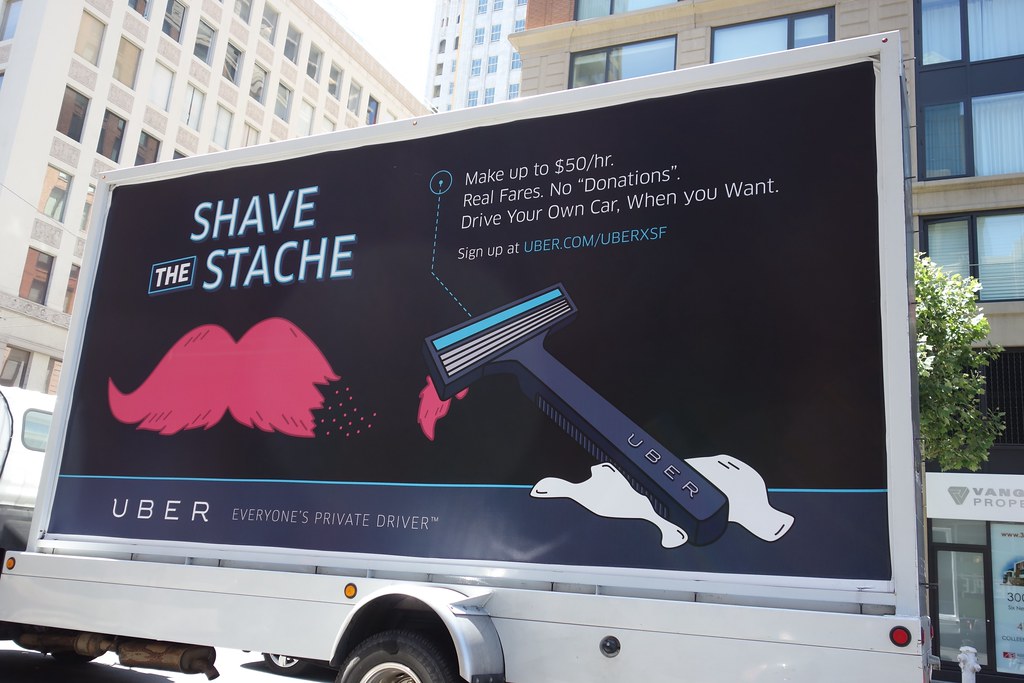
The above 2013 ad illustrates the competitive spirit embodied by Uber (originally UberCab), which quickly became, in effect if not in name, San Francisco’s largest and most politically connected cab company. Like the previous holders of this title (United Carriage and Yellow Cab), Uber has proved both technologically innovative and mercilessly expansionist (though not, perhaps, as classy; is there a tackier way to advertise than by clogging the streets with mobile billboards?)


SFMTA bus ad, 2014. Courtesy of San Francisco Citizen.

Competing trends of regulation and deregulation face off in the 21st Century. For San Francisco’s cab system, this means a contest between the city’s Municipal Transit Authority (MTA), which governs licensed taxicabs, and corporations like Uber, Lyft, and Sidecar (which, though headquartered in San Francisco, are incorporated in Delaware). At stake is not just the movements of cabs, drivers, and passengers, but the data they create as they are increasingly tracked by mobile, interconnected devices. The debate over cab regulation today is just a precursor to future conflicts over who will control the technology and information used to move cities in the coming century.

The public image of drivers for hire is up for grabs. Rideshare services ask riders to think of their drivers, not as “cabdrivers,” but as either “private drivers” or as “friends with cars;” “Hail a Fellow Human, Not a Taxi” read one rideshare-promoting headline, revealing a new (sub-"human") low in the cultural image of the cabdriver. “Do you know what you’re getting into?” responded city regulators, using this 2013 bus ad to cast suspicion back at the less-regulated “rideshare” services.

Caught in the middle are the drivers. Since the 1970s, drivers for traditional cab companies have been treated as independent contractors, with few workplace protections, no benefits, and no job security. The growth of corporate “ridesharing” services like Uber and Lyft represent a further intensification of this trend towards precarious work. Drivers have begun to organize in return: rideshare drivers have held strikes and protests to bring attention to their precarious working conditions; San Francisco’s licensed cabdrivers have formed a local branch of the AFL-CIO-affiliated National Taxi Workers Alliance, in the most significant instance of labor organizing in the San Francisco cab industry since the downfall of the old Chauffeurs’ Union forty years earlier.

What does the future hold? Will there be a resurgence of the regulated taxi model (integrated into an intelligent “transit first” system overseen by the MTA)? Or the further spread of the deregulated “ridesharing” model, controlled by multi-city (or in Uber’s case, transnational) corporations? Or will both be swept aside by the development of driverless cabs, which (depending on which expert you ask), we can expect to see within five years, within twenty years, tomorrow, or never? (Place your bets!)

(For the record, my money is on low-flying drone sedan chairs...)

The trouble with reading history from advertisements is that they tend to paint a rosier, more simplistic picture than what really exists; a deeper understanding has to be filled in from the gaps and silences that haunt the edges of the advertised image. Today we live in a world more saturated with a marketing perspective, and with the distorted view that it feeds us, than ever before. Yet, whatever the future holds, it depends on the choices we make, collectively, today. What sort of city do we want to live in? How do we want workers to be treated? And what relationship do we want to see between technology and its users? Hopefully, a little historical perspective can help us see past the myopia of the present.


(Read Part One here.)