Showing posts with label story-telling. Show all posts

Thursday, June 15, 2023

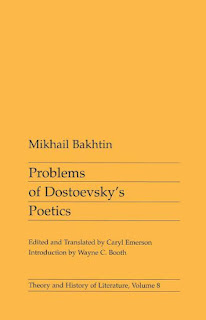
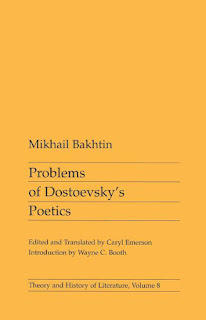
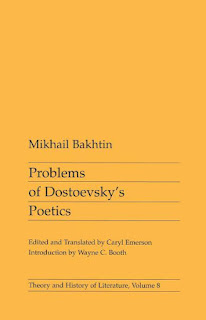
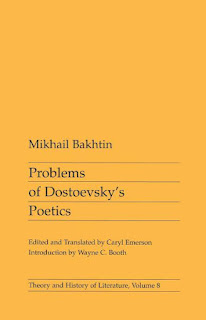
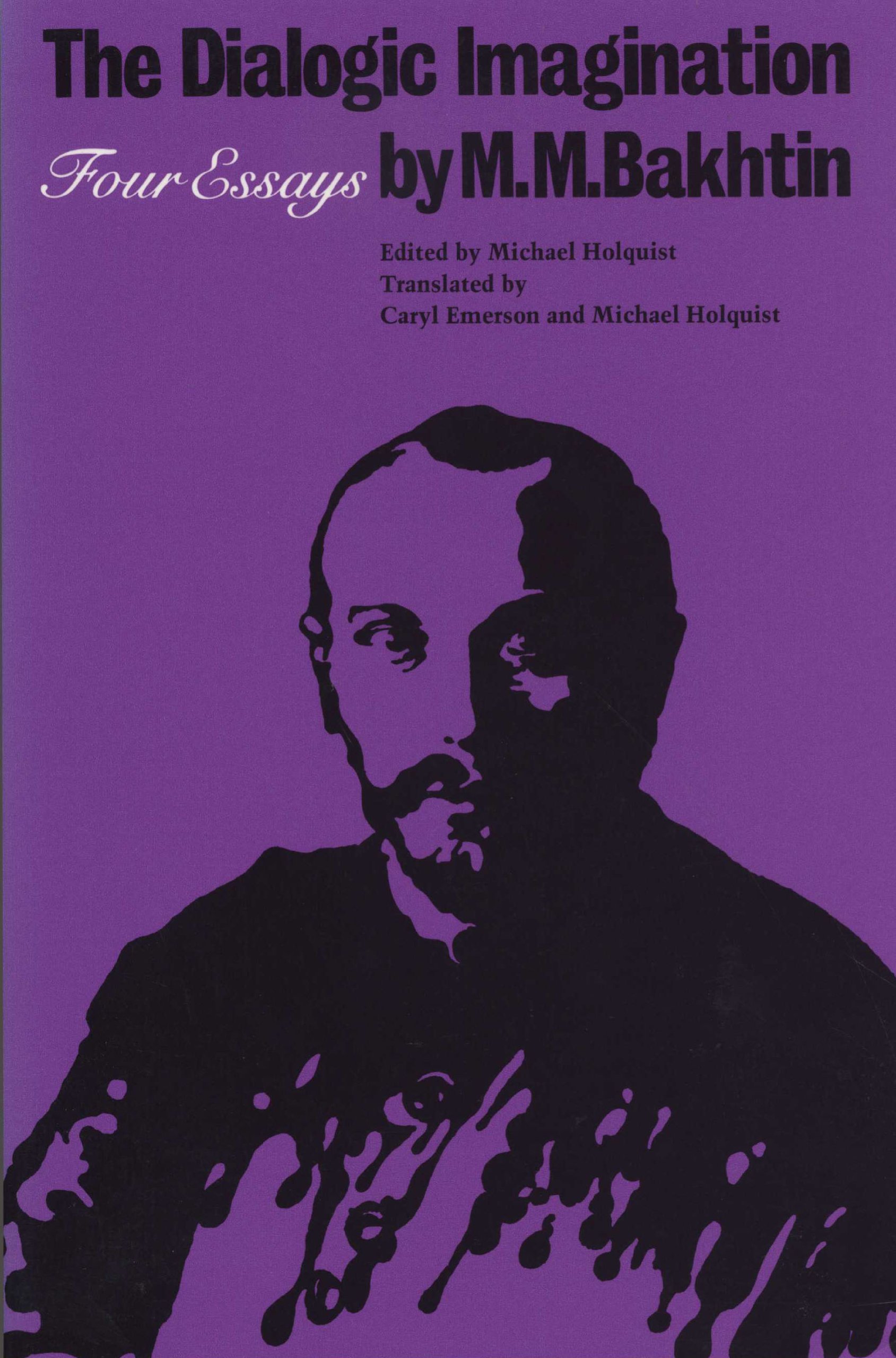
Discourse in the Novel, Part 4


 Part 4: The Speaking Person in the Novel


B starts off by restating the inherently heteroglossic character of the novel, as a form of writing that, even when it does not actually contain heteroglossia, nevertheless acknowledges its “heteroglot environment, such that even “unitary and direct” language used by an author recognizes itself as contestable, necessary of being “championed” and “defended” in a polemical environment (332). Nevertheless one of the most important ways that the novel recognizes and engages with the “heteroglossia that surrounds it,” is the introduction of characters who give voice to different languages (in B’s definition of the term):

From this follows the decisive and distinctive importance of the novel as a genre: the human being in the novel is first, foremost and always a speaking human being; the novel requires speaking persons bringing with them their own unique ideological discourse, their own language. (332)

B then clarifies this importance with the explication of three “aspects:”

1) Heteroglossic discourse in the novel is not merely “transmitted or reproduced,” as it might be, for instance, in drama; it is instead “artistically represented... by means of (authorial) discourse” (332: emphasis in original). The significance of this is that it brings in all the complexity of reported speech, and exists in a more complicated, entangled and interacting relationship, (aka orchestration) with the author’s language, than presumably would be the case in [the ideal types of] contrasting genres such as drama or epic. Cf. also the argument made by the editors in the introduction that polyphony exists only in the interaction of centripetal and centrifugal forces, not simply in one or the other.

2) What is important about speaking characters is not their actual characters or fates, but the social languages they represent, the dialogicality they introduce into the novel.

3) Speaking characters in novels are always ideologues, and their words “ideologemes” (333); this is the same point made before, above and in the Dostoevsky book, about their independence from and equality with the narrator, and ability to in principle be authors or narrator/personalities of their own.

The activity of a character in a novel is always ideologically demarcated: he lives and acts in an ideological world of his own (and not in the unitary world of the epic), he has his own perception of the world that is incarnated in his action and in his discourse. (335)

What’s important, again, is not that these are individual characters but that they are socially representative; also, that their speech is represented by the author, because this act of representation itself qualifies and undermines the independence and authority of the author’s speech (which uncontested authority it would otherwise have in the ideal types of epic or poetry). This is actually a very interesting perspective on the problem of representation, in general, as something that is inherently double-voiced, and which problematizes, rather than privileges, the voice or author doing the representing; furthermore, from B’s point of view, this is also important because it shows the actually fluid and always contested nature of language (and of languages, in all the senses B uses this word). Thus, “the central problem for a stylistics of the novel may be formulated as the problem of artistically representing language, the problem of representing the image of a language” (336: emphasis in original). Even stylization and parody are “double-voiced and double-languaged phenomena” (337).

One of B’s major goals in this section is to discuss how this artistic representation of heteroglossic speech in the novel is both related to, and distinct from, the general [citationality] of language in “extra-artistic” everyday communication. The relationship to the speech of another is central to any act of enunciation/[articulation]:

The transmission and assessment of the speech of others, the discourse of another, is one of the most widespread and fundamental topics of human speech. In all areas of life and ideological activity, our speech is filled to overflowing with other people’s words, which are transmitted with highly varied degrees of accuracy and impartiality. The more intensive, differentiated, and highly developed the social life of a speaking collective, the greater is the importance attaching, among other possible subjects of talk, to another’s word, another’s utterance, since another’s word will be the subject of passionate communication, an object of interpretation, discussion, evaluation, rebuttal, support, further development, and so on. (337)

[In the above he is basically describing the “heteroglot context” previously referred to, in which any act of articulation/enunciation takes place; also, the increased complexity or “developed” nature of a society presumably underlies the relevance of the novel in modernity, as opposed to earlier, simpler forms of society for which epic was more appropriate.] [It seems to me this historical theory of his would not stand scrutiny, however, since epic and poetry probably never really had this separate and unquestionable rigidity that he assumes in the ideal type; cf. call and response, and the whole Albert Lord argument about the situated re-working of living, oral epics in context, in each retelling.]

He writes at length about the importance of metadiscourse in everyday life and speech, and the importance of making sense and interpreting what others are saying, and saying about us, and our words, as “living hermeneutics” (338); “...in the everyday speech of any person living in society, no less than half (on the average) of all the words uttered by him will be someone else’s words...” (339). He makes an interesting point about quotation marks:

... not all transmitted words belonging to someone else lend themselves, when fixed in writing, to enclosure in quotation marks. Their degree of otherness and purity in another’s word that in written speech would require quotation marks (as per the intention of the speaker himself, how he himself determines this degree of otherness) is required much less frequently in everyday speech. (339)

The point here is the distinction between the stylistic and artistic means by which speech is artistically represented in the novel, and the way the speech of others is reported/cited/echoed in everyday speech, quotation marks being one of the “special formal devices” used in written speech, to demarcate between the author or narrator’s speech, and that of others. In everyday speech, such clear boundaries are used less often, and the speech of others flows through our mouths, and becomes our own. B expresses this in a somewhat weird way as the “engaged transmission of practical information,” which he contrasts with “artistic representation.”

For this reason everyday speech is not concerned with forms of representation, but with means of transmission. (339: emphasis in original)

On the one hand, this recreates the poetics/rhetoric distinction which imho B was rightly castigating in an earlier part of the essay. B has a valid point to make, but it may not be best served by a reductive opposition between “representation” and “transmission.” The important point is that the stakes, and the means, of orchestration, indirect speech, and so on, in everyday conversation, and in the novel, are distinct, though related. In any event B does go on to complicate the distinction by recognizing that there are “certain aspects of representability” (340) involved in this “transmission,” but insists that “[t]his representation is always subordinated to the tasks of practical, engaged transmission and is wholly determined by these tasks” (341).

Expanding on the way others’ speech is transmitted in everyday speech, B distinguishes between the two school-taught modes of “reciting by heart” and “retelling in one’s own words” (341); in the first the voices of the speaker and that of the recited text are kept clear and distinct, but in the latter they are mixed, it is double-voiced. This is a crucial part of the assumed superiority of the latter in the modern disciplinary subject, and one of those aspects of pedagogy most imperilled, or seemingly so, by the rise of AI chatbots that can spew out plausible student essays. In any event B develops this distinction into a further one, between authoritative discourse and internally persuasive discourse (342). Here, the distinction relates to the role of these received or repeated texts in the development of the speaking subject’s ideology (or “idea system”). The recited text forms an exterior, authoritative discourse outside of the speaker, to be followed or obeyed; the retold, double-voiced text becomes internally persuasive, part of the speaker’s own belief system and sense of self.

The “authoritative word” stands outside the subject and demands recognition or submission; there is a distance established between it and the subject. The subject does not necessarily respond with submission (but can be either “sympathetic or hostile,” or take more complicated positions (343); the point is that this distance is established. B states that “the degree to which a word may be conjoined with authority” is what creates this distance; he notes the complexity of this, with the authoritative word on the one hand surrounding itself with a swirl of interpreting, evaluative discourses which nevertheless are like a cushion or protective layer; the authoritative word or discourse itself remains intact, unalterable; “... it demands, so to speak, not only quotation marks but... a special script, for instance.” [Specialized religious languages like Latin, Church Slavonic, etc. come to mind, but one could think also of the logical notation of certain branches of philosophy.] B emphasizes that that [entextualized, reified] word of authority allows no play:

no play with the context framing it, no play with its borders, no spontaneously creative stylizing variants on it. It enters our verbal consciousness as a compact and indivisible mass; one must either totally affirm it, or totally reject it.

[Here, in addition to the beautifully ultra-Volosinovian phrase “verbal consciousness,” is a direct link to Rappaport’s theory of the importance of the digital/binary in ritual.]

[Somewhere around here I had a brilliant paragraph which got deleted somehow, on the relevance of Bakhtin’s points about authoritative language to modern scientific and critical approaches. Above, I put Bakhtin’s terms authoritative discourse and internally persuasive discourse originally in italics (a special script), and other phrases in quotation marks; this marks their use or invocation as authoritative discourse, drawn from Bakhtin-as-authority, and placed in his voice, not my own. However, through further discussion, I start adopting the terms on my own, without demarcation, showing the shift from authoritative into internally persuasive discourse. However, there was a further, brilliant point to be made about play and scientific/critical discourse’s relation to authority, which I can’t quite remember.]

B continues emphasizing the difference between AD and IPD: AD cannot be represented, it can only be transmitted (because representation requires that play which AD disallows). Authoritative discourse in the novel appears as a thing, a “dead quotation” (344).

At this point B starts throwing out references to a key concept, zone of contact or contact zone; with no attempt to provide a definition. And here I have lost another brilliant paragraph in which I went online, found numerous sources using the term “zone of contact” very confidently and usually with no clear definition, but with a wide range of largely inconsistent meanings. Without recreating all that iirc the common usages were that the “zone of contact” is 1) the zone in which two speakers/characters interact in speech; 2) the zone of contact between two languages (in the sense of such speakers’ languages, or social languages in society); 3) the contact between an authoritative discourse and a speaker interacting with or challenging it; and 4) contact and mutual exchange/influence between two cultures or languages (in the usual sense of the word). My sense is that definitions 1 and 2 are the closest to what B seems to intend. His point is that authoritative discourse tries to keep itself distant from this zone of contact to protect itself, as it does not want to be played with or refracted; yet speakers respond to this with struggle:

... there is a struggle constantly being waged to overcome the official line with its tendency to distance itself from the zone of contact, a struggle against various kinds and degrees of authority. In this process discourse gets drawn into the contact zone, which results in semantic and emotionally expressive (intonational) changes: there is a weakening and degradation of the capacity to generate metaphors, and discourse becomes more reified, more concrete, more filled with everyday elements and so forth. (345)

B now switches to the obviously preferred term, internally persuasive discourse. Against the discussion of authoritative discourse with imagery of “thingness” and death, IPD is all about openness, creativity, and life. There is still a struggle involved, but this is not a struggle against death but within life, over what path the subject is to take in forming themself, in the midst of so many creative and competing discursive possibilities:

Internally persuasive discourseas opposed to one that is externally authoritativeis, as it is affirmed through assimilation, tightly interwoven with ‘one’s own word.’ In the everyday rounds of our consciousness, the internally persuasive word is half-ours and half-someone else’s. Its creativity and productiveness consist precisely in the fact that such a word awakens new and independent words, that it organizes masses of our words from within, and does not remain in an isolated and static condition. It is not so much interpreted by us as it is further, that is, freely, developed, applied to new material, new conditions; it enters into interanimating relationships with new contexts. More than that, it enters into an intense interaction, a struggle with other internally persuasive discourses. Our ideological development is just such an intense struggle within us for hegemony among various available verbal and ideological points of view, approaches, directions, and values. The semantic structure of an internally persuasive discourse is not finite, it is open, in each of the new contexts that dialogize it, this discourse is able to reveal ever new ways to mean. (345-6)

The term “zone of contact” reappears:

The internally persuasive word is either a contemporary word born in a zone of contact with unresolved contemporaneity, or else it is a word that has been reclaimed for contemporaneity... (346)

So here, the contact is with “unresolved contemporaneity,” the discursive present; the word that has been reclaimed from the past gains multiple contemporaneities and contexts, retaining those from the past and gaining new ones from the present. Along with such words in IPD is a conception of the listener: “Every discourse presupposes a special conception of the listener, of his apperceptive background and the degree of his responsiveness; it presupposes a specific distance.”

B of course wants to get back around to the role of speaking characters in the novel, as a form of heteroglossic representation, and the next step he makes is to formulate a theory of what could be called [proto-representation] in everyday thought and speech [he eventually names it “organic hybridization”]. There are all these ways in which we take on others’ speech [and styles, ways of thinking and acting, etc.] in our search to develop our own self out of these influences; we crassly mimic some, transmit others, come to reject others, etc. “A few changes in orientation and the internally persuasive word easily becomes an object of representation.” By taking these words/discourse which had come to be IP for us, and placing it in the mouths of imaginary speakers, or “images” (B suggests a preacher, a wise man, a leader, for ethical, philosophical, and sociopolitical discourse); while experimenting with this discourse, “we attempt to guess, to imagine how” such a person would talk, act, and so on; and this is the [proto-representation] of characters in our own minds and speaking.

This process—experimenting by turning persuasive discourse into speaking persons—becomes especially important in those cases where a struggle against such images has already began, where someone is striving to liberate himself from the influence of such an image and its discourse by means of objectification, or is striving to expose the limitations of both image and discourse. The importance of struggling with another‘s discourse, its influence in the history of an individual‘s coming to ideological consciousness, is enormous. One‘s own discourse and one‘s own voice, although born of another or dynamically stimulated by another, will sooner or later begin to liberate themselves from the authority of the other‘s discourse. (348)

B uses the concept of “experiment” throughout this discussion: “experimentally objectifying another's discourse” allows “liberation from this discourse by turning it into an object.” I also think we can see here Bakhtin’s more complex and nuanced concept dialogism or dialogicality, substituting for the three-part dialectic movement of more standardly Marxist approaches.

B returns to his favorite subject of all time, which is the importance of Dostoevsky. There are two ways in which D’s works show “the acute and intense interaction of another’s word” (349). First, in each of his characters’ languages there is “a profound and unresolved conflict with another’s word” on the levels of lived experience, of ethical life, and of ideology. Second, the novels in their entirety are never-resolved conversations between the author and the characters, in which the characters are not subordinated to the author, and the characters always remain “incomplete and unresolved,” in other words, alive and agentive.

He spends a few pages discussing “extra-artistic ideological communication,” the very Foucauldian subjects of [veridiction and interpellation] in confession, and legal, religious, and scientific discourses; he gives some recommendations for improved methods and approaches in philology and the study of rhetorical genres.

Returning to the novel, he states that there are two ways in which this dialogized discourse is present in the novel. First, it is present in the speech of characters, and in the inserted genres; second, it is “subordinated to the task of artistically representing the speaker and his discourse as the image of a language” (355). It is this second aspect which turns out to be essential to the difference between artistic and “extra-artistic” dialogism (and to the distinction mentioned above, between “representation” and “transmission”: extra-artistic dialogism is merely concerned with transmitting the content, or information of specific statements (“isolated utterances”); only artistic dialogism endeavors “to recognize and intensify images lying behind the isolated utterances of social language, a language that realizes itself in them, but is not exhausted by them...” (356). The novel, thus, moves beyond double-voicedness to double-languagedness, the interaction and confrontation of two social languages.

A social language, then, is a concrete socio-linguistic belief system that defines a distinct identity for itself within the boundaries of a language that is unitary only in the abstract.

A social language is a “potential dialect:”

Language, in its historical life, in its heteroglot development, is full of such potential dialects: they intersect one another in a multitude of ways; some fail to develop, some die off, but others blossom into authentic languages.

Key to the distinction between, and the importance of, these social languages is not simply their differention around identities, but around ideological beliefs:

The image of such a language in the novel is the image assumed by a set of social beliefs, the image of a social ideologeme that has fused with its own discourse, with its own language.

B now delineates three categories under which “devices in the novel for creating the image of a language” may be subsumed (358): hybridizations, the dialogized interrelation of languages, and pure dialogue. Hybridization is “the mixture of two social languages within the limits of a single utterance.” This is done intentionally in the novel, but unintentional or unconscious hybridization plays an important role in the evolution and historical change of languages, as indicated above in the discussion of the formation and dissolution of dialects, and the historicity of language change. He provides the compelling image of the utterance as the “crucible” in which these hybridizations (and thus, social languages and dialects themselves, over time) are forged. Novelistic hybridization differs from hybridization-in-the-wild [which he also calls “historical, organic hybrids”] not only on account of being intentional, but by involving two individualized (as opposed to “impersonal”) language consciousnesses, that is, the image of the language is individualized or [embodied] in the voice of the author and of the character. The importance of these individuals in intentional hybridization is because these are, not merely the mixing of two languages or styles, but “the collision between differing points of views on the world that are embedded in these forms” (360). Compared to organic hybrids, that are “mute and opaque,” intentional hybrids make use of “conscious contrasts and oppositions.” Nevertheless, organic hybrids have played important historical roles, as they are “pregnant with potential for new world views, with new ‘internal forms’ for perceiving the world in words.” Intentional hybrids go beyond organic hybrids by being internally dialogic, that is, the two points of view are “set against each other dialogically.”

He goes on to talk about the relationship between the representing and the represented languages; the language embodied in, reified in the novel itself (as the style of the author), versus that embodied or represented in the speech of the characters, etc. through hybridization. He draws a contrast between hybridization “in the strict sense” and “internally dialogized interilluminations of language systems taken as a whole” (the second of his three categories, above) (362). His first example of this is stylization, which has been covered at length in his Dostoevsky book; the second is variation, which

freely incorporates material from alien languages into contemporary topics, joins the stylized world with the world of contemporary consciousness, projects the stylized language into new scenarios, testing it on situations that would have been impossible for it on its own. (363)

The writing style of Philip Reeve in Mortal Engines comes to mind: a somewhat goofy mock-Dickensian style, set in a steampunk future, with numerous quirky and witty references to contemporary pop culture, the effect being to create a completely new and unique style, mood, and voice. (A truly epic book series, unfortunately travestied by a disgracefully bad film adaptation.)

The third style is parodic stylization, in which “the intentions of the representing discourse are at odds with the intentions of the represented discourse” (364). He notes that stylization and parody form two extremes, between which there are many “varied forms for languages to mutually illuminate each other.” He ends with some observations on dialogue and plot, and summarizes his views on the importance of the artistry involved in hybridization in the novel (when it is done right), which distinguishes it from organic hybridization, as well as from the incompetent mixings of hack writers.



Monday, May 23, 2022

Discourse in the Novel, Part 3


Summary of Part 3: Heteroglossia in the Novel


This section is devoted to the “compositional forms for appropriating and organizing heteroglossia in the novel” (301), which Bakhtin lists as “comic playing with languages, a story ‘not from the author’ (but from a narrator, posited author, or character), character speech, character zones, and lastly various introductory or framing genres” (323). Beginning with the comic novel, he discusses the ways in which the speech of different social strata, etc. are incorporated via parodic stylization in which a gap is maintained between the author’s voice and a “common view” or common voice, which is presented parodically, or as a means to refract the author’s view. The distance between the author’s view and the common view is not static, but “oscillates” in a manner that allows for refraction, ventriloquation, and direct authorial discourse, in turn.

Numerous devices for blending or managing the amount of heteroglossia in a statement are described. The speech of another may be concealed in the author’s speech through avoidance of the formal markers (e.g., quotation marks, etc.) normally used in direct quotation to clearly demarcate between the author’s and another’s voices. This is an example of a hybrid construction, which Bakhtin defines as “an utterance that belongs, by its grammatical (syntactic) and compositional markers, to a single speaker, but that actually contains mixed within it two utterances, two speech manners, two styles, two ‘languages,’ two semantic and axiological belief systems” (304). Bakhtin kindly does something he does not always do, which is provide a number of clear examples of what he is talking about, from Dickens. Some of the limits and possibilities of parodic comic style is discussed in relation to authors like Rabelais, Cervantes, and others in the comic genre.

Bakhtin notes two features of heteroglossia in the comic novel: first, heteroglossia is incorporated in the form of other styles, and other voices; second, parodic stylization is used to undermine these other voices and styles, and even to undermine the concept of seriousness or truth itself. There is a link here to the concept of critique, in both its secondariness (needing something to react against), and its connection to a critical awareness resulting from some kind of break with the everyday or expected: in the case of the novel, heteroglossia is an essential component, and this is even more true for the comic novel; the author’s ability to “oscillate” between forms and positions relative to “seriousness” or the “common view” demonstrates their independence in relation to language [a la Humpty Dumpty], which is connected to their awareness of the materiality of language (324) and to their awareness of the arbitrariness of the multiple forms by which language is stratified (as per the code-switching peasant in the previous section), [and therefore also of the arbitrariness and contestability of all social order]. The institution of a “posited author” or narrator, or character telling a story within a story (e.g., Chaucer, etc.), as described as a technique for establishing and putting to use this independence.

The interesting concept of character zones is introduced, in part as an explanation of some of the earlier hybrid constructions. These are “zones” in which the perspective or voice of the character bleeds out, as it were, influencing the author’s voice or diction, beyond the bounds of their formally circumscribed voice in direct or indirect quotation. The author, again, oscillates, using a diversity of direct speech, indirect speech, and “quasi-direct speech.” Bakhtin turns to the subject of incorporated genres, which he also discusses at greater length (as “inserted genres”) in the Dostoevsky book.

Having summarized the different means for incorporating and organizing heteroglossia in the novel, Bakhtin provides some useful definitions and discussion of heteroglossia and double-voiced discourse, and re-emphasizes the difference between such true double-voicing and the use of ambiguous language in poetry. He uses an interesting metaphor, in describing double-voiced language as containing a dialogue “as yet unfolded” (324) [which I at first took in the opposite, as in “as yet to be unfolded” – the dialogue in the heteroglossic word being not yet unpacked or drawn out into a real dialogue, but only being in potential, folded up and waiting. However, he is apparently saying the opposite, that a dialogue is a process of folding, perhaps of creating new relationships or oppositions, etc. – Deleuze of course would have to be folded into this. But Bakhtin only mentions this metaphor in passing, and does not develop it.]

He distinguishes between individual and social heteroglossia (the latter is more important), and discusses the importance of the unfinishedness, and openness, of language, which is relevant to his concept of the novel as a form which marks and makes more full use of this openness, instead of fighting against it, as he argues poetry does (326). He describes poor novelists as “unable to attain the heights of a relativized, Galilean linguistic consciousness” (327) which makes clear the stakes he sees here: the novel allows for a Galilean relativistic consciousness of language. That is, revolutionary and world-transforming, tradition-shattering, like the perspective of Galileo. He notes that all writing goes through this encounter with the voice and words of others, that is with a heteroglot, dialogicized world – but that poetry (for example), in its attempt to produce at the end of this process a pure, unitary form, clears away all the “slag of the creative process … as scaffolding is cleared away once construction is finished” (331). Prose, in contrast, leaves in and delights in this mess, as part of its

deliberate feeling for the historical and social concreteness of living discourse, as well as its relativity, a feeling for its participation in historical becoming and a social struggle; it deals with a discourse that is still warm from that struggle and hostility, as yet unresolved and still fraught with hostile intentions and accents... (331)

Prose does subordinate this discourse to the unity of its style, but this is a “dynamic unity.”


Friday, March 25, 2022

Questioningly


I would like to discuss the example of two competing versions of some lyrics by one of the great 20th-Century poets, Jeffrey Hyman (aka Joey Ramone). The printed, “official” (boo, hiss) version uses direct quotation of speech, whereas the lyrics as (apparently) sung use indirect quotation; this has pronounced effects on the way the subjectivities of the speaker and his interlocutor are developed in the song itself

The lyrics, as found online, are as follows:


Questioningly, her eyes looked at me,
and then she spoke, “Aren’t you someone
I used to know, and weren’t we lovers
a long time ago?”

Looked at her close, forced her into view,
Yes,” I said, “You’re a girl
that I once may have knew.”

In this version the reported speech (including that of the I who is reporting) is carefully bracketed and kept separate from the narrative itself. Self and other are kept carefully apart and communicate solely through speech, in fact through implausibly blunt, stagey speech. Compared to the sung lyrics (below), much of the development and nuance has been sacrificed so that “clear-cut, external contours” can be maintained, in accordance with the style of “authoritarian dogmatism” as per Volosinov/Bakhtin. Note (as you probably have) that in this direct-quotation version ends with a particularly egregious example of poetic license overriding syntax (“I once may have knew”) ( as well as the clumsy use of spoke instead of said in the second line).

Whether as an effect of the gap between script and performance, dialectal pronunciation, melismatic rock crooning, or some combination of these, the sung version, as I hear it, differs through the use solely of indirect quotation (if even that), which leads to a process of progressive contamination of (and struggle over) the subjectivity of the first-person narrator, who is also a character.

Questioningly, her eyes looked at me,

In the first line, the agent is not “her” but “her eyes”, a clue to the fact that visual rather than aural communication will remain central to the account.

And then she spoke unto someone I used to know,

The first-person narrator apparently agrees with Goffman that the “I” by which we refer to ourselves is “a figurea figure in a statementthat serves as the agent, a protagonist in a described scene, a ‘character’ in an anecdote, someone, after all, who belongs to the world that is spoken about, not the world in which the speaking occurs” (Goffman 1981: 147). He uses the flexibility this creates to avoid being addressed by making a perhaps Sartrean distinction between the I of Es and the I of Et (which becomes split into I and someone). Becoming unstuck in time, he does not recognize her as addressing him, but as addressing “someone I used to know,” even though this someone is his past self with which he refuses to identify.

and weren’t we lovers a long time ago?

This apparent quotation could be considered a mid-sentence split suddenly developing between the “narrator” (as a function of the narrative) and the first-person character, but I think its more productive to think of it as the dissolution of the first-person narrator’s ego.

The change of voice in mid-sentence (especially with that “and”) obviates the narrator’s attempts at avoiding identification: instead he is subsumed into the “we” who are both subject and object of this question. It is not clear if these words are in fact spoken, or by whom; they may be communicated by her eyes, or be posited necessarily by the very fact of these two people meeting each other’s glances. In a way this line is not quotation at all, but a metalinguistic commentary on the interaction itself.

Looked at her close, forced her into view,

Nietzsche may have felt that to speak of an “I” who “acts” is a needless doubling, a mistaken positing of cause and effect, akin to saying that “lightning flashes” (which is to divide the event into subject and action). Joey’s narrator, however, is here trying to regain his I-ness through first-person action, even if he not able at this point to regain “I” per se. Specifically he seeks a position as Cartesian subject, looking out at the world, and distinct from the world by means of this looking. So to “force her into view” is to regain his own identity from the encompassing we-ness of the previous line (and to describe the action in this way, as the narrator does, is metapragmatic commentary on the interactional effect of such a move of “close looking”).

just to say, you’re a girl

“You’re a girl” is not necessarily spoken out loud, its “saying” being more an effect of his looking, which repositions her as “you.” He is now ready to restore himself to being an “I”, but things will then rapidly fall apart again. This dissolution over the next line is accentuated by the music which consists of descending heavy, lingering chords, which each play predictable roles within the self-referentially “classic” rock model in which the song is written:

                         That

[Fourth]            I

[Minor Sixth]    once

                          may have

[Fifth]                knew


The confident fourth chord with its I is swiftly undermined by the troubled sixth, during which the narrator again tries distancing tactics (“once,” “may have”). But by the final fifth, which marks this part of the song as unresolved (it needs to end on a first), the narrative ego is again dissolved into a “he” or more probably the returning “we”, subject of “knew;” his belonging to this we is in fact the central message of the song, a message which the author resists, but which, in the interaction within which he finds himself, he cannot avoid voicing.

This interpretation of the lyrics (whether or not it is correct) leads to a much more nuanced understanding of the shifts of subjectivity involved. However, looking back at the direct-quotation version of the lyrics, the stilted, cartoonishly archetypal confrontation can now be seen as itself a metalinguistic reference to the more subtle, interactionally metapragmatic possibilities exploited in the indirect-quotation version. It therefore becomes clear, in the over-directness of their statements, that the interlocutors may not be “speaking” these words after all, but “saying” them nevertheless.


Goffman, Erving (1981) Forms of Talk. University of Pennsylvania Press, Philadelphia.


Tuesday, March 1, 2022

Limits of Critique, Chapter 3


Summary of Chapter 3: An Inspector Calls


In this chapter Felski explores the connections between the practice of critique in literary studies, and the detective novel. Both have certain continuities, such as the presumption of some crime or mystery to be solved, and a particularly insightful character who solves this crime or mystery. She does not focus, again, on the sociological context (which would have been more interesting imho) in part because she wants to highlight the rhetorical aspects of this connection. For instance, she points out that literary studies, like novels, have plots or “plotting” and that suspicious readings are one of these typical, and culturally recognizable and invocable, plots: one of the central stories or familiar narratives by which authors and readers are prepared to organize the books they encounter, and understand their relation to the world. One of her key charges is that suspicious readings, like detective novels, blend interpretation with moral judgment, and thus take a normative, judgmental position on the “crimes” they are solving or revealing.

She points out that both detective novels and literary critiques have a double plot: one involving a criminal and a crime, the other involving a detective who solves the crime. In the detective novel the criminal is revealed to be a particular person, the crime is individualized; in critique, on the other hand, the culprit is “a text, genre, or linguistic structure” rather than a particular writer; however, Felski argues that these “nonhuman forces” are “personified” because they are imputed “intentions, needs, or desires” (94). It is not clear to me why imputing causality or even agency to a “nonhuman force” should be the same as “personification;” Felski insists on this because the next step is the assignment of guilt to the personified force. Both this move of personification, and the linked one of moralizing judgment, may well have plenty of exemplars (she cites several), yet it seems more than a bit forced to insist that these are qualities of every kind of critical reading. Then again, she is taking a somewhat polemical approach: she is using categorical language here, but later on will qualify this and bring more nuance into her account.

This is also the first of several points in the chapter where I wondered when she will call herself out for the obvious ironies of her position: she is herself investigating the crime of suspicious reading, identifying a non-human “critique” as guilty party, and assignment the blame of the crime of moralizing judgment. Assuredly, she must be fully aware of this irony, and also that readers will be aware. In fact, not until late in this chapter does she give any recognition of this, acknowledging her own attempt at “a nimble two-step without tripping over my own feet, both agreeing and disagreeing with my fellow critics of suspicious reading” (113). My only thought is that she is refraining, intentionally – perhaps, in order to distance her own authorial position from that of some of the critics she is critiquing – specifically, the postmodern, Foucauldian ones she will get to later in the chapter – who would take the position of delighting in such irony. Felski perhaps wants to avoid this, by now, somewhat cliché stance, and could also be intentionally not making the jujitsu power move, of calling oneself out in order to forestall the reader’s ability to do so. There has been no clear indication of this, but could one of the aspects of a postcritical critic, as we are told we will find in the final chapter, be this sort of non-parrying exposure, intentionally leaving insights and authority to the reader instead of claiming or attempting to corral as much as possible for the author?

Some aspects of the practice of critique she is critiquing:

The critic thus assembles a line of argument that correlates textual clues to larger social conditions that the work is anxious to paper over. (96).

(Felski incidentally is innocent of this by default, because her approach is rhetorical rather than sociological). Despite their claims that they are uncovering what is hidden, Felski insists that “the critic does not uncover guilt so much as generate it out of the axioms of her own interpretative practice.” Again, this is a surprisingly simplistic insistence on the reality vs. irreality of that which is “uncovered” vs. “generated” by critique, and also notably an insistence that these must be exclusive of one another.

She turns to the topic of “metasuspicion,” aka post-structural critiques of suspicious reading. Here, “suspicion is not eliminated or eradicated but ratcheted up a few more notches and applied with fresh zeal to a fresh target” (105), even “scrutinizing its own motives in a self-reflexive loop of spiralling distrust” (106). This is the practice she calls the “critique of critique” and which she herself intends to avoid:

The more vigorously critique is interrogated, after all, the more we seem to reinforce the very style of thinking we are trying to avoid. (107)

It seems a bit ironic, given that she lists “Foucauldian critics” among her main targets here, that her criticism at this point to be is essentially that of the “blackmail of the enlightenment.” She also, at least at this point, is not addressing the disabling aspects of such critique – neither, on the one hand, the strategically political disabling of dominant narratives that Foucault discussed as one of his motives; nor, on the other hand, the power move such critiques can make to choke off or render less practicable some particular practice of critique (e.g., the Freudian methods she mentions these critics as targetting).

Having set up this encounter with “Foucauldian critics” and the critique of critique, which she promises will come in the next chapter, she then shifts tone and starts discussing the positive, attractive and pleasurable aspects, even the enchantment, of the “art of critique.” [This bears a superficial resemblance to D&G’s practice, in A Thousand Plateaus, of setting up dichotomies in the first half of a chapter, then dissolving these dichotomies later, in an attempt to get past the concept of dichotomy; however, Felski’s acknowledgments of nuance are temporary, and Bakhtin might say, orchestrating; they are a momentary diversion from her polemical stance, which returns at the end.] Critique can provide a “jolt in perspective” (109) and can take the form of “addictive play” (110); she even notes the positive impacts that critical readings can have (115). Here is where she acknowledges her “nimble two step” of trying to both agree and disagree with the critics of critique, as she states that “critique is not a capital crime” (it is not in itself bad) but “only a misdemeanor” (in other words, it is still to be avoided). She reiterates her charges that suspicious readings involve personification and moral judgment; more tellingly, imho, she charges it with having become predictable (114) and even banal (115-6): “it no longer tells us what we do not know; it singularly fails to surprise” (116). This observation immediately strikes me as dependent on the sociological and political context of critique (which she has excluded from consideration; it also seems to distinguish her ultimately playful and opening-up (though along the way moralizing) critique of critique, from Latour’s more closing-off critique; perhaps because the stakes and context of discourse (who argues or takes what positions against whom, and to what ends) are very different in their respective fields.


Wednesday, February 2, 2022

Problems of Dostoevsky's Poetics, Conclusion


Summary of Conclusion

Bakhtin summarizes his point that Dostoevsky is brilliant and the polyphonic novel provides important insights. It is an example of the artistic consciousness catching up to the scientific consciousness of complexity a la Einstein, etc.

In this book we have sought to reveal the uniqueness of Dostoevsky as an artist, an artist who brought with him new forms of artistic visualization and was therefore able to open up and glimpse new sides of the human being and his life. Our attention has been concentrated on that new artistic position which permitted him to broaden the horizon of artistic visualization, which permitted him to look at the human being from a different artistic angle of vision. (270)

 Polyphonic thinking could expand beyond the novel:

This mode of thinking makes available those sides of a human being, and above all the thinking human consciousness and the dialogic sphere of its existence, which are not subject to artistic assimilation from monologic positions

 The polyphonic novel will not replace the monologic one, but it will provide greater insight and an ability to live in the more complex world we find ourselves in. There is an argument similar to that made by Norbert Weiner (who I am also reading), that Twentieth Century scientific understandings of complexity have made it clearer that we don’t need to cling to solid and monologic categories and modes of thinking; with polyphony, the artistic consciousness is catching up to the scientific:

The scientific consciousness of contemporary man has learned to orient itself among the complex circumstances of "the probability of the universe"; it is not confused by any "indefinite quantities" but knows how to calculate them and take them into account. This scientific consciousness has long since grown accustomed to the Einsteinian world with its multiplicity of systems of measurement, etc.

… We must renounce our monologic habits so that we might come to feel at home in the new artistic sphere which Dostoevsky discovered, so that we might orient ourselves in that incomparably more complex artistic model of the world which he created. (272)


Tuesday, February 1, 2022

Problems of Dostoevsky's Poetics, Chapter 5, Parts 2-4


Summary of Chapter 5, parts 2-4

Compared to the extremely dense first part, the next three parts of the chapter are much fluffier and are mostly composed of specific examples from Dostoevsky's books.


Part 2: The Hero's Monologic Discourse and Narrational Discourse in Dostoevsky's Short Novels

This part of the chapter is mostly examples from the shorter novels of phenomena Bakhtin had already laid out. Prominent are The Double and Notes from Underground. B talks about the "word with a sideward glance" at another discourse or perspective; three voices (apparently the original voice, the imagined second voice, and a third that unites them), "loopholes" etc.


Part 3: The Hero's Discourse and Narrative Discourse in Dostoevsky

Bakhtin explores the internal dialogue and regular dialogue of heroes in Dostoevsky, particularly Raskolnikov, for whom other characters are “ideological positions,” that he reacts to and is in dialogue with, and places in dialogic juxtaposition with each other. Heroes reveal themselves or learn to situate themselves in a field of inter-orientations. "Penetrated word" (“a word capable of actively and confidently interfering in the interior dialogue of the other person, helping that person to find his own voice” (242)) and "penetrated discourse" (“a firmly monologic, undivided discourse, a word without a sideward glance, without a loophole, without internal polemic” which is nevertheless “only possible in actual dialogue with another person” (249)) are defined, though they seem to be opposites; the former is discussed but not the latter much. He ends with a reference to unfinalizabilty and the  fact that the narrator's voice does not dominate. 

He states that in Dostoevsky's novels, almost no evolution of thought happens; characters never change their perspective; when something happens, they knew it was going to happen, and are not changed by it. [Why would Bakhtin consider this good? Because surely everything Dostoevsky does is the most awesome thing possible... I guess the point is that such change in the character would be an internal situating; what Bakhtin wants is social situating, the interplay of ideas in a social setting, not just the internal development of an individual.]


Part 4: Dialogue in Dostoevsky

Bakhtin summarizes he importance of dialogue in Dostoevsky's works. Particularly emphasized is that external dialogue is always related to internal dialogue; sometimes speakers in external dialogue are responding to (wittingly or not?) another speaker's statement in an internal dialogue. It is also emphasized that the dialogue is not plot-dependent: though it still follows and relates to the plot, it has an openness or "unfinalizability.” He also talks about how words and themes "pass through" many different voices (the image reminds me of a motif in music, picked up and transformed through different instruments, etc.) – fitting for Bakhtin’s ideal of “polyphony” in the novel. (An example that comes to mind is the phrase “the lesser evil” in the Witcher story of that name).

A character's self-consciousness in Dostoevsky is thoroughly dialogized: in its every aspect it is turned outward, intensely addressing itself, another, a third person. Outside this living addressivity toward itself and toward the other it does not exist, even for itself. In this sense it could be said that the person in Dostoevsky is the subject of an address. (251)

[This marks an interesting potential link with interpellation; Dostoevsky's subjects are highly conscious of, knowingly dependent on, their interpellation? Some echo of Volosinov’s insistence that there is no interiority beyond or before language seems to link here as well.]


Monday, January 31, 2022

Problems of Dostoevsky's Poetics, Chapter 5, Part 1


Summary of Chapter 5: Discourse in Dostoevsky, part 1: Types of Prose Discourse. Discourse in Dostoevsky


This part of a four-part chapter is simply massive in terms of its theoretical content. Most importantly, Bakhtin lays out a three-part outline of different kinds of discourse (with multiple subtypes within the three). This is discussed throughout before being summarized in outline form on page 199 (it would have been easier to follow if the outline had appeared first). The three kinds are:

1) “Direct unmediated discourse directed exclusively toward its referential object”

2) “Objectified discourse (discourse of a represented person)”

3) “Discourse with an orientation toward someone else's discourse (double-voiced discourse)”

The third has three subcategories, and the list appears to be a more elaborated version of the 5-part list from “Discourse in the Novel.”

As he goes through this outline, numerous key concepts are elucidated. One is metalinguistics, Bakhtin’s project for a linguistics that goes beyond the textual limits of his day, to understand “discourse as concrete lived reality” (181). He talks about things like the speech characterizations of characters, to what extent these characters become more distinguished in speech, etc. from the voice of the author, which means they are more objectified (elsewhere he has called this “stylized,” though perhaps that means objectified with the voice of some particular group in society). (On second thought these might just be differing translations of the same word in Russian).

He brings up criticisms that have made of Dostoevsky, that his characters speak the same way he does (there is less “speech characterization); Bakhtin’s response is that this makes Dostoevsky less objectifying, and thus more dialogical, than other authors. This "speech characterization" I have seen, for instance, used to caricature passengers in (certain) taxi memoirs, and it distances and objectifies the voice and character of the passenger from that of the driver/narrator (though this is sometimes perhaps not itself so an intent at monologicality or orchestration, but rather shows a lack of ability or competence of the driver/author to represent or speak for (re-voice) the passenger). Also this seems a good place for a nod to Jack Vance, whose characters who all speak in the same stilted, witty manner as the author.

Dialogic relationships are the subject matter of metalinguistics; as Bakhtin is pointing out, these can also be found within texts, not just outside of texts. He gives examples of various "judgments," (statements), and how they can be or not be in dialogical relationships; this is a key point where his relationship to Volosinov and to Foucault can be elucidated. There seem to be at least four aspects of these dialogical relationships: they must be 1) discursive [they are not relationships per se, but relationships in discourse); 2) embodied (they are not just potential linguistic or articulatory positions, but they have to actually be taken and voiced; 3) they require a logical connection to a referential object; and 4) as utterance in discourse they need to receive an author [or subject position they are voiced by or attributed to]; this could be a real author (as in a speaker or writer of the utterance), or one to whom they are being attributed (such as a character in a story or in double-voiced speech) . [Presumably two judgments being expressed by the same character could be dialogic if the character is shifting positions in an internal debate. Anyway this whole approach seems contrary to Foucault's in the Archaeology of Knowledge.]

An example of a judgment: "Life is good." "Life is good." This is the same judgment repeated twice: the two are separate "verbal embodiments" [utterances] of the same judgment, and can also be placed into dialogic relation (e.g. as two characters agreeing].

The issue of the objectification of another's speech comes up, and this is explored through the different forms this takes in the different discourse types. He also discusses all these types as historical phenomena, making remarks about "epochs" (Classicism, Romanticism) in which different discursive possibilities were available to authors. Bakhtin's point is that the modernist idea of “access to one's own personal ‘ultimate’ word” (202) is a historical condition – in some epochs there is permitted "the ultimate semantic authority of the creator to be expressed without mediation in direct, unrefracted, unconditional authorial discourse" which presumably means modernism (Whitman comes to mind in this regard, as a representative of prose invading poetry). In other epochs, dominated by stylization, the author must speak through the words of others (he calls this “refraction”). However, the fact that Bakhtin's words above sound pertinent today – despite our prose and freedom from stylistic conformity, two aspects that Bakhtin sees as crucial for the modern authorial subject – indicates that for other reasons the independence of the author has become questioned, or culturally fraught as a concept; thus refraction seems more fitting than Bakhtin apparently felt it was (cf. all the communication done through “sharing” and “liking” today). Which leads to a second question: I think Bakhtin is setting up the concept of independent authorial discourse as a historical phenomenon here; this same authorial discourse is what he is in fact critical of, and wants to fight or undermine with polyphony. Yet if this sense of authorial independence has been weakened, is this a result of the polyphony Bakhtin celebrated? Or by something else, meaning the power of the author is less serious of a problem than he presumed?

Without naming them as such, he also discusses the concepts of citationality and orchestration.


Sunday, January 30, 2022

Problems of Dostoevsky's Poetics, Chapter 4


Summary of Chapter 4: Characteristics of Genre and Plot Composition in Dostoevsky's Works


This lengthy chapter could possibly have been several chapters, as it travels from one subject to another. Several genres of the seriocomic are covered, in long lists of “aspects” which often seem they could have been combined into shorter lists. In the first part, Bakhtin discusses how Dostoevsky’s novels are similar and different from other novel forms of the day, including social and biographical novels, but also adventure and “boulevard” novels.

After this he starts talking about carnivalization, and goes back to the Menippean/seriocomic tradition of antiquity, in genres like Socratic dialogues, diatribes, etc. These are examples of ancient carnivalized literature and their influence on later ages is traced. He delineates the aspects of the seriocomic: 1) it is set in present as opposed to ancient or legendary time; 2) it relies on experience (the world around you) rather than legend/myth; 3) it is multi-styled and hetero-voiced.

He treats Socratic dialogue as a sub-genre of the above, with the following aspects:

1. an assumption of the dialogic nature of truth, which is something to be sought out through dialogue (an interesting connection to Detienne's thesis of the changing nature of truth at that time); an opposition to monologism

2. syncrisis (juxtaposition of views) and anacrisis (provocation, e.g. through plot or situation)

3 heroes as ideologists (meaning that the characters engage in explication of ideas)

4. (along with the above) idea is combined with a person, as the image of an idea.


The characteristics of Menippean satire, another seb-genre of the seriocomic:

1. more comic than Socratic dialogues, but this can take form of "reduced laughter"

2. fantastic plot/setting, which allows invention

3. the plot plays a role [as anacrisis?]

4. combination of the fantastic with "slum naturalism"

5. universal, ultimate questions

6. "three planed construction" of movement between earth, heaven, and hell, creating many "dialogues on the threshold"

7. "experimental fantasticality"

8. "moral-psychological experimentation"

9. "scandal scenes" and inappropriate behavior

10. contrasts, combinations, reversals, etc.

11. social utopias in dreams and journeys

12. "inserted genres" [probably akin to the relevance of reported speech in Volosinov]

13. multi-styled, multi-toned

14. concern with current and topical issues


Bakhtin distinguishes between the "objective memory" of genres as opposed to the "subjective memory" of individuals; this allows a tracing of the origins of the novel in carnivalization, whether or not the authors writing them are aware of these influences. However, these earlier genres do not fully develop polyphony: Dostoevsky's big improvement over these ancient sources will be his full use of polyphony, which they lack.

Bakhtin then talks about carnival and carnivalization, very similar to his Rabelais book which he was apparently revising for publication at the time he was rewriting this book. Carnivalistic senses: (numbering not quite clear):

1. upside down/reversal

2. eccentricity

3. "mesalliances" (indiscrete or inappropriate mixing of opposites/contrasts, like laughing corpses)

4. profanation

Perhaps the most important thing about carnival is its revolutionary potential:

Carnival is the place for working out, in a concretely sensuous, half-real and half-play-acted form, a new mode of interrelationship between individuals, counterposed to the all-powerful socio-hierarchical relationships of noncarnival life. (123)

Bakhtin next talks about the carnivalistic act of crowning/decrowning; the ambivalence of this is key. Ritual laughter is always aimed at that which is higher. The most important site of carnival is the public square; this appears in reduced or bourgeois forms as parlors, etc. He talks about the debasement of the sense of carnival in later ages, and its bourgeoisification (not in those precise words) or domestication as it becomes part of the novel etc.; then he goes back to Socratic dialogues and then again to Menippea. Finally he turns to a series of texts by Dostoevsky to discuss how they are menippean.

One important point Bakhtin makes is regarding catharsis: he supports a concept of this distinct from Aristotle's based on tragedy, what could be called an [ambivalent] catharsis, linked to ambivalent laughter; catharsis that implies that nothing is conclusive. [Arguably Bakhtin insists this is "catharsis" only because he believes in the "unity" of the work; it is catharsis by definition, and so Brechtian anti-catharsis could conceivably be called Bakhtinian catharsis.] He also includes notes on Dostoevsky as a responder to capitalist modernity, as his style of writing is designed for this and influenced by this context. Bakhtin ends the chapter with the observation that Dostoevsky is most important for bringing the polyphony, building something more out of the menippean tradition.


Saturday, January 29, 2022

Problems of Dostoevsky's Poetics, Chapter 3


Summary of Chapter 3: The Idea in Dostoevsky

This chapter concerns Dostoevsky's use of "ideas" in his novels, and how this differs from their treatment in monologic novels. Dostoevsky was interested in being an "artist of the idea" and always has some idea which is the central motivation for each novel; however, he does not impose this monologically on his novel, but instead sets it in conversation with other ideas, other voices; it is only in this way that an idea can become "full" or "fully realized" or something like that. Dostoevsky's heroes are also "ideologues" who engage in commentary and explication of ideas through their engagement with the world and other characters/voices. There is a link between this engagement and the "confessional discourse" and self-consciousness of the characters: this provides a link between dialogicity as articulation, and as subjectification. 

In the "monologic world" of a monologic text, thoughts can only be affirmed or denied. The dialogic approach does neither of these, but instead has a third way. Bakhtin traces the history of modern monologism with the growth of rationalism [and thus of the abstract subject]. A monologic author expresses directly their own view, but represents others (or perhaps does not even fully represent them; anyway “representation,” meaning a fixed image, is monologic not dialogic, and subordinates the ideas and voices of the others to the control of the author). In the dialogic novel, in contrast, there is an unfinalizability of characters, and a plurality of independent "voice-ideas" which the hero or the author is able to hear and interact with.

Another key concept is the "form-shaping ideology" or "form-shaping worldview" which governs how ideas and interactions work and are depicted in his novels. "Dostoevsky's form-shaping ideology lacks those two basic elements upon which any ideology is built: the separate thought, and a unified world of objects giving rise to a system of thoughts"(93). [So it both is, and isn’t, an “ideology?”] This is a fairly direct contrast to the way statements and discourses work in (for example) Foucault's Archaeology of Knowledge, and in Deleuze's book about it. Bakhtin instead focuses on the "position of a personality," which could presumably be equated with subject position. [Perhaps it could be argued that this is more like the more bottom-up approach which Foucault subsequently took up after the archaeology of knowledge]. Actually it seems like Bakhtin is saying that Dostoevsky focuses on the "integral points of view" of integral personalities, rather than on statements/utterances (like both Foucault and Volosinov), so Bakhtin's point here might not be as radical as he thinks it is. 

Dostoevsky (or his heroes) "thinks in voices," and moves in a "labyrinth of voices." Bakhtin attacks aphorisms because they separate the word out from its actual context, treating it as self-complete, something that nothing is, according to Bakhtin (cf. Debord’s similar critique of quotations). Instead of a monologic "I" judging the world, there is the interrelationship of "cognizant and judging 'Is' to one another" (100).


Friday, January 28, 2022

Problems of Dostoevsky's Poetics, Chapter 2


Summary of Chapter 2: The Hero, and the Position of the Author with Regard to the Hero, in Dostoevsky's Art

In this chapter Bakhtin lays out his theory of the polyphonic novel with regard to the relationship between the author and the hero. Essentially, they each have their own voice, and neither is superior; whereas in the monologic novel the author has a "surplus" of knowledge available, over and above all the characters, in the polyphonic novel the author has no surplus. [But I wonder what happens when the author/narrator is one of the characters? Despite the first-person Notes from Underground, Bakhtin dismisses first-person narration as a trick that does not really compromise the power of the author.] Dostoevsky depicts, not the reified image of a character (which would be monologic), but the self-consciousness of the character. (Although "chunks" of monologic style persist within the dialogic novel, this does not prevent the latter aspect from forming the most important part of it).

Characters also give voice to "double-voiced" speech (often imagining the words of others about themselves, and responding) in "microdialogues". This involves them enunciating potential statements that others could make, mostly about themselves – in other words, engaging in articulation, largely in relation to the process of interpellation. "Truth" also is shown to be relative to the speaker's subject position: the same statement voiced by a person within their own self-consciousness becomes a lie from the outside as a reification [this and related parts are strongly reminiscent of Volosinov]. The concepts of unfinaliizability (a character who is unfinishable, existing as more than the author or narrator can contain or represent), and dialogicity (statements existing in relation to other statements), are explored.


Monday, January 17, 2022

Society of the Spectacle, Chapter 8


Chapter 8: Negation and Consumption Within Culture


In this chapter Debord takes on "culture," by which he means "the general sphere of knowledge and of representations of the lived; ... the power of generalization existing apart, as division of intellectual labor and as intellectual labor of division." (180) Mostly he means art and the academic disciplines, which will be his primary focus as examples of "culture." Culture in this sense is not an eternal aspect of humanity, but something that came about, or came about as something with its own existence, only after the dissolution of the unifying power of myth. Culture appears to be the separate and partial representation of the unity of society, within the post-Myth society of the spectacle. It inherently fails in its intent to represent or create unity. It is characterized by a struggle between tradition and innovation, in which innovation always wins and is then superseded by a further innovation. In 182 he references the death of God as the "first condition of any critique," but this sets up the condition of a "critique without end." It seems that this critique without end is a good thing because it destabilizes the foundation of the knowledge about society created through this critique; unless he means to imply that critique without end is a bad thing, because it never leads anywhere and does not actually challenge the spectacle (later he calls this aspect the "spectacular critique of the spectacle"). (This later aspect of “critique without end,” is part of the target of postcritique).

One confusing aspect of this chapter is his repeated use of terms like "collapse," "negation," "disappearance" ... it is hard to know what he means (e.g., "In this search for unity, culture as a separate sphere is obliged to negate itself." (180) My guess is that this is a use of dialectic terminology: culture becomes its own antithesis or negation. Or maybe some kind of consumption or using-up is implied, I have only a vague recollection of terms like "the enjoyment of pure negation" from Hegel. In either way there are two "ends" of culture: one as a dead object in the library/museum/archive/etc. of the society of the spectacle; the other is as the supersession of culture in "total history," i.e., revolution. So it is possible that all these instances of negation, disappearance, and collapse refer to this ambiguity, an end that is on the one hand a supersession, or possible supersession, and at the same time a death, an objectification into the spectacle.

 Debord sets up an opposition between fragmentary knowledges which uphold the spectacle, and the critique of the spectacle through praxis. 

He goes into a critique of art (starting c. 186), with the big break being the Baroque period, which is the first to depart from the society of myth and the mere communication of the ideology supporting the church and nobility. The Baroque brings in the everyday, choosing "life against eternity," it is the "art of the change" and allied with theater and festival [hints of Bakhtin] (189). Debord points out how the various attempts at classicism, as reactions against the Baroque, inevitably fail because of the ridiculousness of the bourgeois (even as revolutionaries) dressed up as Romans (the story of George Washington’s statue by Houdon fits well here). Instead, the later movements which "followed the general path" of the Baroque, (Romanticism, Cubism, presumably the other isms), ended up being an art of negation increasingly fracturing itself and its representation of the world, thus negating culture as such a representation. Inserting my own interpretation a bit, this must on the one hand be good as it leads to supersession/critique; but also bad in the way it ends as a dead object, indeed creating the possibility of art history, which looks at the art of all previous periods as collectibles, souvenirs, which can all be admitted and admired because they no longer have any power: "they no longer suffer from the loss of their specific conditions of communication in the current general loss of the conditions of communication." (189)

[Debord does not of course call this last observation the "postmodern condition" but I feel it is. I am immediately reminded of the ISIS soldiers defacing ancient Lamassu and the shock this generated in the West: in a limited sense, the destruction of the Lamassu was the first example of treating them with any respect in a long time -- the first time they were recognized as having power independent of the current system of collection and interpretation (i.e., the spectacle). (Of course this is only a partial sense, because ISIS were very much involved in the spectacle, and staged these destructions to trigger the west; they also looted and sold artifacts, and thus engaged in the art market).]

He notes what I call the paradox of the avant-garde, which is that the avant-garde seeks the supersession of culture (he calls it a "negative movement," which is a good thing for Debord). He criticizes Dada and the surrealists as being two partial critiques (one to suppress, the other to realize art). "The critical position later elaborated by the Situationists has shown that the suppression and the realization of art are inseparable aspects of a single supersession of art." (191) So maybe the two forms of the negation are united in the transcendence? Anyway art in the time of the spectacle is stuck with an impossible goal: "communication of the incommunicable" (192)

He takes on Clark Kerr, which is funny because I was just reading Braverman doing the same thing in his book from a few years later. He turns to the subject of the "science of false consciousness," that is, academic disciplines, of which sociology will be his primary target, followed by history. Sociology is the "spectacular critique of the subject," while structuralism (of all kinds), which he really hates, is the "apology for the spectacle" (195) because it posits eternal verities in the form of these eternal structures [he has moved on from Kerr here, but the points he makes are very reminiscent of Braverman's attack on the eternalism [and anti-historicism] of Kerr's sociology, as well as his criticism of the search for "formulae" for history.] From 197 he attacks the kind of labor condition sociology which Braverman also attacks. From 198 on he attacks an article by Boorstin in which a partial (conservative) critique of the spectacle is articulated; he points out its incompleteness, then turns from 201 to continue his attack on structuralism. 

In 203 he returns to his earlier theme of praxis (theory plus practice). The idea of the spectacle can be vulgarized--again, just like Braverman had complained of the vulgarization of the Marxist concept of "alienation" by bourgeois sociologists. The opposite of this sort of [vulgar or spectacular critique] is praxis: "no idea can lead beyond the existing spectacle, but only beyond the existing ideas of the spectacle" (203). Ideas need to be united with "practical force," with the "practical current of negation in society," (though it is only by uniting with the idea that such a force can learn "the secret of what this negation can be"). [This is Debord again articulating what he did before, and what Graeber has also stated, that the post-revolutionary society cannot actually be described by someone in the pre-revolutionary society, because (in this form of the argument) it takes more than ideas to make history.]  He then discusses "critical" and "dialectical" theory before going into an analysis of his own style of writing, in particular the form which has become more and more pronounced throughout this very chapter, of the "inversion of the genetive" [sic] (206), which he traces back to Hegel, Feuerbach, and Marx. He starts mentioning this term, "diversion," which is presumably linked to (or is) detournement. He gives his shocking pronouncement that "Plagiarism is necessary. Progress implies it" (207) because this is part of taking words and ideas of the spectacle and diverting them, erasing the old ideas and creating them anew (indeed this is what he is doing with the word/concept "plagiarism" in this example). 

In 208, he opposes diversion to quotation: quotation is (obviously) the spectacular dead form that knowledge and words of the past take, in the spectacle (for instance, I have seen the above quote about plagiarism sitting by itself out of context; the subtle and more pointed meaning is completely lost). He is here very reminiscent of Volosinov in his insistence on the meaning of an utterance in the precise conditions under which it was spoken. In contrast to the reifying practice of quotation, diversion "has grounded its cause on nothing" -- another reference to Stirner. In 209, he expresses the idea of a [trojan horse]. "What openly presents itself as diverted" denies the autonomy of the sphere of culture or expression, and otherviews the entire existing order. This is linked also to the demand for praxis. This unification in praxis is what will allow the critique and practice of the Situationalists to be a "unified theoretical critique" that meets "unified social practice." (211)