Showing posts with label Guy Debord. Show all posts

Friday, July 19, 2024

Smooth City, Chapter 1


René Boer (2023), Smooth City: Against Urban Perfection, Towards Collective Alternatives. Valiz, Amsterdam.


Summary of Chapter 1: Welcome to the Smooth City

In this brief introduction, Boer illustrates the “smooth city” with the example of Amsterdam’s Reestraat. He sets up a by now very familiar opposition between the homogenized, “perfect” and “safe” city produced by the process of “smoothening” which he will discuss, and the more interesting and diverse cities which the smooth city replaces, erases, or displaces – he cites several of the earlier authors in this discourse (Jacobs, Sennett, Debord, etc.). I say it is a familiar discourse (cf. the Hollow City, the Soft City, etc.), but this does not mean it is not still timely and relevant, and in need of a clear articulation of the current state and processes involved, and means of fighting back, which this book promises to discuss, in terms of queering and commoning. Boer invokes Benjamin and Lacis’s concept of porosity as a potential counterpoint to the smooth city; he also spends some time clarifying the difference between his concept of smoothness, and the “smooth space” discussed by Deleuze and Guattari.


Saturday, December 2, 2023

The Revolution of Everyday Life, Chapter 1


Summary of Chapter 1: The Insignificant Signified.

The title is a play on semiotic terminology. Vaneigem provides his own brief summary of each chapter, and here is this one's:

Because of its increasing triviality, daily life has gradually become our central preoccupation (1). No illusion, sacred or deconsecrated (2), collec­tive or individual, can hide the poverty of our daily actions any longer (3). The enrichment of life calls inexorably for the analysis of the new forms taken by poverty, and the perfection of the old weapons of refusal (4).

Similarly (not surprisingly) to the premise of the Society of the Spectacle, the opening falls into the Death-of-God, disenchantment-of-the-world tradition. V writes that we are like cartoon characters who have rushed off a cliff and have yet to notice. “Lucidity” is an awareness that the spectacle/etc. is not satisfying, that there is something wrong; that we are off the cliff and falling. [The potential felicitous connection with “lucid dreaming” does not appear to be invoked.] “Everyday life” appears as both an illusion and an unnoticed or underappreciated source of potential understanding or inspiration: “There are more truths in twenty-four hours of a man’s life than in all the philosophies” (21). Philosophers see everything upside down (a very Marxian reversal-style criticism, favored also by Debord).

The analyst tries to escape the gradual sclerosis of existence by reaching some essential profun­dity; and the more he alienates himself by expressing himself according to the dominant imagery of his time (the feudal image in which God, monarchy and the world are indivisibly united), the more his lucidity photographs the hidden face of life, the more it 'invents' the everyday. (22)

The Enlightenment accelerated the “descent towards the concrete.” [It would be great if this was a continuation of the falling metaphor; that does not seem to be the case.] Science exposes the fallacy of mysticism, pops its bubble:

I have little inclination to choose between the doubtful pleasure of being mystified and the tedium of contemplating a reality which does not concern me. A reality which I have no grasp of, isn't this the old lie reconditioned, the highest stage of mystification?

This is to be asked to choose between “the false reality of gods or ... the false reality of technocrats.” [i.e., the technocrats support their order by exposing the previous order of mysticism, but they simply ask us to have faith in a new order [which furthermore is beyond our senses, dependent on technology to grasp?]]

Docility is no longer ensured by means of priestly magic, it results from a mass of minor hypnoses: news, culture, city planning, advertising, mecha­nisms of conditioning and suggestion ready to serve any order, established or to come. (23)

There is a reference to the “living reality of non-adaptation to the world:” [with an almost hauntological language of a double or shadow?]:

Art, ethics, philosophy bear witness: under the crust of words and concepts, the living reality of non-adaptation to the world is always crouched ready to spring. Since neither gods nor words can manage to cover it up decently any longer, this commonplace creature roams naked in railway stations and vacant lots; it confronts you at each self-evasion, it grasps your shoulder, catches your eye, and the dialogue begins. Win or lose, it goes with you.

“Non-adaptation” seems to be used usually (e.g. by Leroi-Gourhan, Steven Jay Gould) as a synonym for cultural adaptation, or reliance on technology. V might mean that, or (more interestingly) he might mean a sense of discomfort, of inability to adapt or conform to the mediated world of the spectacle. [It is probably the former, given how often V will speak of "adaptation" throughout the rest of the text.]

Individualism and collectivism are “two apparently contrary rationalities" which "cloak an identical gangsterism, an identical oppression of the isolated man.” -Isms are falsehoods:

The three crushing defeats suffered by the Com­mune, the Spartakist movement and Kronstadt-the-Red showed once and for all what bloodbaths are the outcome of three ideologies of freedom: liberalism, socialism and Bolshevism. (24)

The great collective illusions, anaemic from shedding the blood of so many, have since given way to the thousands of pre-packed ideologies sold by consumer society like so many portable brain-scrambling machines. Will it need as much blood­shed to show that a hundred pinpricks kill as surely as a couple of blows with a club?

Modern consumerism is less bloody than the great ideologies of the past, but it is also weaker, less enthralling, more dependent on constant change and novelty, and this means its illusion grows threadbare:

... to consume without respite is to change illusions at an accelerating pace which gradually dissolves the spaces behind the waterfall of gadgets, family cars and paperback books.

... people are not really tired of comfort, culture and leisure, but of the use to which they are put, which is precisely what stops us enjoying them. (25)

The affluent society is a society of voyeurs.

[In his many references to the technologically-enabled illusions of modern consumerism, it is easy to find imagery applicable to smartphones, e.g.,:]

To each his own kaleidoscope: a tiny movement of the fingers and the picture changes.

But the kaleidoscope of consumerism is just a new kind of monotony:

The monotony of the ideological spectacle makes us aware of the passivity of life, of survival.

Class struggle grew as a response to this, a refusal; contra mainstream Marxism, V argues that not just workers should be considered as revolutionary, but also artists; he lists various romantic poets and asks, “wasn't this also poverty and its radical refusal?” it was a mistake for revolutionary Marxism to “turn its back on artists,” especially now:

What is certain is that it is sheer madness a century later, when the economy of consumption is absorbing the economy of production and the exploitation of labour power is submerged by the exploitation of everyday creativity. The same energy is torn from the worker in his hours of work and in his hours of leisure, and it drives the turbines of power which the custodians of the old theory lubricate sanctimoniously with their purely formal opposition. (26)

The importance of the revolutionary potential of art and poetry, etc., have to do with the importance of the everyday as a potential subversive realm:

People who talk about revolution and class struggle without referring explicitly to everyday life, without understanding what is subversive about love and what is positive in the refusal of constraints – such people have a corpse in their mouth.


Wednesday, February 23, 2022

Limits of Critique, Introduction


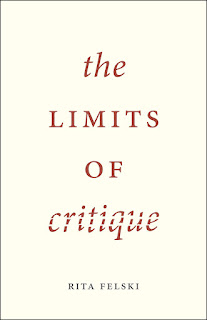
Rita Felski, (2015) The Limits of Critique. University of Chicago Press, Chicago.


Summary of Introduction


Felski announces that she will be taking on critique as both mood (rhetorically speaking, and perhaps also as a stance of the author) and method, and reiterates Ricoeur's term, the "hermeneutics of suspicion,” from which so much of the present critique of critique (or “postcritique” as Felski would prefer) is framed. She identifies four key elements of critique:

1) a "spirit of skeptical questioning or outright condemnation";

2. an "emphasis on its precarious position vis-à-vis overbearing and oppressive social forces;”

3) "the claim to be engaged in some kind of radical intellectual and/or political work" and

4) "the assumption that whatever is not critical must therefore be uncritical" (4). She will presumably be tackling each of these in turn throughout the book.

At several points she makes statements which place her project on the side of what I call "opening up" critiques of critique, that is, the emphasis is not on disabling critique as a term or a practice, but on opening up space for other approaches in an academic context in which "critique" has become dominant and even mandatory. [Note: by resisting "critique" as a dominant force, she is employing element 3 of "critique," above, even while resisting tactic 4 (she allows that non-post-critical critiques can be [critical].)]

 She jousts with invisible and unnamed interlocutors who sometimes take the form of straw men (e.g. on page 9). She launches into a criticism of what she identifies as the "critique of critique:" namely, the critique of critique as normally done, that is is not sufficiently critical (9). She points out that this can involve a certain posturing ("To be sure, critique has its problems, but only because it has strayed from its true path as I define it" (8)). [Debord's denouncements of "spectacular critique" come to mind]. And she points out that this “critique of critique” means that critique is the cure for critique, which leads to an endlessness of critique – which I hope she will later discuss in terms of Foucault's concept of the "Blackmail of the Enlightenment," and yet also of his sense of critique as an ethical imperative. She ends with a mention of "receptivity" as a position that is distinct from the shielded and wary practice of critique: this struck me as strange, because I had been thinking specifically of openness and receptivity as inherent aspects of critique (based on the practice at SUVA: to practice critique you need to be open to, receptive of the work of art while also keeping some distance (much like Lefebvre's in-out stance); and to be receptive to critique, you have to be open to criticism, while also keeping yourself separate enough from your artwork so as to not feel hurt, etc.]

In general this book looks quite exciting and promises to greatly expand my understanding of the nuance and breadth of "post-critique." Nevertheless I am also more and more convinced that this really could be called a "critique of critique." Felski (and others) are clearly delimiting "critique" into a particularly narrow category (just like Latour did) and then insisting that what is outside of that (namely, what they are doing) is not "critique." They thus are performing the very same definition-based move that they are criticizing. [And Foucault’s comments on how Kant opened up a “gap” between “critique” and Aufklärung seem immediately relevant]. This is all, also, situated within disciplines like literary criticism, which Felski identifies as overly saturated with critique. Much like with Latour, there is a presumption that "critique" is solely the practice of academics, and just how or why such a concept or term could be important outside of academia remains unaddressed and perhaps not even considered (but she promises to address the politics of critique in chapter four).

In passing, I noted a number of uses of enchanted language involving "spirit," or "demon," used negatively as something that possesses "critics." A promising aspect is the discussion of "mood" or rhetoric, and alternative hermeneutics beyond "suspicion."


Saturday, January 29, 2022

Problems of Dostoevsky's Poetics, Chapter 3


Summary of Chapter 3: The Idea in Dostoevsky

This chapter concerns Dostoevsky's use of "ideas" in his novels, and how this differs from their treatment in monologic novels. Dostoevsky was interested in being an "artist of the idea" and always has some idea which is the central motivation for each novel; however, he does not impose this monologically on his novel, but instead sets it in conversation with other ideas, other voices; it is only in this way that an idea can become "full" or "fully realized" or something like that. Dostoevsky's heroes are also "ideologues" who engage in commentary and explication of ideas through their engagement with the world and other characters/voices. There is a link between this engagement and the "confessional discourse" and self-consciousness of the characters: this provides a link between dialogicity as articulation, and as subjectification. 

In the "monologic world" of a monologic text, thoughts can only be affirmed or denied. The dialogic approach does neither of these, but instead has a third way. Bakhtin traces the history of modern monologism with the growth of rationalism [and thus of the abstract subject]. A monologic author expresses directly their own view, but represents others (or perhaps does not even fully represent them; anyway “representation,” meaning a fixed image, is monologic not dialogic, and subordinates the ideas and voices of the others to the control of the author). In the dialogic novel, in contrast, there is an unfinalizability of characters, and a plurality of independent "voice-ideas" which the hero or the author is able to hear and interact with.

Another key concept is the "form-shaping ideology" or "form-shaping worldview" which governs how ideas and interactions work and are depicted in his novels. "Dostoevsky's form-shaping ideology lacks those two basic elements upon which any ideology is built: the separate thought, and a unified world of objects giving rise to a system of thoughts"(93). [So it both is, and isn’t, an “ideology?”] This is a fairly direct contrast to the way statements and discourses work in (for example) Foucault's Archaeology of Knowledge, and in Deleuze's book about it. Bakhtin instead focuses on the "position of a personality," which could presumably be equated with subject position. [Perhaps it could be argued that this is more like the more bottom-up approach which Foucault subsequently took up after the archaeology of knowledge]. Actually it seems like Bakhtin is saying that Dostoevsky focuses on the "integral points of view" of integral personalities, rather than on statements/utterances (like both Foucault and Volosinov), so Bakhtin's point here might not be as radical as he thinks it is. 

Dostoevsky (or his heroes) "thinks in voices," and moves in a "labyrinth of voices." Bakhtin attacks aphorisms because they separate the word out from its actual context, treating it as self-complete, something that nothing is, according to Bakhtin (cf. Debord’s similar critique of quotations). Instead of a monologic "I" judging the world, there is the interrelationship of "cognizant and judging 'Is' to one another" (100).


Friday, January 21, 2022

Comments on the Society of the Spectacle, Part 3


Summary of final 11 theses:


The subject of the mafia, and how it exemplifies conditions under the integrated spectacle, continues. Secrecy, assassinations, hidden operatives, falsification undertaken not only by government, mafia, terrorists, etc. but by corporations and even state corporations, in pursuit of their own interests; "conspiracies" or "plots" in the defense of the established order. Debord captures in some ways the sense of the "post-truth" moment with his reference to this disabling discourse regarding conspiracies, and the lack of a revolutionary alternative, or at least a clearly recognizable one. He also discusses the role of "pacemakers," who would now be called “influencers.” Nevertheless his argument is that there is even more of a clear ruling class than before, who control the spectacle or at least society (they themselves are to some degree controlled by the spectacle was well.) The question is whether he overstates the "integration" and control by this faction. His vision contrasts with those of others, e.g. Foucault on the rise of neoliberalism, and Graham and Marvin as well on how neoliberalism takes down the "integrated ideal" – though perhaps Debord would agree with part of this, the point is that his state-centric or at least power-elite-centric explanation fails to provide as subtle or deep an analysis; he seems to be focusing on surface phenomena.

Debord's integrated spectacle seems to be derived primarily from Italy as his premier model. My first thought is that Debord has failed to make the insight Foucault had made over a decade earlier, about the impending growth in influence of neoliberalism. From this perspective, the integrated spectacle reads as an alternate potential path for late-20th century modernity, if it hadn't gone to neoliberalism; or perhaps instead, as an alternate competing form that existed at that time in states like Italy (Mexico and other semi-peripheral states come to mind as well). Then again, there is the history of the neoliberal form as something organized by think tanks in leading core states, imposed first on unwilling victims in the periphery and semi-periphery, and then imported back into the core; in this case the integrated spectacle is a competing form or perhaps related in some way as an effect. So either 1) Debord’s integrated spectacle identifies a variant and competing form of late modernity, or 2) it identifies an effect of neo-liberalism which Debord is failing to recognize as such, because he is distracted by the idea of the union of his "diffuse" and "consolidated" spectacles. THEN AGAIN something could be said of the idea of neoliberalism as not just an outgrowth of the diffuse spectacle, but as a union of it with the consolidated spectacle; this connects to my idea of neoliberalism as "artefact" and methinks might be hinted at in the name of the documentary series, Commanding Heights. I am also reminded of my own observations of Mexico City in relation to the theory by Graham and Marvin of the "integrated ideal," [here ironically the opposite of Debord's "integrated spectacle," or is it?] But anyway Debord's integrated spectacle reminds me of the dissolved, or only haphazardly applied integrated ideal I wrote about in regard to urban space in Mexico City.

Debord notes that in the past, one only “conspired” against established power; now conspiracy in favor of power is an established profession (74). This is admittedly a very broad use of "conspire," and yet it opens to what is perhaps Debord's key insight in this book, as far as it seems relevant to the present day, that the idea of just who is "conspiring" becomes something debated. Trumpists (for example) claim that covid, etc. is a conspiracy by the state against their "freedoms;" the reply is that obviously their whole conspiracy including the attack on DC is a conspiracy in the name of power, and certainly not revolutionary. Perhaps the loss of history as Debord puts it [the revolutionary ideal, what I have called the "eye of history"] has been marginalized enough that now all factions/movements can in fact be argued/seen as having powerful interests behind them, working in the name of the spectacle: both sides see the others as conspiracies in the name of power, because that is at once the only way things can be seen; and yet it still remains an insult or an undercutting to be named in that way. Nevertheless people still believe there is an alternative, because that is what they believe their own side to be.


Thursday, January 20, 2022

Comments on the Society of the Spectacle, Part 2

Summary of second 11 theses:

In this middle of the book, Debord sounds a lot at times like an angry, ranting conspiracy theorist. The primary point of argument is about "disinformation", which is not so much disinformation spread by the government, as the idea of disinformation, or the name, applied to any information or [articulation] that contradicts the happiness or inevitability of the spectacle. (Today, however, we can talk about “disinformation” in favor of the spectacle, as well). The concept of secrecy is repeatedly emphasized, that everything is secretly controlled [apparently a key aspect of the integrated spectacle.] Various experts are exposed as dupes, and so on. There is potentially some important insight or so in here regarding the present "post-truth" moment and the public sphere response to the loss of credibility of the state and scientific experts, although Debord would presumably deny that social media etc. (which he did not see coming so far as I can tell) counts as a "public sphere."

In a perhaps tongue-in-cheek moment he talks about conspiracy theory, as another concept used to delegitimize alternative explanations. In this he stands in a contrast with, e.g., Latour, who uses the existence of conspiracy theories to undermine the legitimacy of “critique” itself. Debord is probably right here – it is lazy and self-defeating to invoke the bugbear of the “conspiracy theorist,” but what is a better term, a better way of talking about the self-claimed “skepticism” of climate change “skeptics,” and so on? There is a temptation (which I succumbed to at the end of my previous post) to fall into the language of “real” vs. “fake,” but I’m wondering if Debord’s own insistence on clinging to an idea of the “true” which he opposes to the “falseness” of the spectacle – which seems all the weaker and outdated a strategy in the context of the integrated spectacle, and even moreso today – shows how insufficient such language is, or has become.


Wednesday, January 19, 2022

Comments on the Society of the Spectacle, Part 1

With the Society of the Spectacle the question remains to what extent its ideas are useful or relevant today, and to what extent they are fixed in the mid-to-late Twentieth Century context they describe. Pursuing this line of thought, it makes sense to turn to Debord's own attempt to update his ideas in the Comments on the Society of the Spectacle. Of course, since these comments were themselves published in 1988, it is reasonable again to ask to what extent they, in turn, remain relevant. Added to this is a question of translation: I used Imrie's (1990) translation, having a pdf of it; I was most of the way through the book when I read a criticism of this translation (by Not Bored, who have their own translation) as overly blunt and apodictic, making Debord come across incorrectly as paranoid and defensive -- and this is telling, because I repeatedly call him paranoid and defensive in these summaries... Anyway the Comments take the form of 33 theses, which I broke into three parts for convenience.

Summary of first 11 theses:

Debord's revisit of his Society of the Spectacle text and the topic of the spectacle reads as more than a bit defensive. His major claim is about a new version of the spectacle, the integrated spectacle, (as opposed to the diffuse and the concentrated spectacles that he had identified in the first book), and a reasonable test of this book is to what extent this new version of the spectacle accurately or usefully describes the changes that have happened since the publication of the earlier book. Whereas Debord had modeled the "diffuse" spectacle off of the US, the integrated spectacle is modeled on the experiences of France and above all Italy in the 70s and 80s; these are now thought by Debord to be ahead of the US in regard to the development of the spectacle.

The integrated spectacle is "both concentrated and diffuse;” it is not clear if that means the state plays a more central role in regard to production and market (as a combination of aspects of the diffuse and of the concentrated spectacles).  In Thesis V he identifies five key aspects of the integrated spectacle: incessant technological renewal; integration of state and economy; generalised secrecy; unanswerable lies; an eternal present" (pages 11-2). Integration of state and economy, and generalised secrecy, are not strongly defended and seem the most irrelevant of these to what has actually happened. Technological change is obviously accurate; the "unanswerable lies" involves concepts similar to those of the postmodern condition and the "post-truth" condition as well.  [It is unclear just what is meant here by “unanswerable lies.” My first guess was, it was like the lies used by Trump etc., which dissolve the very answerability of "truth." Yet, when he says that public opinion becomes powerless and dissolves, this sounds like something more autocratic is meant, such as the statements made by a technocratic state.  Also problematic here is Debord's old and continuing reliance on the naive distinction between "true" and "false” (in which he speaks the “truth” to the “false” powers of the spectacle; this is just borrowing the language of the system he is opposing). Beyond this overly simplistic opposition of "truth" to "lies", what is more interesting is how these are constructed.

The "eternal present" has to do with a denial of the past, and an "end of history" presentism that is also linked to the end of modernist -isms. He posits how the post-historical "democracy" of the integrated spectacle relies on a contentless other, "terrorism" (this seems accurate). A new category of "social crime" is created to allow the punishment of what would previously have been termed "political criminals" (and thus ethically distinct and even challenging to the integrated spectacle; instead, no such challenge is to be allowed). Debord still makes claims about people being submissive and passively consuming images created by others – this is outdated and was always simplistic. Some of his observations regarding the death of dialogue, etc. could be salvaged by rethinking them in terms of the society of control and so on. He makes an interesting observation on page 29 which sounds a lot like QAnon, etc. cultists trying to gain authority, in an age when authority does not claim to be more than illogical (the spectacle has admitted itself to be spectacular, he said earlier); they thus ape this illogicality [a reasonably stated point, that though they claim the position of “skeptics,” they do not engage in critique in any real way].


Tuesday, January 18, 2022

Society of the Spectacle, Chapter 9


Chapter 9: Ideology Materialized


Debord ends the book with this somewhat perfunctory chapter on how the ideology is “materialized” in the form of, and by means of, the spectacle. His first point is that ideology has never been a mere “simple chimaera,” but is instead “deformed consciousness” (212). This must of course be because to have grip, to serve some purpose in people’s life as a belief system, it must have some relevance and appeal, and it has this because it is an outgrowth of the real, albeit transformed or “deformed.” Much of the earlier text was about this relation between “real” or actual conditions of production and existence, and the spectacle which takes their place. This is presumably also part of why détournement should work, because it reverses the deformation, or at least reveals the artificial process of materialization/reification, as discussed at the end of the previous chapter. Debord reiterates that aspect of the Spectacle which could be called the post-political or the “end of history” argument, to wit, that history has ended and liberal capitalism will be the only option henceforth. He talks again about an earlier theme, which is the spectacle’s connection to money or the “philosophy of money” as Simmel put it. He returns to his emphasis on praxis as the needed alternative to the spectacle. He spends a few paragraphs drawing out connections between the spectacle and forms of madness such as schizophrenia and autism. Returning to praxis in #220, he talks about the madness of wanting instant results—this in itself is a form of the insane consumerist mentality of the spectacle. “Conversely, the critique which goes beyond the spectacle must know how to wait” (220). “It must struggle in practice among the irreconcilable enemies of the spectacle and admit that it is absent where they are absent” (presumably a reference to a true revolutionary class, which is not that of the Situationist intellectuals themselves; thus, they cannot make the revolution, and must wait to align themselves with those who can). In his final paragraph he notes that neither the “isolated individual” nor the “atomized crowd subjected to manipulation” (a fitting term for the audience of social media) can make revolution; instead this will be “the class which is able to effect the dissolution of all classes” [i.e., the “dictatorship of the proletariat”], by bringing about “realized democracy” in the form of “the Council” (i.e., a system of federated, local worker’s councils).


Monday, January 17, 2022

Society of the Spectacle, Chapter 8


Chapter 8: Negation and Consumption Within Culture


In this chapter Debord takes on "culture," by which he means "the general sphere of knowledge and of representations of the lived; ... the power of generalization existing apart, as division of intellectual labor and as intellectual labor of division." (180) Mostly he means art and the academic disciplines, which will be his primary focus as examples of "culture." Culture in this sense is not an eternal aspect of humanity, but something that came about, or came about as something with its own existence, only after the dissolution of the unifying power of myth. Culture appears to be the separate and partial representation of the unity of society, within the post-Myth society of the spectacle. It inherently fails in its intent to represent or create unity. It is characterized by a struggle between tradition and innovation, in which innovation always wins and is then superseded by a further innovation. In 182 he references the death of God as the "first condition of any critique," but this sets up the condition of a "critique without end." It seems that this critique without end is a good thing because it destabilizes the foundation of the knowledge about society created through this critique; unless he means to imply that critique without end is a bad thing, because it never leads anywhere and does not actually challenge the spectacle (later he calls this aspect the "spectacular critique of the spectacle"). (This later aspect of “critique without end,” is part of the target of postcritique).

One confusing aspect of this chapter is his repeated use of terms like "collapse," "negation," "disappearance" ... it is hard to know what he means (e.g., "In this search for unity, culture as a separate sphere is obliged to negate itself." (180) My guess is that this is a use of dialectic terminology: culture becomes its own antithesis or negation. Or maybe some kind of consumption or using-up is implied, I have only a vague recollection of terms like "the enjoyment of pure negation" from Hegel. In either way there are two "ends" of culture: one as a dead object in the library/museum/archive/etc. of the society of the spectacle; the other is as the supersession of culture in "total history," i.e., revolution. So it is possible that all these instances of negation, disappearance, and collapse refer to this ambiguity, an end that is on the one hand a supersession, or possible supersession, and at the same time a death, an objectification into the spectacle.

 Debord sets up an opposition between fragmentary knowledges which uphold the spectacle, and the critique of the spectacle through praxis. 

He goes into a critique of art (starting c. 186), with the big break being the Baroque period, which is the first to depart from the society of myth and the mere communication of the ideology supporting the church and nobility. The Baroque brings in the everyday, choosing "life against eternity," it is the "art of the change" and allied with theater and festival [hints of Bakhtin] (189). Debord points out how the various attempts at classicism, as reactions against the Baroque, inevitably fail because of the ridiculousness of the bourgeois (even as revolutionaries) dressed up as Romans (the story of George Washington’s statue by Houdon fits well here). Instead, the later movements which "followed the general path" of the Baroque, (Romanticism, Cubism, presumably the other isms), ended up being an art of negation increasingly fracturing itself and its representation of the world, thus negating culture as such a representation. Inserting my own interpretation a bit, this must on the one hand be good as it leads to supersession/critique; but also bad in the way it ends as a dead object, indeed creating the possibility of art history, which looks at the art of all previous periods as collectibles, souvenirs, which can all be admitted and admired because they no longer have any power: "they no longer suffer from the loss of their specific conditions of communication in the current general loss of the conditions of communication." (189)

[Debord does not of course call this last observation the "postmodern condition" but I feel it is. I am immediately reminded of the ISIS soldiers defacing ancient Lamassu and the shock this generated in the West: in a limited sense, the destruction of the Lamassu was the first example of treating them with any respect in a long time -- the first time they were recognized as having power independent of the current system of collection and interpretation (i.e., the spectacle). (Of course this is only a partial sense, because ISIS were very much involved in the spectacle, and staged these destructions to trigger the west; they also looted and sold artifacts, and thus engaged in the art market).]

He notes what I call the paradox of the avant-garde, which is that the avant-garde seeks the supersession of culture (he calls it a "negative movement," which is a good thing for Debord). He criticizes Dada and the surrealists as being two partial critiques (one to suppress, the other to realize art). "The critical position later elaborated by the Situationists has shown that the suppression and the realization of art are inseparable aspects of a single supersession of art." (191) So maybe the two forms of the negation are united in the transcendence? Anyway art in the time of the spectacle is stuck with an impossible goal: "communication of the incommunicable" (192)

He takes on Clark Kerr, which is funny because I was just reading Braverman doing the same thing in his book from a few years later. He turns to the subject of the "science of false consciousness," that is, academic disciplines, of which sociology will be his primary target, followed by history. Sociology is the "spectacular critique of the subject," while structuralism (of all kinds), which he really hates, is the "apology for the spectacle" (195) because it posits eternal verities in the form of these eternal structures [he has moved on from Kerr here, but the points he makes are very reminiscent of Braverman's attack on the eternalism [and anti-historicism] of Kerr's sociology, as well as his criticism of the search for "formulae" for history.] From 197 he attacks the kind of labor condition sociology which Braverman also attacks. From 198 on he attacks an article by Boorstin in which a partial (conservative) critique of the spectacle is articulated; he points out its incompleteness, then turns from 201 to continue his attack on structuralism. 

In 203 he returns to his earlier theme of praxis (theory plus practice). The idea of the spectacle can be vulgarized--again, just like Braverman had complained of the vulgarization of the Marxist concept of "alienation" by bourgeois sociologists. The opposite of this sort of [vulgar or spectacular critique] is praxis: "no idea can lead beyond the existing spectacle, but only beyond the existing ideas of the spectacle" (203). Ideas need to be united with "practical force," with the "practical current of negation in society," (though it is only by uniting with the idea that such a force can learn "the secret of what this negation can be"). [This is Debord again articulating what he did before, and what Graeber has also stated, that the post-revolutionary society cannot actually be described by someone in the pre-revolutionary society, because (in this form of the argument) it takes more than ideas to make history.]  He then discusses "critical" and "dialectical" theory before going into an analysis of his own style of writing, in particular the form which has become more and more pronounced throughout this very chapter, of the "inversion of the genetive" [sic] (206), which he traces back to Hegel, Feuerbach, and Marx. He starts mentioning this term, "diversion," which is presumably linked to (or is) detournement. He gives his shocking pronouncement that "Plagiarism is necessary. Progress implies it" (207) because this is part of taking words and ideas of the spectacle and diverting them, erasing the old ideas and creating them anew (indeed this is what he is doing with the word/concept "plagiarism" in this example). 

In 208, he opposes diversion to quotation: quotation is (obviously) the spectacular dead form that knowledge and words of the past take, in the spectacle (for instance, I have seen the above quote about plagiarism sitting by itself out of context; the subtle and more pointed meaning is completely lost). He is here very reminiscent of Volosinov in his insistence on the meaning of an utterance in the precise conditions under which it was spoken. In contrast to the reifying practice of quotation, diversion "has grounded its cause on nothing" -- another reference to Stirner. In 209, he expresses the idea of a [trojan horse]. "What openly presents itself as diverted" denies the autonomy of the sphere of culture or expression, and otherviews the entire existing order. This is linked also to the demand for praxis. This unification in praxis is what will allow the critique and practice of the Situationalists to be a "unified theoretical critique" that meets "unified social practice." (211)


Sunday, January 16, 2022

Society of the Spectacle, Chapter 7


 Chapter 7: The Organization of Territory


After two chapters on time, Debord now has a very short one on space. The theme is that under commodity capitalism, all space has become banalized. Places lose their unique meaning as part of becoming universally equivalent and interchangeable. In particular, the distinction between the city and the country has been eroded or overwritten [though he does not say this, perhaps because he is looking at France rather than the US, this could be called universal suburbanization.]  Tourism (168) relies on this universal equivalence and consumability of place. Debord talks about urbanism under capitalism as being an attempt by capital to remake space in its own image, by destroying or disabling the city, fighting against the threat posed by the workers having been brought together by the conditions of production . This involves mass architecture as housing for workers (173), and also "the suppression of the street" (172).

The city had been where universal history had come to life and remains the locus of history; capitalism and the spectacle work to keep this from coming to fruition. In 178-9 he talks about revolution, to be led by worker's councils, which will remake cities again, in their own image, instead of capitalism's.


Saturday, January 15, 2022

Society of the Spectacle, Chapter 6


Chapter 6: Spectacular Time


After rehearsing his theory of the history of time in the previous chapter, Debord here turns to the role of time in today's spectacle. He begins by drawing an opposition between irreversible commodity time (apparently the time of labor-value), that is, universally equivalent clock-time; and consumable time, which is the reappearance of the cyclical but in a consumable form as "pseudo-cyclical time.” An interesting reversal is involved: whereas cyclical time in the past had been non-individualizing, but irreversible time had been the time of unique individuals; in today's reversed spectacle, it is the irreversible time of commodity production (through the expenditure of labor time) that is non-individualized (quantitative rather than qualitative), and pseudo-cyclical time which is the lived time of unique experience (of the consumer). 

He spends several paragraphs expanding on the role of pseudo-cyclical time in the spectacle. It has two aspects: as "the time of consumption of images," and as "the image of consumption of time;" that is, it is both the time of consumption (of the modern spectacle and commodities), but also the image and meaning of such consumption, the spectacle itself. The vacation replaces the festival as the focus of pseudo-cyclical time, and the vacation then becomes the image of "real life" which the rest of existence is merely the build-up to [cf. "working for the weekend," or Jack Vance's story of a society of people who are aristocrats one day a week, and servants the rest.] "Here this commodity is explicitly presented as the moment of real life, and the point is to wait for its cyclical return” (153).

"Vulgarized pseudo-festivals" take the place of ancient cyclical ones (154). Whereas ancient cyclical time was in tune with the labor and natural processes of reproduction, the new pseudo-cyclical time exists in a contradiction with the "abstract irreversible time" of production [and this is why it is "pseudo"] (155). 

Because everything that is real is seen to happen to other people (celebrities) or to yourself only when outside of your own life (on vacation), your real everyday lived life "has no history" (157). That is, the "general historical life," as it exists during the spectacle, leaves no room for, and denies, individual life. Your actual experience of your own life is "without language, without concept," because all meaning is recuperated by the spectacle. This private life of the unique individual is forgotten. This is all part of the "false consciousness of time" (158). Debord notes that this was all made possible because back at the beginning of the capitalist era there was a primitive accumulation of the time that had belonged to individual workers [an interesting interpretation of time as a means of production].

There is also a denial of the underlying biological aspect of life and labor. Death is something denied and/or not dealt with. Whereas Hegel had argued that time is a necessary alienation, whereby we become other to ourselves and thus realize ourselves, this is denied us in spectacular time. Also, the sequence of fashions, commodities, etc in pseudo-cyclical time obscures the "obvious and secret necessity of revolution" (162). The real point of history, and of generalized historical time, has been denied – that is, "the revolutionary project of realizing a classless society ... a withering away of the social measure of time, to the benefit of a playful model of irreversible time of individuals and groups, a model in which independent federated times are simultaneously present " (163). [i.e., as we called it in Yellow #5, "everybody doing their own shit at the same fucking time”]. Debord defines communism as that "which suppresses 'all that exists independently of individuals'" (163; according to the Bureau of Public Secrets, the line is from the German Ideology).

Debord makes an ending reference to dream, reminiscent of Benjamin: "The world already possesses the dream of a time whose consciousness it must now possess in order to actually live it" (164).


Friday, January 14, 2022

Society of the Spectacle, Chapter 5


Chapter 5, Time and History


Debord here outlines his theory of history, or rather his dialectical account of the history of time, that is, on the relationships between cyclical and "irreversible" (aka linear) times. He follows a standard framework in which the earliest societies are seen as purely cyclical. He discusses time in early nomadic and sedentary societies.


Debord links the emergence of "the social appropriation of time" to the emergence of hierarchy (#128). Irreversible/linear lived time emerges as "temporal surplus value" which is enjoyed by the elites in their named adventures and conflicts (the subject matter of ancient chronicles and epics), while the masses remain anonymous in the cyclical time that reproduces society. Irreversible time is "squandered" [echoes of Bataille], like a luxury good, it is not put to use reproducing society (but maybe myth, or some kind of elite ideology). "History then passes before men as an alien factor, as that which they never wanted and against which they thought themselves protected." (128) If you’re a peasant, you don’t want history coming to your village.


He details the emergence of writing as a tool of the ancient state; chronicles and epics tell the individual stories of the elites at the surface, and give no regard to the depth of everyday cyclical time (132). Ancient Greece and the Mediterranean are given as a time of a break in which historical consciousness emerges for a wider elite; this brings the "menace of forgetting” (133) (this is presumably derived from Plato’s thoughts on the effect of writing). But with the middle ages comes the return to cyclical time, though damaged; a compromise is made with religion which becomes "semi-historical," a compromise between myth and history, to sustain myth. Debord discusses the middle ages, the figures of the pilgrim and of millenarian movements, and their relationship to modern day revolutionary movements. "The millenarians had to lose because they could not recognize the revolution as their own operation" (138) (i.e., they thought it was the will of God). The return of historical life begins in the Renaissance. 


The bourgeoisie overthrow the old feudal order (140) and make irreversible time the time of labor (and labor time in factories) and of commodities (and their succession). Irreversible time is now democratized and becomes the engine of society, as opposed to cyclical time which decreases in power. This is the "time of things" (142). But there is also a move to reify history or declare the end of history, to prevent revolution and the thought of the possibility of revolution. A new compromise is made with Christianity. The globe is unified under the irreversible time of commodities.


In my 1989 notes I say that Debord's 2 chapters on time "tends to escape me." I add that, "Like Marx, Hegel, and Stirner, Debord feels compelled to place dialectical progression within historical progression. I don't feel this is necessary (and probably misleading) because dialectical progression is not tied in to experiential time; dialectical moments do not follow the chronological exclusion principle."


Thursday, January 13, 2022

Society of the Spectacle, Chapter 4


Chapter 4: The Proletariat as Subject and as Representation


This very long chapter details the question as to whether the proletariat play their revolutionary (and unitary) role as subjects of history, or whether that power is deferred or dissipated or recuperated (not sure which would be best) through representation. The chapter starts off with a play on the final Thesis on Feuerbach and returns to this theme throughout.

"The subject of history can be none other than the living producing himself, becoming master and possessor of the world which is history, and existing as consciousness of his game” (74). He is talking about the proletariat, but in a way that sounds very Stirnerian, and he indeed mentions Stirner in #78 as one of the "theoretical currents of the revolutionary workers' movement" grounded in confrontation with Hegel.

Debord refers to the "long revolutionary epoch" beginning with the rise of the bourgeoisie as the first revolutionary class, and (pace Marx) the only class to ever successfully mount a revolution. After a discussion of Hegel, he talks about Marx's turn to science as a mistake or weakness. Science is inherently bourgeois as it tries to understand the world as a closed totality, much like Hegel did. In #80, he invokes the opposition between the blindness of quantitative data, and the qualitative as "conscious." He is absolutely Marxist in arguing that revolution can only come about when the practical conditions for it exist, and history should be studied to figure out when this will be and how to respond. However, this should not be a "science" and we should not let old, failed models interfere with the future actions.

In his critique of the utopian socialists, he elaborates the concept of the "mode of elaboration of truth” (#83). The utopians idolize science and thus follow the idea of trying to invent a model of a perfect society which they implement like an experiment, failing to understand the larger critique of history and existing power structures that would be necessary for a real revolution (as if the future society could be simply invented like a new device or something). Debord's point is that the utopians don't even understand science as it is actually done, they understand it through its popular appeal, or mode of explication, by which it is made sense of to the masses (and this, per Sorel who Debord cites, apparently is derived from the earlier mode of explication of astrology.) [This concept of a "mode of explication" of elite theory for the masses has a potential to play in a theory of articulation, as I do not recall a similar or equivalent concept in Foucault or Deleuze]

He has some fairly brutal comments about the failure of Marxism and of Marx. Marx and Engels had a critique for their own time (he means the Manifesto and the revolutions of 1848). These failed, then Marx spent years retroactively trying to justify, through an appeal to science, an approach which was already outdated, and could only get in the way of future revolutions. By the appeal to science, they basically turn Marxism into a bourgeois program, mistaking the proletarians for bourgeois (seizing power of the state, for example, was the Bourgeois mode of revolution, but would not suffice for the proletarian revolution). Debord is thus in an interesting position of being very Marxist in some regards, while strongly criticizing Marx in others. 

He is particularly critical of the vanguardists, especially the Bolsheviks. Vanguardism mistakenly recreates bourgeois forms of practice (with leaders, state power, scientific agenda), and then fails to recognize spontaneous manifestations of actual workers' power. 

He goes into the opposition of Bakunin and Marx, then critiques anarchism (#92-4). In my 1989 reading notes I call this an "important critique of anarchism," focusing on "informal domination within consensus organizations." However on rereading it is clear that Debord is more interested in critiquing anarchists as idealists, having an ideal of the perfect society which they use as their motive and goal for revolution, and which they then try to impose (like the utopians in a way). He does not seem to actually point out informal or uncritiqued domination, so much as intentional domination by a "conspiratorial elite" as called for by Bakunin. [cf. "Invisible Committee;" however, Debord will end the chapter by giving an out to revolutionary organizations (such as his own of course) and this could equally be applied to such anarchist groups as well)].

His main targets through the chapter will be 1) Bolsheviks and the international Communist Party; and 2) social democrats. He grounds an interesting critique of the Russian Revolution on the idea that the bourgeois intellectuals had had only constrained opportunities in Czarist Russia; this led them to adopt revolutionary positions and become "professional revolutionaries" of the sort that (like Lenin and Trotsky) flocked back to Russia after the revolution began (spontaneously) and then warped the revolution to suit their own purposes. Their profession of revolution then became the "profession of the absolute management of society" (98) because these guys would have been management in a capitalist society, after all.

The working class gets trapped into representation when it is trapped between bolsheviks on the one side and social democrats on the other. In post-WWI uprisings the real alternatives like the Spartacists get wiped out. Social democrats actually support the ruling regime, compromising and "representing" the workers in the electoral system. Because of this compromise, the real "central question" of the choice between capitalism and socialism cannot be asked (per Luxembourg). Debord notes, the spectacle keeps this question from being posed, there can be no "central question."

The Bolsheviks, meanwhile, become the "pseudo-bourgeoisie" of the Russian state in the form of the bureaucracy. Per Debord, the bourgeois need to start off the revolutionary epoch, and a revolution in a state not already ruled by the bourgeoisie will only end up creating a substitute or proto-bourgeoisie. The CP bureaucrats in the USSR are caught in all kinds of contradictions because they can't really exist as "bourgeoisie" nor as "bureaucrats" so they must undergo constant purges. The crucial discussion of the bureaucrats as the "substitute ruling class" in "state capitalism" is in 102-108. Anyway the bolsheviks then market their (failed, crypto-Bourgeois) model of revolution as the only one possible; they then use the CPs of various nations to further the interests of the USSR, not for revolution. In #113, he discusses the form this proto-or crypto-Bourgeoisie takes in undeveloped nations through aid from the USSR and the west.

#109, Fascism. Debord is closer to my sense of Fascism as a retro-disease of the modern state, than Gilroy etc. seeing it as the core or essence of the state. Fascism is to some extent enabled by the false radicalism of the Bolshevik model, but this is turned in defense of the state and conservative ideals. "Fascism is technically-equipped archaism" (109), [or rather, as I have argued about fundamentalism, it is an absolutely modern movement that makes a revisionist appeal to an imagined past.] "However, since fascism is also the most costly form of preserving the capitalist order" it gives way to the mainstream capitalist state, which is "stronger and more rational" in defense of the same interests. Debord also emphasizes the capitalist connections of Fascism, over the Holocaust side emphasized by Gilroy etc.,

[There is a potentially disturbing point re the commonalities of left and right party forms hinted at here, when he talks about how fascism unites the petty bourgeois and the unemployed. these same groups came up in Shumsky's book on the Workingmen’s Party of California, which I am currently reading. Shumsky seems to see the WPC as proto-socialist, or but there is so much reason to see them also as proto-Fascist!]

He goes on to critique Trotskyism, which was influential when he was writing; also Lukacs, ironically because he is of course obviously influenced by the early Lukacs. 

From 114 he turns to the revolutionary potential of the proletariat, which he recognizes in the youth movements and uprisings of the late 60s when he is writing (115). From 116 he talks about worker's councils (presumably modeled after the soviets?) as the real revolutionary form which will emerge in the future revolution, on their own from the working class, without being led by any vanguard etc. From 119-121 he talks about the role of revolutionary organizations (such as presumably the Situationists) within this context. A revolutionary organization must know that "it does not represent the working class, It must recognize itself as no more than a radical separation from the world of separation." Their role is to critique separation, and spread unitary understanding and communication, to help the working class become aware of its own role. "The revolutionary organization can be nothing less than a unitary critique of society" (121).

In 123 he states, the revolution will require "workers to become dialecticians and to inscribe their thoughts into practice." [A call for bottom-up critique as itself an inherent and necessary part of revolution]. "Revolutionary thought is now the enemy of all revolutionary ideology and knows it." (124) [presumably Debord is on the side of "revolutionary thought" and the ideology is that of the Bolsheviks, etc.]

 [from my 1989 notes on this section: "I have to wonder if these alienations, spectacles, etc. are really merely products of Capitalism or whether the capitalist economy has merely made them evident (exposed them) by being itself the physical manifestation of a process (linguistic or otherwise sociological) which has been there all along. In other words, is the painfulness of modern life that it has created alienation in the individual, or that it has just exposed the alienation and separation which was (perhaps) previously concealed beneath comfortable layers of self-deception (mauvais-foi)? ... The history of the 20th Century has been the history of the destruction of illusion; what we have left to learn is whether there can be life without illusion. Clarification: illusion has not yet been destroyed, but seriously undermined. Soon it shall fall altogether (it is already coming apart in large pieces) and the world shall be plunged into a relativist vortex, a state of metaphysical chaos. That chaos, that arises, will be (as it were) the question mark at the end of the question (which we are still in) ...”]



Wednesday, January 12, 2022

Society of the Spectacle, Chapter 3


 Chapter 3: Unity and Division Within Appearance


The subject of this chapter is false divisions within the spectacle, such as the realm of political contests; also markets [I infer this, the struggle of corporations, brands, etc. He will later in this chapter refer to the epic struggle of commodities with each other]. The impact of the developed-world spectacle, as exported to the developing world [parts of the film Learning from Ladakh spring to mind]. The banalization of the world, repressive pseudo-enjoyment, etc.

Even dissatisfaction becomes a commodity:

"The smug acceptance of what exists can also merge with purely spectacular rebellion: this reflects the simple fact that dissatisfaction itself became a commodity as soon as economic abundance could extend production to the processing of such raw materials." (#59)

The role of celebrities as "agents of the spectacle."  Division of labor: everyone is engaged in only partial production, so they need the life of the celebrity to believe in, fantasize about; to live out aspects of life that the rest can never experience. The rule of things (commodities) (#62) which are youthful, have contests, lives that are more real than those of the humans who live vicariously through them. The concentrated spectacle of totalitarianism, vs. the diffuse spectacle of advanced capitalism. The epic struggle of commodities; but every star or celebrity, every commodity, once it wins, has lost, because it will now be disavowed and denied by the spectacle which continues with the new star, the new commodity. This is "the essential poverty of the commodity" (that it loses its value once bought; this is also linked to "the misery of its production").


Tuesday, January 11, 2022

Society of the Spectacle, Chapter 2


 Guy Debord, Society of the Spectacle.


Chapter 2: The Commodity as Spectacle.


The summary from my first reading in 1989:

Through the development of the dominance of exchange value over use value, i.e., industrialization, the rise of Commodity, advent of the Spectacle, etc. Old work for survival was replaced by work for satisfaction. Yet the satisfaction is defined as survival, and the list of what is "needed" grows ever longer. "The real consumer becomes the consumer of illusions" (#47).


Debord sets up his discussion of the spectacle through oppositions: the metaphorical opposition of "fluid" (old reality) vs. "congealed" (spectacle) (#35); the relation between tangible and intangible (#36); quantitative replaces qualitative. He gives a history of commodity production, leading to the triumph of the commodity and of exchange value. The "humanism of the commodity" is its new respect for the working class, as they gain new importance as consumers, a status which had previously been only for the upper classes. This is related to the elimination of labor through automation: "the technical equipment which objectively eliminates labor must at the same time preserve labor as a commodity and as the only source of the commodity." (45) [Because commodified labor is part of the subjection/subjugation process; labor is the (obscured) source of the spectacle's power/agency].  The spectacle is an equivalent form, much like money. 


He discusses the growth of "pseudo-needs" (#51). This immediately brings to mind things like the internet, smartphones, Uber, etc.; things we "can no longer live without." As an (ahem) nominalist I of course cannot endorse Debord's essentialism in distinguishing between "true" (his actual word is "fundamental") needs, and "pseudo-needs," but I can appreciate the term as a move in a game of articulation (as in, drawing the on the language of truth to call such needs into question). Because of their recent historical emergence, and the continuing contestation of technology, social relations, etc., their articulation as "needs" remains uncomfortable; this leaves an opening for Debord and others to insist that they are "pseudo-needs," which could mean either partial (conflicted, not fully need or non-need) or merely fake needs, mimics. This insistence, this use of the term "pseudo-need" to emphasize the difference between these and "fundamental" needs, is a form of resistance against the spectacle.


"The victory of the autonomous economy must at the same time be its defeat" (#51). Debord is a dialecticist, and will see a new contradiction in the spectacle which can be exploited to destroy it; this has some basis in the exchange economy and in the process of subjectification which will presumably be touched on in more detail later. "That which was the economic it must become the I" (52). Presumably the “it” in that sentence is the worker, or the worker’s labor-power. He is referring to the relationship between the subject and class struggle (in Chapter 1 the spectacle was described as "the proletarianization of the world" (#26), so presumably this refers to the broader field of social reproduction (not just the factory) in which the struggle will take place.


Significant articulations/oppositions so far:

real life        spectacle

fluid             congealed

conscious     unconscious

touch            sight

active            passive

unification    separation


Monday, January 10, 2022

Society of the Spectacle, Chapter 1

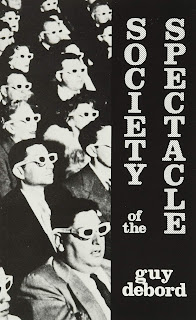
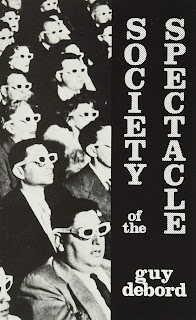
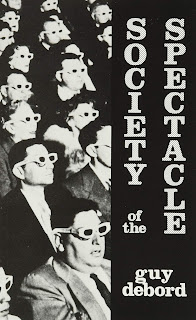
I'm going to try using this site more like a traditional blog, and post the chapter summaries of books I have been reading lately. First off is Guy Debord's Society of the Spectacle, which I chose to re-read earlier this year since the question as to how well, or how poorly, it holds up in the current media and political context was a point of discussion the last time I taught Popular Culture -- in addition to which, the more general question of to what extent such late-20th century critiques remain relevant, irrelevant, or have even become more crucial than ever, seems increasingly important. Even though there are supposedly newer and better translations, I chose the old Black & Red version out of nostalgia, because this is the copy I picked up at the San Francisco Anarchist C/Nonvention in 1989.


Guy Debord, (1983 [1967]), Society of the Spectacle. Black & Red, Detroit.


Chapter 1: Separation Perfected.

In this initial chapter, Debord sets up the opposition of "separation" vs. "unification,” the former of which is the spectacle. The spectacle has no purpose or goal other than self-reproduction. It has power through the commodification of labor (i.e., as labor-time or labor-power), and the consumption of commodities. The spectacle possesses the "monopoly of appearance" and demands passive acceptance and consumption (such a view was clearly most relevant to the era of films and television).

Debord traces the ancestry or history of the spectacle from earlier forms of theology/ideology/illusion. He takes the stance that the "specialization of power" (i.e., hierarchy, authority) is "the oldest social specialization ... at the root of the spectacle" (#23); such a statement is perhaps one of the reasons Debord is more attractive to anarchist theorists than to “true” Marxists, for whom control of the means of production is most crucial, and political power is merely a reflection of this.

Debord makes observations regarding the link between spectacle and technology, relevant to the present. Concepts like "unitary view" and "direct communication" are used to describe those aspects of the social which are eroded or destroyed/supplanted by the spectacle.