Showing posts with label V.N. Volosinov. Show all posts

Thursday, January 26, 2023

A Thousand Plateaus, Chapter 4


Chapter 4: November 20, 1923—Postulates of Linguistics


In this chapter, somewhat less imposing than the previous one, but nevertheless very dense, D&G tackle four “postulates of linguistics,” which are more accurately strawman arguments representing postulates of linguistics-as-a-major-science which D&G will argue against. The date refers to an announcement of the German government re-valuing the Deutschmark to end hyperinflation, and thus stands for the power of the order-word. Because of all the detail in this chapter I went with a paragraph-by-paragraph outline instead of a regular summary.


First postulate: “Language is Informational and Communicational.”

1. Language is not communicational; rather it commands. The teacher orders the students, she does not inform them. The fundamental unit of language is the order-word, a pun on mot d’ordre, meaning slogan or password, and here treated also as “word of order.” “Language is made not to be believed but to be obeyed” (76). “Language is not life; it gives orders.” There is an opposition made between language and life, and language, the order word, becomes a sequence of death sentences, or “Judgments.”

2. They then turn to the “status and scope of the order-word,” arguing that it “is only a language-function, a function coextensive with language.” Language, in other words, is not informational; it is not about transmitting information, for instance about something seen or experienced; instead it is a repetition of the already heard, hearsay. The authors here draw heavily on the language theory of Volosinov: all language is indirect discourse. They draw on a distinction made by Benveniste in arguing that bees do not have true language: bees, according to Benveniste, can describe a food source they have seen, but cannot repeat such a description that they have witnessed.

3. They underline this with a turn to Austin’s theory of speech acts, arguing that his concepts of performative utterances, and illocutionary acts, are internal to language and thus distinct from any idea of reference or information external to [that is, excludable from an analysis of] language. The theory of performance and illocution has, they argue, three effects: 1) language can no longer be thought of as a code (like dna is a code: the mere transmission of information) [recall also their discussion in the previous chapter of coding, defined by B&P as “the process of ordering matter as it is drawn into a body;” language, as in that chapter, is something much more]; 2) pragmatics becomes the most important aspect of language, and no other aspect (“semantics, syntactics, or even phonematics”) can be thought independently of pragmatics (77); and 3) the distinction between speech and language, so important to diverse thinkers as Saussure and Chomsky, becomes unworkable (they here reference Labov, but their position owes much to Volosinov’s theory of the utterance).

4. They next clarify another theory of language which they are arguing about under the name “communicational,” namely Benveniste’s appeal to intersubjectivity. Performance is “that which one does by saying it,” and illocution is “that which one does by speaking” (78); there is a temptation to start with performance and derive illocution from it, but this is not correct, as the performative is too easily dismissed, by Benveniste, as a “self-referentiality” in language, which is ultimately founded on communication between pre-existing subjects. Naturally, supposing pre-existing subjects begs the question of where these subjects come from; both Volosinov and Foucault, key interlocutors here, have had much to say about this; in any event “subjectifications are not primary but result from a complex assemblage” (79), and it is this complex assemblage which has to be examined. D&G will approach this by instead deriving performance (corresponding to subjectification) from illocution, which itself is “explained by collective assemblages of enunciation” (78) and by juridical acts or their equivalents (cf. Volosinov on language permeating into, or rather composing, the entire consciousness of the speaker), and they will further explore this through the discussion of indirect discourse in the Bakhtinian/Volosovinovan tradition.

5. To set up order-words as having a function co-extensive with language, they define them as “the relation of every word or statement to implicit presuppositions” and to the speech acts that can be accomplished in these statements; Language, in turn, is defined as “the set of all order-words, implicit presuppositions, or speech acts current in a language at a given moment” (79).

6. Instead of being informational and/or communicational, language is “the transmission of order-words, either from one statement to another or within each statement, insofar as each statement accomplishes an act and the act is accomplished in the statement” (79). Thus performativity, not to mention power in the Foucauldian sense, is what characterizes language. Their meaning can be taken as a somewhat more subtle and felicitous version of what Foucault actually meant when he said there was nothing outside of the text: the subjects who speak or use language, and the world of information and references they speak about, and even the criteria of truth or falsehood by which the relation between the statements of the subjects and what they are talking about is evaluated, cannot be presumed or treated as some pre-existing entities within and among which language takes place, as some kind of add-on. The relationship between statement and act is not one of identity, but rather of redundancy, which has two forms: frequency, corresponding to signifiance/information, and resonance, corresponding to subjectification/communication.

7. This next paragraph largely translates Volosinov into Deleuzian terms: “There is no individual enunciation. There is not even a subject of enunciation.” Rather, the assignation and distribution of individuality takes place according to the requirements of the collective assemblage of enunciation. They provisionally define this collective assemblage as “the redundant complex of the act and the statement that necessarily accomplishes it” (80); but they immediately admit (and correctly so), that this is unsatisfying. “If we wish to move to a real definition of the collective assemblage, we must ask of what consist these acts immanent to language that are in redundancy with statements or constitute order-words.”

8. They now go into more detail clarifying just what will be meant by an act, which is something much less than “action” or “acts” in general (this presumably is less forced with the French acte than with English act; their examples are pretty much all literal speech acts, “media acts,” etc.). Acts are incorporeal transformations which are attributed to bodies; “body” is here meant “in its broadest sense” to include pretty much anything, including souls and other “mental bodies.” Bodies interact with each other through actions and passions; “acts” are distinct from these in being incorporeal. Acts are also simultaneous with their effects (and thus datable): “I declare war,” makes war happen that instant; “I now pronounce you husband and bride,” etc. They refer to this as “the illocutionary.” As all of their examples involve speech or writing, it is not quite clear where they would put an action such as kneeling before a king (and thus submitting); presumably the illocutionary effect of this would be considered an act, in their sense (since kneeling in different contexts has different meanings: we are back to the relevance of the assemblage).

9. They discuss history, or the telling of history, as recounting the actions and passions of bodies, but more especially as being about order-words. The simultaneity/instantaneity of order words is reflected in their datability; they give their example of November 20, 1923, the day the German Reichsmark was replaced with a new currency, to bring about an end to inflation.

10. They explore further the (social, etc.) assemblage or range thereof within which language has meaning, including the circumstances in which “I love you,” “I declare a general mobilization,” etc., are meaningful or nonsensical. They echo Volosinov’s arguments against a linguistics that excludes consideration of all this as “exterior,” in order to focus only on internal “constants” of language; the pragmatics they are for, in contrast, is about both the exterior and what is internal, immanent, to language (this “incorporeal”); the order-word is the “something else” beyond language itself which establishes this relation between the interiority of language and the bodies, passions etc. upon which it acts.

11. They discuss Lenin’s text “On Slogans,” focusing on examples in which order-words create their subjects: “Workers of the world, unite!” “invents” the working class; Lenin’s announcement transferring power from the soviets to the Party predates the existence of the Party to which it is attributed. Against the objection that this is “politics” (and thus merely external to language) they respond that “it must be observed how thoroughly politics works language from within” (83), and give a summary of their pragmatics:

A type of statement can be evaluated only as a function of its pragmatic implications, in other words, in relation to the implicit presuppositions, immanent acts, or incorporeal transformations it expresses and which introduce new configurations of bodies. (83)

12. They propose two new names for the collective assemblage of enunciation: “regime of signs,” and “semiotic machine;” they add the very Bakhtinian observation that “society is plied by several semiotics, ... its regimes are in fact mixed” (83-4). They then discuss the primacy of indirect speech over direct speech and tie this to schizophrenia and the hearing of voices. There is a very interesting footnote on Elias Canetti’s concept of the command as a “sting on the soul, which forms a cyst” (525n17); [in contrast to the “shocks” experienced by the Baudelarian hero] this sting is enabling, the one who follows orders feels like a victim of the orders, and thus feels innocent of their consequences, which further situates them to follow future orders. According to D&G, Canetti tries to limit the consequences of this insight by attributing it to a particular psychological disposition in the minds of those who succumb to it, rather than to the regular functioning of the order-word itself; “rational,” “common-sensical” individuals [aka abstract subjects] are thus immune. D&G observe:

The whole classical rationalist theory—of “common sense,” of universally shared good sense based on information and communication—is a way to cover up or hide, and to justify in advance, a much more disturbing faculty, that of order-words. This singularly irrational faculty is best safeguarded by gracing it with the name of pure reason, by saying that it is nothing but pure reason... (525n17)

[To which could be added that, once again, the “universal” qualities of the rational abstract subject are invoked precisely when some population (in this case those who are prone to fascism) is being excluded.]

13. They note that “order-words, collective assemblages, and regimes of signs cannot be equated with language. But they effectuate its condition of possibility” (85, emphasis added), and this is the key point they are making. Without these, “language would remain a pure virtuality,” which is why all the attempts to define it as informational or communicational miss the point. They also tie in the concept of “superlinearity” from the previous chapter.


Second Postulate: “There is an abstract machine of language that does not appeal to any extrinsic factor.”

Their repudiation of this is naturally tied to their previous discussion of pragmatics and performativity. This is one of the points where their method of arguing against straw-man propositions is at its most ridiculous, because obviously anyone actually making the above claim would not use the distinctly Deleuzo-Guattarian term, “abstract machine.”

1. They discuss the relationship between content and expression, which, in the previous chapter, had correlated with the first and second articulation, respectively; here they refer to these as formalizations, emphasizing the independence of these two strata (content is not dependent on expression, nor vice versa). They trace their argument back to the ancient Stoic distinction between the actions and passions of bodies, body here defined as “any formed content” (86).

2. Following the usage of the Stoics, anything that can interact through actions and passions (i.e., in the [material]/corporeal world) is a body. What counts as a body for D&G thus immediately begins to proliferate in a manner reminiscent of what happened with “strata” in the previous chapter:

The purpose [of language, and of this chapter] is not to describe or represent bodies: bodies already have their proper qualities, actions and passions, souls, in short forms [emphasis added], which are themselves bodies. Representations are bodies too! (86)

The speech act being, as was previously stated, an incorporeal transformation, this is here distinguished again from representations, which are bodies with actions and passions. This is all related back to the independence of content and expression (as each having their own forms) from the previous chapter. Language-as-speech-act thus intervenes, rather than representing, and it does so in a non-corporeal way. The image of a loom or fabric is used to clarify these two forms: “The warp of the instantaneous transformations is always inserted into the woof of the continuous modifications.” But the relation between these two registers is at the same level: “An assemblage of enunciation does not speak ‘of’ things; it speaks on the same level as states of things and states of content” (87). Here, they appear to move beyond their examples of words to explicitly discuss signs in general (thus answering my earlier questioning about kneeling): “...the same x, the same particle, may function either as a body that acts and undergoes actions or as a sign constituting an act or order-word, depending on which form [content or expression] it is taken up by....” [They make a reference to the “causality of contents” which makes me wonder if their distinction between the incorporeal and the corporeal, while insisting also on their flatness and interdependence, is related to the ancient Stoic attempt at resolving the causality/free will relationship.]

3. They qualify their assertion that incorporeal speech acts “intervene” in the continuous modification of the corporeal world, by noting that this might imply a new idealism; instead, both modification and intervention are characterized by deterritorializations which make possible subsequent reterritorializations. The external circumstances, and the internal factors, of bodies, languages, etc. are variables of content and variables of expression. Again, this is all about denying a traditional understanding of language as representation: instead, “...forms of expression and forms of content communicate [with each other, not the communication between subjects which was dismissed earlier] through a conjunction of their quanta of relative deterritorialization, each intervening, operating in the other” (88).

4. From this, they draw “some general conclusions on the nature of Assemblages” (88). First, a horizontal axis including two segments, one of content (a machinic assemblage of bodies, actions, and passions) and one of expression (“a collective assemblage of enunciation”); as we have already seen, these two “segments” exist together on this axis interwoven, as warp and woof. The vertical axis gives the assemblage two sides, one resting on a process of re/territorialization, the second a “carrying away,” “cutting edge” of deterritorialization. Kafka’s writings are discussed as providing insight.

5. This is then re-expressed as the four qualities (or “tetravalence”) of assemblages: 1) “interminglings of bodies,” 2) incorporeal transformations, 3) “territorialities and reterritorializations,” and 4) deterritorialization (89). This is illustrated with the example of the feudal order.

6. They then revisit their argument against a base/superstructure model in which content (as economic base) is seen as determining expression (as ideology). Their key argument against this is again that there is a form of content and a form of expression, and these two forms are thus independent rather than one being dependent on the other. Furthermore, they argue that ideological models of language ignore these two forms, or separate them out as somehow abstract and eternal, rather than seeing them also as affected by historical struggle. They suggest that “expressions and statements intervene directly in productivity, in the form of a production of meaning or sign-value.” Production, then, as a way of understanding language, avoids the problems already pointed out, with seeing language as representation, information, or communication; however, it has its own problems, in that it “appeals to an ongoing dialectical miracle of the transformation of matter into meaning, content into expression, the social process into a signifying system” (90).

7. Thus, they move beyond the concept of production to a general intermingling of bodies, “including all the attractions and repulsions, sympathies and antipathies, alterations, amalgamations, penetrations, and expansions that affect bodies of all kinds in their relations to one another.” This is governed by alimentary and sexual regimes. They reiterate their understanding of tools as necessarily part of assemblages, a la Leroi-Gourhan, and show how their understanding of language is parallel to this, again showing the flatness of the machinic assemblage of bodies (which has a “primacy” over individual tools and goods) with the collective assemblage of enunciation (which has a primacy over language and words). Having moved beyond the production process as the engine of meaning, they supercede dialectics as well, stating that “the social field is defined less by its conflicts and contradictions than by the lines of flight running through it.”

8. Finally, they directly address the postulate they are refuting, namely that “there is an abstract machine of language that does not appeal to any extrinsic factor;” they explicitly link this to Chomsky’s theory of language. The problem is that this is really not abstract enough, because, excluding “extrinsic factors,” language is only a part of the assemblage. “For a true abstract machine pertains to an assemblage in its entirety; it is defined by the diagram of that assemblage” (91). [Thus, the related question of just where an assemblage ends, in all this intermingling and so on, is related to the concept of the diagrammatic, which will be discussed at more length in the next chapter.] They reiterate one of the key points they have derived from Volosinov: “the interpenetration of language and the social field and political problems lies at the deepest level of the abstract machine, not at the surface.” They end with a reference to two “states of the diagram:” 1) relative deterritorialization, in which variables of content and expression are discernable and heterogeneous; and 2) “an absolute threshold of deterritorialization” in which they can no longer be distinguished.


Third Postulate: “There are constants or universals of language which allow us to define it as a homogeneous system.”

1. This is obviously related to the previous postulate regarding an “abstract machine,” though here they are intent on dismissing the idea of “constants or universals of language” which are part of the way that linguistics is posited as a science, a la Chomsky, etc.

2. They argue against a way of incorporating pragmatics into the scientific view of language, which nevertheless tries to recreate universal or constant aspects of these pragmatics. The Langue/parole distinction, or the competence/performance distinction in Chomsky, is criticized in this way, and also as being too arborescent.

3. They go deeper into this by contrasting the approaches of Chomsky and Labov. Chomsky argues, according to D&G, that a science of language must “carve out” a “homogeneous or standard system” from the “essentially heterogeneous reality” of language (93). Variations, from this perspective, just become deviations from this established norm. However, such an approach is arbitrary. Labov, in contrast, tries to grasp how such variation works at the core of language, rather than reducing it to some secondary phenomenon.

4. They expand on this critique, using the phenomenon of [codeswitching] to argue that language is best seen in terms of “continuous variation” (94).

5. They further explore the concept of continuous variation in relation to their theory of music, chromaticism, etc.

6. They dismiss the objection that music and language are separate phenomena, invoking Rousseau to indicate how the study of language and music together could have taken a different course; Labov’s variable language rules are discussed, along with Dahomeyan chants, and “chromatic” and secret languages.

7. They call for a “generalized chromaticism,” pointing to how music has advanced from the simplistic major/minor organization into more complex and varying chromaticism. They argue that linguistics is stuck in “a kind of major mode,” and has yet to make the chromaticist leap, to understand the “immanent continuous variation” that actually characterizes language (97).

8. In a move reminiscent of Bakhtin, they discuss style as a way that such chromaticism takes shape in the works of particular authors. They summarize the method they are advocating for:

when one submits linguistic elements to a treatment producing continuous variation, when one introduces an internal pragmatics into language, one is necessarily led to treat non-linguistic elements such as gestures and instruments in the same fashion, as if the two aspects of pragmatics joined on the same line of variation, in the same continuum. (98)

Drawing on the French pun, est and et, they contrast the logic of “is” and “and:”

the first acts in language as a constant and forms the diatonic scale of language, while the second places everything in variation constituting the lines of a general chromaticism.

In other words, the “and... and... and...” logic (which is elsewhere used to describe the workings of assemblages) is like chromaticism, adding in additional notes to a chord.

9. Per Hjelmslev, the unexploited possibilities of language (aka the virtuality of language) are part of the language; change and variation are part of the machine, not something that happens to it, or that it somehow produces externally. They use the examples of “atypical expression” from e. e. cummings’ poetry, e.g., “he danced his did” (99). Such an a typical expression is a tensor, which “constitutes a cutting edge or deterritorialization of language...”

10. They summarize their argument against the third postulate: the “abstract machine of language” is “not actual, but virtual-real” (100). Through the concept of virtuality applied to language they are arguing against, e.g., the langue/parole and competence/performance distinctions; the reality of the virtual means that all of this is on the same plane, part of the same process of de/re/te in which language is formed, operates, and is eventually dissolved or transformed. Instead of being organized around constants and invariable rules, language has “optional rules that ceaselessly vary with the variation itself, as in a game in which each move changes the rules.” [This description evokes calvinball; but if so, then this is calvinball as the very essence of game itself, such that baseball, or football, and so on, could be seen as particular instances of calvinball.] To an extent, they replace the old langue/parole (etc.) distinction with abstract machine of language and collective assemblage of enunciation, but the relationship between these two is quite different. There is no primacy or hierarchy of one over the other, they are part of the same process or phenomenon of de/re/te.


Fourth Postulate: “Language Can Be Scientifically Studied Only under the Conditions of a Standard or Major Language.”

1. The four postulates, particularly the last three, are in a way restatements of each other; this last links most directly to the politics of language, and provides D&G an opportunity to drive this aspect of their argument home. They point out the problematic link between the assumptions of the linguistics they are criticizing, and nationalist homogenization and centralization of languages, e.g., French as opposed to its regional dialects. (They add the Boasian insight that these processes of homogenization are distinct and need to be understood historically before they could be studied comparatively). Chomsky’s linguistics is singled out as giving the scientific cover for what is essentially an operation of the state (somewhat ironic, given Chomsky’s politics). “Forming grammatically correct sentences is for the normal individual the prerequisite for any submission to social laws” (101). Here, they re-emphasize the deep imbrication of politics and language, calling to mind not only Althusser’s interpellation, but Augustine on the evil character of babies, due in part to their inability to speak. They end with a quote from Michèle Lalonde’s poem, “Speak White,” which is well worth reading in full, not least because D&G’s selection is far from the most powerful part of the poem.

2. Drawing on Lalonde’s poem, they discuss the concepts of major and minor languages. They note that the concept of “dialect” is complicated and problematic, and note the complicated situations of Quebeçois, which is subordinated both to “proper” French and Canadian English, and Bantu dialects in South Africa, which stand in relation to Afrikaans and English as competing dominant major languages.

3. Having established a distinction between dominant major languages, and subordinated minor ones, they then introduce (of course) two reasons for calling this distinction into question. First, Even minor languages will tend to have the same process of centralization and local dominance that characterize major languages. Second, the very position of being a major language in relation to minor languages means that those minor languages start to deterritorialize and transform the major language; thus, “Chomsky’s and Labov’s positions are constantly passing and converting into each other” (103). In a way these are not even contrary processes, but can be described as “a regulated, continuous, immanent process of variation” (emphasis original).

4. Thus, there are not really two kinds of languages, but two “possible treatments of the same language.” You can either extract constants from the variables of language, or place those variables into continuous variation. The further implication is that “constants” are not opposed to variables (they apologize if they have given this impression “only for convenience of presentation”). Instead, “constants” are just one way of treating variables, the other being continuous variation.

5. “Major” and “minor,” thus, refers not to two different languages or kinds of languages, but “two usages or functions of language” (104). Two “conjoined tendencies” or aspects of minor languages are discussed: impoverishment (or rather, restriction or ellipsis), and proliferation or overload.

6. These aspects of “poverty” and “overload” should be better seen as ways of becoming, or reterritorialization. They discuss “minor authors” and their role in transforming major languages.

7. They begin this lengthy and dense paragraph by providing new definitions for minority and majority which are not necessarily, nor even primarily, about number. “Majority implies a constant, of expression or content, serving as a standard measure by which to evaluate it” (105) [“it” being the opposition or relationship between majority and minority]. Their argument runs along the same lines as markedness theory, in which “the average adult-white-heterosexual-European-male-speaking a standard language” serves as the constant or standard of “majority” against which any other identity, no matter how numerous, is judged:

It is obvious that “man” holds the majority, even if he is less numerous than mosquitoes, children, women, blacks, peasants, homosexuals, etc. This is because he appears twice, once in the constant and again in the variable from which the constant is extracted. Majority assumes a state of domination and power, not the other way around.

This is a powerful and clear iteration of the unmarked/marked distinction, and they bring in also some of the classic feminist criticisms of traditional marxism’s blindness to gender. [They also tie into a common reading of Ulysses as a representation of colonialism (because he wanders the world, tells the cyclops his name is “Nobody” (and thus stands here for the abstract, unmarked subject), which I have always felt is a bit unfair (particularly to such an incarnation as Poldy Bloom, which they reference); surely Odysseus, the iconic embodiment of metis, could as easily be anti-colonial? Isn’t it Penelope’s suitors who better resemble, for example, the European powers gathering to carve up Africa, or a meeting this year in Davos? But I digress.] In any event, majority is founded on an abstract standard that limits, categorizes, evaluates, and hierarchizes, and minority is a subsystem that places this in variation, such that becoming-minoritarian is about becoming and potentiality.

8. Having defined the major and minor modes, we must now return to discussion of the order-word, which is “the variable of enunciation that effectuates the condition of possibility of language and defines the usage of its elements according to one of the two [modes]” (106). The question thus becomes just what it is about the order word that makes possible its treatment through these two modes. D&G turn again to Canetti, from whom they had earlier derived the concept of the order-word as a “sting” that creates a “cyst;” they now refer to this aspect as a “little death sentence” (which it seems must be an even more charged term in French). But the order word is not only a death sentence or command, it is also “a warning cry or a message to flee” (107). It thus has “two tones,” or two potentials. [There are those who live out their lives in Omelas; others walk away.]

9. They explore the first aspect of the order-word, “death as the expressed of a statement,” as an incorporeal transformation that affects or is attributed to bodies. They link to Canetti’s concept of enantiomorphosis (the editors note that this is translated into English as “prohibitions of transformation” (528n44), which seems to be a very poor translation as the original evokes a doubling of crystalline structures which ties to a philosophical debate about identity going back to Kant]. A sentence later they state that “death is the Figure,” stepping into another deep-rooted concept and debate in art history, which Deleuze has also discussed elsewhere, e.g. in “Plato and the Simulacrum.” [I also find it particularly interesting as a link to how the figure in Latour identifies/circumscribes an agentive subject in an assemblage, the form of a person in a painting, etc.] Thus, the order-word, as death and as the Figure, links again to the abstraction of constants to form a measure by which variation is evaluated and hierarchized, subordinated; there is an uncanny aspect in death/order-word/figure confronting you as your double, limiting and ending you, sending you through an incorporeal transformation. [The uncanny aspect gives an interesting hauntological link between enantiomorphosis and the doppelgänger, Diderot’s phantom, etc.]

10. They reiterate the importance of seeing this as involving both content and expression: “the incorporeal transformation is the expressed of order-words [in the plane of expression], but also the attribute of bodies” [in the plane of content] (108). They emphasize again that these two planes are always presupposing each other, but also independent, to the extent that there is “no analytic resemblance, correspondence, or conformity between the two planes.”

11. Finally, they turn to the other aspect of the order-word, “flight rather than death.” This is not a simple opposition to death/order-word/constants and so on, but a placing into continuous variation: “that is the only way, not to eliminate death, but to reduce it or make a variation itself.” They bring up the distinction between major and minor sciences, which will be returned to in a future chapter. In light of the second aspect of the order-word as flight, the content/expression opposition is dissolved [as binaries always are when used by D&G]:

the synthesizer has replaced judgment, and matter has replaced the figure or formed substance. It is no longer even appropriate to group biological, physiochemical, and energetic intensities on the one hand [i.e., the regime of bodies], and mathematical, aesthetic, linguistic, informational, semiotic intensities, etc., on the other [i.e., the regime of signs]. (109)

The second aspect draws out the “revolutionary potentiality of the order-word,” (110) which they call a pass-word, which allows us to “answer the answer of death, not by fleeing, but by making flight act and create,” and thus “transform the compositions of order into compositions of passage.”


Friday, March 25, 2022

Questioningly


I would like to discuss the example of two competing versions of some lyrics by one of the great 20th-Century poets, Jeffrey Hyman (aka Joey Ramone). The printed, “official” (boo, hiss) version uses direct quotation of speech, whereas the lyrics as (apparently) sung use indirect quotation; this has pronounced effects on the way the subjectivities of the speaker and his interlocutor are developed in the song itself

The lyrics, as found online, are as follows:


Questioningly, her eyes looked at me,
and then she spoke, “Aren’t you someone
I used to know, and weren’t we lovers
a long time ago?”

Looked at her close, forced her into view,
Yes,” I said, “You’re a girl
that I once may have knew.”

In this version the reported speech (including that of the I who is reporting) is carefully bracketed and kept separate from the narrative itself. Self and other are kept carefully apart and communicate solely through speech, in fact through implausibly blunt, stagey speech. Compared to the sung lyrics (below), much of the development and nuance has been sacrificed so that “clear-cut, external contours” can be maintained, in accordance with the style of “authoritarian dogmatism” as per Volosinov/Bakhtin. Note (as you probably have) that in this direct-quotation version ends with a particularly egregious example of poetic license overriding syntax (“I once may have knew”) ( as well as the clumsy use of spoke instead of said in the second line).

Whether as an effect of the gap between script and performance, dialectal pronunciation, melismatic rock crooning, or some combination of these, the sung version, as I hear it, differs through the use solely of indirect quotation (if even that), which leads to a process of progressive contamination of (and struggle over) the subjectivity of the first-person narrator, who is also a character.

Questioningly, her eyes looked at me,

In the first line, the agent is not “her” but “her eyes”, a clue to the fact that visual rather than aural communication will remain central to the account.

And then she spoke unto someone I used to know,

The first-person narrator apparently agrees with Goffman that the “I” by which we refer to ourselves is “a figurea figure in a statementthat serves as the agent, a protagonist in a described scene, a ‘character’ in an anecdote, someone, after all, who belongs to the world that is spoken about, not the world in which the speaking occurs” (Goffman 1981: 147). He uses the flexibility this creates to avoid being addressed by making a perhaps Sartrean distinction between the I of Es and the I of Et (which becomes split into I and someone). Becoming unstuck in time, he does not recognize her as addressing him, but as addressing “someone I used to know,” even though this someone is his past self with which he refuses to identify.

and weren’t we lovers a long time ago?

This apparent quotation could be considered a mid-sentence split suddenly developing between the “narrator” (as a function of the narrative) and the first-person character, but I think its more productive to think of it as the dissolution of the first-person narrator’s ego.

The change of voice in mid-sentence (especially with that “and”) obviates the narrator’s attempts at avoiding identification: instead he is subsumed into the “we” who are both subject and object of this question. It is not clear if these words are in fact spoken, or by whom; they may be communicated by her eyes, or be posited necessarily by the very fact of these two people meeting each other’s glances. In a way this line is not quotation at all, but a metalinguistic commentary on the interaction itself.

Looked at her close, forced her into view,

Nietzsche may have felt that to speak of an “I” who “acts” is a needless doubling, a mistaken positing of cause and effect, akin to saying that “lightning flashes” (which is to divide the event into subject and action). Joey’s narrator, however, is here trying to regain his I-ness through first-person action, even if he not able at this point to regain “I” per se. Specifically he seeks a position as Cartesian subject, looking out at the world, and distinct from the world by means of this looking. So to “force her into view” is to regain his own identity from the encompassing we-ness of the previous line (and to describe the action in this way, as the narrator does, is metapragmatic commentary on the interactional effect of such a move of “close looking”).

just to say, you’re a girl

“You’re a girl” is not necessarily spoken out loud, its “saying” being more an effect of his looking, which repositions her as “you.” He is now ready to restore himself to being an “I”, but things will then rapidly fall apart again. This dissolution over the next line is accentuated by the music which consists of descending heavy, lingering chords, which each play predictable roles within the self-referentially “classic” rock model in which the song is written:

                         That

[Fourth]            I

[Minor Sixth]    once

                          may have

[Fifth]                knew


The confident fourth chord with its I is swiftly undermined by the troubled sixth, during which the narrator again tries distancing tactics (“once,” “may have”). But by the final fifth, which marks this part of the song as unresolved (it needs to end on a first), the narrative ego is again dissolved into a “he” or more probably the returning “we”, subject of “knew;” his belonging to this we is in fact the central message of the song, a message which the author resists, but which, in the interaction within which he finds himself, he cannot avoid voicing.

This interpretation of the lyrics (whether or not it is correct) leads to a much more nuanced understanding of the shifts of subjectivity involved. However, looking back at the direct-quotation version of the lyrics, the stilted, cartoonishly archetypal confrontation can now be seen as itself a metalinguistic reference to the more subtle, interactionally metapragmatic possibilities exploited in the indirect-quotation version. It therefore becomes clear, in the over-directness of their statements, that the interlocutors may not be “speaking” these words after all, but “saying” them nevertheless.


Goffman, Erving (1981) Forms of Talk. University of Pennsylvania Press, Philadelphia.


Monday, February 28, 2022

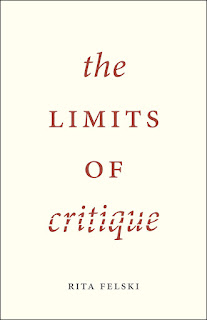
Limits of Critique, Chapter 2


Summary of Chapter 2: Digging Down and Standing Back


In this chapter, Felski takes on the role of spatial metaphors in the practice and discourse of critique. she talks about the power of “metaphor clusters” and the advantages and disadvantages of using particular metaphors: “analogies can smooth or derail the path of thought” (53) [how do you “derail a path”?] She uses the metaphor of “fresh” vs. “stale” to describe the effect of promising new metaphors as opposed to established, constraining ones. “Figures of speech can become stubbornly entrenched and hard to budge, taking on a life of their own, dictating what and how we see.” [aka, wheels in the head]. She talks about how metaphors “choreograph” a text, influencing how a reader approaches and understands it. Her main intent in this chapter is to take on the two prominent metaphorical descriptions of critique, featured in the title. The first, “digging down” metaphor of uncovering is associated with Freudian and Marxist traditions; the second, “standing back” metaphor with post-structuralism and a recently influential issue of Representations.

A key text for the “digging down” metaphor is Jameson’s The Political Unconscious, which combined both Freudian and Marxist influences and popularized the “digging down” metaphor, along with Althusser’s concept of “symptomatic reading.” The presumption of such an approach is that the “manifest meaning” of a text is superficial or misleading, because there is a deeper, “latent” meaning, which reveals the true purpose or message of the text. For Freudians this is a “repressed” meaning. More broadly, “digging is an ethical and political imperative” on the part of the critic (58). She traces some of the history of this metaphor, from the influence of archaeological discoveries (such as Troy) on Freud’s use of the digging and discovering metaphor; to the emergence of a more sophisticated psychoanalytical approach, informed by semiotics, in the 1970s (Lacan, etc., are not named).

In exploring the productivity of this approach, she notes that when “gaps and fissures” in a text are discovered, this allows for an ambiguous reading, rather than mere hypercriticality and “suspicion” (63). “Admiration and love,” can coexist with, or form an essential motivation for, critique, and texts can be “rescued” from the “shame of the sheerly ideological” by noting how they struggle with or challenge ideology rather than merely replicating it. She notes Jameson’s “stout defense” of the “positive hermeneutic” aspect of Marxist critique (64): that this is not merely, or even primarily, about tearing down, and that leftist critique in fact has utopian elements and inspirations. She then somewhat weakly criticizes Jameson’s point, by calling such utopianism an “endemic suspicion of the present,” in which “all hopes are pinned on a world beyond this world.” She backs this up with a note citing Latour’s “compositionist manifesto.” Similarly, she notes the nuance of George Steiner’s “fourfold structure of interpretation,” only to conclude that “this double-sidedness disappears, however, once dialogue gives way to a diagnosis of symptoms.” That is, the specific form or practice of “symptomatic reading,” (a subcategory of this broader metaphor which she has traced over a century) is taken as more significant than all the ambiguity and complexity that advocates of “digging” critique speak about. It’s like she has to recognize that they talk about and praise ambiguity, but then take it away from them, because it will be part of “post-critique,” and thus be denied as an inherent or essential aspect of “critique.”

Part of her criticism could be understood as a call for a “flat ontology” or a “flat reading” (though she uses neither of these terms, nor the “flat” metaphor, which is part of the “surface” metaphor she will be critiquing next). In such a reading, “ideology” or the “political unconscious” are [spooks,] and don’t really exist out in some imagined underworld or overarching space; instead they are “housed in the scribbled notes, computer files, and footnotes of the critic’s own workspace” (66). This is a riff on Latour’s criticism of Levi-Strauss’s “unconscious structures of primitive myths,” (202n23), as existing not in Africa or Brazil but in the filing cards in Levi-Strauss’s office, or more specifically, in the assemblage of human and non-human actants that has composed or created or established them, or whatever word Latour wants to use [though isn’t it fair to ask, does not “Levi-Strauss’s office,” itself, exist in Latour’s files and folders, etc.?]. Felski follows this with one of the first of three or four short paragraphs (scattered through the chapter) in which she outlines her own vision of how texts should be read. She cites Ricoeur re: a “surplus of meaning,” which any text overflows with, and which is more than any one reader or critic could capture or interpret. “There is no need to resort to repression, in other words, to account for contradiction, nuance, or implicit meaning” (66). [here we are at the boundary between the opening and closing sides of post-critique: does the above “no need” imply that the search for “repression” should cease? Or that it should simply not be mandatory or dominant, and that it can co-exist with other approaches and styles? After all, sometimes, repression happens, however that term is to be understood].

It seems her argument is really with “symptomatic reading,” and its need to posit symptoms which are themselves the result of a repression of the latent meaning, in the service of some kind of ideological unity or orthodoxy. Althusser and Jameson seem fitting targets of such a critique. However, it is less clear that this criticism accurately fits all of the variety of approaches which use the “digging” metaphor, and she seems to be taking this as a kind of ideal form which the rest must be seen as somehow trending to – perhaps “unwittingly?” She ends the section on digging with a reference to criticisms that arose from within, and a move toward a more nuanced and open form of reading by Macherey and others. She notes the rehabilitation of Freud as the “French Freud,” who was not simply a believer in the scientific veracity of his own theories, but one who was always testing the limits of the knowable: Freud was thus rehabilitated “by applying essentially the same techniques that had been used to ‘save’ canonical works of art” (68). She notes: “it was assimilated, in other words, into an influential style of thinking, that views irresolution, contradiction, and doubleness as the quintessential intellectual virtues” (69). This invocation of a late-20th century academic form of metis leads to the emergence of the next, competing critical metaphor of surfaces and “standing back.”

However, the second “metaphor cluster” she has identified ends being a bit more mixed: “surface,” “standing back” at a distance, and so on. Instead of keeping the “standing back” emphasis from the chapter title, she names this section, “Against Nature,” emphasizing a different key aspect of this form of critique, which is denaturalization [although this whole concept of “second nature” seems also key to many of the Marxist critics who fit better with the first trend]. Typical of her argument here are statements like: “The right to rail against social injustice, reinterpret images, or take issue with badly made arguments is not in dispute, but it is less evident that such rebuttals need to be framed as excoriations of nature” (71). Not to jump ahead too far, there is just so much conflation going on in that sentence: for instance, the implications that to criticize naturalization per se means also to insist that “such rebuttals need” to take that specific form; and also that accounts of “second nature” and “denaturalization” are “excoriations of nature.” WTF?

She traces this “excoriation of nature” through various precursors, such as the 19th century dandies of the aestheticism movement, a la Baudelaire, etc. In a reaction against the idealization of nature in Romanticism, the aestheticists celebrated artificiality and feared or derided “nature” as the “realm of the automatic and unthinking.” Another trend is that of Russian Formalism and their practice of ostranenie, or “strangemaking.” (Phenomenology’s suspicion of the “natural attitude” is added as another precursor a few pages on (73)). “Denaturalize” and “defamiliarize” become synonyms (72). The point of defamiliarization/denaturalization is to reveal that what we consider to be “natural” is in fact a product of culture. “Modern ‘culture,’ in a paradoxical reversal of the usual distinction, thus enforces the metaphorical sway of ‘nature,’ as second nature.” The “paradoxical reversal” she seems to be referencing here, is the fact that “nature” is culturally (ahem) a much stronger and more privileged term than “culture;” this form of criticism reverses that to undermine the power of exactly this privileging of “nature” and of naturalizing categories, etc. It is interesting that (and all the moreso given her frequent references to Latour) she does not mention the cultural (ahem) and institutional dominance of the “hard sciences” and of biological and “natural” explanations in the US, which is in fact the source of the “cultural and social explanations are belittling” theme she has copied over from Latour (and seeks to deploy uncritically, if it is fair to use that word). She has of course signalled in the previous chapters that she will argue against the claim of critique to be oppositional; she may of course be correct about this within specific discourses but on the broader field, it certainly remains a counterhegemonic discourse – and it seems a bit naive or willful to ignore this fact, quite evident to, for instance, an instructor of introductory anthropology and sociology courses. She will, later in the chapter, claim that “critique” is elitist and academic, and cultivates an alienating language and stance which distance it from the everyday language of everyday people; be that as it may, this very insistence on “critique” as a dominant discourse, seems clearly confined by a perspective limited to the ivory tower, and only certain parts of it, at that. And certainly not the best funded or influential parts!

She lists three kinds or aspects of “nature” which come under the glare of critique: human nature, inner nature, second nature. She repeats this theme often throughout the rest of the chapter, and the question arises as to whether she really wants to rehabilitate the concept of “nature” (untouched or excused from these criticisms), and to what end? One guess is that this is a form of post-humanist argument, that our way of talking and being suspicious of “nature” limits our connections and “alignments” or whatever with non-humans and the natural world more generally. However, this has not been specifically stated here. Another question that arises here is what role such rearticulations of words and concepts like “critique” and “nature” as here proposed, play in a potential contemporary rearticulation of the position of academics, the university, and so on in these early decades of the 21st century. Felski (paralleling and echoing the more pointed account in Bookchin, as I was reading recently) outlines the growth of “critique” as an academic practice, corresponding to the era of the acceptance of (tame variants of) Marxism into the academy from the 60s through the 80s. Bookchin’s reading seems to see these radical intellectuals/academics (he was himself one after all) as part of a class fraction (or what have you) involved in a link or alliance with the working class (and later on, with progressive movements challenging racial, gender, and heteronormative hierarchies). The academic practices of “critique” and “denaturalization” Felski is critiquing emerged in this era, and thus served the interests of this class or group, (or class fraction, I don’t really know the Marxist terminology). [Felski herself does not mention any kind of class or group analysis of this sort, though she does make a passing reference to “elective affinity;” perhaps she is saving this topic for chapter 4, on politics]. In any event, some have argued that we are currently in the midst of a new rearticulation to fit new changing circumstances: old words and concepts are being updated to meet the new needs of the time. This is the critique outlined, for instance, by Michel Bauwens of the “woke ideology” (or the coherent and interesting parts of that critique, anyway). A word like “critique” from this view, is done away with to make way for new terminology: a fresh start and a shorter citation pattern (we all just talk about “matters of concern” now, and cite Latour instead of Foucault or Butler, or Gramsci). But a new rehabilitation of “nature” seems to put a lot more at stake. Later in this chapter Felski recounts, critically, the attempts by Butler and others to stave off naturalizing categories and the collapse of their form of critique into “orthodoxy;” she again will dismiss this as “not necessary.” But the other (suspicious, yes) side of the question is what is gained by academics (or a group or faction thereof) becoming newly re-enabled to talk about “nature” and the “nature” of things? In the context, of course, of a university and culture that have privileged nature and naturalizing categories all along, all the moreso as the university becomes increasingly streamlined into a productive, corporate-aligned business model.

She turns next to the topic of antinaturalism as style and tone, starting off with a surprisingly inaccurate reading of Foucault’s style as “famously impassive,” “purged of obvious signs of affect and attachment,” “cool rather than hot” (74). Though it is fair that Foucault is “scrupulously nonjudgmental,” this is all part of his ironic detachment, which is, far from lacking in affect, above all playful and often maddeningly so. In a footnote she slightly qualifies this with a recognition that there is “another side” to Foucault, but overall it is surprising that a writer like Felski, so attuned to nuance and style, would short-change one of the foremost proponents and practitioners of the gay science.

She turns then to Roland Barthes, and describes the great influence of his Mythologies: followed with his own dissatisfaction at how orthodox and common the method he used had become by the 1970s; his response was to “move away from critique” (75; in Felski’s words), to experiment with more diverse and playful styles of reading and writing. (It is of course Felski’s circumscribed usage of “critique” that limits the word to Barthes’ earlier, but not his later, texts, nor indeed to his own critique of his earlier style).

She notes that this “ironic consciousness” was often linked to political and radical activism, and that an “elective affinity” was forged between “French theory” and “a vanguard of queer theorists, feminists, and postcolonial scholars (76). This group is/was particularly critical of naturalizing language and the use of it by social movements: they used the ironic detachment and corrosive unending critique of the “stand back” variety to evade cooptation. This led them to question or oppose the use of any received, naturalizing, or essentialist language, like “identity,” appeals to the biological reality of “woman,” etc. (and is not Felski herself carrying this forward a step by critiquing the received value of “critique?”) Felski quotes Lee Edelman: “critical negativity, lacking a self-identity, can never become an orthodoxy.” This idea of critique, or a radical practice of critique, as immune to cooptation, and specially so, is one of the key arguments Felski is determined to refute. Here, she takes Edelman’s claim to task from “the perspective of actor-network theory,” by pointing out that “critical negativity” in fact has numerous “identities:” “as a material and physical object, a contribution to a tenure file, a reckoning with one’s scholarly rivals, a means of working through a midlife crisis,” and so on. Other than the fact that “identity” seems to be being used in different sense by Edelman and Felski, this appeal to context (always situate?) is of course reasonable but seems to too-confidently insist that a corrosive critique, or an attempt at hewing to anti-naturalizing or anti-essentializing discourse, can have no effect whatsoever and is nothing but a pipe dream. The ultimate question is about the power and possibilities of articulation which such concepts and uses of language have – and situating/contextualizing them does problematize them further but not in a way that actually discredits such language, but rather, that renders it really more important to be understood fully, imho. (And it seems likely that Felski will return to this as her point: she is not anti-critique, but postcritique, after the manner of the “postmodern” or the “post-structural”; however, her polemical language and rhetorical stance (of disabling by explaining) makes her come across as a bit blunter, and indeed I suspect she is moving (“unwittingly” or not) between both positions).

She continues her discussion of postcolonial readings informed by the “stand back” tradition; the idea that texts and their authors “unwittingly” reproduce colonial ideology “is key” (77). “The set of socially constructed phenomena becomes an ever-expanding field that subsumes every conceivable object and practice.” This latter is a silly-sounding statement – the very premise of cultural anthropology and several related disciplines is that “socially constructed phenomena” are what we have to work with, and it is better to realize and study that, than otherwise – by this light, the perception that socially constructed phenomena is “an ever-expanding field” is reminiscent of the conservative who complains that gay and transgender people have suddenly been brought into existence by political activists. There is, of course, a sense in which, per the usage of ANT, this is true; and in fact the point Felski is making is, ironically, that the concept of “socially constructed phenomena” is itself a socially constructed phenomenon, a product of a specific, situated, assemblage of humans and non-humans, etc. But we get again here to the problem of just where Levi-Strauss’s office is (see above); and there is an extent to which both Latour and Felski, having marshalled the endlessness of critique to embark upon a critique of critique, want to suddenly cut off this endless process at a convenient or useful point – which is, itself, quite reasonable as a pragmatic and productive move, but which imho is less felicitous when it appears to be made into a basis for a moralizing argument against other ways of talking about the social and so on, and of using critique.

Here, she again refers to the argument that to explain something as socially or culturally constructed is to “reduce it to dust” (paraphrased from her words, which derive from Latour’s). She cites Latour’s discussion from Reassembling the Social where he is moving away from the terminology of “social construction” because other sociologists misunderstand it – specifically, he and the other ANT thinkers having shown that science is socially constructed, other sociologists congratulate them for showing science to be all “hogwash” or words to that effect. (Scientists, in turn, are also indignant over this idea). Latour and his friends are initially (and correctly) surprised that other sociologists misunderstand the concept and accord so little status to products of social construction, even though these are the things they themselves study. The problem with this passage is it is wholly a straw man argument – no one is named or quoted to this effect – very typical of Latour (though not of Felski, who gives direct quotes from real people and texts when she wants to give examples of discourse). And then these people who clearly misunderstand sociology and the concept of social construction, are taken as exemplars of sociology and social construction, and the reason these concepts have to be moved beyond. This slippery slope argument used by Latour is then adopted by Felski but used as a tool – by explaining the rhetorical and socially situated character of critique as a practice and as a set of metaphors, she seems to believe she is degrading it – but that does not follow, at all, because of course everything is socially constructed.

She turns then to Butler as an exemplar of “fin-de-siècle critical theory” (78), trying to avoid essentializing language and the trap of identity. I think in reality the more important metaphor or sense of critique here, which Felski has not identified as such, so far as I can tell, is not its “superficialness” as opposed to depth (that was a convenient organizing opposition of her own, but it does not live up to the needs of the chapter overall), but its endlessness and corrosiveness or mobility, its resistance to fixed endings and conclusions. And yet how Felski responds to Butler is also to emphasize the undendingness of discourse: she points out that when people accept or claim identities (which Butler is resisting) they are practicing what I would call (after Spivak) “strategic essentialism;” not as final or enduring states but as temporary ones: “they speak, they hesitate, and they speak again” (79). Such essentializing can be used to police and control, but it is not always used for this purpose or this effect. “It is not that questions of power are irrelevant to such speech acts but that the writer must clarify their relevance by attending to specific cases.” [Always contextualize?] None of these very apt observations seem to be much of a criticism of Butler’s point about language, however. It seems that in Felski’s situated view, aspects like citationality and the entailments of articulation are simply being ignored. Of course, for instance, a strategic essentialism that makes an appeal to a concept of enduring identity, reproduces that concept and keeps it alive and relevant. Merely to point out that discourse is situated and agonistic, etc. does not obviate that point about overall and long-term effects. It is all about articulation, and Latour and Felski, in debating the uses of language and concepts, are playing the same game. She does cite Toril Moi making an observation Volosinov would approve of: “It is impossible to theorize power in language in advance of any utterance.... You need to understand who says what to whom, for what purpose, under what circumstances.” Yet again, Volosinov’s target was actual functionalists and structuralists, it is hard to see how such a criticism applied to Butler cannot but depend on a reductive understanding of what they are saying and doing.

Nearing the end of this section, she makes the claim that the style of antinaturalism creates “a forbiddingly high wall between ordinary language and the language of critique” (80). A fair point but one fitting more for the academy in general than any particular school within it – one could argue that much of what ANT does is construct new terminology to replace the old, thus creating new in-groups who know the right language to use (e.g., “matters of concern,” “attachments,” and so on). She reiterates her critique of the critique of naturalism and the “taken for granted:”

It is one thing to point out that certain ideas are bad and also taken for granted. It is another to conclude that they are bad because they are taken for granted—in other words, that anything taken for granted is an agent of domination.

Two thoughts here: 1) part of the most successful aspect of her critique of critique so far, is precisely how she has pointed out that certain aspects of it (such as its special radical or moral character) are in fact taken for granted, and that this is bad! And even allows for domination to creep in! 2) again, what she is specifically targetting in this paragraph is the idea of nature, and it seems a rearticulation is being called for – and what rearticulation of “nature” and of “the natural” is being made possible, and for whom, and for what interests could an “elective affinity” be found, in the present and near future?

She ends with the observation that all forms of thinking and language rely on unanalyzed “black boxes” and here we see perhaps, a more important critique – a reference to the limits of critique promised by the book’s title. “In short, critique overestimates [aka, “takes for granted?”] the transcendent force of its own self-consciousness and the extent to which it can liberate itself from convention” (81). [Mind you, what was identified a few pages ago as “fin-de-siècle critical theory” is now equated with all of “critique.”] She equates this with “the old dream of philosophical transcendence, the view from nowhere,” – what she earlier referred to as the “suspended animation” of the philosopher (76) – and this is a ridiculous thing to say, given the political attachments of many of the people she is criticizing, and the arguably disabling attack she herself is making on their attempts at avoiding essentialism, etc. – and to what end? Is she not the one who will be left in “suspended animation” via her critique of all the attachments and black box assumptions of critique as a radical practice?

In the concluding section, she summarizes, “we have considered two variants of critique, hermeneutics versus genealogy, depth versus surface, the pursuit of truth versus the interrogation of nature.” Once again, slippages abound – two common sets of metaphors used to describe critique have somehow become two “variants of critique,” not to mention the fact that she has in fact identified quite a range of metaphors, which don’t seem to neatly fall into the two categories that she keeps insisting on. And of course, it is weird to call arguments against naturalization “the interrogation of nature,” for so many reasons, but most simply, because its advocates don’t believe that what they are interrogating is in fact “nature.” She discusses Foucault’s theory of power and how it differs from Marxian and Freudian depth-seeking, and cites Dreyfuss and Rabinow on the claim that Foucault’s work escapes the charge of being a “hermeneutics of suspicion” (82). She goes back to her move, in the previous chapter of (quite reasonably, imho) expanding on the use of the word “hermeneutics” to include what Foucault is also doing, as “second-order hermeneutics” (83). (And thus the opposition between “digging down” and “standing back” “variants” of critique, has now become an opposition or rather historical and methodological relation, between “strong” (aka first-order) and second-order hermeneutics). Here I should expect some recognition of the similarity in moves: Foucault criticized “hermeneutics” and tried to create new methods (e.g., “genealogy”) that move beyond it; isn’t this what Felski is also doing with “critique?” And in both cases it is a fair question to what extent the words they have chosen to describe what they are critiquing are accurate or even reasonable fits. She ends with a call for a text to be seen as a “phenomenon to be engaged” and “a potential source of knowledge rather than just an object of knowledge;” and for reading as “a cocreation between actors that leaves neither party unchanged” (84). To me, this comes across as a reasonable, though not particularly shocking or surprising call – for what we could call a third-order hermeneutics?


Thursday, February 3, 2022

The Dialogic Imagination, Introduction

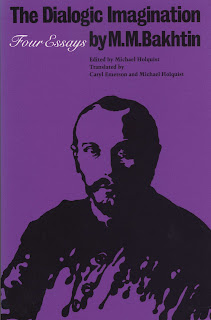
M. M. Bakhtin (1981) The Dialogic Imagination: Four Essays. Edited by Michael Holquist; Translated by Caryl Emerson and Michael Holquist. University of Texas Press, Austin.


Summary of Introduction (by Emerson and Holquist, presumably)

In this introduction, Emerson and Holquist, or one or the other of the two (it is not indicated; the term “I” is used, so perhaps it is Holquist, the editor) summarize Bakhtin’s life and work and introduce a few key concepts. One key argument is that Bakhtin’s thinking is characterized by a “Manichaean” opposition between centrifugal and centripetal forces in language. I’m not sure if “Manichaean” is quite the right word, because Bakhtin’s thinking on these two forces is ambivalent. In contrast to, for example, Norbert Wiener (for whom “entropy” is equivalent to evil), Bakhtin clearly favors the centrifugal; but he is also a bit like Deleuze and Guattari (whose striated and smooth spaces are clearly related concepts), when they admit that “a smooth space will not always save us” – for Bakhtin, some amount of centripetal or unifying force is important as well (as in his comments on “style” in the Dostoevksy book). Thus it seems that what Bakhtin is looking for is a kind of balancing, though favoring the centrifugal.

In relation to this, Holquist (or Emerson and Holquist) makes an interesting yet cryptic observation that Bakhtin does not reduce this dichotomy to a “binary opposition” such as those employed in structural linguistics. “That opposition leads from human speech to computer language; it conduces, in other words, to machines” (xviii). Here thinkers like Wiener, arguably also someone like Chalmers, is clearly implicated (though it is interesting to think how Haraway, for example, would respond). Nevertheless, to the extent that such a reductive, binarist/digital “conducement” to machines and computer language is something to be resisted, Bakhtin’s nuanced thinking could be useful; however, this observation is made only in passing and is not fleshed out.

Heteroglossia, in this account, becomes the interaction of the two opposed forces: the writer or speaker as unifying force drawing on (or in) the centrifugal, proliferating and novel speech of others, in a way that does not reduce them or their creative power.

The authors summarize Bakhtin’s vision of language as communication evocatively:

“Bakhtin’s basic scenario for modeling variety is two actual people talking to each other in a specific dialogue at a particular time and in a particular place. But these persons would not confront each other as sovereign egos capable of sending messages to each other through the kind of uncluttered space envisioned by the artists who illustrate most receiver-sender models of communication. Rather, each of the two persons would be a consciousness at a specific point in their history of defining itself through the choice it has made—out of all the possible existing languages available to it at that moment –of a discourse to transcribe its intention in this specific exchange.” (xx)

First of all, this recalls Felski’s complaint about the language of discourse “creating” subjects, etc.; and quite reasonably, since Emerson and Holquist are exactly the kind of 80s theorists she is talking about. Nevertheless this is a good example of why such language is not “unfortunate” but rather quite productive and important. Wiener also comes to mind because he specifically recognized the noise in such exchanges, and thus was more subtle than the straw man model of the naive “artists” evoked above. Yet, Wiener also assumes the two conversants as independent, previously existing, “sovereign” (in a literal sense because any entity is like a kingdom holding itself together against the forces of chaos) subject. The image of the situated, self-constructing subject not only improves on Wiener’s model but also allows for a more complex understanding of the uses of “noise” as these subjects are shown to be shielding themselves from, but also drawing on, such noise (“interference” in the text) in the next paragraph.

The authors, incidentally, make the assumption that Voloshinov is Bakhtin, so the above interpretation seems to bear the imprint of Voloshinov (his idea that there is no interiority beyond language, and that the utterance in the situated moment is the most important aspect of language).

It is clear that, for Bakhtin, these centrifugal (or entropic) forces are productive, rather than merely destructive, as Weiner would have it. And perhaps their world views are opposite: it is the eternally productive centrifugal which must be reined in by the centripetal (but not too much, because it must be allowed to remain itself) in order for order to be created (not just maintained). The authors end with a discussion of why Bakhtin feels the novel is so revolutionary and distinctive compared to other genres: it joyfully admits and makes use of its own limitations (and is always playing with and expanding on these). Such joyful inadequacy of the modern novel stands in contrast to Felski’s complaint that modern literature, through just such games, trains readers to be suspicious. If so, this is the fun suspicion of a game (something I do not recall her discussing so far). Presumably Felski will invoke a call for (non-suspicious) joyful reading in her conclusion, but here is a sign that it has been available in modernity all along.


Tuesday, February 1, 2022

Problems of Dostoevsky's Poetics, Chapter 5, Parts 2-4


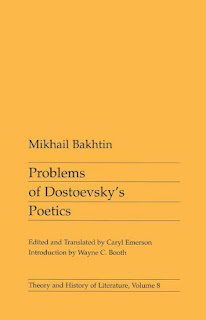
Summary of Chapter 5, parts 2-4

Compared to the extremely dense first part, the next three parts of the chapter are much fluffier and are mostly composed of specific examples from Dostoevsky's books.


Part 2: The Hero's Monologic Discourse and Narrational Discourse in Dostoevsky's Short Novels

This part of the chapter is mostly examples from the shorter novels of phenomena Bakhtin had already laid out. Prominent are The Double and Notes from Underground. B talks about the "word with a sideward glance" at another discourse or perspective; three voices (apparently the original voice, the imagined second voice, and a third that unites them), "loopholes" etc.


Part 3: The Hero's Discourse and Narrative Discourse in Dostoevsky

Bakhtin explores the internal dialogue and regular dialogue of heroes in Dostoevsky, particularly Raskolnikov, for whom other characters are “ideological positions,” that he reacts to and is in dialogue with, and places in dialogic juxtaposition with each other. Heroes reveal themselves or learn to situate themselves in a field of inter-orientations. "Penetrated word" (“a word capable of actively and confidently interfering in the interior dialogue of the other person, helping that person to find his own voice” (242)) and "penetrated discourse" (“a firmly monologic, undivided discourse, a word without a sideward glance, without a loophole, without internal polemic” which is nevertheless “only possible in actual dialogue with another person” (249)) are defined, though they seem to be opposites; the former is discussed but not the latter much. He ends with a reference to unfinalizabilty and the  fact that the narrator's voice does not dominate. 

He states that in Dostoevsky's novels, almost no evolution of thought happens; characters never change their perspective; when something happens, they knew it was going to happen, and are not changed by it. [Why would Bakhtin consider this good? Because surely everything Dostoevsky does is the most awesome thing possible... I guess the point is that such change in the character would be an internal situating; what Bakhtin wants is social situating, the interplay of ideas in a social setting, not just the internal development of an individual.]


Part 4: Dialogue in Dostoevsky

Bakhtin summarizes he importance of dialogue in Dostoevsky's works. Particularly emphasized is that external dialogue is always related to internal dialogue; sometimes speakers in external dialogue are responding to (wittingly or not?) another speaker's statement in an internal dialogue. It is also emphasized that the dialogue is not plot-dependent: though it still follows and relates to the plot, it has an openness or "unfinalizability.” He also talks about how words and themes "pass through" many different voices (the image reminds me of a motif in music, picked up and transformed through different instruments, etc.) – fitting for Bakhtin’s ideal of “polyphony” in the novel. (An example that comes to mind is the phrase “the lesser evil” in the Witcher story of that name).

A character's self-consciousness in Dostoevsky is thoroughly dialogized: in its every aspect it is turned outward, intensely addressing itself, another, a third person. Outside this living addressivity toward itself and toward the other it does not exist, even for itself. In this sense it could be said that the person in Dostoevsky is the subject of an address. (251)

[This marks an interesting potential link with interpellation; Dostoevsky's subjects are highly conscious of, knowingly dependent on, their interpellation? Some echo of Volosinov’s insistence that there is no interiority beyond or before language seems to link here as well.]