Showing posts with label commodities. Show all posts

Tuesday, September 24, 2024

The Revolution of Everyday Life, Chapter 5


Summary of Chapter 5: The Decline and Fall of Work

V’s summary:

The obligation to produce alienates the passion for creation. Productive labour is part and parcel of the technology of law and order. The working day grows shorter as the empire of conditioning expands.

“In an industrial society which confuses work and productivity, the necessity of producing has always been an enemy of the desire to create.” (52) The two opposed terms through this chapter will be productivity, forced upon us from above, and creativity, freely chosen from below. In the current capitalist system, forced labor maintains order and the status quo by confusing and exhausting people.

The same people who are murdered slowly in the mechanised slaughterhouses of work are also arguing, singing, drinking, dancing, making love, taking to the streets, picking up weapons and inventing a new poetry. Already the front against forced labour is forming; its gestures of refusal are moulding the consciousness of the future.

V traces the etymologies of travail and labor from torture and suffering, respectively. While in the feudal order, the elite eschewed labor as demeaning, the bourgeoisie embrace it:

The bourgeoisie does not dominate, it exploits. It does not need to be master, it prefers to use. Why has nobody seen that the principle of productivity simply replaced the principle of feudal authority? Why has nobody wanted to understand this? (53)

Is it because work ameliorates the human condition and saves the poor, at least in illusion, from eternal damnation? Undoubtedly, but today it seems that the carrot of happier tomorrows has smoothly replaced the carrot of salvation in the next world. In both cases the present is always under the heel of oppression.

The point of productivity (as opposed to creativity) is not the transformation of nature, and not self-realization, because Taylorism destroyed the craft spirit of work.

Nowadays ambition and the love of a job done are the indelible mark of defeat and of the most mindless submission. Which is why, wherever submission is demanded, the stale fart of ideology makes headway, from the Arbeit Macht Frei of the concentration camps to the homilies of Henry Ford and Mao Tse-tung. (54)

The aristocracy ruled on the basis of a “unitary myth;” the bourgeois order cannot recreate this, so relies on the fractious reign of competing ideologies, unified by the ideal of productivity.

So what is the function of forced labour? The myth of power exercised jointly by the master and God drew its coercive force from the unity of the feudal system. Destroying the unitary myth, the fragmented power of the bourgeoisie inaugurated, under the flag of crisis, the reign of ideologies, which can never attain, separately or together, a fraction of the efficacy of myth. The dictatorship of productive work stepped into the breach. Its mission is to weaken the majority of people physically, to castrate and stupefy them collectively and so make them receptive to the feeblest, least virile, most senile ideologies in the entire history of falsehood.

V discusses the role of consumerism and the “leisure explosion” in prompting people to work harder to be able to have leisure. He critiques Maoist China as just “another example of the perfected form of capitalism called socialism.” (55)

Has anyone bothered to study the approaches to work of primitive peoples, the importance of play and creativity, the incredible yield obtained by methods which the application of modern technology would make a hundred times more efficient? Obviously not.

[This is an interesting observation in 1967, as Marshall Sahlins would have recently articulated the concept of the “original affluent society,” and Vaneigem might well have heard of this; Richard Lee had finished his dissertation, and Pierre Clastres was conducting fieldwork in South America. On the liberatory potential of modern technology, several of Bookchin’s essays that would later be collected as Post-Scarcity Anarchism would have been coming out in New York during this period, as well. So, despite V’s “obviously not” shrug, such questions were definitely in the air.]

To the extent that automation and cybernetics foreshadow the massive replacement of workers by mechanical slaves, forced labour is revealed as belonging purely to the barbaric practices needed to maintain order. Power manufactures the dose of fatigue necessary for the passive assimilation of its televised diktats.

And yet:

One day, perhaps, we shall see strikers, demanding automation and a ten-hour week, choosing, instead of picketing, to make love in the factories, the offices and the culture centres. Only the planners, the managers, the union bosses and the sociologists would be surprised and worried. (56)


Wednesday, May 25, 2022

The Paris of the Second Empire in Baudelaire, Part 4


Summary of Part IV: Addenda


This section is composed of two brief fragments from the plan for the larger book; the first on Benjamin’s method, the second on “taste.”

Benjamin remarks on the relationship between the “materialist method,” as he practices it, and the idea of truth. One cannot simply try to separate out truth from falsehood, because the object under study is “riddled with error, with doxa” (129); as the translators note, this is Plato’s word for “opinion” or common beliefs, which the philosopher must counter and go beyond to achieve truth; for Benjamin, the use of the term seems closer to “ideology” or “false consciousness” as used in the Marxist tradition. Yet his positioning of this doxa within the object is a mark of his particularly materialist form of “materialism,” akin to the way his “phantasmagoria” are situated within or as material accounts, books, specific articulations of the social (in contrast to, for example, Debord, whose “spectacle” is an over-arching abstraction, only instantiated in local forms; for Benjamin it seems the instantiation is the whole thing, the object of study). Yet this is not to say that he wants to study “the matter in itself,” as this was the goal. Rather, it must be questioned for larger purposes: using the metaphor of a stream, the “historical materialist” is not mesmerized by its beauty, nor by the mystery of its origin or source, but instead asks

Whose mills does this stream drive? Who is utilizing its power? Who dammed it? These are the questions that historical materialism asks, changing our impressions of the landscape by naming the forces that have been operative in it. (130)

[After all, the point of philosophy is no longer to merely interpret the world...] And further, these forces are to be questioned, not only in regard to the production of historical objects (as with Marx’s famous table), but of the “tradition” or means of communication/transmission of objects to the present: the “production process in which they continue to survive.” In a footnote he explains part of his fascination with Baudelaire:

There is little point in trying to include the position of a Baudelaire in the fabric of the most advanced position in mankind's struggle for liberation. From the outset, it seems more promising to investigate his machinations where he was undoubtedly at home: in the enemy camp. ... Baudelaire was a secret agent – an agent of the secret discontent of his class with its own rule. (300n261)

The section on “taste” begins with the announcement, “Taste develops when commodity production clearly surpasses any other kind of production” (131). “Taste” in the way Benjamin is using it appears to be a reaction against commodification and fetishization. Whereas buyers interacting with artisans had had some knowledge of the production process, consumers of mass-produced goods have little understanding. They know nothing about the actual qualities of the material, etc. and are unable to judge the workmanship; they are influenced instead by the “profane glimmer (Schein)” that “makes the commodity phosphorescent.”

As the expertness of a customer declines, the importance of his taste increases proportionately—both for him and for the manufacturer. For the consumer, it serves as a more or less elaborate masking of his lack of expertness. For the manufacturer, it serves as a fresh stimulus to consumption, which in some cases is satisfied at the expense of other consumer needs that would be more costly for the manufacturer to meet.

He then discusses the link between this development of “taste” and the use of language in l’art pour l’art, jugendstil poetry, and Mallarmé. This has to do with the class position of bourgeois/lumpen writers who, renounced by or alienated from the bourgeoisie (whom they might previously have represented), have nothing to say based on their own experience, and so produce wholly "esoteric" works focusing on expressing their own character, or taste. Baudelaire, however, is different, because although his works, as well, are “nowhere derived from the production process,” nevertheless the “roundabout ways” in which his works originated “are quite apparent” in his writing, instead of obscured behind the mask of taste (133).


Wednesday, March 9, 2022

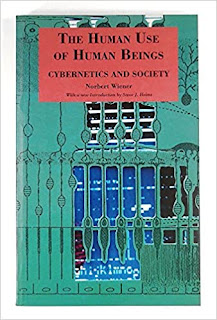
The Human Use of Human Beings, Chapter 7


Summary of Chapter 7: Communication, Secrecy, and Social Policy

In this interesting little chapter Wiener turns the cybernetic lens to organizations, particularly nation-states, to address the issues of scientific advance, and of secrecy in the name of military advantage or national security. Essentially, secrecy is the enemy of communication and progress, and is typically based on an outdated or incorrect understanding of information and how it works. The US and USSR have brought back the Machiavellian politics and subterfuge of the Italian Renaissance; however, we now have a much more sophisticated scientific understanding of communication, and we can use this to analyze the present moment and see what we could do better.

One big problem that comes under Wiener’s scrutiny is the American propensity for judging the “value” of any thing by its value on the market. This is tied also to old-fashioned ideas, such as the idea that information can be treated like private property. He starts with the example of patent law; this made sense in age when inventions were made by skilled artisans working alone, but not today. He goes into the history of the changing relationship between artisan/inventors and groups of scientists.

He describes the qualities that make a thing a good commodity:

What makes a thing a good commodity? Essentially, that it can pass from hand to hand with the substantial retention of its value, and that the pieces of this commodity should combine additively in the same way as the money paid for them. The power to conserve itself is a very convenient property for a good commodity to have. (116)

A very cybernetic definition! He notes that gold makes a good basis for currency, because it is relatively stable (take that, bitcoin!). One presumes Wiener is not a big fan of markets, because of course these can cause even the value of gold to fluctuate wildly.

Information, in contrast, makes a bad commodity because it is subject to entropy – indeed, it is the opposite of entropy: “just as en­tropy is a measure of disorder, so information is a measure of order.”

He gives an example of competing measures of value: the value of a piece of jewelry has two parts: the gold, and the "façon" or workmanship [unfortunately I can't find other internet sources using this latter term, an interesting name for the imprint of labor on an artifact]. The latter leads to artificial markets such as stamp collecting, which depend on the existence of a group of buyers, and thus is open to dramatic swings in value, because “there is no permanent common denominator of collectors' taste.” A reasonable point so far as it goes, but can't even gold swing greatly in value? or more importantly, bread? It seems to me that trying to distinguish between “stable” and “unstable” commodities based on inherent qualities (derived from the theory of information) is not going to be successful.

“The problem of the work of art as a commodity raises a large number of questions important in the theory of information” (117). He moves into a discussion of art markets, noting that “the physical possession of a work of art is neither sufficient nor necessary for the benefits of appreciation which it conveys” [this is pretty much what Lady Philosophy tells Boethius regarding beautiful natural countrysides: you don't need to possess it to enjoy it]. Reproductions can give you a lot of the experience of the originals (even more so with music) – it is interesting what Wiener might have said about Benjamin’s theory of aura, perhaps this is relatable to his information theory of art? Reproduction is good because it spreads the enjoyment, though it also undermines the value of the original, and is furthermore lossy. (Wiener’s treatment of information here could benefit from some of the insights of the Innis school regarding space-binding and time-binding media). He derides derivative and second-rate copies.

 [The cybernetic theory of information may not be so good at explaining the value of art:]

What has been said before may not be worth saying again; and the informative value of a painting or a piece of literature cannot be judged without knowing what it contains that is not easily available to the public in contemporary or earlier works. It is only independ­ent information which is even approximately additive. The derivative information of the second-rate copyist is far from independent of what has gone before. (119)

[Scarcity of information = value, here. I thought Wiener was critical of such an idea? Or maybe he is not advocating such market reductionism, just describing it. And yet he seems to be taking it for granted as an aspect of the value of information.]

… a piece of information, in order to contribute to the general information of the community, must say something substantially different from the community's previous common stock of information. Even in the great classics of literature and art, much of the obvious informative value has gone out of them, merely by the fact that the public has become acquainted with their contents. (119)

If the value of art can be reduced to “information” in this sense (and furthermore, simply novel or new information), then schoolboys who detest Shakespeare are quite reasonable to do so (until they are trained to see beyond the expected and cliché), and artists like Picasso can be seen as a "destructive influence" because they use up the available future positions for art [based on his later discussion of science, he is perhaps seeing art history as “path-dependent” here, an interesting idea but it seems just as easy to say that explorers like Picasso spur others to innovate as well. Then again I have actually made this argument myself, that the avant-garde is really about seeking out and pre-emptively using up possible future positions, in order to sort of suck the power out of these possible futures].

An interesting disquisition on what Wiener believes that the "man in the street" thinks about "Maecenas" (an ancient Roman art collector whom, imho, the “man in the street” has almost certainly never heard of) leads into his criticism of the idea that information (including artistic value) can be stored. This in turn leads to a discussion of weaponry and military tactics, which cannot be reasonably stored (at least not in modernity) but must be updated: storage, as antithesis of the process of change, is destructive and wasteful. England and New England are given as examples of regions which are economically hampered by being over-invested in older models (because they were first to develop), while later adopters easily move ahead.

Quite apart from the difficulties of having a relatively strict industrial law and an advanced labor policy, one of the chief reasons that New England is being deserted by the textile mills is that, frankly, they prefer not to be hampered by a century of traditions. (121)

[A.E.J. Morris makes a similar argument, in his History of Urban Form, regarding the ascendancy of Birmingham over the older artisanal center of Coventry; though he then notes that "with hind sight" this resulted in Coventry being spared many of the ravages of the Industrial Revolution (Morris, p. 290).]

Thus, from cybernetic viewpoint, law, “advanced labor policy” (as in, worker’s rights and protections) and traditions are examples of “storage:” once again cybernetics takes the form of a deeply functionalist way of looking at culture. Now Braverman, who I am reading at the same time in part specifically as a contrast with Wiener, might actually agree about this storage idea; but the overall role would have to be understood within the context of struggle over who has knowledge, and whose interests technology and production serve. I am reminded also of Braverman’s observation that the theory of management could have developed differently in a society run by workers themselves, as opposed to the current society in which workers are a problem to be “managed” – the same holds true for Wiener’s cybernetics. Perhaps there could be a more subtle and complex conflict theory cybernetics, or conflict theory/agonistic view informed by the insights of cybernetics, but going beyond Wiener’s functionalist assumptions – such as that the country that will be most successful is "the country in which it is fully realized that information is important as a stage in the continuous process by which we observe the outer world, and act effectively upon it." (122)

This, in any event, brings him back to the question of military secrecy: there is no need or use for "storing" information using secrecy.

An example of the sort of description that must have influenced Silvan Tomkins:

I repeat, to be alive is to participate in a continuous stream of influences from the outer world and acts on the outer world, in which we are merely the transi­tional stage. In the figurative sense, to be alive to what is happening in the world, means to participate in a continual development of knowledge and its unham­pered exchange. (122)

International relations involves bluffing, similar to litigation which was discussed in a previous chapter (and bluffing and misrepresentation is a bad thing, according to Wiener). Scientific military advance ends up being a paradox:

I have already said the dissemination of any scien­tific secret whatever is merely a matter of time, that in this game a decade is a long time, and that in the long run, there is no distinction between arming ourselves and arming our enemies. Thus each terrifying discovery merely increases our subjection to the need of mak­ing a new discovery. (129)

He ends with demonic images, such as summoning demons, and the "Gadarene swine" from the Bible. The link between military development and evil is two-fold, because this will increase entropy (which he has equated with evil, before), besides literally resulting in the world being blown up.


Saturday, January 15, 2022

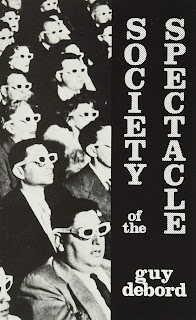
Society of the Spectacle, Chapter 6


Chapter 6: Spectacular Time


After rehearsing his theory of the history of time in the previous chapter, Debord here turns to the role of time in today's spectacle. He begins by drawing an opposition between irreversible commodity time (apparently the time of labor-value), that is, universally equivalent clock-time; and consumable time, which is the reappearance of the cyclical but in a consumable form as "pseudo-cyclical time.” An interesting reversal is involved: whereas cyclical time in the past had been non-individualizing, but irreversible time had been the time of unique individuals; in today's reversed spectacle, it is the irreversible time of commodity production (through the expenditure of labor time) that is non-individualized (quantitative rather than qualitative), and pseudo-cyclical time which is the lived time of unique experience (of the consumer). 

He spends several paragraphs expanding on the role of pseudo-cyclical time in the spectacle. It has two aspects: as "the time of consumption of images," and as "the image of consumption of time;" that is, it is both the time of consumption (of the modern spectacle and commodities), but also the image and meaning of such consumption, the spectacle itself. The vacation replaces the festival as the focus of pseudo-cyclical time, and the vacation then becomes the image of "real life" which the rest of existence is merely the build-up to [cf. "working for the weekend," or Jack Vance's story of a society of people who are aristocrats one day a week, and servants the rest.] "Here this commodity is explicitly presented as the moment of real life, and the point is to wait for its cyclical return” (153).

"Vulgarized pseudo-festivals" take the place of ancient cyclical ones (154). Whereas ancient cyclical time was in tune with the labor and natural processes of reproduction, the new pseudo-cyclical time exists in a contradiction with the "abstract irreversible time" of production [and this is why it is "pseudo"] (155). 

Because everything that is real is seen to happen to other people (celebrities) or to yourself only when outside of your own life (on vacation), your real everyday lived life "has no history" (157). That is, the "general historical life," as it exists during the spectacle, leaves no room for, and denies, individual life. Your actual experience of your own life is "without language, without concept," because all meaning is recuperated by the spectacle. This private life of the unique individual is forgotten. This is all part of the "false consciousness of time" (158). Debord notes that this was all made possible because back at the beginning of the capitalist era there was a primitive accumulation of the time that had belonged to individual workers [an interesting interpretation of time as a means of production].

There is also a denial of the underlying biological aspect of life and labor. Death is something denied and/or not dealt with. Whereas Hegel had argued that time is a necessary alienation, whereby we become other to ourselves and thus realize ourselves, this is denied us in spectacular time. Also, the sequence of fashions, commodities, etc in pseudo-cyclical time obscures the "obvious and secret necessity of revolution" (162). The real point of history, and of generalized historical time, has been denied – that is, "the revolutionary project of realizing a classless society ... a withering away of the social measure of time, to the benefit of a playful model of irreversible time of individuals and groups, a model in which independent federated times are simultaneously present " (163). [i.e., as we called it in Yellow #5, "everybody doing their own shit at the same fucking time”]. Debord defines communism as that "which suppresses 'all that exists independently of individuals'" (163; according to the Bureau of Public Secrets, the line is from the German Ideology).

Debord makes an ending reference to dream, reminiscent of Benjamin: "The world already possesses the dream of a time whose consciousness it must now possess in order to actually live it" (164).


Wednesday, January 12, 2022

Society of the Spectacle, Chapter 3


 Chapter 3: Unity and Division Within Appearance


The subject of this chapter is false divisions within the spectacle, such as the realm of political contests; also markets [I infer this, the struggle of corporations, brands, etc. He will later in this chapter refer to the epic struggle of commodities with each other]. The impact of the developed-world spectacle, as exported to the developing world [parts of the film Learning from Ladakh spring to mind]. The banalization of the world, repressive pseudo-enjoyment, etc.

Even dissatisfaction becomes a commodity:

"The smug acceptance of what exists can also merge with purely spectacular rebellion: this reflects the simple fact that dissatisfaction itself became a commodity as soon as economic abundance could extend production to the processing of such raw materials." (#59)

The role of celebrities as "agents of the spectacle."  Division of labor: everyone is engaged in only partial production, so they need the life of the celebrity to believe in, fantasize about; to live out aspects of life that the rest can never experience. The rule of things (commodities) (#62) which are youthful, have contests, lives that are more real than those of the humans who live vicariously through them. The concentrated spectacle of totalitarianism, vs. the diffuse spectacle of advanced capitalism. The epic struggle of commodities; but every star or celebrity, every commodity, once it wins, has lost, because it will now be disavowed and denied by the spectacle which continues with the new star, the new commodity. This is "the essential poverty of the commodity" (that it loses its value once bought; this is also linked to "the misery of its production").