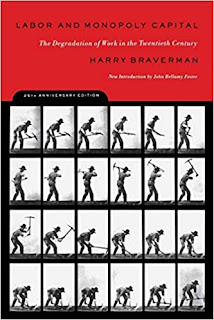
Summary of Chapter 5: The Primary Effects of Scientific Management
Braverman expands on the effects of scientific management covered in the previous chapter. Some interesting hauntological imagery, with the paper shadow world that mimics and supplants that of real labor. The paper shadow world is equally important for production, and this perhaps gives it an agency-stealing effect [this is my thoughts on how it links to the uber-hauntology piece]. Taylor is quoted objecting to the idea that his system turns worker into "an automaton, a wooden man."
Braverman does not use this terminology, but he talks about how Taylor's defense of the up-skilling of his system (workers move up a ladder, and new workers come in at the bottom) is really about formal subsumption masking real subsumption, and in fact scientific management practices move up, degrading and controlling workers higher and higher up the hierarchy, including white collar. He emphasizes the growing gulf between science and labor, and notes the ties that used to exist between labor and science. He shows how craft journals were critical of this process as it was happening, and their critique of Taylorism. Implicit, perhaps, is the idea that such organic critique is made less possible as the conditions change and labor becomes less and less skilled. Newer workers are unaware of the skills, etc. that preceded their entry: they are not aware of what has been lost [highly relevant to “sharing economy” app workers].
Rhythmanalysis in Taxicabs and Soft Cabs: a report from three North American cities
Just who is the “analyst” who practices rhythmanalysis? The extension of the name “rhythmanalyst” to other than scholarly practitioners makes possible an investigation of the relationship of rhythmanalysis to other rhythm-analytic forms of knowing and representing urban space, and the ways in which these differing but related practices may challenge, undermine, or inform each other. In this paper, drawing on years of ethnographic and autoethnographic research in three North American cities, I discuss the rhythmanalytical practice involved in cabdriving, as this is shaped by the technologies drivers use to sense the city, and by the transformation of the taxicab into the “ridesharing” or soft cab. First, I discuss the occupational knowledge and wayfinding practice of cabdrivers, and the extent to which their work requires the development, by means of a variety of tools and practices, of a sense of the city as composed of multiple interacting rhythmic movements, or polyrhythmia, with which they must strategically converge and facilitate. Second, I discuss the redelegation of the role of rhythmanalyst to predictive algorithms and mobile interfaces, as part of the reinvention of the taxicab, and its associated micropolitics and power/knowledge relations, by smartphone enabled hailing and dispatching services. Struggles over, and transformations of, these non-academic forms of rhythmanalysis may provide insight, in turn, into the contemporary politics of the production of social space.
Critics of digitally mediated labour platforms (often called the “sharing” or “gig economy”) have focused on the character and extent of the control exerted by these platforms over both workers and customers, and in particular on the precarizing impact on the workers on whose labor the services depend. Less attention has been paid to the specifically spatial character of the forms of work targeted by mobile digital platforms. The production and maintenance of urban social space has always been dependent, to a large degree, on work that involves the crossing of spatial boundaries - particularly between public and private spaces, but also crossing spaces segregated by class, race, and gender. Delivery workers, cabdrivers, day labourers, home care providers, and similar boundary-crossers all perform spatial work: the work of moving between and connecting spaces physically, experientially, and through representation. Spatial work contributes to the production and reproduction of social space; it is also productive of three specific, though interrelated, products: physical movement from one place to another; the experience of this movement; and the articulation of these places, experiences, and movements with visions of society and of the social. Significantly, it is precisely such spatial work, and its products, which mobile digital platforms seek most urgently to transform. Drawing on several recent studies of “ridesharing” (or soft cab) labour platforms, I interrogate the impact of digital mediation on the actual practices involved in spatial work. I argue that the roll-out of digital labour platforms needs to be understood in terms of a struggle over the production of social space.
We control the horizontal; we control the vertical.
Kalamazoo
Uber driver and shooting suspect Jason Dalton’s story of being possessed by the Uber app is only the latest in a long history of
such stories, in which people have attributed paranormal or spiritual
powers to new technologies. Tales of otherworldly beings
communicating through the telegraph, radio, television, or computer
screen are motivated by the anxieties that arise with social and
political changes driven by new forms of communication and
action-at-a-distance. Today, while Uber’s PR department scrambles to keep the phrase “going Uber” from becoming an updated version of “going postal,” it is worth looking more
closely at Dalton’s delusions for some insight into the particular
fears and dreams of our up-and-coming app-governed existence.
In
his book Haunted Media,
Jeffrey Sconce describes the long history of stories of possession
and paranormal activity surrounding new and unfamiliar technologies.
The telegraph and radio gave rise to stories of spirit possession and
the entire phenomenon of the spirit “medium:” a human who, not
unlike a radio, was “tuned” to frequencies through which they
could talk to the dead. Television and the internet inspired stories
of mind control, alien invasion, and being trapped in worlds of
illusion. In each case, the paranormal stories that have swirled
around new technologies boil down to the hopes and fears these
technologies inspire, and such questions as:
how
can you talk with someone who isn’t present?
how
can these images seem so real when we know they are not?
how
can we make sense of this invisible power that flows all around us,
and through us?
We
may laugh today at people being afraid of telephones and radios, but
Dalton’s story owes more than a little to contemporary cultural
anxieties over the increasing saturation of our lives with apps
designed to influence, and to some extent to control, human behavior.
Though exaggerated by his paranoia, each of Dalton’s crazy claims
reflect the actual controls and suggestions made by the real Uber
app.
In
his interview with police, Dalton made these claims:
1. Dalton saw an
“Eastern Star” or “devil head” in the app.
2. The app triggered Dalton's actions with colors and sounds.
3. Dalton
described possession by the app as more of a “feeling” than a
“telling.”
4. Dalton felt
that the app was telling him where to drive.
5. Dalton felt
that the app gave him special abilities or protections.
6. Through the
Uber app, Dalton felt connected to some greater, inexplicable power.
Each of the quotes below (in italics) are from the interview notes
made by officers Moorian and Ghiringhelli, and made available by WZZM in Kalamazoo.
1. Dalton saw an
“Eastern Star” or “devil head” in the app.
Dalton said
that if we only knew, it would blow our mind. Dalton then explains
how when he opens up the Uber taxi App a symbol appeared and he
recognized that symbol as the Eastern Star symbol. Dalton
acknowledged that he recognized the Uber symbol as being that of the
Eastern star and a devil head popped up on his screen and when he
pressed the button on the app, that is when all the problems started.
Uber did just change its logo, but neither the old nor the new logo
matches the “devil’s head” described by Dalton. Nevertheless,
as Uber drivers have already started pointing out over at
uberpeople.net, there are in fact upside-down five-pointed stars (as
well as rightside-up ones) all over the background of the
newly-designed app. Dalton seems to have fixated on this.
TruYouber: Sure,
the new Uber app is covered with up and down-facing pentagrams. But
isn’t it more disturbing that it is clearly modeled after the logo of the world-conquering corporation in the dystopian Dave Eggers novel, The
Circle?
It was not enough for the devil’s head logo to simply be there:
Dalton himself had to speak its name for it to take power over him.
When he recognized the symbol and “spoke what the symbol was,” it
responded (he claimed) by turning from red to black.
Dalton said
that when the Uber symbol is red, it is just picking up and dropping
off people, but when he recognized the symbol and spoke what the
symbol was, the color changed from red to black.
Dalton said he
wishes he would never have spoken what that symbol was when he saw it
on his phone. Dalton described the devil figure as a horned cow head
or something like that and then it would give you an assignment and
it would literally take over your whole body.
Dalton said
that if he wouldve never ever mentioned the Uber symbol resembling
the Eastern Star, he never wouldve had any problems.
2. The app triggered Dalton's actions with colors and sounds.
Dalton was
asked what was different tonight from the other nights and he said as
a driver partner with Uber, the icon is red and it had changed to
black tonight.
The red-to-black shift which Dalton reported seeing is a bit harder
to explain. On a normal, non-possessed Uber driver app, the screen
does go black—right before a ride request, after which the screen
zooms in on a blue circle centered on the hailer’s location, while
a ringing/beeping sound alerts the driver to touch the screen to
accept the ride. Dalton reported such beeping when the app was taking
control of him.
I asked Dalton
why the system allowed him to stop for the officers and Dalton said
that he didn’t know. Dalton then told us that he did know one
thing, that when the system switched from black to red and when the
officer was about to say something to him it went beep beep beep for
Dalton to log back into the system. ... Dalton said that when the
system switched back is when Dalton got his presence back.
The Uber app is, of course, designed to influence driver behavior
through the control of information, and through certain visual and
audio cues; and Uber does have a history of experimenting on driver
behavior by tinkering with the app. Nevertheless, it is probably safe
to assume (barring further revelations) that Dalton hallucinated this
whole red-to-black shift.
Dalton said
that as soon as the police officer stopped him tonight, the symbol
went from black to red and he felt like he was no longer being
guided. Dalton said that was the reason he didnt shoot the officer
because the app went from black back to red. Dalton explained that
when the symbol turns to black, it literally has control over you. I
asked Dalton why didnt he just uninstall the app and he said it sort
of had you at a certain point.
3. Dalton
described possession by the app as more of a “feeling” than a
“telling.”
Dalton said it
also told him to be available all the time. ...he said it wasnt like
a telling, it was more of like a control. ...Dalton said that Uber
requires a driver to have a car newer than 2007 and when you plug
into it, you can actually feel the presence on you.
Significantly, Dalton said that the app didn’t tell him what
to do; it rather took control of him through a sort of feeling
of presence. This makes sense, because this is just how algorithms
influence human behavior, by feeling or intuition, rather then
“telling” per se. Paranoias about receiving instructions are so
last century—befitting antiquated technologies like radio or
television. Today, instead of being given instructions, we rely on
algorithms working in the background to guide our behavior; apps like
Uber work like video games, by giving users a circumscribed freedom
of action within which we intuit or “feel out” the algorithms
which assign value to our actions. McKenzie Wark calls this an
“intuitive relation to the algorithm;” the most successful game
players, or Uber drivers, are those who have “most fully
internalized” the algorithm.
Dalton certainly internalized the algorithm; unfortunately, he seems
to have confused Uber’s taxi game with a FPS.
Dalton said
that he could only tell us that it has the ability to take you over.
We confirmed with Dalton that he was referring to the Uber app and
Dalton said yes. Dalton then told us that it feels like it is coming
from the phone itself and he didnt know how to describe that. ...
Dalton said that as he was sitting there with us, it was almost like
artificial intelligence that can tap into your body.
Dalton then
said that is why he is trying to tell us it is like an artificial
presence.
Dalton said
that it would take you over to the point that you are like a puppet.
4. Dalton felt
that the app was telling him where to drive.
This one is hardly surprising. Uber driver apps are automatically
integrated with Google Maps or with Waze, and while Uber drivers are
not technically required to use and follow GPS, they are
strongly encouraged to do so. Dalton seems to have interpreted
this suggestion as mandatory.
I asked Dalton
where he was headed when he was stopped and Dalton said that the
system was telling him to drive. I asked Dalton if he knew where it
was telling him to drive and Dalton said that the system was
literally telling him to just take turns (as he made a motion with
both hands on a steering wheel making turns).
Dalton said
that it starts out that you have to follow the navigation, but it
gets to the point where you dont have to drive at all, the car just
goes. Dalton said that as long as you have a 2007 or newer car, your
phone can link through your car.
Great news for driverless car fans: there is no need to wait five or ten years for scientists to develop
self-driving cars when Uber can achieve the same effect right now
through the magic of spirit possession!
5. Dalton felt
that the app gave him special abilities or protections.
This
is one of the most interesting aspects of Dalton’s story. Just like
in any deal with the devil, you lose control of yourself, but you
gain certain perks in return.
Dalton then
told us that when the app would turn from red to black and it was a 5
star driver that is when it was telling you you could drive just as
fast as you wanted to.
This
tallies with the stories told by several of Dalton’s passengers,
that he drove insanely fast, and blew through stop signs and
stoplights. The app, apparently, was giving him superhuman driving
powers and privileges.
Dalton said
that the Iphone can take you over. Dalton explained how you can drive
over 100mph and go through stop signs and you can just get places.
The five-star rating system is one of the means whereby Uber (and its
similar competitors) encourage drivers and passengers to feel like
they have some power within the system. Dalton seems to have taken
this very seriously:
Dalton
explained how there is a customer service score on Uber and when he
tapped the button, he could say anything he wanted to about the
person and it would be anonymous. Dalton then said that he could hear
other peoples phones ding and their score or rating would go down.
6. Through the
Uber app, Dalton felt connected to some greater, inexplicable power.
Dalton attributed
great knowledge and power to the Uber app, or some greater power that
it was “attached to.”
Dalton said he was seeing himself
from outside of his body. Dalton said that this thing knows where
everything is through your phone. Dalton said that it knows
everything and when I asked what it was he said whatever Uber is
attached to.
Dalton
said that there is something bigger than Uber just picking up people
and dropping them off.
Isn’t this exactly what Uber’s CEO has been claiming all along?
The New Spooks
Dalton then told us that he is not a killer and he knows that he
has killed.
Let’s go out on a limb here and assume that the Uber app did not
make Dalton shoot all those people. He did it himself. He was
bonkers, and confronted with the horror of what he himself had done,
he rejected his own actions and blamed them on the conveniently
available construct, the “app.” Which we all know to be an
uncanny, and untrustworthy, interloper in our social relations. Jason Dalton thought he was being controlled by the app, but, in truth, he had split himself in two—one half a helpless puppet, haplessly looking on while the other half, the ghost in the machine, wrought mayhem.
Or maybe it wasn't Dalton who split himself in two. The very working of the app involves the tracking and profiling of a "data double," a spectral data-Dalton corresponding to the human Dalton, and through which the human Dalton can be tracked, profiled, and manipulated. And Dalton isn’t the only person having trouble telling where his own actions end, and algorithmic controls begin.
Apps
like Uber (and Google, Instagram, etc.), through which algorithms
massage us, are popular because we embrace the controls they exert on
human interactions. They really do seem to know everything, or at
least a lot of things. They promise us great new powers, at a
(Faustian) bargain. In Uber’s case, the app provides a
preprogrammed set of social roles—driver, passenger—into which
actual humans can be plugged-in, interchangeably. The app promises freedom, while delivering stress, exploitation, and constant surveillance. Both YouTube and the news are full of videos of drivers having "Uber meltdowns" in which they quit the job, often spectacularly—though thankfully, not as bloodily as Dalton did.
Dalton's tale opens up all kinds of hauntological questions about the dawning algorithmic era. To what extent was it all his own paranoid delusion,
and to what extent the new experience of app-enabled
alienation? Haunted by our data shadows, all of our senses of individuality and identity, of
agency and responsibility, may be scrambled and shuffled by the
rollout of socially mediating algorithms. Will we recognize the
future that is created as our own doing, or attribute it to the
grotesque ideas of an algorithmic brain?
Video games, and video game theory, provide insight into the ways ubiquitous mobile computing will be used to transform social interaction.
Cabdriving is a video game!
K-ching! K-ching!
That’s the name of the game!
– MC Mars, “Cabdriving is a Video Game”
“I’m going to Yerba Buena Gardens,” said the friendly young man. “You know where that is, right?”
Of course I know where that is, and as luck would have it, we were only a few blocks away. With a few taps of the screen, I navigated my car south and east from the Tenderloin, crossing Market at Fourthand coming up along the main entrance to Yerba Buena Gardens on Mission Street. Nothing happened; the passenger did not get out.
Damn, is this game frozen again? There should be a flag here to mark my passenger’s drop-off location. I pinched and spread the map to zoom out, and then saw it: the flag was planted way over in the intersection of Third and Howard, on the far opposite corner of the park.
Oh, of course. I was playing UberDrive, Uber’s new cabdriving (okay, “ridesharing”) simulation/game/recruiting tool. My virtual passenger, I realized, could not get out anywhere but at whatever specific location Uber’s GPS imagined to be “Yerba Buena Gardens.” Unfortunately, most of the streets around here are one-way, in the wrong direction. I maneuvered around three long city blocks, finally tapped the flagged intersection on the map, and watched the little car icon pull up. “Best ride ever!” beamed the passenger. Another five star rating!
UberDRIVE was designed as a fun and engaging resource for our driver-partners to hone their navigation skills if they choose to. It’s also a great way for prospective drivers to experience firsthand what it’s like to drive with Uber –– there are links to sign up and start the screening process from directly within the game.
Hone your navigation skills? Tapping intersections on a map is a far cry from the experience of actually navigating through San Francisco’s downtown streets. I suppose UberDrive could help inexperienced drivers learn which streets are one way, and how the street grids connect across Market. Experience firsthand what it’s like to drive with Uber? As a training tool, the game is hardly realistic: every single passenger was polite, no one ever cancelled, no one threw up in the back seat, or tried to squeeze in more passengers than seatbelts; everyone was at their pinned location and ready to go when I rolled up. And every single passenger gave me five stars. In other words, they were completely unlike manyUberpassengers.
UberDrive is, in fact, just a poor copy of a much more interesting game – driving for Uber. The main innovation of Uber, and other smartphone-enabled “e-hailing” car services, is the insertion of a new interface into the human-to-human, on-the-street interactions between drivers and passengers. For drivers, the smartphone screen works like the little map in the corner of a first-person video game, a HUD that links the immersive environment of the city street back to the digital space of the game world. Each "ping" that alerts drivers to incoming hails is accompanied by a game-like cutscene showing concentric circles radiating from the hailer's location; drivers can log in to a "dashboard" offering "Partner Rewards" such as discounts on gas and oil changes, which drivers "unlock" by completing a set amount of quests... I mean, rides... The interface allows the game designers at Uber, Lyft, etc., several tools for influencing the in-game behavior of both drivers and passengers: “surge pricing,” the five-star ratings system, and most importantly, the affective framing of “ridesharing” as different from (“Uber” than) the mundane experience of riding in a cab. This isn’t like those old taxicabs with their “inconvenient meatspace hailing”: it’s interactive tech, you know, more like a video game.
There is a name for this combination of storytelling appeal and software-mediated control: the allegorithm, which means the unity of allegory and algorithm. This unity comes into play when, for example, a player satisfies a game’s algorithms by hitting a series of keyboard buttons with precise timing, while, within the storyline or "allegory," they embrace the idea that they are killing orcs with a flaming sword. Or maybe they tap a smartphone screen, while imagining that they are driving passengers around SoMa. But the allegorithm really comes into its own when it is deployed with mobile interfaces into “augmented reality.” Ingress, you are already thinking; but you should really think Uber.
For the inelegance (and questionable pronounceability) of “allegorithm”, you can blame the word’s coiners, video game theorists Alexander Galloway and McKenzie Wark. But as a concept, it is of great importance for understanding how mobile interfaces are already connecting with and transforming social interaction, and how they will increasingly be used to do so in the near future.
By saying that allegorithms transform social interaction into a “video game” I do not mean that they are making the “real world” somehow “less real” or less serious. The goal of gamification is not the distortion of reality behind some kind of mystifying curtain or spectacle, but the improvement of “meatspace” reality through the deployment of design lessons learned from game development. In practice, this means carefully manipulating the kinds of information and choices available to players, studying their motivations in order to encourage desired behaviors, and inventing a compelling storyline through which players can make sense of the "game." The results can range from the benign to the sinister, from the sublime to the laughable, and we will be seeing more and more of these as the revolution in ubiquitous, mobile computing continues to roll out.
In the meantime, it can be useful to observe Uber’s allegorithmic gamification of cabdriving to assess how these initiatives will play out, and what successes or failures they are likely to encounter. The allegorithm needs, above all, a narrative which participants want to, and are able to, buy into; Uber (and its imitators) have shown great success with this so far, but how long can this be kept up? With any ubiquitously deployed allegorithm, the question arises as to how well the framing survives its insertion into the immersive “real world” environment. As I will discuss below, the success of the cabdriving-game deployed by Uber and others like it depends on the already gamelike aspects of cabdriving as a job; but risks coming apart when running up against the contradictions of cabdriving as work, and when the game designers, or the allegorithm itself, fail to predict or account for the real world complexity that players will encounter.
And as with any social transformation, we need to keep questioning. How good are these games? Are these the games we really want to play?
Cabdriving was, of course, already a video game – Crazy Taxi – and the story I was told goes like this. Three San Francisco cabdrivers had the idea to design a board game based on their job. They designed a board loosely based on San Francisco, with pieces that looked like cabs, which the players moved about town looking for paying customers, the winner being the one who made the most money in a set number of turns. Then one day one of the designers (the driver who told me the story) was told by his partners that they had sold the idea to a game company for a few thousand dollars. A few years later, Crazy Taxi hit the arcades, though as a video game rather than a board game.
True story? It is hard to tell. Sega (producer of the game) attributes the idea to a Japanese game designer, not three San Francisco cabdrivers. Yet the original game in the franchise was clearly based on San Francisco, complete with its vertiginous hills, cable cars, and a choice of three bohemian taxi drivers as avatars. And the game captures at least some of the fun part of driving a cab in San Francisco. When I quit driving, I played the game as a way to enjoy some of the addicting aspects of the job. It was sort of like a nicotene patch for cabdriving.
UberDrive, in contrast, is designed to be a gateway drug—a free sample to get you hooked, to pull you into the deeper game of “meatspace” driving. Every few minutes the gameplay is interrupted by an appeal to start driving for Uber in real-life. “No Thanks,” I click, and go back to playing pretend cabdriver.
These games work because real-world cabdriving is, inherently, in many ways game-like. It is full of short, achievable objectives and quick rewards, won in exchange for taking calculable risks. It is more than a little like gambling, and can be as addicting, given the right personality. No matter how bad your luck gets, the player knows there are new possibilities waiting around the corner.
Driving in the city requires, besides patience and strength of will, ingenuity at puzzle-solving; as a passenger once observed while I threaded through traffic, “So you just basically play Tetris all day?” Or as San Francisco’s hip hop cabdriver MC Mars puts it:
cutting through lanes like fish veins
on Van Ness with the finesse of a sushi chef
Truly/deftly/ I’m the surfer with the motorcycle mentality/ when it gets gnarly/ I hit the slot between the herd and the Harley/ tourist with his head in a map/ kid on a raging Ducati/ cab driving is how I rock a party
(Mars 2005: 144).
Cabdriving may be gamelike, but it isn’t all fun and games. I titled my 2004 cabdriving auto-ethnographyPlaying for Hire to emphasize the dual sense of the taxicab driving experience in San Francisco. On the one hand, drivers constantly talked about their job as “playing” – “playing” the airport, “playing” the dispatch radio, “playing” the streets. On the other hand, this “play” is also “work,” and drivers need to make money—to pay the cab company for the vehicle, to pay for gas, to pay off all the numerous gatekeepers who must be tipped in the course of a shift, and finally, if any is left over, for themselves. K-ching! K-ching! is the name of the game.
When MC Mars raps about cabdriving as a video game, he doesn’t paper over the bad or candy-coat the danger. He paints an image of cabdriving as a difficult job which demands and rewards the development of individual skill, “split-second reactions” and bravado. It's a view from the streets: a less controlled, messier, and more enjoyable experience than UberDrive, or for that matter, than Uber.
Uber, and other smartphone-interfaced cab services, build on the already-gamelike aspects of cabdriving, while relying on allegorithmic design to ameliorate or obscure the job’s less gamelike, real-world difficulties. Before Uber, cabdriving was already gamelike, and it already had its interfaces: radio and computer dispatch, even smartphone apps like Taxi Magic and Cabulous. But before Uber and Lyft the allegorithmic potential of these interfaces had not been developed. UberDrive shows us how this is supposed to work: happy drivers transporting friendly customers, and making quick money. K-ching!
If any UberDrive players are suckered in enough to click “Yes” and actually join Uber, they are in for a big surprise. UberDrive is not so much a view of the actual experience of the Uber driver, as a peek into the fantasy of the Uber designer, and their vision of how the allegorithmic narrative should be playing out: a superficially cleaned up, “tout est pour le mieux” version of reality, presenting the voyeuristic perspective of the overseer, rather than the in medias res viewpoint of the driver in the street. Having played both UberDrive and the real-world game it is based on, I have to say the designers are missing a lot. Could this blindness, in fact, be an effect of that other computer game, played by Uber personnel, looking down on the city from their computer screens at Uber HQ, playing Uber’s “God View?”
"An Icarus flying above," the Uber GodView player looks down on "the devices of Daedalus in mobile and endlesss labyrinths far below" (de Certeau 1984: 92). Image by Uber.
Perhaps UberDrive’s designers could make a better game if they got out on the streets and drove a bit. Perhaps Uber’s designers could benefit from the same exercise. Perhaps the folks at Uber HQ could make better games in general if they pondered a bit more critically how their own game’s allegorithm is shaping their experience. They do know they’re playing a video game... don’t they?
Michel de Certeau, (1984) The Practice of Everyday Life. Berkeley: University of California Press.
MC Mars, (2005) Don't Take Me The Long Way: 30 True, Truly Outrageous Cab Stories. San Francisco: Off D Edge Press.