Showing posts with label management. Show all posts

Wednesday, February 11, 2026

Seeing Like A State, Chapter 3


Summary of Chapter 3: Authoritarian High Modernism

This chapter introduces the concept of “High Modernism” which will be explored through subsequent chapters.

All the state simplifications that we have examined have the character of maps. That is, they are designed to summarize precisely those aspects of a complex world that are of immediate interest to the mapmaker and to ignore the rest. (87)

Yet they not only summarize facts, they transform them in portraying them; not just description, but prescription:

The state has no monopoly on utilitarian simplifications. What the state does at least aspire to, though, is a monopoly on the legitimate use of force. That is surely why, from the seventeenth century until now, the most transformative maps have been those invented and applied by the most powerful institution in society: the state. (87-8)

This had to wait until the mid-19th to 20th century, when state power grew to match its ambitions. “I believe that many of the most tragic episodes of state development in the late nineteenth and twentieth centuries originate in a particularly pernicious combination of three elements” (88). These are:

1. “the aspiration to the administrative ordering of nature and society”. S terms this high modernism (after Harvey), an ideology shared by both right and [statist] left.

2. “the unrestrained use of the power of the modern state as an instrument for achieving these designs.” (88-9)

3. “a weakened or prostrate civil society that lacks the capacity to resist these plans”

The ideology of high modernism provides, as it were, the desire; the modern state provides the means of acting on that desire; and the incapacitated civil society provides the leveled terrain on which to build (dis)utopias. (89)

S sees Nazism as a reactionary form of Modernism. He discusses “progressive” variants of High Modernism:

Where the utopian vision goes wrong is when it is held by ruling elites with no commitment to democracy or civil rights and who are therefore likely to use unbridled state power for its achievement. Where it goes brutally wrong is when the society subjected to such utopian experiments lacks the capacity to mount a determined resistance.

A section on “the discovery of society” (90ff) details the role of the social sciences; S quotes Condorcet on the “moral sciences,” which are to be modeled after the physical sciences.

One essential precondition of this transformation was the discovery of society as a reified object that was separate from the state and that could be scientifically described. (91)

The development of statistics:

The existing social order, which had been more or less taken by earlier states as a given, reproducing itself under the watchful eye of the state, was for the first time the subject of active management. It was possible to conceive of an artificial, engineered society designed, not by custom and historical accident, but according to conscious, rational, scientific criteria. (92)

There is a link between class control, and colonialism, in this project:

It is important to recognize that, among Western powers, virtually all the initiatives associated with the “civilizing missions” of colonialism were preceded by comparable programs to assimilate and civilize their own lower-class populations, both rural and urban. The difference, perhaps, is that in the colonial setting officials had greater coercive power over an objectified and alien population, thus allowing for greater feats of social engineering. (378n19)

The difficulty with this resolution is that state social engineering was inherently authoritarian. In place of multiple sources of invention and change, there was a single planning authority; in place of the plasticity and autonomy of existing social life, there was a fixed social order in which positions were designated. (93)

In the 20th century, industrial warfare and the response to the Depression both required a more thorough mobilization of society; as did the rebuilding of post-war states. Beyond this, both revolutionary and colonial societies exerted special concentrated power [meeting the three criteria listed above].

The “birth” of 20th-Century High Modernism can be located in post-WWI Germany, under Walter Rathenau, who was motivated in part by his belief in productivism:

For many specialists, a narrow and materialist “productivism” treated human labor as a mechanical system which could be decomposed into energy transfers, motion, and the physics of work. The simplification of labor into isolated problems of mechanical efficiencies led directly to the aspiration for a scientific control of the entire labor process. (98)

Productivism had two lineages: 1) Taylorism; 2) the European school of “energetics.” S quotes Rabinbach (from the Human Motor book) on the point that productivism is “politically promiscuous,” embraced by both left and right (99). Productivism is a technological fix for class struggle; for capitalists, enabling control of worker; for the statist left, the elimination of capitalist management:

For much of the left, productivism promised the replacement of the capitalist by the engineer or by the state expert or official. It also proposed a single optimum solution, or ‘best practice,’ for any problem in the organization of work. The logical outcome was some form of slide-rule authoritarianism in the interest, presumably, of all.

Scott lists Thorstein Veblen, Sinclair Lewis, and Ayn Rand as all very different expounders of this ideology.

The world war was the high-water mark for the political influence of engineers and planners. Having seen what could be accomplished in extremis, they imagined what they could achieve if the identical energy and planning were devoted to popular welfare rather than mass destruction. (100)

Lenin was impressed with Rathenau’s example, and with Taylorism:

A command economy at the macrolevel and Taylorist principles of central coordination at the microlevel of the factory floor provided an attractive and symbiotic package for an authoritarian, high-modernist revolutionary like Lenin. (101)

S ends with three sources of resistance to “the authoritarian temptations of twentieth-century high modernism” in liberal democracies:

1. The “existence and belief in a private sphere of activity in which the state and its agencies may not legitimately interfere.” Scott notes that such private spheres have been much eroded, but the idea that there is a proper outside to the control of the state still forms a limit.

2. The “private sector in liberal political economy;” this is thought to be outside the capacity of the state to recreate or master, and thus limits the state’s “economic sovereignty” [quoting from The Foucault Effect].

3: Most importantly, democratic institutions and liberal freedoms; “the existence of working, representative institutions through which a resistant society could make its influence felt” (102), and thus limit the power of elites and bureaucrats.


Saturday, October 14, 2023

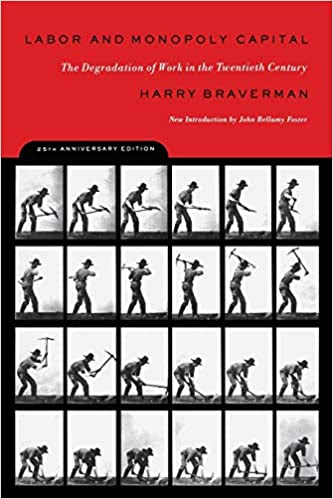
Labor and Monopoly Capital, Chapter 12


Summary of Chapter 12: The Modern Corporation

The first of the forces transforming modern capitalism which Braverman will discuss is the modern monopolist corporation, and how it has been formed by the concentration and centralization of capital in fewer hands. Before the invention of the modern corporation form, capitalist enterprises were limited by the scale of the “personal fortunes and personal capabilities” of individual capitalists (179).

It is only in the monopoly period that these limits are overcome, or at least immensely broadened and detached from the personal wealth and capacities of individuals.

This makes vast amounts of wealth available (from stockholders, etc.), and largely replaces the individual owner with a “specialized management staff.” “Owner” and “manager” are two aspects of the ruling capitalist class; “as a rule, top managers are not capital-less individuals, nor are owners of capital necessarily inactive in management. But in each enterprise the direct and personal unity between the two is ruptured.” The limiting personal form of the past has been replaced with an institutional form. The existence of a managerial element within the ruling class gives an opening for those from lower classes to rise by virtue of ability, through “a process of selection... having to do with such qualities as aggressiveness and ruthlessness, organizational proficiency and drive, technical insight, and especially marketing talent” (180), which abilities are co-opted by the capitalist organization; nevertheless, managers are usually drawn from within the ranks of the ruling class.

B discusses the large number of jobs which go by “manager” in the census, most of these are much lower positions than the ones he is talking about. The expansion of upper management corresponds with a great expansion in scale and also diversity of departments in modern capitalist enterprise vs earlier family-run firms.

However, this emergence of management as a part of the corporation is perhaps outstripped in importance by the role of marketing. B traces the development of transportation networks which allowed corporate products to reshape city life: “cities were released from their dependence on local supplies and made part of an international market” (182). The food industry (e.g. Gustavus Swift’s refrigerator railroad cars) played an important trailblazing role: “the industrialization of the food industry provided the indispensable basis of the type of urban life that was being created;” this industry was also important for developing the “marketing structure” of modern corporations. Specialty and electrical equipment need not only distribution but maintenance and service available in urban markets, this affects corporate structure and marketing network; example, auto industry.

Finance is discussed as another important division; subdivisions are formed within these divisions, because each division may require its own accounting division, personnel, etc. “Thus each corporate division takes on the characteristics of a separate enterprise, with its own management staff” (183). This is made yet more complex by vertical and horizontal integration. This “pyramiding” in turn creates a need for decentralization, resulting in the “modern decentralized corporate structure” of the 1920s through Braverman’s day. Each division is relatively self-governing and contributes to the corporation as a whole.

From this brief sketch of the development of the modem corporation, three important aspects may be singled out as having great consequences for the occupational structure. The first has to do with marketing, the second with the structure of management, and the third with the function of social coordination now exercised by the corporation. (184)

1. Marketing

Marketing becomes of great importance as a means of reducing uncertainty in business, by inducing demand. Braverman quotes Thorstein Veblen extensively on the “fabrication of customers” (185). Marketing also reshapes manufacturing, with styling, design, and packaging, as well as planned obsolescence and the idea of a “product cycle: the attempt to gear consumer needs to the needs of production instead of the other way around.”

2. Change in overall structure of management

The proliferation of divisions represent the “dismemberment of the functions of the enterprise head;” each takes over “in greatly expanded form a single duty which he exercised with very little assistance in the past. Corresponding to each of these duties there is not just a single manager, but an entire operating department which imitates in its organization and its function­ing the factory out of which it grew. … Thus the relations of purchase and sale of labor power, and hence of alienated labor, has become part of the management apparatus itself.” (185-6)

This means we can now look at labor relations, and exploitation, within this realm of “management:”

Management has become administration, which is a labor process conducted for the purpose of control within the corporation, and conducted moreover as a labor process exactly analogous to the process of production, although it produces no product other than the operation and coordination of the corporation. From this point on, to examine management means also to examine this labor process, which contains the same antagonistic relations as are contained in the process of production. (186)

3. The corporate function of social coordination.

The complex division of labor which has emerged with modern capitalism comes with an increased need for “social coordination” or planning. Because our society resists the rational emergence of this, it is left to corporations to play much of the role of social planning in our society. This is irrational, because corporate planning is limited to seeking returns on capital, at the expense of all other motivations. [This is the same argument made today by the “planned degrowth” school.] As long as the corporations play such a huge role in investment, and control of resources, personnel, etc., government in fact plays a secondary role in social planning, filling “the interstices left by these prime decisions” 187).


Tuesday, June 27, 2023

Labor and Monopoly Capital, Chapter 10


Summary of Chapter 10: Further Effects of Management and Technology on the Distribution of Labor


This brief chapter discusses the changing composition of the industrial workforce due to management practices and mechanization. Braverman points out several times that this is not simply due to the effects of technological change and increased productivity, but also to the specific demands of the capitalist system, and the form this has taken since the Scientific-Technical revolution:

A necessary consequence of management and technology is a reduction in the demand for labor. The constant raising of the productivity of labor through the organiza­tional and technical means that have been described herein must, in itself, produce this tendency. The application of modern methods of management and machine technology, however, become practical only with the rapid increase in the scale of production. Thus the rapid increase in the productivity of labor tends to be counterbalanced by the growth in production. Chiefly as a conse­quence of this, employment in those industries concerned with the production of goods has not declined in absolute terms. (163)

That is, increased productivity [real subsumption] reduces the need for labor, but overall increased productivity [expansion, formal subsumption], keeps people employed by creating new industries. Also, creating a reserve army of laborers who have been put out of work [and deskilled], lowers the price of labor, and so puts a check on mechanization, since it has to compete with this lowered cost of labor.

Thus the very rapidity of mechanization, insofar as it makes available a supply of cheap labor by discharging workers from some industries or putting an end to the expansion of employment in others, acts as a check upon further mechanization.

The absolute numbers of workers in industry has grown, but as a percentage of the workforce they were fairly consistent through 19th century up until the 1920s, after which they have shrunk. But within the industrial workforce, the percentage of those involved in actual production has decreased, and indirect workers (administration, etc.; those involved in maintaining the “shadow replica of the entire process of production in paper form” (165)) has risen, since the late 19th century. Within this “residual category” of nonproductive workers, Braverman identifies two categories: technical: “engineers, technicians, and the clerical workers associated with production tasks,” (he later adds scientists of various sorts employed in industry), and commercial: “administrative, financial, marketing, and other such employment.” (166)

The point he is going for is that the actual technical personnel are a small group:

On balance, it is probably proper to say that the technical knowledge required to operate the various industries of the United States is concentrated in a grouping in the neighborhood of only 3 percent of the entire working population-although this percentage is higher in some industries and lower in others. (167)

He gives a history of the dramatic rise in the number and diversity of engineers in the US, since the early 19th century, with a rapid rise since the late 19th century

The enormous and continuous growth in demand for engineers has created a new mass occupation. On the one hand, this has, along with other new professions such as accounting, given a place to those thrust out of the old middle class by the relative decline of the petty entrepreneurial occupations in trade and other erstwhile arenas of small business. But on the other hand, having become a mass occupation engineering has begun to exhibit, even if faintly, some of the characteristics of other mass employments: rationalization and division of labor, simplification of duties, application of mechanization, a downward drift in relative pay, some unemployment, and some unionization.

Even design is now broken down into tasks and division of labor; he gives the example of the design of an AO Smith auto frame plant; engineers encounter increased routine and limited responsibilities, with less creativity and independence. Computer-aided design and engineering result in an increasing amount of knowledge and control over the design process being transferred from engineer to computer.

Apart from the labor-saving aspects of the technique, it alters the occupational composition in the same manner as does numerical control. Since such techniques are used in accord with the management-fa­vored division of labor, they replace engineers and draftsmen with data-entry clerks and machine operators, and further intensify the concentration of conceptual and design knowledge. Thus the very process which brought into being a mass engineering profession is being applied to that profession itself when it has grown to a large size, is occupied with duties which may be routinized, and when the advance of solid-state electronic technology makes it feasible to do so. (169)

He discusses the class of technicians, less educated and paid less than engineers, “the routine which can be passed to a lower-paid and slightly trained person goes to the technician.” But with the high supply of people with engineering degrees, an increasing number end up as technicians.


Tuesday, March 22, 2022

Labor and Monopoly Capital, Chapter 8


Summary of Chapter 8: The Scientific-Technical Revolution and the Worker


In another short chapter Braverman further explores the scientific-technical revolution and its treatment of the worker, in particular its reduction of the worker to a machine. There had been two stages in capitalist/industrial development during the original Industrial Revolution: first, a change in the organization of labor, and second, a change in the instruments of labor. Those two stages, as described by Marx, refer to the initial industrial revolution; the ensuing scientific-technical revolution cannot be so simply described, because it involves revolutionizing all aspects of production, and manufacture in this time is also continually changing at every level:

It is in the age of the scientific-technical revolution that management sets itself the problem of grasping the process as a whole and controlling every element of it, without exception. (118). 

This involves an attack on the unity of thought and action leads to a “crisis:” labor as a subjective process is removed from the process of production and treated as an object which can then be added (or re-added) to the process conceived as steps controlled or designed by management. This ideal is not achieved in all industries, often for technical reasons; it also creates "new crafts and skills and technical specialties which are at first the province of labor rather than management" [though what these are is not specified]. Workers leave the places where tech has taken over, but move into different fields, some of which have been created by mechanization, others move into fields resistant to mechanization. Braverman promises to return to this subject in future chapters.

In addition to actual mechanization, there is the move to treat workers as machines. Gilbreth, the follower of Taylor, adds motion to Taylor's time studies, and new, more scientifically elaborated ways of studying and representing motions, the units of which are called "therbligs" (120). Gilbreth and his followers developed detailed lists of motions with initials that stand for them, like G for “Grasp,” TE for “Transport Empty.” There are also finer distinctions, such as subcategories of "grasp" [all this is clear machinification of human labor, preparation for automation, or at least dreamed-of automation].

To pick up a pencil, therefore, would involve the proper categories of Transport Empty, Pinch Grasp, and Transport Loaded, each with a standard time value, and the sum of the time categories for these three therbligs, given in ten-thousandths of a minute. constitutes the time for the complete motion. (121)

He gives further examples of "the charting approach to human sensory activity, visual, auditory, and tactile, which have been developed since the early 1950s and which aim at comprehending a larger range of work activities outside the purely manual, in order to apply them not only to clerical work but also to professional and semi-professional specialties." (122) The Universal Operator Performance Analyzer and Recorder (UNOPAR) records human movements using sound waves; other devices measure force exerted by worker, or "kinematic characteristics" of limb movement, etc. These allow the "human factor" of labor to be engineered ahead of time; instead of conducting on the job studies like Taylor had, engineers now use accumulated data to plan out work movements, breaks, etc. before even hiring people; from this point of view labor can appear to be something that is plugged in to an existing process. The numbers and statistics give the whole process an aura of authority; even greater authority is achieved as the calculations come to be carried out by computers.

Braverman provides a great summary of the view of humans as machines:

The animating principle of all such work investigations is the view of human beings in machine tenns. Since management is not interested in the person of the worker, but in the worker as he or she is used in office, factory, warehouse, store, or transport processes, this view is from the management point of view not only eminently rational but the basis of all calculation. The human being is here regarded as a mechanism articulated by hinges, ball-and­-socket joints, etc. (124)

He quotes a psychologist (Kraik) who in fact states this quite explicitly:

" ... as an element in a control system, a man may be regarded as a chain consisting of the following items: (1) sensory devices ... (2) a computing system which responds ... on the basis of previous experience ... (3) an amplifying system-the motor-nerve endings and muscles ... (4) mechanical linkages ... whereby the muscular work produces externally observable effects."

[This is immediately reminiscent of Wiener, who would no doubt wonder just what the objection is to this way of thinking. Per Braverman’s discussion, it is in part the critique of the "partial identity" in contrast to the whole or species being; or more generally, a freedom to create oneself (whether this is or is not seen as part of a "whole," it is about not being objectified or "humiliated" in Vaneigem's terms); and, of course, the struggle over control of the production process and knowledge, identity, etc.].

This attempt to conceive of the worker as a general-purpose machine operated by management is one of many paths taken toward the same goal: the displacement of labor as the subjective element of the labor process and its transformation into an object.

This means that a predetermined rate can be decided or engineered (based upon the authority of the data) and then imposed on actual workers:

In this, the manager counts not only upon the physiological charac­teristics of the human body as codified in his data, but also upon the tendency of the cooperative working mass, of which each worker is, along with the machines, one of the limbs, to enforce upon the individual the average pace upon which his calculations are based.

But, as Braverman notes in a lengthy footnote, workers are rebellious and the actual production process "assumes the form of a struggle, whether organized or not." Humans, like other machines, have "internal friction" which prevent them from working exactly as imagined or engineered.

In conclusion, Braverman observes that the process of abstracting and dividing labor into classified and generalized types of motions, is a process of making it abstract; this corresponds to Marx's concept of abstract labor, completely interchangeable, and shows that actual capitalist thinking confirms Marx’s analysis.


Wednesday, February 16, 2022

Labor and Monopoly Capital, Chapter 6


Summary of Chapter 6: The Habituation of the Worker to the Capitalist Mode of Production


Braverman turns to the general question of how the worker is acclimated or habituated to the capitalist mode of production, given that this mode of production is deeply "inhuman" and exploitative; and also that it is the result of a growing control over the labor process, taking away skills and control, as well as better pay, that workers had previously had. The short answer is that they are not: they are merely forced to comply because other options have been destroyed, but remain deeply resentful of the labor situation. A key distinction is also made between industrial engineers who design and develop the labor process for management, and industrial psychologists and sociologists who are supposedly supposed to get the workers to go along with this.

Braverman gives the history of industrial psychology, and later the human relations movement, which grew out of criticisms of the former (that it was deeply inaccurate and simplistic). He then dismisses both, because industrial engineers pay no attention to them. At best, they serve to provide an ideological dressing for the factory. He quotes some sociologists who talk about the "inconsistency" of the fact that the labor process is redesigned to make the individual worker less and less important, while they are repeatedly being told by HR etc that they are absolutely important: Braverman responds that:

But this is more than an "inconsistency," since job design represents reality while personnel administration represents only mythology. From the point of view of the corporation, there is no inconsistency, since the latter represents a manipulation to habituate the worker to the former. (100)

Nevertheless, if manipulation by sociology and psychology are of relatively little importance, and only secondary, the question remains: 

If the adaptation of the worker to the capitalist mode of production owes little to the efforts of practical and ideological manipulators, how is it in fact accomplished? (100)

Braverman gives the example of the Fordist assembly line and worker response of walkouts and unionization attempts under the IWW. Ford is forced to respond by raising pay, and the overall industry responds with a graduated pay scale which appears to separate low-skill workers from the ones who will get higher pay [in accordance with the “detail worker” separation discussed in Chapter 3]. Organized labor goes along with this, leading to Fordism. The result is that the new capitalist control of production beats out all competitors: when there are no other options to turn to, workers must acquiesce. However, the manipulation and control are essentially economic, existing in the broader economic system, not in the psychological controls of HR and so on. Workers remain hostile and cynical regarding their work.

 An immediate observation is that Braverman is contradicting the sociological [!] argument that school, for instance, operates as a training ground for work (Braverman calls youth a "reserve" who have been held in "a prolonged period of adolescence" at the end of which they are "plunged into work from the outside" (96), in contrast to the earlier craft mode in which youths worked and learned family trades or were apprentices). The contrast that comes to mind is Foucault's "disciplinary archipelago" which he wrote about just a few years after this book, in which discipline in schools, work, the army, etc. come together to produce disciplined individuals. Several points of difference can be described here:

1) Braverman is talking particularly about the experience of the working class; Foucault discusses factories, etc. but his perspective and its reception could be more relevant to the middle classes, office work (which is more like school work), etc. If working class youth see their schooling as ridiculous or unconvincing, then the disciplinary archipelago is not instilling its values into them anyway: as in the "no future" generation of exactly this time period, or a little after.

2) There could also be some relevant difference here between US and European contexts in how different classes are schooled.

3) Foucault's approach is also individualistic – about how discipline shapes individual subjects, while Braverman is focused more on the class and on workers as groups – this was a critique made also by the HR school of the original industrial psychologists, which Braverman points out. Of course in Foucault discipline is not perfectly successful in disciplining "unruly bodies", and this inherent failure is part of its self-justification and continuing need for expansion.

4) Nevertheless the resistance to discipline in Foucault seems that of an individual, while Braverman is more interested in class consciousness. Thus the figure of workers being hostile and only apparently accepting of their role, essentially awaiting a historic moment in which to rebel, makes sense from his perspective, and is more desirable for his argument. There is a good question about a rapprochement between the perspectives, rendering a less individualized account than Foucault's in which resentment and class consciousness (latent or otherwise) has more of a role, while also treating discipline more seriously and less dismissively than Braverman does.


Tuesday, February 15, 2022

Labor and Monopoly Capital, Chapter 5


Summary of Chapter 5: The Primary Effects of Scientific Management


Braverman expands on the effects of scientific management covered in the previous chapter. Some interesting hauntological imagery, with the paper shadow world that mimics and supplants that of real labor. The paper shadow world is equally important for production, and this perhaps gives it an agency-stealing effect [this is my thoughts on how it links to the uber-hauntology piece]. Taylor is quoted objecting to the idea that his system turns worker into "an automaton, a wooden man."

Braverman does not use this terminology, but he talks about how Taylor's defense of the up-skilling of his system (workers move up a ladder, and new workers come in at the bottom) is really about formal subsumption masking real subsumption, and in fact scientific management practices move up, degrading and controlling workers higher and higher up the hierarchy, including white collar. He emphasizes the growing gulf between science and labor, and notes the ties that used to exist between labor and science. He shows how craft journals were critical of this process as it was happening, and their critique of Taylorism. Implicit, perhaps, is the idea that such organic critique is made less possible as the conditions change and labor becomes less and less skilled. Newer workers are unaware of the skills, etc. that preceded their entry: they are not aware of what has been lost [highly relevant to “sharing economy” app workers].


Monday, February 14, 2022

Labor and Monopoly Capital, Chapter 4


Summary of Chapter 4: Scientific Management

This chapter is an overview of the role of Taylor's "scientific management" in the history of the development of management. Braverman argues that it is incorrect to dismiss Taylorism as a failure or as something that has been superceded, because it is the foundation of modern management; also, related later schools such as "human relations" are actually more circumscribed, and do not get to the bottom of the issue like Taylorism. Finally, Taylor is very direct and outspoken in how he explicitly articulates the motives of his method, which are the ideology and perspective of the capitalist ruling class; later theorists are more muted and circumspect in their explanations. Taylor’s understanding of the workplace in fact derived from his own experience as a worker, and he in turn understood that the workers were being rational in fighting his system, and even admitted this to a group who asked him for advice (69). Braverman contrasts Taylor's awareness with the Hawthorne investigators (who founded the "human relations" school), who assumed workers were just irrational in resisting incentives.

He discusses the details of Taylor's physiological definition of a "fair day of work," even though Taylor clearly knew quite well that such a thing is socially determined; his fight against "soldiering" whereby workers in a piece work system conspire to keep the rate down. [It is interesting that “soldiering” is a bit like contractors or other business owners making bids, in that they want to see how much the other party is willing to pay; it is in a way typical market-driven negative reciprocity (although with the added effect of solidarity among the workers). Essentially this is the same kind of competition that the market system eulogizes in the marketplace, but shifted to the working place because of working conditions; and that shift is what Taylor and other of this monopoly over knowledge to control each step of the labor process and its mode of execution. In passing in this discussion the question of who has and controls knowledge, or could or should develop a science, is explored (e.g., why not scientific workmanship rather than scientific management?) Taylor's answer to this, stated before congress, (80) is very reminiscent of the "Why Are There No Great Women Artists?" argument – workers don’t have the opportunity, they can't afford the costs or the time for study, because they are busy working for a living. Braverman points out – this is all just the effect of the capitalist system].

 Braverman discusses how Taylor’s methods, such as the instruction list, creates the illusion, from the management perspective, that the work is in fact created by the manager, with the worker becoming only a tool (or at most a motive force, but no longer a creative force). [A parallel investigation of the "creatives" in design could be pursued, not to mention the entire "concept art" idea in which the actual production is done by someone else who gets no credit as the "artist"].

 Braverman makes an ironic point about labor and knowledge:

This same instruction card inspired in Alfred Marshall, however, the curious opinion that from it, workers could learn how production is carried on: such a card, "whenever it comes into the hands of a thoughtful man, may suggest to him something of the purposes and methods of those who have constructed it.” The worker, in Marshall's notion, having given up technical knowledge of the craft, is now to pick up the far more complex technical knowledge of modem industry from his task card, as a palaeontologist reconstructs the entire animal from a fragment of a bone! (82)

[Marshall’s claim is ironic because the worker's knowledge was in reality the starting point of the process, which management studied and replicated in the form of tasks, then hired new workers who did not have the knowledge. The "palaeontologist" line is very fitting for algorithmically controlled workers, such as drivers trying to comprehend the soft cab algorithm].