Showing posts with label control revolution. Show all posts

Sunday, August 17, 2025

Seeing Like A State, Introduction


James C. Scott (1998) Seeing Like A State: How Certain Schemes to Improve the Human Condition Have Failed. Yale University Press, New Haven, CT.


Summary of Introduction

Scott lays out his agenda, which is to describe exactly what is advertised in the book’s subtitle. He lists four elements involved in every such disaster; all four must be present (4): 

1. “the administrative ordering of nature and society”

2. “a high-modernist ideology. It is best conceived as a strong, one might even say muscle-bound, version of the self-confidence about scientific and technical progress, the expansion of production, the growing satisfaction of human needs, the mastery of nature (including human nature), and, above all, the rational design of social order commensurate with the scientific understanding of natural laws.”

High modernism was about ‘interests’ as well as faith. Its carriers, even when they were capitalist entrepreneurs, required state action to realize their plans. In most cases, they were powerful officials and heads of state. They tended to prefer certain forms of planning and social organization (such as huge dams, centralized communication and transportation hubs, large factories and farms, and grid cities), because these forms fit snugly into a high-modernist view and also answered their political interests as state officials. There was, to put it mildly, an elective affinity between high modernism and the interests of many state officials. (4-5)

3. “an authoritarian state that is willing and able to use the full weight of its coercive power to bring these high-modernist designs into being” (5); and

4. “a prostrate civil society that lacks the capacity to resist these plans.”

In sum, the legibility of a society provides the capacity for large-scale social engineering, high-modernist ideology provides the desire, the authoritarian state provides the determination to act on that desire, and an incapacitated civil society provides the leveled social terrain on which to build."

But given these four factors, the question remains, why did the projects fail?

Designed or planned social order is necessarily schematic; it always ignores essential features of any real, functioning social order. (6)

The formal scheme was parasitic on informal processes that, alone, it could not create or maintain. To the degree that the formal scheme made no allowance for these processes or actually suppressed them, it failed both its intended beneficiaries and ultimately its designers as well.

Much of this book can be read as a case against the imperialism of high-modernist, planned social order. I stress the word "imperialism" here because I am emphatically not making a blanket case against either bureaucratic planning or high-modernist ideology. I am, however, making a case against an imperial or hegemonic planning mentality that excludes the necessary role of local knowledge and know-how.

At this level, I am making a case for the resilience of both social and natural diversity and a strong case about the limits, in principle, of what we are likely to know about complex, functioning order. One could, I think, successfully turn this argument against a certain kind of reductive social science. Having already taken on more than I could chew, I leave this additional detour to others, with my blessing. (7)

He cites inspiration from Kropotkin, Bakunin, Malatesta, and Proudhon for his particular mutualist-inflected understanding of mētis, then distances himself by defending against two potential charges, the first being romanticism regarding traditional, local knowledge.

The second charge is that my argument is an anarchist case against the state itself. The state, as I make abundantly clear, is the vexed institution that is the ground of both our freedoms and our unfreedoms. My case is that certain kinds of states, driven by utopian plans and an authoritarian disregard for the values, desires, and objections of their subjects, are indeed a mortal threat to human well-being. Short of that draconian but all too common situation, we are left to weigh judiciously the benefits of certain state interventions against their costs. 

He makes clear that capitalism is every bit as complicit in this as the state:

large-scale capitalism is just as much an agency of homogenization, uniformity, grids, and heroic simplification as the state is, with the difference being that, for capitalists, simplification must pay. A market necessarily reduces quality to quantity via the price mechanism and promotes standardization; in markets, money talks, not people. Today, global capitalism is perhaps the most powerful force for homogenization, whereas the state may in some instances be the defender of local difference and variety. (8)

Put bluntly, my bill of particulars against a certain kind of state is by no means a case for politically unfettered market coordination as urged by Friedrich Hayek and Milton Friedman. As we shall see, the conclusions that can be drawn from the failures of modern projects of social engineering are as applicable to market-driven standardization as they are to bureaucratic homogeneity.


Thursday, January 11, 2024

Labor and Monopoly Capital, Chapter 14


Summary of Chapter 14: The Role of the State


In the most elementary sense, the state is guarantor of the conditions, the social relations, of capitalism, and the protector of the ever more unequal distribution of property which this system brings about. But in a further sense state power has everywhere been used by governments to enrich the capitalist class, and by groups or individuals to enrich themselves. (197)

The state has always played this function, but it is expanded with monopoly capitalism. In the cases of post-war Germany and Japan, the state and the new capital form are created simultaneously; however, in older states such as the US and UK, a more circumscribed role for the state existed earlier, so the transformation to the more interventionist state appeared to be a struggle against capital, though this was only an illusion.

the maturing of the various tendencies of monopoly capitalism created a situation in which the expansion of direct state activities in the economy could not be avoided.

This is explored under four “headings.”

1. “Monopoly capitalism tends to generate a greater economic surplus than it can absorb,” leading to periodic stagnation and depressions. Government spending is necessary to buy up the surplus; Braverman points to Baran and Sweezy’s text for a more complete analysis.

2. The new, international/trans-national structure of capitalist production, along with resistance movements which arise to oppose it, means that, to police this order, the leading capitalist states need to have a permanent active military. This in turn assists in creating effective demand (per #1) with the added bonus that military spending, unlike welfare spending, does not redistribute income, and is thus more acceptable to the capitalist class. B states this solution originates with the Nazis, and is picked up by the US and other nations after WWII.

3. Increased poverty and insecurity under monopoly capitalism lead to a need for welfare spending focusing on cities to render this population manageable; “the disputes within the capitalist class over this issue, including disagreements over the scale, scope, and auspices of the welfare measures to be adopted, offer an arena for political agitation which engages the working population as well, and offers a substitute for the revolutionary movements which would soon gain ground if the rulers followed a more traditional laissez-faire course” (198).

4. Another new role for the state today is as provider of institutionalized education, replacing the home-and-community-based practical education of yore:

The minimum requirements for “functioning” in a modern urban envi­ronment—both as workers and as consumers—are imparted to children in an institutional setting rather than in the family or the community. At the same time, what the child must learn is no longer adaptation to the slow round of seasonal labor in an immediately natural environment, but rather adaptation to a speedy and intricate social machinery which is not adjusted to social humanity in general, let alone to the individual, but dictates the rounds of production, consumption, survival, and amusement. Whatever the formal educational content of the curriculum, it is in this respect not so much what the child learns that is important as what he or she becomes wise to. In school, the child and the adolescent practice what they will later be called upon to do as adults: the conformity to routines, the manner in which they will be expected to snatch from the fast-moving machinery their needs and wants. (199)

The opposition between “learning” (facts, techniques, etc.) and “getting wise” is interesting, and the latter has an interesting link to metis. B’s primary point is that it is the form of schooling which teaches the patterns of obedience, conformity, etc., which is more important than the content of what is taught; there is also the sense in which the actual knowledge that is relevant in this ever-changing work environment is very fleeting and always shifting, so it is more a sense of what is going on and a readiness to adapt, in order to “snatch from the fast-moving machinery their needs and wants,” that students need to obtain.


Tuesday, June 27, 2023

Labor and Monopoly Capital, Chapter 10


Summary of Chapter 10: Further Effects of Management and Technology on the Distribution of Labor


This brief chapter discusses the changing composition of the industrial workforce due to management practices and mechanization. Braverman points out several times that this is not simply due to the effects of technological change and increased productivity, but also to the specific demands of the capitalist system, and the form this has taken since the Scientific-Technical revolution:

A necessary consequence of management and technology is a reduction in the demand for labor. The constant raising of the productivity of labor through the organiza­tional and technical means that have been described herein must, in itself, produce this tendency. The application of modern methods of management and machine technology, however, become practical only with the rapid increase in the scale of production. Thus the rapid increase in the productivity of labor tends to be counterbalanced by the growth in production. Chiefly as a conse­quence of this, employment in those industries concerned with the production of goods has not declined in absolute terms. (163)

That is, increased productivity [real subsumption] reduces the need for labor, but overall increased productivity [expansion, formal subsumption], keeps people employed by creating new industries. Also, creating a reserve army of laborers who have been put out of work [and deskilled], lowers the price of labor, and so puts a check on mechanization, since it has to compete with this lowered cost of labor.

Thus the very rapidity of mechanization, insofar as it makes available a supply of cheap labor by discharging workers from some industries or putting an end to the expansion of employment in others, acts as a check upon further mechanization.

The absolute numbers of workers in industry has grown, but as a percentage of the workforce they were fairly consistent through 19th century up until the 1920s, after which they have shrunk. But within the industrial workforce, the percentage of those involved in actual production has decreased, and indirect workers (administration, etc.; those involved in maintaining the “shadow replica of the entire process of production in paper form” (165)) has risen, since the late 19th century. Within this “residual category” of nonproductive workers, Braverman identifies two categories: technical: “engineers, technicians, and the clerical workers associated with production tasks,” (he later adds scientists of various sorts employed in industry), and commercial: “administrative, financial, marketing, and other such employment.” (166)

The point he is going for is that the actual technical personnel are a small group:

On balance, it is probably proper to say that the technical knowledge required to operate the various industries of the United States is concentrated in a grouping in the neighborhood of only 3 percent of the entire working population-although this percentage is higher in some industries and lower in others. (167)

He gives a history of the dramatic rise in the number and diversity of engineers in the US, since the early 19th century, with a rapid rise since the late 19th century

The enormous and continuous growth in demand for engineers has created a new mass occupation. On the one hand, this has, along with other new professions such as accounting, given a place to those thrust out of the old middle class by the relative decline of the petty entrepreneurial occupations in trade and other erstwhile arenas of small business. But on the other hand, having become a mass occupation engineering has begun to exhibit, even if faintly, some of the characteristics of other mass employments: rationalization and division of labor, simplification of duties, application of mechanization, a downward drift in relative pay, some unemployment, and some unionization.

Even design is now broken down into tasks and division of labor; he gives the example of the design of an AO Smith auto frame plant; engineers encounter increased routine and limited responsibilities, with less creativity and independence. Computer-aided design and engineering result in an increasing amount of knowledge and control over the design process being transferred from engineer to computer.

Apart from the labor-saving aspects of the technique, it alters the occupational composition in the same manner as does numerical control. Since such techniques are used in accord with the management-fa­vored division of labor, they replace engineers and draftsmen with data-entry clerks and machine operators, and further intensify the concentration of conceptual and design knowledge. Thus the very process which brought into being a mass engineering profession is being applied to that profession itself when it has grown to a large size, is occupied with duties which may be routinized, and when the advance of solid-state electronic technology makes it feasible to do so. (169)

He discusses the class of technicians, less educated and paid less than engineers, “the routine which can be passed to a lower-paid and slightly trained person goes to the technician.” But with the high supply of people with engineering degrees, an increasing number end up as technicians.


Tuesday, March 22, 2022

Labor and Monopoly Capital, Chapter 8


Summary of Chapter 8: The Scientific-Technical Revolution and the Worker


In another short chapter Braverman further explores the scientific-technical revolution and its treatment of the worker, in particular its reduction of the worker to a machine. There had been two stages in capitalist/industrial development during the original Industrial Revolution: first, a change in the organization of labor, and second, a change in the instruments of labor. Those two stages, as described by Marx, refer to the initial industrial revolution; the ensuing scientific-technical revolution cannot be so simply described, because it involves revolutionizing all aspects of production, and manufacture in this time is also continually changing at every level:

It is in the age of the scientific-technical revolution that management sets itself the problem of grasping the process as a whole and controlling every element of it, without exception. (118). 

This involves an attack on the unity of thought and action leads to a “crisis:” labor as a subjective process is removed from the process of production and treated as an object which can then be added (or re-added) to the process conceived as steps controlled or designed by management. This ideal is not achieved in all industries, often for technical reasons; it also creates "new crafts and skills and technical specialties which are at first the province of labor rather than management" [though what these are is not specified]. Workers leave the places where tech has taken over, but move into different fields, some of which have been created by mechanization, others move into fields resistant to mechanization. Braverman promises to return to this subject in future chapters.

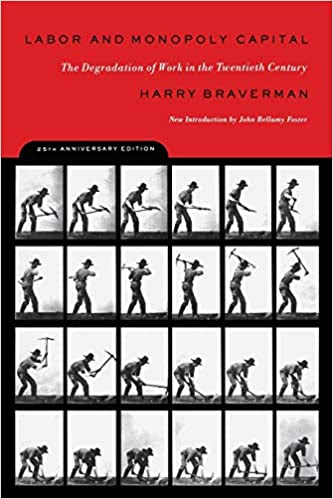
In addition to actual mechanization, there is the move to treat workers as machines. Gilbreth, the follower of Taylor, adds motion to Taylor's time studies, and new, more scientifically elaborated ways of studying and representing motions, the units of which are called "therbligs" (120). Gilbreth and his followers developed detailed lists of motions with initials that stand for them, like G for “Grasp,” TE for “Transport Empty.” There are also finer distinctions, such as subcategories of "grasp" [all this is clear machinification of human labor, preparation for automation, or at least dreamed-of automation].

To pick up a pencil, therefore, would involve the proper categories of Transport Empty, Pinch Grasp, and Transport Loaded, each with a standard time value, and the sum of the time categories for these three therbligs, given in ten-thousandths of a minute. constitutes the time for the complete motion. (121)

He gives further examples of "the charting approach to human sensory activity, visual, auditory, and tactile, which have been developed since the early 1950s and which aim at comprehending a larger range of work activities outside the purely manual, in order to apply them not only to clerical work but also to professional and semi-professional specialties." (122) The Universal Operator Performance Analyzer and Recorder (UNOPAR) records human movements using sound waves; other devices measure force exerted by worker, or "kinematic characteristics" of limb movement, etc. These allow the "human factor" of labor to be engineered ahead of time; instead of conducting on the job studies like Taylor had, engineers now use accumulated data to plan out work movements, breaks, etc. before even hiring people; from this point of view labor can appear to be something that is plugged in to an existing process. The numbers and statistics give the whole process an aura of authority; even greater authority is achieved as the calculations come to be carried out by computers.

Braverman provides a great summary of the view of humans as machines:

The animating principle of all such work investigations is the view of human beings in machine tenns. Since management is not interested in the person of the worker, but in the worker as he or she is used in office, factory, warehouse, store, or transport processes, this view is from the management point of view not only eminently rational but the basis of all calculation. The human being is here regarded as a mechanism articulated by hinges, ball-and­-socket joints, etc. (124)

He quotes a psychologist (Kraik) who in fact states this quite explicitly:

" ... as an element in a control system, a man may be regarded as a chain consisting of the following items: (1) sensory devices ... (2) a computing system which responds ... on the basis of previous experience ... (3) an amplifying system-the motor-nerve endings and muscles ... (4) mechanical linkages ... whereby the muscular work produces externally observable effects."

[This is immediately reminiscent of Wiener, who would no doubt wonder just what the objection is to this way of thinking. Per Braverman’s discussion, it is in part the critique of the "partial identity" in contrast to the whole or species being; or more generally, a freedom to create oneself (whether this is or is not seen as part of a "whole," it is about not being objectified or "humiliated" in Vaneigem's terms); and, of course, the struggle over control of the production process and knowledge, identity, etc.].

This attempt to conceive of the worker as a general-purpose machine operated by management is one of many paths taken toward the same goal: the displacement of labor as the subjective element of the labor process and its transformation into an object.

This means that a predetermined rate can be decided or engineered (based upon the authority of the data) and then imposed on actual workers:

In this, the manager counts not only upon the physiological charac­teristics of the human body as codified in his data, but also upon the tendency of the cooperative working mass, of which each worker is, along with the machines, one of the limbs, to enforce upon the individual the average pace upon which his calculations are based.

But, as Braverman notes in a lengthy footnote, workers are rebellious and the actual production process "assumes the form of a struggle, whether organized or not." Humans, like other machines, have "internal friction" which prevent them from working exactly as imagined or engineered.

In conclusion, Braverman observes that the process of abstracting and dividing labor into classified and generalized types of motions, is a process of making it abstract; this corresponds to Marx's concept of abstract labor, completely interchangeable, and shows that actual capitalist thinking confirms Marx’s analysis.


Friday, November 9, 2018

“The Bonds of Telegraphy:” class and gender politics of the urban telegraph

Advertisement for American District Telegraph, by Schmidt Label Co., San Francisco; early 1880s. (Image courtesy of the Bancroft)

I'll be presenting a paper on the urban telegraph this weekend at the Social Science History Association meeting in Phoenix. Here is the abstract:

Despite the well-worn analogy of the early telegraph as a “Victorian internet,” the story of the intra-urban telegraph—which might be called a “city-wide web”— has been almost completely neglected. In the 1870s, the American District Telegraph Company developed a dial-based interface that simplified the use of the telegraph, making possible a network connecting the businesses and homes of wealthy subscribers to a city of services. The interconnectivity provided by the urban telegraph promised both to transform urban space in the bourgeoisie’s image, and to professionalize the occupations—messengers, firemen, police, and hackdrivers—whose services were ordered through the telegraph callbox. More than simply a communication device, the urban telegraph promised to alter the class and gender constellations of advantage and disadvantage relating to public space and mobility.

This paper will focus on how the urban telegraph realigned advantage and disadvantage for both customers and workers, in particular though the provision of dispatched hack service. Telegraph dispatch increased the disadvantage of working-class hackdrivers vis-a-vis their wealthy customers, by constraining drivers’ movements, behavior, and control over the negotiation of fares and acquisition of passengers. At the same time, the urban telegraph brought new advantages to women customers, whose access to public space and mobility were increased, though not without controversy. Although the urban telegraph was quickly supplanted by the spread of the telephone, its story provides insight into the ongoing search for technological fixes for the complicated class and gender politics of urban space.


Monday, January 15, 2018

How Ludwig van Beethoven Invented the Taximeter (a true story, with some caveats)

In 1876, a new technology for managing interactions between drivers and passengers promised to transform the cab-riding experience.


People converging on the Centennial Exhibition via multiple means of transportation (Library of Congress).

The year was 1876; the place, Philadelphia; and the event was the grand Centennial International Exhibition, commemorating the 100th anniversary of the United States.

The Centennial was a massive event, drawing over ten million visitors, who strolled the grounds viewing such wonders as the first public demonstration of the telephone, and a massive arm and torch which would later be part of the Statue of Liberty, while enjoying such novel (but afterwards well-known) treats as popcorn and non-alcoholic root beer.

Getting all these people to the exhibition gates was both a challenge and a business opportunity. Railroads, streetcars, and omnibuses moved passengers. Hack and cab proprietors came from as far away as Texas, looking to make money operating their vehicles during the Exhibition.

This caused a bit of concern for the city fathers. Cab regulation was still in its early days, and they had few ways to keep this flood of out-of-town vehicles from swamping their streets. The city council passed laws requiring cabs to be licensed, which most of the out-of-towners ignored; they also proposed that real Philadelphia carriage drivers be issued uniforms, so they could be distinguished from the horde of outsiders.

Opportunities for misunderstandings between drivers and passengers were rife. Before the existence of the taximeter, the fares for most trips were calculated by the mile, which was usually estimated based on the number of blocks that had been travelled. Visitors unfamiliar with the city did not always know the rates of fare or the distances between places, so they were liable to be taken advantage of by unscrupulous drivers.

Sometimes fares were reckoned by time, but this led to its own difficulties in an era when not everyone carried watches, and when they did, the watches did not always agree.

On top of this there was the issue of class conflict. It was primarily upper middle class visitors who could afford to ride in hired carriages, and they did so because they didn’t want to mingle with the hoi polloi in the public streetcars. But to ride in a hack meant to put themselves under the control of low-status, working class drivers, who were often immigrants to boot (at the time, mostly Irish). Class anxiety mixed with suspicion meant that passengers often accused drivers of cheating them over the fare, even when they were not, in fact, cheating.

Something needed to be done, both to exert more control over drivers, and to ensure their upper-class passengers that the system could be trusted.

To the rescue: the “Ingenious German,” Ludwig van Beethoven.


The great composer, Ludwig van Beethoven (1770-1827) was unable to attend the 1876 Centennial Exhibition in Philadelphia. (Wikipedia)  

Okay, so not that Ludwig van Beethoven. That famous composer, however, had a grandnephew, Ludwig Johann van Beethoven. The younger Ludwig was born in 1839, the son of Karl van Beethoven, the “old Ludwig Van’s” dissolute nephew. This part of the family tended to free-load off their more successful relatives, while also changing the “van” in their name to “von,” to give the impression that they were descended from nobility.

Marie and Ludwig Johann van Beethoven (The Beethoven Family Trees)

Music writer Alex Ross has described the younger Ludwig as an “energetic and determined character, though somewhat lacking in moral fibre. Posing as the “grandson” of Beethoven, he wormed his way into the court of Ludwig II of Bavaria, but had to flee Europe in 1871, due to charges of fraud and embezzlement. Arriving in the New World, Beethoven changed his name to Louis von Hoven. Although he later claimed that this was to avoid constantly being harassed by fans of his great ancestor, historians agree that the name change was meant to avoid creditors and possible prosecution, and to enable von Hoven and his family to start afresh in America.

Ludwig’s—I mean, Louis’s—wife Marie was an accomplished concert pianist, and her performances supported the young “von Hoven” family as they rambled from city to city in the US and Canada. Louis started working for railroad companies, presumably in some technical capacity, as he soon showed an interest in the use of technology to organize and control the flow of information, people, and goods. He developed an on-demand messenger service, the New York Commissionaire Company, which operated in New York and Chicago. He also invented a new check register. In 1876, Louis von Hoven was in Philadelphia for the Centennial Exhibition. He may have been involved in running a “rolling chair” company, renting wheelchairs to fair-goers.

Then came his greatest achievement: the invention of the taximeter.


Alright: so he didn’t invent the taximeter per se. The “taximeter” (a device which calculates cab fares using both distance and time) would not come into existence until 1891, and is attributed to German inventor F.W.G. Bruhn. What von Hoven did invent was an important, and very revealing, precursor to the taximeter, which he called the “Fare Controller and Indicator.”

It wasn’t the first proto-taximeter: as early as the 1840s there had been a “patent mile index” installed in some London cabs, and in Paris in the 1860s at least four different kinds of “compteur” had been tried, none of which proved satisfactory. Von Hoven’s invention, however, had some novel features.

Mechanical devices intended to rationalize driver-passenger relations often simply created new controversies (Punch).

Von Hoven’s fare controllers were installed in the carriages of the National Cab Company, which had formed that same year to provide service during the Exhibition. To ride in such a cab, you hailed one of its vehicles off the street, distinguished by a “little blue illuminated sign” on the front, reading “To Hire.” Upon stepping into the carriage, you saw these instructions posted on the wall:


Much like with later mechanical taximeters, the driver then pushed down the “To Hire” flag, engaging a mechanism which recorded the time duration of the trip in quarter-hour increments. This action also swung a clock in front of the passenger’s face, so that they could verify the time at which the trip began.


At the end of the trip, the driver restored the “To Hire” sign, thus stopping the trip recorder. As the passenger paid, the driver pushed another button, making a gong sound, for each quarter in payment; the result is that both the duration of the ride and the payment received were recorded.

As a contemporary newspaper put it, “what has all along been needed has been some way to manage the driver.” Now passengers could put their faith in a mechanical device instead of in their drivers. At the same time, in von Hoven’s words, “each passenger will thus become a sort of detective against the driver,” ensuring that all the money taken in by the driver during a shift would be reported to the owner of the vehicle.

A carriage with von Hoven's Fare Controller and Indicator installed; when the driver pushes down the "To Hire" sign behind him, a clock appears inside the carriage (New York Daily Graphic).

But von Hoven’s device had one more trick up its sleeve: it was also a transformer. While carrying a passenger, with the “To Hire” sign swung down out of view, not only did the vehicle no longer advertise itself as for hire, it no longer looked like a “for hire” vehicle at all:
By a special ordinance of the municipal government they are allowed the unusual privilege of concealing their license numbers when engaged. This, with tidy-looking drivers dressed in neat livery and well-groomed horses, takes away all the ordinary marks of a public vehicle and makes them as finely appointed turnouts as any private coupés in town. (New York Herald)

This ability to transform from hired cab to (apparently) private vehicle was all-important for the class-conscious passengers of the day, who wanted nothing more than to be mistaken for members of the truly rich, who rode around in their own private carriages. This desire for social distinction is what gave rise to the historical division between taxicabs (with taximeters, prominent numbering, and often garish colors), and limousines and black car services. And who better than Louis von Hoven—himself a transformer, with his name changes and pretensions to nobility—to understand and cater to such class anxiety?

The end of the Exhibition, in November 1876, led to a dramatic curtailment of the transport business in Philadelphia, and with it the end of the National Cab Company. This also meant the end of von Hoven’s fare controllers and indicators in operation. An attempt to install them in a New York carriage company came to naught, and the device disappears from history.

The precise reason for the disappearance of the von Hoven fare controller is unclear. Perhaps, like many other early precursors to the taximeter, its physical mechanism was just no match for the continuous jolts and wear and tear of the cab trade. It is also possible that von Hoven was once again in financial trouble: by the end of 1876, both the National Cab Company and the New York Commissionaire Company had gone out of business, and the inventor and his family returned to Europe soon thereafter. In Paris in 1877, von Hoven filed a new patent for a compteur de voiture, with some improvements, which never appears to have been put into service. Von Hoven once again seems to have lived off gifts from wealthy friends and kin; once again “Ludwig van Beethoven,” he died in Brussels in 1913. With the deaths of his wife and son within a few years, the Beethoven surname came to an end.


Von Hoven’s proto-taximeter was not just a device for calculating cab fares: it was a technological means to intervene in person-to-person interaction at a site of social and class anxiety. As such, it bears more than a passing resemblance to the cab-reforming technology of today:

  • Much like von Hoven’s invention, the “soft meter” (like a taximeter, but on a smartphone) used by companies like Uber, Flywheel, and Lyft makes an appeal to the prestige of cutting-edge technology to serve as an arbiter between passenger and driver, even if today it’s all about algorithms and GPS, rather than mechanical gears and clockwork.
  • Through the infamous five-star rating system, Uber and Lyft enlist their passengers to be “detectives against the driver,” just like von Hoven imagined.
  • Just like von Hoven’s transformer-carriage, Uber and Lyft dispel the image of the taxicab by getting rid of its symbols, turning the cab into a “rideshare,” and semantically replacing the cabdriver with either a “private driver” or a “friend with a car” (it is for this reason that “soft cab” is the best name for these services).
  • And finally, just like in 1876, these technologies are about a lot more than simply calculating a fare for getting people from point A to point B: they are about enabling middle and upper class mobility through increased control over a working class, largely immigrant workforce.


On Louis von Hoven and his family:

  • Paul Nettle (1957) “Beethoven’s Grand-Nephew in America,” Music & Letters, 38:3, pp. 260-264.
  • Alex Ross (2014) “Beethoven’s Grand-nephew” The Rest is Noise, http://www.therestisnoise.com/2014/05/beethovens-grand-nephew.html
  • Michael Lorenz (2016) “The Beethoven Family Graves in Vienna,” The Beethoven Journal 31:2.

Or click here for a detailed history of the taxanom/taxameter/taximeter in the late 19th Century: