Sunday, January 16, 2022

Society of the Spectacle, Chapter 7


 Chapter 7: The Organization of Territory


After two chapters on time, Debord now has a very short one on space. The theme is that under commodity capitalism, all space has become banalized. Places lose their unique meaning as part of becoming universally equivalent and interchangeable. In particular, the distinction between the city and the country has been eroded or overwritten [though he does not say this, perhaps because he is looking at France rather than the US, this could be called universal suburbanization.]  Tourism (168) relies on this universal equivalence and consumability of place. Debord talks about urbanism under capitalism as being an attempt by capital to remake space in its own image, by destroying or disabling the city, fighting against the threat posed by the workers having been brought together by the conditions of production . This involves mass architecture as housing for workers (173), and also "the suppression of the street" (172).

The city had been where universal history had come to life and remains the locus of history; capitalism and the spectacle work to keep this from coming to fruition. In 178-9 he talks about revolution, to be led by worker's councils, which will remake cities again, in their own image, instead of capitalism's.


Saturday, January 15, 2022

Society of the Spectacle, Chapter 6


Chapter 6: Spectacular Time


After rehearsing his theory of the history of time in the previous chapter, Debord here turns to the role of time in today's spectacle. He begins by drawing an opposition between irreversible commodity time (apparently the time of labor-value), that is, universally equivalent clock-time; and consumable time, which is the reappearance of the cyclical but in a consumable form as "pseudo-cyclical time.” An interesting reversal is involved: whereas cyclical time in the past had been non-individualizing, but irreversible time had been the time of unique individuals; in today's reversed spectacle, it is the irreversible time of commodity production (through the expenditure of labor time) that is non-individualized (quantitative rather than qualitative), and pseudo-cyclical time which is the lived time of unique experience (of the consumer). 

He spends several paragraphs expanding on the role of pseudo-cyclical time in the spectacle. It has two aspects: as "the time of consumption of images," and as "the image of consumption of time;" that is, it is both the time of consumption (of the modern spectacle and commodities), but also the image and meaning of such consumption, the spectacle itself. The vacation replaces the festival as the focus of pseudo-cyclical time, and the vacation then becomes the image of "real life" which the rest of existence is merely the build-up to [cf. "working for the weekend," or Jack Vance's story of a society of people who are aristocrats one day a week, and servants the rest.] "Here this commodity is explicitly presented as the moment of real life, and the point is to wait for its cyclical return” (153).

"Vulgarized pseudo-festivals" take the place of ancient cyclical ones (154). Whereas ancient cyclical time was in tune with the labor and natural processes of reproduction, the new pseudo-cyclical time exists in a contradiction with the "abstract irreversible time" of production [and this is why it is "pseudo"] (155). 

Because everything that is real is seen to happen to other people (celebrities) or to yourself only when outside of your own life (on vacation), your real everyday lived life "has no history" (157). That is, the "general historical life," as it exists during the spectacle, leaves no room for, and denies, individual life. Your actual experience of your own life is "without language, without concept," because all meaning is recuperated by the spectacle. This private life of the unique individual is forgotten. This is all part of the "false consciousness of time" (158). Debord notes that this was all made possible because back at the beginning of the capitalist era there was a primitive accumulation of the time that had belonged to individual workers [an interesting interpretation of time as a means of production].

There is also a denial of the underlying biological aspect of life and labor. Death is something denied and/or not dealt with. Whereas Hegel had argued that time is a necessary alienation, whereby we become other to ourselves and thus realize ourselves, this is denied us in spectacular time. Also, the sequence of fashions, commodities, etc in pseudo-cyclical time obscures the "obvious and secret necessity of revolution" (162). The real point of history, and of generalized historical time, has been denied – that is, "the revolutionary project of realizing a classless society ... a withering away of the social measure of time, to the benefit of a playful model of irreversible time of individuals and groups, a model in which independent federated times are simultaneously present " (163). [i.e., as we called it in Yellow #5, "everybody doing their own shit at the same fucking time”]. Debord defines communism as that "which suppresses 'all that exists independently of individuals'" (163; according to the Bureau of Public Secrets, the line is from the German Ideology).

Debord makes an ending reference to dream, reminiscent of Benjamin: "The world already possesses the dream of a time whose consciousness it must now possess in order to actually live it" (164).


Friday, January 14, 2022

Society of the Spectacle, Chapter 5


Chapter 5, Time and History


Debord here outlines his theory of history, or rather his dialectical account of the history of time, that is, on the relationships between cyclical and "irreversible" (aka linear) times. He follows a standard framework in which the earliest societies are seen as purely cyclical. He discusses time in early nomadic and sedentary societies.


Debord links the emergence of "the social appropriation of time" to the emergence of hierarchy (#128). Irreversible/linear lived time emerges as "temporal surplus value" which is enjoyed by the elites in their named adventures and conflicts (the subject matter of ancient chronicles and epics), while the masses remain anonymous in the cyclical time that reproduces society. Irreversible time is "squandered" [echoes of Bataille], like a luxury good, it is not put to use reproducing society (but maybe myth, or some kind of elite ideology). "History then passes before men as an alien factor, as that which they never wanted and against which they thought themselves protected." (128) If you’re a peasant, you don’t want history coming to your village.


He details the emergence of writing as a tool of the ancient state; chronicles and epics tell the individual stories of the elites at the surface, and give no regard to the depth of everyday cyclical time (132). Ancient Greece and the Mediterranean are given as a time of a break in which historical consciousness emerges for a wider elite; this brings the "menace of forgetting” (133) (this is presumably derived from Plato’s thoughts on the effect of writing). But with the middle ages comes the return to cyclical time, though damaged; a compromise is made with religion which becomes "semi-historical," a compromise between myth and history, to sustain myth. Debord discusses the middle ages, the figures of the pilgrim and of millenarian movements, and their relationship to modern day revolutionary movements. "The millenarians had to lose because they could not recognize the revolution as their own operation" (138) (i.e., they thought it was the will of God). The return of historical life begins in the Renaissance. 


The bourgeoisie overthrow the old feudal order (140) and make irreversible time the time of labor (and labor time in factories) and of commodities (and their succession). Irreversible time is now democratized and becomes the engine of society, as opposed to cyclical time which decreases in power. This is the "time of things" (142). But there is also a move to reify history or declare the end of history, to prevent revolution and the thought of the possibility of revolution. A new compromise is made with Christianity. The globe is unified under the irreversible time of commodities.


In my 1989 notes I say that Debord's 2 chapters on time "tends to escape me." I add that, "Like Marx, Hegel, and Stirner, Debord feels compelled to place dialectical progression within historical progression. I don't feel this is necessary (and probably misleading) because dialectical progression is not tied in to experiential time; dialectical moments do not follow the chronological exclusion principle."


Thursday, January 13, 2022

Society of the Spectacle, Chapter 4


Chapter 4: The Proletariat as Subject and as Representation


This very long chapter details the question as to whether the proletariat play their revolutionary (and unitary) role as subjects of history, or whether that power is deferred or dissipated or recuperated (not sure which would be best) through representation. The chapter starts off with a play on the final Thesis on Feuerbach and returns to this theme throughout.

"The subject of history can be none other than the living producing himself, becoming master and possessor of the world which is history, and existing as consciousness of his game” (74). He is talking about the proletariat, but in a way that sounds very Stirnerian, and he indeed mentions Stirner in #78 as one of the "theoretical currents of the revolutionary workers' movement" grounded in confrontation with Hegel.

Debord refers to the "long revolutionary epoch" beginning with the rise of the bourgeoisie as the first revolutionary class, and (pace Marx) the only class to ever successfully mount a revolution. After a discussion of Hegel, he talks about Marx's turn to science as a mistake or weakness. Science is inherently bourgeois as it tries to understand the world as a closed totality, much like Hegel did. In #80, he invokes the opposition between the blindness of quantitative data, and the qualitative as "conscious." He is absolutely Marxist in arguing that revolution can only come about when the practical conditions for it exist, and history should be studied to figure out when this will be and how to respond. However, this should not be a "science" and we should not let old, failed models interfere with the future actions.

In his critique of the utopian socialists, he elaborates the concept of the "mode of elaboration of truth” (#83). The utopians idolize science and thus follow the idea of trying to invent a model of a perfect society which they implement like an experiment, failing to understand the larger critique of history and existing power structures that would be necessary for a real revolution (as if the future society could be simply invented like a new device or something). Debord's point is that the utopians don't even understand science as it is actually done, they understand it through its popular appeal, or mode of explication, by which it is made sense of to the masses (and this, per Sorel who Debord cites, apparently is derived from the earlier mode of explication of astrology.) [This concept of a "mode of explication" of elite theory for the masses has a potential to play in a theory of articulation, as I do not recall a similar or equivalent concept in Foucault or Deleuze]

He has some fairly brutal comments about the failure of Marxism and of Marx. Marx and Engels had a critique for their own time (he means the Manifesto and the revolutions of 1848). These failed, then Marx spent years retroactively trying to justify, through an appeal to science, an approach which was already outdated, and could only get in the way of future revolutions. By the appeal to science, they basically turn Marxism into a bourgeois program, mistaking the proletarians for bourgeois (seizing power of the state, for example, was the Bourgeois mode of revolution, but would not suffice for the proletarian revolution). Debord is thus in an interesting position of being very Marxist in some regards, while strongly criticizing Marx in others. 

He is particularly critical of the vanguardists, especially the Bolsheviks. Vanguardism mistakenly recreates bourgeois forms of practice (with leaders, state power, scientific agenda), and then fails to recognize spontaneous manifestations of actual workers' power. 

He goes into the opposition of Bakunin and Marx, then critiques anarchism (#92-4). In my 1989 reading notes I call this an "important critique of anarchism," focusing on "informal domination within consensus organizations." However on rereading it is clear that Debord is more interested in critiquing anarchists as idealists, having an ideal of the perfect society which they use as their motive and goal for revolution, and which they then try to impose (like the utopians in a way). He does not seem to actually point out informal or uncritiqued domination, so much as intentional domination by a "conspiratorial elite" as called for by Bakunin. [cf. "Invisible Committee;" however, Debord will end the chapter by giving an out to revolutionary organizations (such as his own of course) and this could equally be applied to such anarchist groups as well)].

His main targets through the chapter will be 1) Bolsheviks and the international Communist Party; and 2) social democrats. He grounds an interesting critique of the Russian Revolution on the idea that the bourgeois intellectuals had had only constrained opportunities in Czarist Russia; this led them to adopt revolutionary positions and become "professional revolutionaries" of the sort that (like Lenin and Trotsky) flocked back to Russia after the revolution began (spontaneously) and then warped the revolution to suit their own purposes. Their profession of revolution then became the "profession of the absolute management of society" (98) because these guys would have been management in a capitalist society, after all.

The working class gets trapped into representation when it is trapped between bolsheviks on the one side and social democrats on the other. In post-WWI uprisings the real alternatives like the Spartacists get wiped out. Social democrats actually support the ruling regime, compromising and "representing" the workers in the electoral system. Because of this compromise, the real "central question" of the choice between capitalism and socialism cannot be asked (per Luxembourg). Debord notes, the spectacle keeps this question from being posed, there can be no "central question."

The Bolsheviks, meanwhile, become the "pseudo-bourgeoisie" of the Russian state in the form of the bureaucracy. Per Debord, the bourgeois need to start off the revolutionary epoch, and a revolution in a state not already ruled by the bourgeoisie will only end up creating a substitute or proto-bourgeoisie. The CP bureaucrats in the USSR are caught in all kinds of contradictions because they can't really exist as "bourgeoisie" nor as "bureaucrats" so they must undergo constant purges. The crucial discussion of the bureaucrats as the "substitute ruling class" in "state capitalism" is in 102-108. Anyway the bolsheviks then market their (failed, crypto-Bourgeois) model of revolution as the only one possible; they then use the CPs of various nations to further the interests of the USSR, not for revolution. In #113, he discusses the form this proto-or crypto-Bourgeoisie takes in undeveloped nations through aid from the USSR and the west.

#109, Fascism. Debord is closer to my sense of Fascism as a retro-disease of the modern state, than Gilroy etc. seeing it as the core or essence of the state. Fascism is to some extent enabled by the false radicalism of the Bolshevik model, but this is turned in defense of the state and conservative ideals. "Fascism is technically-equipped archaism" (109), [or rather, as I have argued about fundamentalism, it is an absolutely modern movement that makes a revisionist appeal to an imagined past.] "However, since fascism is also the most costly form of preserving the capitalist order" it gives way to the mainstream capitalist state, which is "stronger and more rational" in defense of the same interests. Debord also emphasizes the capitalist connections of Fascism, over the Holocaust side emphasized by Gilroy etc.,

[There is a potentially disturbing point re the commonalities of left and right party forms hinted at here, when he talks about how fascism unites the petty bourgeois and the unemployed. these same groups came up in Shumsky's book on the Workingmen’s Party of California, which I am currently reading. Shumsky seems to see the WPC as proto-socialist, or but there is so much reason to see them also as proto-Fascist!]

He goes on to critique Trotskyism, which was influential when he was writing; also Lukacs, ironically because he is of course obviously influenced by the early Lukacs. 

From 114 he turns to the revolutionary potential of the proletariat, which he recognizes in the youth movements and uprisings of the late 60s when he is writing (115). From 116 he talks about worker's councils (presumably modeled after the soviets?) as the real revolutionary form which will emerge in the future revolution, on their own from the working class, without being led by any vanguard etc. From 119-121 he talks about the role of revolutionary organizations (such as presumably the Situationists) within this context. A revolutionary organization must know that "it does not represent the working class, It must recognize itself as no more than a radical separation from the world of separation." Their role is to critique separation, and spread unitary understanding and communication, to help the working class become aware of its own role. "The revolutionary organization can be nothing less than a unitary critique of society" (121).

In 123 he states, the revolution will require "workers to become dialecticians and to inscribe their thoughts into practice." [A call for bottom-up critique as itself an inherent and necessary part of revolution]. "Revolutionary thought is now the enemy of all revolutionary ideology and knows it." (124) [presumably Debord is on the side of "revolutionary thought" and the ideology is that of the Bolsheviks, etc.]

 [from my 1989 notes on this section: "I have to wonder if these alienations, spectacles, etc. are really merely products of Capitalism or whether the capitalist economy has merely made them evident (exposed them) by being itself the physical manifestation of a process (linguistic or otherwise sociological) which has been there all along. In other words, is the painfulness of modern life that it has created alienation in the individual, or that it has just exposed the alienation and separation which was (perhaps) previously concealed beneath comfortable layers of self-deception (mauvais-foi)? ... The history of the 20th Century has been the history of the destruction of illusion; what we have left to learn is whether there can be life without illusion. Clarification: illusion has not yet been destroyed, but seriously undermined. Soon it shall fall altogether (it is already coming apart in large pieces) and the world shall be plunged into a relativist vortex, a state of metaphysical chaos. That chaos, that arises, will be (as it were) the question mark at the end of the question (which we are still in) ...”]


Wednesday, January 12, 2022

Society of the Spectacle, Chapter 3


 Chapter 3: Unity and Division Within Appearance


The subject of this chapter is false divisions within the spectacle, such as the realm of political contests; also markets [I infer this, the struggle of corporations, brands, etc. He will later in this chapter refer to the epic struggle of commodities with each other]. The impact of the developed-world spectacle, as exported to the developing world [parts of the film Learning from Ladakh spring to mind]. The banalization of the world, repressive pseudo-enjoyment, etc.

Even dissatisfaction becomes a commodity:

"The smug acceptance of what exists can also merge with purely spectacular rebellion: this reflects the simple fact that dissatisfaction itself became a commodity as soon as economic abundance could extend production to the processing of such raw materials." (#59)

The role of celebrities as "agents of the spectacle."  Division of labor: everyone is engaged in only partial production, so they need the life of the celebrity to believe in, fantasize about; to live out aspects of life that the rest can never experience. The rule of things (commodities) (#62) which are youthful, have contests, lives that are more real than those of the humans who live vicariously through them. The concentrated spectacle of totalitarianism, vs. the diffuse spectacle of advanced capitalism. The epic struggle of commodities; but every star or celebrity, every commodity, once it wins, has lost, because it will now be disavowed and denied by the spectacle which continues with the new star, the new commodity. This is "the essential poverty of the commodity" (that it loses its value once bought; this is also linked to "the misery of its production").


Tuesday, January 11, 2022

Society of the Spectacle, Chapter 2


 Guy Debord, Society of the Spectacle.


Chapter 2: The Commodity as Spectacle.


The summary from my first reading in 1989:

Through the development of the dominance of exchange value over use value, i.e., industrialization, the rise of Commodity, advent of the Spectacle, etc. Old work for survival was replaced by work for satisfaction. Yet the satisfaction is defined as survival, and the list of what is "needed" grows ever longer. "The real consumer becomes the consumer of illusions" (#47).


Debord sets up his discussion of the spectacle through oppositions: the metaphorical opposition of "fluid" (old reality) vs. "congealed" (spectacle) (#35); the relation between tangible and intangible (#36); quantitative replaces qualitative. He gives a history of commodity production, leading to the triumph of the commodity and of exchange value. The "humanism of the commodity" is its new respect for the working class, as they gain new importance as consumers, a status which had previously been only for the upper classes. This is related to the elimination of labor through automation: "the technical equipment which objectively eliminates labor must at the same time preserve labor as a commodity and as the only source of the commodity." (45) [Because commodified labor is part of the subjection/subjugation process; labor is the (obscured) source of the spectacle's power/agency].  The spectacle is an equivalent form, much like money. 


He discusses the growth of "pseudo-needs" (#51). This immediately brings to mind things like the internet, smartphones, Uber, etc.; things we "can no longer live without." As an (ahem) nominalist I of course cannot endorse Debord's essentialism in distinguishing between "true" (his actual word is "fundamental") needs, and "pseudo-needs," but I can appreciate the term as a move in a game of articulation (as in, drawing the on the language of truth to call such needs into question). Because of their recent historical emergence, and the continuing contestation of technology, social relations, etc., their articulation as "needs" remains uncomfortable; this leaves an opening for Debord and others to insist that they are "pseudo-needs," which could mean either partial (conflicted, not fully need or non-need) or merely fake needs, mimics. This insistence, this use of the term "pseudo-need" to emphasize the difference between these and "fundamental" needs, is a form of resistance against the spectacle.


"The victory of the autonomous economy must at the same time be its defeat" (#51). Debord is a dialecticist, and will see a new contradiction in the spectacle which can be exploited to destroy it; this has some basis in the exchange economy and in the process of subjectification which will presumably be touched on in more detail later. "That which was the economic it must become the I" (52). Presumably the “it” in that sentence is the worker, or the worker’s labor-power. He is referring to the relationship between the subject and class struggle (in Chapter 1 the spectacle was described as "the proletarianization of the world" (#26), so presumably this refers to the broader field of social reproduction (not just the factory) in which the struggle will take place.


Significant articulations/oppositions so far:

real life        spectacle

fluid             congealed

conscious     unconscious

touch            sight

active            passive

unification    separation


Monday, January 10, 2022

Society of the Spectacle, Chapter 1

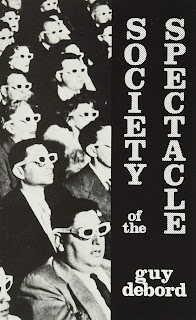
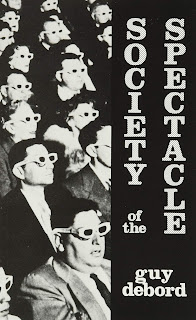
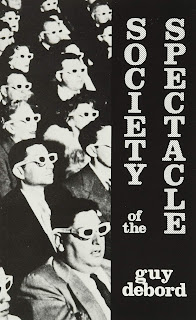
I'm going to try using this site more like a traditional blog, and post the chapter summaries of books I have been reading lately. First off is Guy Debord's Society of the Spectacle, which I chose to re-read earlier this year since the question as to how well, or how poorly, it holds up in the current media and political context was a point of discussion the last time I taught Popular Culture -- in addition to which, the more general question of to what extent such late-20th century critiques remain relevant, irrelevant, or have even become more crucial than ever, seems increasingly important. Even though there are supposedly newer and better translations, I chose the old Black & Red version out of nostalgia, because this is the copy I picked up at the San Francisco Anarchist C/Nonvention in 1989.


Guy Debord, (1983 [1967]), Society of the Spectacle. Black & Red, Detroit.


Chapter 1: Separation Perfected.

In this initial chapter, Debord sets up the opposition of "separation" vs. "unification,” the former of which is the spectacle. The spectacle has no purpose or goal other than self-reproduction. It has power through the commodification of labor (i.e., as labor-time or labor-power), and the consumption of commodities. The spectacle possesses the "monopoly of appearance" and demands passive acceptance and consumption (such a view was clearly most relevant to the era of films and television).

Debord traces the ancestry or history of the spectacle from earlier forms of theology/ideology/illusion. He takes the stance that the "specialization of power" (i.e., hierarchy, authority) is "the oldest social specialization ... at the root of the spectacle" (#23); such a statement is perhaps one of the reasons Debord is more attractive to anarchist theorists than to “true” Marxists, for whom control of the means of production is most crucial, and political power is merely a reflection of this.

Debord makes observations regarding the link between spectacle and technology, relevant to the present. Concepts like "unitary view" and "direct communication" are used to describe those aspects of the social which are eroded or destroyed/supplanted by the spectacle.