Saturday, August 8, 2015

The Spread of TNC Horse-Hiring

A TNC horse-hiring advertisement. Source: Craigslist.
For legal purposes, “Transportation Network Companies” (or TNCs) such as Uber and Lyft are defined as services that “facilitate rides between passengers and private drivers using their own personal vehicles.” Increasingly, however, drivers for these and similar “ridesharing” platforms will be driving cars that they have leased or rented.

Last week, Uber announced its Xchange Leasing program, which is designed to expand Uber’s driver pool to include those who do not have—or do not want to ply for hire with—their own vehicles. With this leasing program, and a rental program being piloted in select cities, Uber is taking a step into a growing phenomenon in the “ridesharing” industry. Numerous companies, large and small, are renting or leasing cars to drivers to operate on the Lyft or Uber platform.

This is just another example of the ways in which “ridesharing” services are recreating aspects of the taxicab industry. In this case, what is being recreated is a very old practice—to wit, horse-hiring.


Horse-hiring in a London cabyard. From Vance Thompson, "The London Cabby," 1904. Courtesy of Taxi-Library.

“Horse-hiring,” as the name suggests, goes back to the horse-drawn era. A would-be cabdriver, who lacked their own horse and cab, could rent these—by the shift, day, week, or month—from a hack company or from a neighborhood livery stable. The driver would pay the owner a set fee for the vehicle, and keep the rest of however much money they were able to make during the period of the lease. As a Parisian cabdriver explained it in 1903:
The day begins at six o'clock. 'Tis then I get my first horse and pay my day––eighteen francs, at present; sometimes the rate is higher, sometimes lower; if it rains the patron puts up the price; if there is a fĂȘte day he puts it up––for the day of the Grand Prix we paid thirty francs this year.... And we do what we can. Here a bourgeois and there a bourgeois and so the day goes. (from Vance Thompson, “The Paris Cabman,” 1903)

Horse-hiring was eclipsed in the Twentieth Century by the spread of the employee-cabdriver model, in which companies tracked cab income using the newfangled taximeter, and split the earnings with drivers (this is one of the reasons why Uber, which takes 20% to 25% of each fare, is currently faced with class action lawsuits for treating its “independent contractor” drivers as employees).

But horse-hiring never completely went away--though it now involved the rental of cars, not of horses. During the Depression it was often the mode of choice for smaller fleets:
Horsing - horse-hiring - A small fleet owner, with 18 or 20 cabs, hires a driver to take car out, buy his own gas and oil, and pay the company $5.00 a day for the cab. What he makes above this is his own. This practice is called “horsing.” (from Marion Charles Hatch, "Stories, Poems, Jargon of Hack Drivers," 1938).

The short-term commitment made possible through horse-hiring created a flexible, intermediate model between the independent driver, who owned and operated a single cab, and the employee driver who worked for the big fleets. With the collapse of the employee-driver model in the 1970s and 1980s, many large fleets turned to horse-hiring; this led to the independent contractor status shared today by cabdrivers and “ridesharing” drivers alike.

It was only a matter of time before horse-hiring emerged in the newest and fastest-growing branch of the cab industry: ”ridesharing.”

TNC horse-hirers come in all sizes, big and small. Last summer, I watched the spread of TNC horse-hiring advertisements in Craigslist’s Jobs-Transport section. First appearing in San Francisco, these spread rapidly to Los Angeles and other large Western cities such as Phoenix and Dallas. A larger horse-hirer with more funding and media coverage is Breeze, which started in San Francisco and has since spread to five other cities; other large players include HyreCar, a horse-hiring marketplace available nation-wide (though spottily), and Flexdrive, a Cox subsidiary which rents cars to Uber drivers in several Southern cities.

And now Uber itself is getting into the game.

For drivers, the attraction of horse-hiring is clear. As many ridesharing drivers have discovered, driving your own car as a taxi adds up to a lot of wear and tear on your personal vehicle. The more miles you drive, the more your car depreciates in value; an accident could result in painful out-of-pocket expenses, and put you out of work until your car gets repaired. Rideshare drivers in many states are still in legal limbo regarding insurance, unsure of what kind to buy, or how, and often avoiding the issue by hiding the fact from their insurers that they drive for hire.

Horse-hiring does away with all of those problems. Many leases cover maintenance, or even include insurance; when a vehicle gets worn down, or is involved in an accident, the lease driver can just switch it for another. Although renting a car involves a higher up-front cost (these are businesses, after all), that is a cost the driver knows ahead of time, unlike the uncertain costs of maintenance, repairs, and insurance claims which fall in the lap of the owner-driver. Fleet owners enjoy economies of scale over individual car owners; if horse-hiring leases reflect these savings, renting could even be cheaper than owning for TNC drivers.  The “ridesharing” movement has shifted many of the risks of taxi operation onto the drivers; horse-hiring is a way for drivers to shrug off some of those risks.


This San Francisco horse-hirer offers drivers a range of leasing options. Source: Craigslist.

Horse-hiring in the TNC world is still young, and different companies are experimenting with different versions (longer or shorter term rentals? insurance included or not? mileage caps or no mileage caps?). However, it can be expected to grow. This should not be surprising; it is just another way that the development of the “ridesharing” industry is recreating economic structures and relationships which have long existed within the cab industry.


Sunday, July 5, 2015

1906: SPEED MADNESS on the Corbett Road!


Upper Market and Corbett, 15 years after the events in this story. Courtesy of San Francisco History Center, San Francisco Public Library.

The year is 1906, just three months after the earthquake and fire. Most of San Francisco lies in ruins. A group of friends, along with a visitor from back East who "came to the city to view the ruins," seek to "get back to normal conditions" by taking a whirl out to the beach in automobiles...

...only to succumb to the temptations of... SPEED MADNESS!!!

For added ambience, click on the song lyrics (below) to hear the soundtrack.


From the San Francisco Call, 29 July 1906:

SPEED MADNESS CARRIES EMERICK TO DEATH'S BRINK

PRETTY COMPANION NARROWLY ESCAPES WITH HER LIFE

TO A gentle providence, in the code of which speed madness is not listed with the capital offenses, W. A. Emerick, society, club and business man, can offer thanks that some grim carver of tombstones is not chiseling on a shaft to mark his grave this epitaph:

Here rests at last a restless man;
In a race with death his auto ran;
Who lost? Why lies he in this silent bed?
He lost, of course; death won. 'Nuf ced!"

But, even as it is, it was with difficulty that the gaunt king of the valley of the shadow was driven from the bedside of Emerick. With a crown that is cracked and a body racked he tosses, sometimes in pain, sometimes in delirium, as a phantom car hurls him into imagination's eternity, at his home, 1245 O'Farrell street. Guarding his life Is Dr T. C. Macdonald. "He is improving," said the physician yesterday. "Consciousness returns at intervals. He will get well." And this is how it happened.

SUGGESTS A MERRY WHIRL.

Thursday evening, dinner through and the cigars passed round, Emerick's mind swept back to the joys of anteconflagration days. "Let's get back to normal conditions,” he said to the merry party around him, "and take a whirl through the park in automobiles." Agreed. Two big touring cars soon wheezed up to the door. In one Mr. and Mrs. David Fox, W. W. Collins and Mrs. Mallory, who conducts the O'Farrell street home, were seated. In the other. Emerick and Miss Mallory were comfortably installed. "To the Cliff House" was the order to the chauffeurs, and off rolled the "devil cars."
The trip through the park was uneventful: the Cliff House was visited and the start for home was made. All went well until they traveled past Mike Sheehan's Inn, whence came in rousing tones the song: 


"Let's fly, too," said Emerick. “Let's race. Smoke up, boys; let'r out."

Caps were pulled down; goggles adjusted. The two chauffeurs leaned forward, touched a lever here, a lever there and off they rushed through the night. Speed madness, they say, has been Emerick's failing, the terror of his friends and the joy of life to him. As though it caught his thrill his auto plowed forward and soon was victor in the spurt. "Good-night, we're going home." shouted Fox from the vanquished car, and turning around, headed back for the South Drive.

TAKES THE CORBETT ROAD.

"We'll come home along the Corbett road and see if we can't beat them out." said Emerick. "Advance your spark to the limit and give 'er all the benzine she'll eat." The chauffeur obeyed and the car sped through the dark like a comet astray until just at the spot where, not long ago, dare-devil Jack Baird was killed for his folly.

Perhaps it was the same rut that turned Jack Baird's machine a somersault and crushed out his life that ripped the wheel from the hands of Emerick's chauffeur. Like a giant acrobat the car leaped into the air, turned clear over, righted and stood still.

In the road lay Emerick, bleeding, covered with dust and gasping. Hanging by her gown from a barbed wire fence at the roadside but little injured was Miss Mallory. Still gripping his seat was the chauffeur, who affirms with wide eyes and raised hand that there's where he sat through all the tumble. Hurrying to Miss Mallory's side the chauffeur tore her gown from the barbs and assisted her into the automobile. Then he dragged Emerick to the car and lifted him in. A tire was flat and two of the four cylinders of the engine were out of commission, but the car responded to his skill and moved off for home.

EXCITEMENT AT THE HOME.

Their arrival at the O'Farrell-street dwelling threw the Mallory household into wild excitement. Dr. Macdonald was hurriedly summoned and for a time his prognosis was unfavorable. But yesterday Emerick brightened. Now the physician says he will recover. Many weeks will pass before Miss Mallory's nerves are quiet again and like the beaten pugilist, the chauffer's courage has suffered a permanent scar.

Emerick is senior member of the firm of Emerick & Duncan, brushes and cordage, 1245 O'Farrell street; David Fox was chief clerk at the destroyed Russ House; Collins resides in Alameda. He is a member of a wealthy Eastern family and came to the city to view the ruins. For all of them automobiling has lost its charm.


Saturday, June 20, 2015

[Your Job] is a Video Game


Video games, and video game theory, provide insight into the ways ubiquitous mobile computing will be used to transform social interaction.


Cabdriving is a video game!
K-ching! K-ching!
That’s the name of the game!

– MC Mars, “Cabdriving is a Video Game”


I’m going to Yerba Buena Gardens,” said the friendly young man. “You know where that is, right?”

Of course I know where that is, and as luck would have it, we were only a few blocks away. With a few taps of the screen, I navigated my car south and east from the Tenderloin, crossing Market at Fourth and coming up along the main entrance to Yerba Buena Gardens on Mission Street. Nothing happened; the passenger did not get out.

Damn, is this game frozen again? There should be a flag here to mark my passenger’s drop-off location. I pinched and spread the map to zoom out, and then saw it: the flag was planted way over in the intersection of Third and Howard, on the far opposite corner of the park.

Oh, of course. I was playing UberDrive, Uber’s new cabdriving (okay, “ridesharing”) simulation/game/recruiting tool. My virtual passenger, I realized, could not get out anywhere but at whatever specific location Uber’s GPS imagined to be “Yerba Buena Gardens.” Unfortunately, most of the streets around here are one-way, in the wrong direction. I maneuvered around three long city blocks, finally tapped the flagged intersection on the map, and watched the little car icon pull up. “Best ride ever!” beamed the passenger. Another five star rating!

According to Uber’s website,

UberDRIVE was designed as a fun and engaging resource for our driver-partners to hone their navigation skills if they choose to. It’s also a great way for prospective drivers to experience firsthand what it’s like to drive with Uber –– there are links to sign up and start the screening process from directly within the game.

Hone your navigation skills? Tapping intersections on a map is a far cry from the experience of actually navigating through San Francisco’s downtown streets. I suppose UberDrive could help inexperienced drivers learn which streets are one way, and how the street grids connect across Market. Experience firsthand what it’s like to drive with Uber? As a training tool, the game is hardly realistic: every single passenger was polite, no one ever cancelled, no one threw up in the back seat, or tried to squeeze in more passengers than seatbelts; everyone was at their pinned location and ready to go when I rolled up. And every single passenger gave me five stars. In other words, they were completely unlike many Uber passengers.

UberDrive is, in fact, just a poor copy of a much more interesting game – driving for Uber. The main innovation of Uber, and other smartphone-enabled “e-hailing” car services, is the insertion of a new interface into the human-to-human, on-the-street interactions between drivers and passengers. For drivers, the smartphone screen works like the little map in the corner of a first-person video game, a HUD that links the immersive environment of the city street back to the digital space of the game world. Each "ping" that alerts drivers to incoming hails is accompanied by a game-like cutscene showing concentric circles radiating from the hailer's location; drivers can log in to a "dashboard" offering "Partner Rewards" such as discounts on gas and oil changes, which drivers "unlock" by completing a set amount of quests... I mean, rides...

The interface allows the game designers at Uber, Lyft, etc., several tools for influencing the in-game behavior of both drivers and passengers: “surge pricing,” the five-star ratings system, and most importantly, the affective framing of “ridesharing” as different from (“Uber” than) the mundane experience of riding in a cab. This isn’t like those old taxicabs with their “inconvenient meatspace hailing”: it’s interactive tech, you know, more like a video game.

There is a name for this combination of storytelling appeal and software-mediated control: the allegorithm, which means the unity of allegory and algorithm. This unity comes into play when, for example, a player satisfies a game’s algorithms by hitting a series of keyboard buttons with precise timing, while, within the storyline or "allegory," they embrace the idea that they are killing orcs with a flaming sword. Or maybe they tap a smartphone screen, while imagining that they are driving passengers around SoMa. But the allegorithm really comes into its own when it is deployed with mobile interfaces into “augmented reality.” Ingress, you are already thinking; but you should really think Uber.

For the inelegance (and questionable pronounceability) of “allegorithm”, you can blame the word’s coiners, video game theorists Alexander Galloway and McKenzie Wark. But as a concept, it is of great importance for understanding how mobile interfaces are already connecting with and transforming social interaction, and how they will increasingly be used to do so in the near future.

By saying that allegorithms transform social interaction into a “video game” I do not mean that they are making the “real world” somehow “less real” or less serious. The goal of gamification is not the distortion of reality behind some kind of mystifying curtain or spectacle, but the improvement of “meatspace” reality through the deployment of design lessons learned from game development. In practice, this means carefully manipulating the kinds of information and choices available to players, studying their motivations in order to encourage desired behaviors, and inventing a compelling storyline through which players can make sense of the "game." The results can range from the benign to the sinister, from the sublime to the laughable, and we will be seeing more and more of these as the revolution in ubiquitous, mobile computing continues to roll out.

In the meantime, it can be useful to observe Uber’s allegorithmic gamification of cabdriving to assess how these initiatives will play out, and what successes or failures they are likely to encounter. The allegorithm needs, above all, a narrative which participants want to, and are able to, buy into; Uber (and its imitators) have shown great success with this so far, but how long can this be kept up? With any ubiquitously deployed allegorithm, the question arises as to how well the framing survives its insertion into the immersive “real world” environment. As I will discuss below, the success of the cabdriving-game deployed by Uber and others like it depends on the already gamelike aspects of cabdriving as a job; but risks coming apart when running up against the contradictions of cabdriving as work, and when the game designers, or the allegorithm itself, fail to predict or account for the real world complexity that players will encounter.

And as with any social transformation, we need to keep questioning. How good are these games? Are these the games we really want to play?

Crazy Taxi: from digital game-world to physical-world toy. Creative Commons photo by Tatton Partington.

Cabdriving was, of course, already a video game – Crazy Taxi – and the story I was told goes like this. Three San Francisco cabdrivers had the idea to design a board game based on their job. They designed a board loosely based on San Francisco, with pieces that looked like cabs, which the players moved about town looking for paying customers, the winner being the one who made the most money in a set number of turns. Then one day one of the designers (the driver who told me the story) was told by his partners that they had sold the idea to a game company for a few thousand dollars. A few years later, Crazy Taxi hit the arcades, though as a video game rather than a board game.

True story? It is hard to tell. Sega (producer of the game) attributes the idea to a Japanese game designer, not three San Francisco cabdrivers. Yet the original game in the franchise was clearly based on San Francisco, complete with its vertiginous hills, cable cars, and a choice of three bohemian taxi drivers as avatars. And the game captures at least some of the fun part of driving a cab in San Francisco. When I quit driving, I played the game as a way to enjoy some of the addicting aspects of the job. It was sort of like a nicotene patch for cabdriving.

UberDrive, in contrast, is designed to be a gateway drug—a free sample to get you hooked, to pull you into the deeper game of “meatspace” driving. Every few minutes the gameplay is interrupted by an appeal to start driving for Uber in real-life. “No Thanks,” I click, and go back to playing pretend cabdriver.

These games work because real-world cabdriving is, inherently, in many ways game-like. It is full of short, achievable objectives and quick rewards, won in exchange for taking calculable risks. It is more than a little like gambling, and can be as addicting, given the right personality. No matter how bad your luck gets, the player knows there are new possibilities waiting around the corner.

Driving in the city requires, besides patience and strength of will, ingenuity at puzzle-solving; as a passenger once observed while I threaded through traffic, “So you just basically play Tetris all day?” Or as San Francisco’s hip hop cabdriver MC Mars puts it:

cutting through lanes like fish veins
on Van Ness with the finesse of a sushi chef
Truly/deftly/ I’m the surfer with the motorcycle mentality/ when it gets gnarly/ I hit the slot between the herd and the Harley/ tourist with his head in a map/ kid on a raging Ducati/ cab driving is how I rock a party
                                           (Mars 2005: 144).

Cabdriving may be gamelike, but it isn’t all fun and games. I titled my 2004 cabdriving auto-ethnography Playing for Hire to emphasize the dual sense of the taxicab driving experience in San Francisco. On the one hand, drivers constantly talked about their job as “playing” – “playing” the airport, “playing” the dispatch radio, “playing” the streets. On the other hand, this “play” is also “work,” and drivers need to make money—to pay the cab company for the vehicle, to pay for gas, to pay off all the numerous gatekeepers who must be tipped in the course of a shift, and finally, if any is left over, for themselves. K-ching! K-ching! is the name of the game.


When MC Mars raps about cabdriving as a video game, he doesn’t paper over the bad or candy-coat the danger. He paints an image of cabdriving as a difficult job which demands and rewards the development of individual skill, “split-second reactions” and bravado. It's a view from the streets: a less controlled, messier, and more enjoyable experience than UberDrive, or for that matter, than Uber.

Uber, and other smartphone-interfaced cab services, build on the already-gamelike aspects of cabdriving, while relying on allegorithmic design to ameliorate or obscure the job’s less gamelike, real-world difficulties. Before Uber, cabdriving was already gamelike, and it already had its interfaces: radio and computer dispatch, even smartphone apps like Taxi Magic and Cabulous. But before Uber and Lyft the allegorithmic potential of these interfaces had not been developed. UberDrive shows us how this is supposed to work: happy drivers transporting friendly customers, and making quick money. K-ching!

If any UberDrive players are suckered in enough to click “Yes” and actually join Uber, they are in for a big surprise. UberDrive is not so much a view of the actual experience of the Uber driver, as a peek into the fantasy of the Uber designer, and their vision of how the allegorithmic narrative should be playing out: a superficially cleaned up, “tout est pour le mieux” version of reality, presenting the voyeuristic perspective of the overseer, rather than the in medias res viewpoint of the driver in the street. Having played both UberDrive and the real-world game it is based on, I have to say the designers are missing a lot. Could this blindness, in fact, be an effect of that other computer game, played by Uber personnel, looking down on the city from their computer screens at Uber HQ, playing Uber’s “God View?”

"An Icarus flying above," the Uber GodView player looks down on "the devices of Daedalus in mobile and endlesss labyrinths far below" (de Certeau 1984: 92). Image by Uber.

Perhaps UberDrive’s designers could make a better game if they got out on the streets and drove a bit. Perhaps Uber’s designers could benefit from the same exercise. Perhaps the folks at Uber HQ could make better games in general if they pondered a bit more critically how their own game’s allegorithm is shaping their experience. They do know they’re playing a video game... don’t they?


Michel de Certeau, (1984) The Practice of Everyday Life. Berkeley: University of California Press.

MC Mars, (2005) Don't Take Me The Long Way: 30 True, Truly Outrageous Cab Stories. San Francisco: Off D Edge Press.


Friday, June 5, 2015

Why "Taxicab Subjects"


Mosaic of a Roman cisium in the Terme dei Cisiarii, Ostia. Creative Commons photo by SebastiĂĄ Giralt.


There are some subjects which may be written about even in a cisium.
Seneca


Cisia were the ancient Roman analogue to the modern taxicab: mule-drawn carts, hired from stands at the city gates, which provided transportation in the Roman suburbs (carriages were banned from the narrow, congested streets of the city center). Seneca wrote these words late in life, a retired statesman living in his villa on the outskirts of Rome. In a letter “On Business as the Enemy of Philosophy,” he detailed the mundane, everyday responsibilities and tasks which prevented him from enjoying the peace and seclusion necessary for the profound philosophical contemplation and writing with which he would rather have been occupied. Fortunately for the harried Seneca, some subjects (possibly this very letter) are simple or direct enough to be written about, even while being jostled along, from one appointment to another, in the back of a cab.

With “taxicab subjects” I want to build upon Seneca’s insight into the link between writing and place. Some subjects are fit for spaces of quiet contemplation; others are suited for cabs, on the move. What are these “subjects” fit for the taxicab? Three kinds spring to mind:

1. The history and development of urban hired vehicles. Despite the fascinating diversity of hired vehicles which have appeared at one time or another in urban history—waterborne gondolas and shikaras, litters and sedan chairs, rickshaws, horse-drawn and motorized cabs, pedicabs and motorcycle cabs—there is nothing inevitable about the emergence of vehicular traffic in cities. For most of urban history, such a mode of travel was rare or unknown. Until very recently, cities were built for pedestrian traffic primarily or exclusively.

2. Urban form and experience as these are impacted by travel in taxicabs and similar vehicles. Our cities today, of course, have been built around the automobile, or altered to acommodate its needs. Hired automobiles (taxicabs, jitneys, and motor liveries) played a crucial role at the outset of the automotive era, in habituating the riding public to the new, motorized experience. If the technology of “self-driving” cars is successfully developed, it is a fair bet that cities will once again be redesigned around that technology. Already, driverless taxis are being envisaged as an entry model to accustom the riding public of the future to the idea of self-driving vehicles.

3. Drivers and passengers. It is the writing, experiencing, and interacting taxicab subjects, in that other sense of the word (the subject as locus of subjectivity) which I am most interested in. In the dual sense (to paraphrase Althusser and Foucault): subject as the seat of awareness and origin of initiative, and subject as one who is subjected, controlled, or directed. Subjects, constrained and empowered as participants in the taxicab assemblage (composed of vehicles, persons, stories, cities, technologies, etc.).

The idea that a cisium driver (cisiarius) might also write would probably not have occured to Seneca. Today, writing on “taxicab subjects” encompasses not only the back seat, and not only the front seat, but any writing in response to the varied subjects that pass through the cab, or that cabs pass through, and so are fit for cab writing. Who writes in the cab? What subjects does the cab, in its movement, inscribe? Encompassed in the practice of “in cisio scribere” are the harried office worker, completing letters or emails on the way to work, the cabdriving memoirist (in San Francisco alone, drivers have produced more than 11 book-length cabdriving memoirs over the last several decades), the passenger who writes about the experience of the ride (check out the eclectic backseat twitter comments collected by @myuberdriverbot), and the ethnographer writing down the words of the driver.


My own research has focused on the changing relations between drivers and passengers, particularly as these are revealed in two historic conjunctures: the switch from horse-drawn to motorized cabs a century ago, and the present moment, in which the fascination with “driverless” vehicles reveals a great deal about contemporary sensibilities, whether or not the technology is ever succesfully rolled out. As they move through the city, cabs of any era have moved through a changing web of images and imagination; evolving ideologies of class, gender, race, labor, and technology; and shifting anxieties and celebrations of the kind of urban mobility which taxicabs, and similar vehicles, provide, and the varying subjects they provide it to.

Saturday, May 16, 2015

The Latest Ride-Hailing App (of 1901)

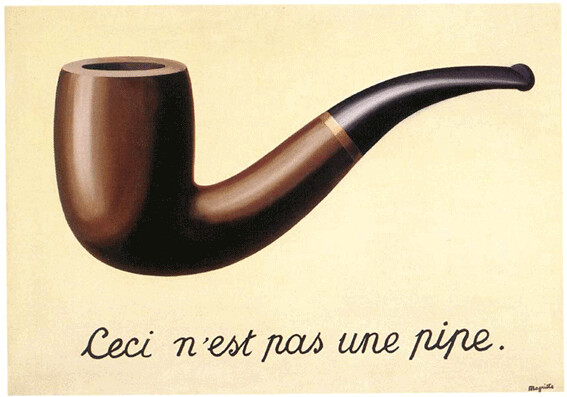
RenĂ© Magritte (1929) La trahison des imagesCreative Commons photo by Dan Iggers (Flickr).

From the San Francisco Call, 20 June 1901:

A Frenchman has invented a tobacco pipe which has a whistle in the stem in order to enable the smoker to summon a cab without taking the pipe from his mouth.


Friday, May 8, 2015

A History of San Francisco's Cab Industry, in Advertisements (Part Two)


Changing perceptions of work, technology, and public space in San Francisco are revealed through historical advertisements for the city's cab industry.

(Read Part One here.)

Pacific Taximeter Cab Company ad, San Francisco Blue Book, 1910 (archive.org).

The taximetered, motorized cabriolet—or, if you’re American and in a hurry, the “taxicab”—was the combination of two inventions. First, the taximeter, which had been invented in the 1890s, but had only gradually been adopted by the world’s cab fleets; and second, the purpose-built motorcab, strong enough for an enclosed rear compartment (or convertible, as in the picture above). Passengers were protected from the elements by a windshield—which also, as it happened, recreated the separation of driver and passengers that had existed in horse-drawn carriages.

(Windshields for the drivers came later).

The first taxicabs to roll onto San Francisco streets in 1909 were operated by the Pacific Taximeter Company, though a slew of competitors followed within the year. Along with driving gloves and tall boots (for muddy streets), the driver in this 1910 ad sports the uniform and chauffeur’s hat which became the new standard “cabby” costume. Only the badge remained from hackdriver days.

1909 was also the year the Chauffeur’s Union (Teamsters Local 265) was founded. Strikes, along with intense competition, unforeseen costs, and insurance payouts, led to the demise of many of the early taxi companies, including Pacific Taximeter, which was absorbed by one of its competitors within a few years.


Kelly's Garage ad, San Francisco News Letter, 1926 (archive.org)

The full-service garage was the automotive descendant of the livery stable: a taxicab company, car rental, parking garage, and repair shop rolled into one. Kelly’s made the transition seamlessly, operating both autos and carriages through the turbulent Teens, and switching to fully automotive by the Twenties. This 1926 ad features a cartoon version of the uniformed chauffeur in full regalia, and manages to cast aspersions on drivers for other, newer cab companies, who, it implies, are more likely to drive recklessly.

Founded in 1878, the business throve until 1936 when the Kelly family sold to the Gray Line. The old stable/garage was converted to offices, and stood until the 1990s when it was torn down to make way for the San Francisco Towers.

Losing its role in everyday street travel, the horse-drawn carriage returned to its origins as a vehicle for pleasure rides and special occasions. The last old-time horse-cab drivers were independents after the tradition of John Glover. They could be found around Golden Gate Park into the late Twenties.

Ad for Luxor Cab, Douglas "20" Police Journal, 1928 (archive.org).

The pattern for most of the Twentieth Century was set by the Twenties, by which time almost all the cab companies of the Teens had vanished, or had been absorbed by the Yellow-Checker conglomerate, which became the dominant company. But Yellow always had competitors. Founded in 1928, Luxor Cab is today the oldest continually operated cab company in the city, and at 87 years, has achieved greater longevity than any of the other cab companies, horse-drawn or motorized, which have ever operated in San Francisco.

DeSoto Sedan Service ad, San Francisco Telephone Directory, 1938 (archive.org).

The Great Depression brought new turmoil into the taxi trade as cabdriving became a back-up job for waves of unemployed workers. Car dealers, having trouble finding buyers, promoted cars as “job-creators”—buy a car and get an instant job, driving that car as your own taxicab! The result was a massive oversupply of cabs on the street, and a race to the bottom as desperate “wildcat” drivers competed for business by slashing prices lower and lower.

The city responded by imposing minimum rates of fare, and prohibiting any new taxicab permits unless "public convenience and necessity” could be shown. This was the birth of the regulatory structure which (through various mutations) continues to this day.

The imposed regulations did not so much squash the cut-rate cabs as squeeze them out sideways into the new category of “sedan service,” which was invented to circumvent taxi regulation by offering flat rates instead of using the taximeter. At "Rates Lower Than Taxis,” the flat-rate sedans multiplied: Olympic Sedan Service, Peacock Sedan Service, Eddie’s Sedan Service... but only DeSoto Sedan Service survived the decade. It was operated by San Francisco’s DeSoto dealership, which, ironically, had a contract to sell purpose-built DeSoto Skyview taxicabs exclusively to Yellow Cab.

Which meant that if you called Yellow, you rode in a DeSoto, but if you called DeSoto, you rode in a Plymouth. Got it? Okay.

By the 1960s, DeSoto had converted its “sedan service” into a regular taxi service, and the company had been sold to a group of drivers, who re-formed it as the DeSoto Cab Cooperative.


Yellow Cab ad, San Francisco Municipal Record, 1964 (archive.org).

An urban icon, the yellow cab owes its origin to Chicago cab magnate John D. Hertz (also of “Hertz Rent-a-Car” fame), whose Yellow Cab Manufacturing Company produced a line of purpose-built taxis in the 1920s. These yellow vehicles were distinct and popular enough that the cab companies around the country which bought them often named themselves after the vehicle; San Francisco got its “Yellow Cab” company in 1922.

In the mid-20s businessman W. Lansing Rothschild consolidated most of the city’s cabs, including Yellows, into the Yellow-Checker company, popularly known as “Yellow Cab.” Yellow Cab went on to dominate the San Francisco cab industry for the next five decades. Yellow controlled all the best cabstands in the city, including the wharf, top hotels, and the airport. Seeking to lure customers, independent drivers painted their own cabs yellow, until the city put a stop to this by requiring the distinct “color schemes” by which San Francisco cab companies are still distinguished.

As Yellow Cab of California, the company expanded its empire into other cities, including Oakland, Los Angeles, and Phoenix. Size proved to be Yellow’s undoing: acquired by the Westgate-California Corporation, Yellow fell prey to the spectacular collapse (due to embezzlement and mismanagement) of that corporation. Yellow went out of business in 1976, putting over a thousand cabdrivers out of work and idling almost half of the city's cabs.

After a year of disorder, medallion-holding drivers formed the Yellow Cab Cooperative, which remains the city’s largest licensed cab company.

City Cab advertisement, The New Deep City Press, 1976 (courtesy of Alan Freberg).

As epicenter of the counter-culture, San Francisco attracted generations of artists, individualists, rebels, and dreamers. More than a few ended up driving cabs. Beat poets of the Fifties, Diggers of the Sixties, and bohemians of every decade found inspiration behind the wheels of San Francisco taxicabs, lured by the independence and freedom—even the danger—of the job, and above all, by the city it allowed them to explore.

Evocative of San Francisco’s tradition of psychedelic poster art, this City Cab ad appeared in a 1976 issue of the New Deep City Press, a magazine of poetry, art, fiction, and political commentary, written and produced primarily by drivers for City Cab. Repeating features included the Maxie the Taxi comic, and a series on how to play craps by cabdriver Jimmy the Glove.

The division between driver and passenger—in the form of the partition between front and back seats, and marked by the driver’s formal uniform—eroded over the course of the century, as what had once been markers of respectability came to be perceived, instead, as uncomfortable tokens of class inequality. The partition became rare in the 50s; by the 60s, drivers were starting to wear everyday streetclothes instead of uniforms or suits. The chauffeur’s cap hung on as a symbol (a cabdriver makes it part of a Sergeant-Pepper-ish look in 1969’s “Yellow Cab Event”), but has rarely been seen since the 80s. Once again, only the badge remained.

The late 1970s saw the breaking of the Chauffeur’s Union, and a loss of status for the occupation, as drivers went from being “employees” (with benefits such as healthcare, pension, and paid vacations) to “independent contractors” (with squat). This went in hand with broader trends in the 70s and 80s: the flight of industrial jobs from the city, and the erosion of union influence.

DeSoto Cab receipt, 1990s.

Changing technology disrupted San Francisco’s cab industry—again and again. Radio dispatch was introduced in the Forties; computerized dispatch in the late Eighties; and over the last decade, improved GPS-based computerized dispatch, and smartphone e-hailing. Each new technology transformed the way cabs and passengers moved through, and interacted with, the city.

By the 1990s, when this DeSoto Cab receipt, complete with Conquistador-as-cabdriver (unshaven, arm slouched on the driver’s window, but still dressed for conquest), advertised “Radio Dispatched 24 Hour Service,” the taxi radio had become a part of the cab’s iconic image. To ride in a cab was to hear the rapid-fire dispatcher (“he sounds like an auctioneer!”); to drive one was to learn to listen, interpret, imagine, and contest the city through the stream of street names, addresses, cab numbers, and random commentary flowing from the radio.

Any kind of technological change involves a trade-off, a shifting around of cost, convenience, knowledge, and relations of dependency. Changes in taxi dispatch—first computerization, then e-hailing—have increasingly restricted the flow of information to drivers, and so decreased the reliance on interpretive and navigational skills developed by drivers through experience.

In early 2015, DeSoto rebranded itself as Flywheel Taxi, taking the name of a prominent e-hailing app. Not unlike the old Telephone Cab and Carriage Company, the name invokes the novelty and appeal of the newest dispatch tech. Yet the rebranding of “DeSoto” to “Flywheel” implies something else as well: a changing image for the San Francisco cabdriver. The legendary explorer, forever searching for the Fountain of Youth, has been replaced with a “flywheel”—literally, a cog in a machine.

"Uber targets Lyft," photo by Steve Rhodes, 2013 (Creative Commons).

The Great Recession brought turmoil into the cab industry as waves of the unemployed and underemployed sought to make ends meet by driving for hire. They were helped along by smartphone e-hailing companies, which, taking a cue from the old “sedan services” of the Thirties, branded themselves as “ridesharing” instead of as “taxicabs” to avoid regulation. Cheap and convenient, paid “ridesharing” car services swiftly became popular—in 2014 there were six such companies operating in San Francisco—and thousands of ridesharing cars roamed the streets, swamping the number of licensed cabs.

Freed from the constraints of the city’s taxi regulations, ridesharing companies recreated the cycles of earlier cab history. Unlimited numbers of vehicles plying for hire led to price wars (at lower than Depression rates); lack of commercial insurance led to legal debates over liability. In an echo of the Thirties, buying a car was promoted as a form of job creation, and one major ridesharing company offered vehicle financing to prospective drivers (though claims of predatory lending ensued). With the development of “horse-hiring” (leasing cars to drivers for a set time and fee)—a practice which, as the name suggests, goes back to livery stable days—little remained to distinguish rideshare drivers from taxi drivers (except, of course, that the latter still wear badges).

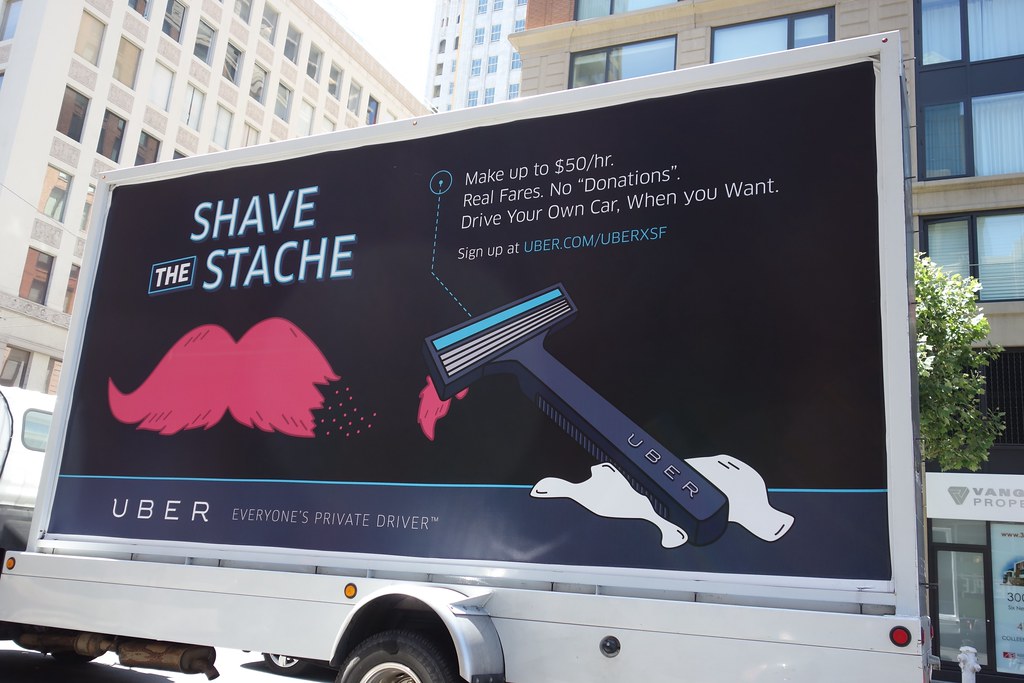
The above 2013 ad illustrates the competitive spirit embodied by Uber (originally UberCab), which quickly became, in effect if not in name, San Francisco’s largest and most politically connected cab company. Like the previous holders of this title (United Carriage and Yellow Cab), Uber has proved both technologically innovative and mercilessly expansionist (though not, perhaps, as classy; is there a tackier way to advertise than by clogging the streets with mobile billboards?)


SFMTA bus ad, 2014. Courtesy of San Francisco Citizen.

Competing trends of regulation and deregulation face off in the 21st Century. For San Francisco’s cab system, this means a contest between the city’s Municipal Transit Authority (MTA), which governs licensed taxicabs, and corporations like Uber, Lyft, and Sidecar (which, though headquartered in San Francisco, are incorporated in Delaware). At stake is not just the movements of cabs, drivers, and passengers, but the data they create as they are increasingly tracked by mobile, interconnected devices. The debate over cab regulation today is just a precursor to future conflicts over who will control the technology and information used to move cities in the coming century.

The public image of drivers for hire is up for grabs. Rideshare services ask riders to think of their drivers, not as “cabdrivers,” but as either “private drivers” or as “friends with cars;” “Hail a Fellow Human, Not a Taxi” read one rideshare-promoting headline, revealing a new (sub-"human") low in the cultural image of the cabdriver. “Do you know what you’re getting into?” responded city regulators, using this 2013 bus ad to cast suspicion back at the less-regulated “rideshare” services.

Caught in the middle are the drivers. Since the 1970s, drivers for traditional cab companies have been treated as independent contractors, with few workplace protections, no benefits, and no job security. The growth of corporate “ridesharing” services like Uber and Lyft represent a further intensification of this trend towards precarious work. Drivers have begun to organize in return: rideshare drivers have held strikes and protests to bring attention to their precarious working conditions; San Francisco’s licensed cabdrivers have formed a local branch of the AFL-CIO-affiliated National Taxi Workers Alliance, in the most significant instance of labor organizing in the San Francisco cab industry since the downfall of the old Chauffeurs’ Union forty years earlier.

What does the future hold? Will there be a resurgence of the regulated taxi model (integrated into an intelligent “transit first” system overseen by the MTA)? Or the further spread of the deregulated “ridesharing” model, controlled by multi-city (or in Uber’s case, transnational) corporations? Or will both be swept aside by the development of driverless cabs, which (depending on which expert you ask), we can expect to see within five years, within twenty years, tomorrow, or never? (Place your bets!)

(For the record, my money is on low-flying drone sedan chairs...)

The trouble with reading history from advertisements is that they tend to paint a rosier, more simplistic picture than what really exists; a deeper understanding has to be filled in from the gaps and silences that haunt the edges of the advertised image. Today we live in a world more saturated with a marketing perspective, and with the distorted view that it feeds us, than ever before. Yet, whatever the future holds, it depends on the choices we make, collectively, today. What sort of city do we want to live in? How do we want workers to be treated? And what relationship do we want to see between technology and its users? Hopefully, a little historical perspective can help us see past the myopia of the present.


(Read Part One here.)


Friday, May 1, 2015

In San Francisco, Uber/Lyft drivers are paid less per mile than cabdrivers were in the Depression

1931 San Francisco taxi rates (adusted for inflation) compared to current Uber, Lyft, and taxi rates.

In the Depression, cabdriving became a back-up job for waves of unemployed workers. Car dealers, having trouble finding buyers, promoted cars as “job-creators”—buy a car and get an instant job, driving that car as your own taxicab! The result was a massive oversupply of cabs on the street, and a race to the bottom as desperate "wildcat" drivers competed for business by slashing prices lower and lower.

In San Francisco, the lowest rates appeared in 1931, and it is worth comparing them (adjusted for inflation) to the costs of cabs (including UberX and Lyft) in the present day:


SF Taxi Rate in 1931 Value in 2014 dollars: SF Taxis today Lyft today UberX today
flag drop $0.15 (first 1/4 mile) $2.30 $3.50 (first 1/5 mile) $2.25 $2.20
per mile rate $0.30 $4.61 $2.75 $1.35 $1.30
first mile total $0.37 $5.68 $5.70 $3.60 $3.50


This quick and dirty comparison can’t tell us everything; other factors would include the cost of gas (lower in 1931), and typical miles-per-gallon (ditto). One thing that is known: the cut-rate cabbies of the Depression cut costs by going without insurance.

But the surprising thing is that at most, a ride in a modern cab will equal the cost of a ride in the Depression; with a higher drop charge, and lower mileage rates than 1931 cabs, a one mile ride in a 2015 taxi is almost exactly the same price as it would have been in 1931. But a ride in UberX or Lyft (unless “surge pricing” is in effect) will be over a third less.

These prices may seem great to the consumer, but the drivers of these vehicles (all three kinds) are independent contractors, whose income is directly affected by these prices. Uber drivers, in particular, have complained that, during regular pricing, they can actually lose money on rides. (No wonder Uber drivers have declared a general strike today to protest low mileage rates!)