Sunday, September 4, 2016

Streetcar Wars of San Francisco History, Vol. III

Before the Google Bus, there was the balloon car...

A San Francisco invention, the "balloon cars" of the Sutter Street Railroad could be rotated on their own chassis, allowing them to turn around more easily. Unfortunately they could also be easily run off the rails, as the story below indicates. (Photo: San Francisco History Center, San Francisco Public Library).

San Francisco Chronicle, December 23, 1877

“OUR BOYS."

HOW THEY HATE THE LARKIN-STREET BALLOON CARS

“Our Boys” residing in the vicinity of Hayes and Market streets have organized and harmonized themselves without distinction of creed, color or previous condition of servitude into an important party, the shibboleth of which is underlying enmity to the drivers of the balloon cars of the Sutter-street railway running along Larkin street. ...

The boys appear to divide themselves into regular strata of “pure cussedness.” At the corner of Hayes, Ninth, and Market streets they modestly content themselves with having so artfully laid a train of misleading rocks from the legitimate track that the driver is never awakened to his responsibilities till he drives his steeds half into the front balcony where a Larkin-street young lady is entertaining her young man.

Having backed out with profuse apologies he continues his frequently interrupted course to the corner of Grove street. There the boys change the programme by pelting him with stones. The only objection that can be made to the boys at this corner is that they are remarkably bad shots, and that every rock, well intended to do for the driver, shivers a window and scatters shattered glass rather promiscuously and dangerously among the passengers.

At Fulton street a low whitewashing investigating committee of three usually jumps aboard, and when the attention of the driver is distracted by some one of his numerous duties, one of the Committee rings the bell and they then all jump off and laugh at the driver for stopping to let off a supposed passenger.

The drivers have done all in their power to counteract this evil. They have laden the fronts of their conveyances with cobbles till they looked like Trojan war chariots, and they fired the said cobbles at the hoodlums with remarkable wickedness, it is true, but with distinguished ill success.

Individual drivers have been so enthused with the war as to leave horse, car and passengers on the track, and start out for a several blocks’ chase of supposed culprit. They have invariably returned with some good little boy who was just going home from an adjacent letter-box, or a contiguous grocery, whither he had been sent on an important errand, and being bound to let all these go, the assistance of the police is respectfully asked.


Wednesday, August 3, 2016

Lewis Hine's New York Taxi Drivers

A New York taxi driver poses for the camera while car 433 of the Third Avenue Railway System passes in the background. Photo by Lewis Hine; George Eastman Museum.
Lewis Hine was an early 20th Century advocate of what he called social photography—photography that helped bring about social change. He is most famous for his photos of child laborers, of immigrants passing through Ellis Island, and of construction workers building the Empire State Building. He also took a series of photos of New York City cabdrivers.

(All photos courtesy of the George Eastman Museum).

The double-breasted coat worn by this taxi driver would have looked right at home on a 19th Century hack driver. Photo by Lewis Hine; George Eastman Museum.

The date given for these photos is “circa 1935,” but judging from the cabs it is more likely the 1920s. The cab in this photo still has carriage-style lamps on either side, behind the driver.

In all of Hine's photos, the cabdrivers look straight ahead, with their hands on the wheel. This reflects Hine’s intention, in his work portraits, to show the relationship between workers and their machines, and to capture how “the character of the men is being put into the motors.” Presumably Hine means to convey how the speed of the taxi forces the driver’s attention on the road ahead—very reminiscent of Marx’s observation that industrial workers become mere “conscious organs” attached to the machine. You might say that, just like for the office workers T.S. Eliot had written about only a few years before this photo, for these taxi drivers
 This makes a sharp contrast with the images I posted about last month, of Honoré Daumier’s hack drivers, who are always shown interacting with passengers or hailers (when they are not falling asleep while driving!)

In his book of photographs, Men At Work, Hine wrote:
Cities do not build themselves, machines cannot make machines, unless back of them all are the brains and toil of men. We call this the Machine Age. But the more machines we use the more do we need real men to make and direct them.

Hine’s goal was to show the importance of labor even in this “Machine Age,” and to depict the dignity of workers.
Then, the more you see of modern machines, the more may you, too, respect the men who make them and manipulate them.

Photo by Lewis Hine; George Eastman Museum.

There’s not much background variation in these photos, indicating that they were probably all taken in quick succession at the same location, perhaps at a cab stand. Here we see the first driver again, having moved forward slightly, perhaps a spot or two up the line. In this photo you can get a sense of how early windshields were designed. Before windshield wipers, a heavy rain could completely obscure the view through the front. To counteract this, the top part of the windshield could be swung outward, to create a gap through which the driver could peer into the rain.

You can also see that this cab, like all the rest in these photos, had no passenger-side front door. The space next to the driver was for storing the passengers’ luggage; if the space was needed for a passenger, there was often a fold-down seat that could be called into service.

And you can see that, although the passenger compartment is enclosed, there isn’t much protecting the drivers from the elements. No wonder that other driver was wearing such a heavy coat.

Yellow Taxi with phone number Lenox 2300. Photo by Lewis Hine; George Eastman Museum.

Here is another reason for the drivers to stare forward: to give their passengers privacy. This photo gives a good view of the glass partition which separated drivers and passengers in early taxicabs. In horse-drawn days, closed carriages created a natural boundary between the interior space for the passengers (inside the carriage), and the exterior space for the driver (outside, “on the box”). This social distinction was eroded by the automobile. The glass partitions in these early taxicabs were meant to recreate the separation of social space between driver and passengers—but this also required the affective work of the driver in knowing when to separate himself from the private space of the passengers.

Such in-cab micropolitics is the focus of a painting by Eugenie McEvoy, roughly contemporaneous with Hine’s photos, and fittingly titled “Lenox 2300.” In that painting (which you can see here) the driver stares straight ahead—just like in Hine’s photos—pointedly excluding himself from the intimate space of the couple in the backseat, whose reflection appears, nevertheless, in the glass of the partition just behind the driver’s hunched, stressed back.

Yellow Taxi with phone number Penn 3723. Photo by Lewis Hine; George Eastman Museum.

Although this cab, just like the last one, is labelled “Yellow Taxi,” it has a different phone number on the side: Pennsylvania 3723, linking through an exchange near Pennsylvania Station (as remembered in the song, “Pennsylvania 6-5000”). In other words, these appear to be the cabs of two rival cab companies, both named “Yellow Taxi” (the Lenox 2300 guys were first, and unsuccessfully sued their competitors for copying their name and color). In fact, all of the cabs in Hine’s photos call themselves “Yellow Taxis,” even though they are evidently from different companies (judging from slight variations in the logo and paint scheme).

In Hacking New York, one of the earliest cabdriving memoirs ever written, old-time taxi driver Robert Hazard describes the color-coded taxi wars of 1920s New York, as taxi owners kept switching to whatever make and color of cab were most fashionable: first Brown and White, then Yellow, then Checker, and finally Brown and White again. The city would eventually put a stop to this by requiring all cabs to have the same yellow and checkered color scheme.

Our serious-looking friend has pulled further ahead in line, and is now in front of the West Shore railroad depot. Photo by Lewis Hine; George Eastman Museum.

In the end, Hine's cabdriver photos come across as a bit wooden and uninspired. Perhaps cab work is a bit more complicated than the "man and machine" image that Hine wanted to portray. Maybe Hine's problem was his limited focus on the driver with the vehicle, with no passengers in sight. In contrast, McEvoy's painting is far more on target as to the actual character of the work.  After all, it's when cabdrivers have passengers that they're really working...


Monday, July 18, 2016

Daumier's Hack Drivers

"Cabriolet, sir, sir?" "I can barely afford to walk!" (Le Charivari, 1839)

A good portion of the current cultural image of the cabdriver developed in the Nineteenth Century. Hack and cab drivers were commonly featured in the physiologies – illustrated lists of common urban personalities or character types, a sort of “Who Are The People In Your Neighborhood?” meant to reassure readers that the quickly changing city was still legible.

Honoré Daumier (1808-1879) was one of the great lithographers and caricaturists of the time. Daumier had a keen political conscience, and loved to skewer the powerful and wealthy, not hesitating to take on the King himself. At the same time, Daumier did not exempt everyday Parisians from satire; as Baudelaire put it, Daumier “teaches us to laugh at ourselves.”

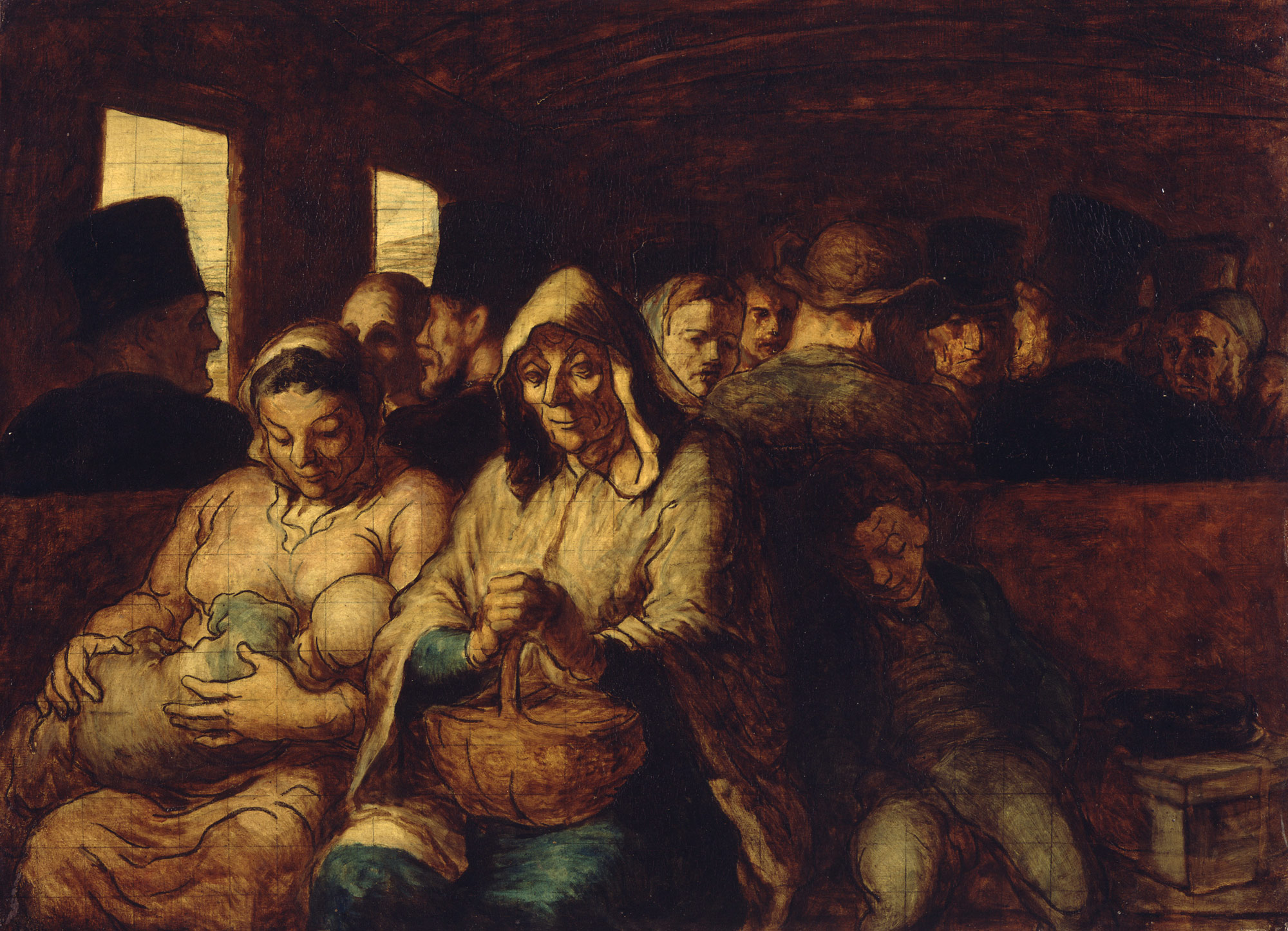
Daumier was very conscious of what today might be called the micropolitics of everyday life. He was also particularly observant of the indignities and hidden injustices of transportation—most famously, in his depictions of third class railway passengers, but also the long-suffering riders of omnibuses and stage coaches, and even those travelling by boat on the Seine. He also repeatedly returned to the subject of Parisian fiacres (hacks) and cabriolets (cabs), and the interactions between their drivers and passengers.

In Daumier’s prints, the hackmen are selfish, wily, and unkempt—precisely as they appeared in the work of his contemporaries. However, as a champion of the poor and oppressed, Daumier was more sympathetic to workers, including hackdrivers, than many of the other physiologues of his time. The bottom line for Daumier, nevertheless, is that no one gets off easy, and most often, both drivers and passengers come across as ridiculous figures.

Driver: Where to, bourgeois? Shall it be by the hour or by the trip?
Passenger: Rue St. Honoré.
Driver: What number?
Passenger: I will show you... Rue St. Honoré.
Driver: What number?
Passenger: I don't know!
Driver: Excuse me then: by the hour!
(1841)
Many of Daumier's cab cartoons focus on a common source of contention between drivers and passengers: the method of fare calculation. Decades before the invention of the taximeter, Parisian cabs charged either a flat rate by the trip, or a variable fare based on time. In the above comic, a savvy driver deals effectively with a drunk, disoriented customer. Seeing that the passenger is uncertain of the correct address, the driver declares it a time-based fare, to ensure that he will be paid for the inevitable time spent searching for the actual destination. Like almost all of Daumier’s hackdrivers, the driver here is holding a whip, wearing an overcoat, and sporting a tall plug hat which has become warped and misshapen through long exposure to the elements.

COACHMAN:  Go on, Gentlemen, argue over my cab as much as you like. But argue by the hour, for I will have my pay! (Le Charivari, 1855)
This driver waits stoically for two disputing passengers to duke it out over his cab, while insisting that he will be paid for the wasted time.

By the Minute: "Driver, you're hardly moving!" "Driver, you're not going anywhere!" (Le Charivari, 1857)
Since the per-hour rate was slightly higher than the per-trip rate, it was often advantageous for drivers to give rides by time rather than by trip—leading in turn to suspicions by passengers that drivers were driving intentionally slowly, in order to “run up the fare.” Daumier illustrates these concerns with these two excruciatingly slow drivers, grinning like Cheshire cats at the complaints of the helpless businessmen trapped in their vehicles.

A fiacre by the hour. (Le Charivari, 1839)
Less conspiratorially, in this illustration the driver has simply fallen asleep through exhaustion, to the consternation of his passenger, who is paying by the hour. The yellow body and black top was typical of Paris cabs in this era.

Daumier would return to the theme of the sleeping fiacre driver in a later cartoon:

"Look here, driver, look here... what are you thinking? I will never arrive at the train on time... I will miss the train!" (The driver continues to voyage through the land of dreams.) (Le Charivari, 1864)

"Driver, stop! I will pay by the hour!"
"By the hour? In the rain? You insult me!"
(Le Charivari, 1864)
Then as now, rain would bring a reversal of power, and cabdrivers, instead of having to search for passengers, took advantage of increased demand to pick and choose the most desirable fares. Here the gentleman hailer offers to pay the driver the higher per-hour rate in order to secure a ride. The driver pretends to be insulted by this pandering—more likely, he hopes to make more money at the per-trip rate than at the per-hour rate, while the rain lasts.

"Driver, driver! You have to stop for me, save my life! bring me quickly, by the trip!" "Come on, Spaniard, you're not being reasonable. You don’t have to fear the rain because you have a coat!" (Le Charivari, 1858)
Then again, these rain-soaked Commedia dell'arte performers dressed as Scaramouche (?) and Pierrot offer to to pay by the trip; but the driver refuses, perhaps because of their destination, or perhaps because he knows actors are likely to be broke, and therefore unlikely to tip well.

"Driver! The hand of our daughter!" (Le Charivari, 1867)
Desperate for a cab, a family offers their daughter's hand in marriage to the driver who will stop for them—to no avail.

"Take you to the Madeleine? Give me a break! I will take you to the Jardin des Plantes, I have a dinner appointment in that direction." (Le Charivari, 1866)
Daumier may be intentionally ambiguous about just who is “abusing the liberty” of whom. The bourgeois couple, who have apparently been pestering the off-duty fiacre driver with requests for a ride? Or the driver, who decides to take them, not to their destination, but to a place more convenient for him?

"The ladies are from the half-world (demi monde), but they don't wear half-skirts (demi-jupes)." (Le Charivari, 1855)
Like expensive clothes, riding in hacks was a status symbol of the rich, but was open to appropriation by upwardly aspiring members of the lower classes. Here, Daumier pokes fun at the pretentions of prostitutes who mimic both the clothes and the riding habits of the nobility.

"Driver, are you hired (loué)?" "No, sir." "Well, love those who advise you, not those who praise (loue) you." (Le Charivari, 1842)

This pedestrian joker’s pun on the French word for "hail" makes the driver grimace. It’s about as funny as asking an English-speaking cabdriver, “Are you free? ... Then how do you make any money?”

The following driver calms an anxious passenger with a mix of soft-spoken friendliness and subtle menace reminiscent of Tom D'Andrea in Dark Passage:

"Calm yourself, bourgeois, and know that I will drive you as gently as if it were your funeral!" (1842)


Wednesday, June 15, 2016

Uber, Devourer of Souls

Moloch, from coverjunkie.com


What sphinx of cement and aluminum bashed open their skulls and ate up their brains and imagination? Moloch! Moloch! Nightmare of Moloch!

Moloch the loveless! Moloch the heavy judger of men! Moloch who employed whole intellects, who dreamt and made incarnate gaps in Time & Space through images juxtaposed, to recreate the syntax and measure of poor human prose with superior technology; and sent the best minds of Silicon Valley onto the streets, looking for a spatial fix;

Creating the great suicidal drama of madman bums, and pink-mustached hipsters:

who jumped in limousines and loned it through the long streets where skyscrapers stand like endless Jehovahs, trying to make a full-time living as part-time taxi drivers; who dreamt of pings, of neon blinking traffic lights, the noise of wheels and children; who wept at the romance of the street;

who wandered around and around at midnight wondering where to go; who accepted into their private vehicles a battalion of conversationalists, yacketayakking screaming vomiting whispering facts and memories and anecdotes and hammers to the eyeball and shocks of surge pricing receipts and jails and class warfare; who received a four-star rating and screamed with joy;

who were promised rates of fare and hourly guarantees that vanished into nowhere; who chained themselves to the endless ride with predatory car loans; who failed to pay unemployment tax and were dumped by insurers; or who poverty and tatters and hollow-eyed were run down by exhaustion, traffic, vitriol, the drunken taxicabs of Absolute Reality.

Moloch whose mind is pure machinery! Moloch whose blood is running money!

They broke their backs lifting Moloch to Heaven!


Sunday, May 29, 2016

The Jitney Stand at 18th and Castro in 1915


Jitneys at 18th and Castro, July 12, 1915. Detail of SFMTA photo U04909. SFMTA Photo | sfmta.com/photo

On a Monday afternoon, July 12, 1915, United Railroads photographer John Henry Mentz set up his camera on Castro street at 18th and took a photograph of the intersection:

SFMTA Photo U04909. SFMTA Photo | sfmta.com/photo

He then moved his camera to the north side of the intersection, and took another photo, facing south:

SFMTA Photo U04910. SFMTA Photo | sfmta.com/photo
Mentz was just interested in the details of the tracks in the middle of the street, but fortunately for us his camera also captured the wealth of street-life that characterized San Francisco in that era. Castro was pretty lively, even 101 years ago:

The jitney stand, as seen from the north. Detail of SFMTA photo U04910. SFMTA Photo | sfmta.com/photo
There is the jitney stand, of course, which Mentz captured not only from the front (as featured in a previous post) but also seen here from the back, with a slightly different set of cars in it.

A three-wheel curbside gasoline pump selling Red Crown Gasoline for 10 cents. Detail of SFMTA photo U04910.  SFMTA Photo | sfmta.com/photo
Yes folks, that is a movable gasoline pump on wheels, which someone has pulled up to the curb at the end of the jitney stop, no doubt to sell gas to the loading jitneys. How safe does that sound?

If you noticed the passenger in the rear jitney pointing off to the side in a previous photo, this is what he appears to be pointing at:

Palm Bar. Detail of SFMTA Photo U04910.  SFMTA Photo | sfmta.com/photo
The Palm Bar, apparently attached to Moses Bodes' pool hall, advertises steam beer, "hot lunch," and "Boxing Next Tuesday" — admission, 25 cents.

Marquee of Castro Street Theater, advertising Lois Meredith in "Help Wanted". Detail of SFMTA Photo U04910. SFMTA Photo | sfmta.com/photo  

Across the street, the old Castro Theater, at its original location (now Cliff's Variety) was playing the silent film "Help Wanted" starring Lois Meredith.

Zerolene horse truck. Detail of SFMTA Photo U04910. SFMTA Photo | sfmta.com/photo
Zerolene may have been "the standard oil for motor cars," but it was delivered by horse. Maybe to help prevent explosions?

Detail of SFMTA Photo U04910. SFMTA Photo | sfmta.com/photo
In the upper stories, windows advertise the offices of a dentist and a surgeon.

Detail of SFMTA photo U04909. SFMTA Photo | sfmta.com/photo.
The 8-Market streetcar turns onto Castro, amid horse-drawn wagons, automobiles, laundry trucks, and a horde of jitneys which have been poaching along its line.

Detail of SFMTA Photo U04910. SFMTA Photo | sfmta.com/photo

Oh yes, and lots of pedestrians. The newsboys hawking their papers in the middle of the street just might be hamming it up for the camera.

Newsboys at 18/Castro, 1915. Detail of SFTMA Photo U04909. SFMTA Photo | sfmta.com/photo
Detail of SFMTA Photo U04909. SFMTA Photo | sfmta.com/photo

(For more on San Francisco jitney history, see here).


Saturday, May 21, 2016

Ride-hailing Apps Swarm Into Austin


Uber alternatives are fine with being regulated, and do not use surge pricing.


In the wake of Uber and Lyft huffily leaving Austin, a swarm of lesser-known "ride-hailing" or "soft cab" services are rushing in to fill the void. Unlike the giants Uber and Lyft, these companies seem to be fine with following local regulations. And the big news is: not a single one of these Uber alternatives uses "surge pricing", the dynamic pricing system which Uber and Lyft use to manipulate the market.


Dallas-based GetMe shows an absolutely insane number of cars available on their app. Uber always tried to make their over-saturation less noticeable by limiting the number of visible cars to 8 or so. GetMe shows so many cars available it actually interferes with the screen refreshing rate. It might also be daunting to would-be GetMe drivers -- how easy can it be to make money with this much competition?


Playing the Lyft to GetMe's Uber is Fare, founded in Phoenix. Part of Fare's selling point is that they claim to be friendlier to drivers. They appear to be far, far behind GetMe in terms of drivers available, but that might be a good thing as far as sustainability of the network is concerned.


Back in 2012, when Uber was just a limousine dispatching service, Tickengo was one of the first companies to go the "ridesharing" route. Since rebranding as Wingz, they have focused exclusively on airport rides--until now. Their new "WingzAround" service, available only in Austin, gets back to their roots. It's interesting that, while both Fare and GetMe's apps follow the map-based style which has become the e-hailing standard, Wingz is sticking with a text-based alternative format, as you can see from this screenshot.


Finally, there is Austin's licensed taxi app, Hail A Cab. Unfortunately this app uses a very old-fashioned (circa 2010) style of map-based format in which you can't see the available cabs until after you have ordered one. Nobody likes that, guys. The licensed cab industry in Austin might want to try attracting a more up-to-date taxi app such as Flywheel.

Certainly the time to roll out a competitive alternative is now, while the elephants are out of the room. If any of these smaller, more driver and passenger friendly alternatives can take hold before Uber and Lyft come crawling back, Austin could invent the future of e-hailing: locally regulated, and free of surge-pricing.


Wednesday, May 18, 2016

Golden Gate Avenue in 1911

Golden Gate Avenue in 1911. Detail of SFMTA photo U02934 . SFMTA Photo | sfmta.com/photo
The past and future of transportation history mingle in this great photo of Golden Gate avenue in 1911, from the SFMTA photo archive. I don't just mean the mix of horse-drawn and motorized vehicles in the street: what's most interesting about this photo is the presence of a livery stable, a full-service garage, and a taxicab company, all in the same shot.

At the center, the Santa Clara Stables, one of the great old livery stables of the city. In the 1800s, if you needed to rent a horse or a carriage, or a place to keep a horse and carriage, this was where you came. Like many livery stables, the Santa Clara also ran a small fleet of hacks. Rebuilt after the fire, in 1911 the Santa Clara only had one more year of existence left before it would be shut down and its inventory sold at auction.

In the foreground can be seen the Mission-style facade of the Golden Gate Garage. This beautiful old garage has been described as "surprisingly lyrical" by Mark Kessler, author of an amazing book on The Early Public Garages of San Francisco. Kessler notes that, by adopting an architectural style associated with Southern Pacific railroad stations, the Golden Gate “relies upon a continuity of imagery to assert that the garage is the successor to the train station, and the car is successor to the train.” More obviously, it was the successor to the livery stable up the street. Boasting a lounge for chauffeurs (waiting around the garage while their employers shopped, dined, etc.), the Golden Gate was also involved in the auto livery business, and at one point housed a taxi service. Now a mere parking garage, the building still stands at 64 Golden Gate, somewhat neglected and under-appreciated, like most old garages.

Alco Taxicab Company, 360 Golden Gate. Detail of SFMTA photo U02934. SFMTA Photo | sfmta.com/photo
And in the distance, the sign for the Alco Taxicab Company peeks over a building. This is the kind of cab company that would last out the Twentieth Century, long after livery stables and full-service garages had been forgotten. In this year of 1911, one of Alco's drivers was a young Malcolm Loughead, who would later found the Lockheed corporation with his brother Allen.

(See here for more on livery stables and cab history in San Francisco.)

Alco Taxicab ad, San Francisco Call, 1910. (California Digital Newspaper Collection)